
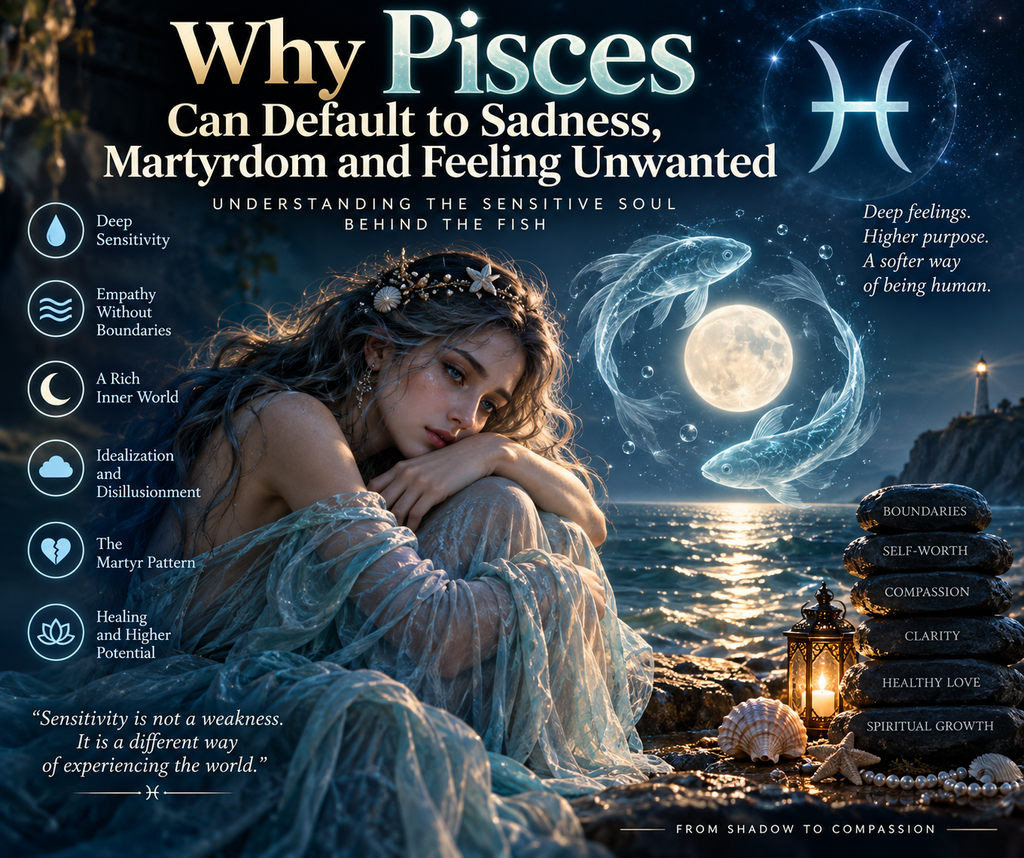
Pisces has a strange reputation in astrology.
At its best, Pisces can be:
compassionate,
intuitive,
imaginative,
romantic,
spiritual,
forgiving,
and deeply empathetic.
But at its worst, Pisces can fall into a very different pattern:
“Nobody understands me.”
“Nobody really wants me.”
“I always give more than I receive.”
“People take advantage of me.”
“I feel everything too deeply.”
“I’m always the one who gets hurt.”
This is where the Piscean shadow begins to overlap with:
victimization,
martyrdom,
self-pity,
sadness,
escapism,
and the feeling of being emotionally unwanted.
Obviously, not every Pisces behaves this way.
A person’s entire chart matters, and astrology itself is a symbolic system rather than scientifically established personality psychology.
But if we stay within the astrological framework, there is a very coherent reason why Pisces can sometimes default to this emotional territory.
It comes down to one central idea:
Pisces has unusually weak boundaries between itself and everything around it.
And when boundaries are weak, feelings can become overwhelming.
Pisces Is the Last Sign
Pisces is the twelfth and final sign of the zodiac.
Symbolically, that gives it an unusual role.
Aries begins.
Pisces dissolves.
Aries says:
“I am.”
Pisces asks:
“Where do I end?”
By the time the zodiac reaches Pisces, the individuality that begins so strongly in Aries has passed through every other sign.
Pisces therefore carries the symbolism of:
completion,
release,
merging,
surrender,
and dissolution.
This can create profound compassion.
A strong Pisces person may easily imagine what another person feels.
They can put themselves in someone else’s position.
They may sense emotional atmosphere very quickly.
But the same quality can create a problem.
If Pisces feels everything around it, then:
other people’s rejection can feel like personal rejection.
someone else’s bad mood can feel like evidence that something is wrong.
a small emotional distance can feel like abandonment.
The sensitivity that makes Pisces compassionate can also make Pisces vulnerable to interpreting the world through emotional pain.
Neptune: The Planet of Sensitivity and Dissolving Boundaries
Modern astrology associates Pisces with Neptune.
Neptune represents:
dreams,
imagination,
mysticism,
compassion,
idealism,
fantasy,
sensitivity,
and blurred boundaries.
Neptune can create beautiful experiences.
It can dissolve ego.
It can inspire art.
It can create spiritual devotion.
But Neptune can also make reality harder to distinguish from what we fear or hope is happening.
This is one of the keys to the Pisces shadow.
A person feels:
“Nobody wants me.”
But is that objectively true?
Or did:
one person not respond,
another person seem distracted,
someone leave early,
or a relationship fail to meet an idealized expectation?
Neptune fills gaps.
And unfortunately, when someone is emotionally wounded, Neptune can fill those gaps with the darkest possible story.
Pisces Does Not Just Feel Sadness—It Can Merge With Sadness
A Scorpio may feel sadness intensely.
A Cancer may hold onto sadness.
Pisces can sometimes do something slightly different:
Pisces becomes the sadness.
Instead of:
“I am feeling rejected.”
it becomes:
“I am unwanted.”
Instead of:
“This person hurt me.”
it becomes:
“People always hurt me.”
Instead of:
“I am lonely tonight.”
it becomes:
“I am fundamentally alone.”
This is an important distinction.
Emotion becomes identity.
That is classic Neptune.
The boundary between:
“I feel this”
and
“I am this”
becomes blurry.
The Pisces Imagination Can Work Against Pisces
Pisces has one of the zodiac’s richest inner worlds.
That is wonderful for:
music,
art,
writing,
fantasy,
spirituality,
romance,
and intuition.
But imagination is neutral.
It can create heaven.
It can also create suffering.
Imagine someone does not reply to a message.
A more literal sign might think:
“They’re busy.”
Pisces may begin imagining:
“They don’t like me.”
“I said something wrong.”
“They’re avoiding me.”
“They never cared.”
“I always care more than everyone else.”
None of those conclusions may be true.
But they feel true.
And Pisces often trusts emotional truth very strongly.
The Martyr Archetype
One of Pisces’ classic shadow expressions is the martyr.
The martyr says:
“I sacrifice everything for everyone else.”
At first, this sounds noble.
And sometimes it is.
Pisces can genuinely be extraordinarily generous.
The problem begins when sacrifice becomes part of identity.
Then something subtle happens.
The person unconsciously needs to be:
the one who gives more,
the one who suffers more,
the one who understands everyone,
the one nobody understands,
the one who sacrifices.
Suffering begins providing psychological meaning.
That is where compassion becomes martyrdom.
Why Martyrdom Can Feel Emotionally Rewarding
This can sound contradictory.
Why would anyone want to feel victimized?
Because victimhood can sometimes provide emotional rewards.
It can offer:
moral superiority,
sympathy,
a clear identity,
an explanation for failure,
or protection from responsibility.
If I am always the one being mistreated, then I never have to ask:
“What did I contribute to this situation?”
This is where the Pisces shadow becomes dangerous.
Compassion without self-reflection can become:
“I am good because I suffer.”
And once suffering becomes proof of goodness, the person may unconsciously recreate situations where suffering continues.
Pisces Can Confuse Love With Sacrifice
Another common pattern is:
“If I love you, I should tolerate everything.”
That is not healthy love.
But Pisces can sometimes romanticize suffering.
The person thinks:
“I understand why they treat me badly.”
“They had a difficult childhood.”
“They don’t mean it.”
“They’re wounded.”
“I can save them.”
This is very Piscean.
Pisces sees the soul underneath the behavior.
That is beautiful.
But sometimes the behavior still matters.
Compassion does not require self-destruction.
The Savior-Victim Cycle
Pisces can move between two archetypes:
the savior
and
the victim.
First:
“I will help you.”
Then:
“I will save you.”
Then:
“I will tolerate everything.”
Then:
“Why don’t you appreciate me?”
Then:
“Everyone uses me.”
This cycle is important.
The martyr frequently begins as the rescuer.
The person over-gives.
But nobody explicitly asked them to give that much.
Then resentment grows.
The Pisces shadow says:
“After everything I did for you…”
This is why boundaries are essential.
Feeling Unwanted Often Begins With Idealization
Pisces does not always want ordinary connection.
It often wants soul connection.
That sounds beautiful.
But it raises expectations.
Ordinary friendship might not feel deep enough.
Ordinary romance might feel disappointing.
Ordinary affection might not feel like destiny.
Pisces can idealize:
the perfect partner,
the perfect friendship,
the perfect spiritual bond.
Then reality arrives.
The other person is distracted.
Imperfect.
Selfish sometimes.
Unavailable sometimes.
Human.
Pisces may experience that as profound disappointment.
The fantasy was so emotionally vivid that ordinary reality feels like rejection.
Neptune Creates Idealization and Disillusionment
This is one of Neptune’s classic patterns.
First:
idealization.
Then:
disillusionment.
Then sometimes:
victimization.
The cycle can look like:
“They are perfect.”
“They understand me completely.”
“This connection is destined.”
Then:
“They didn’t live up to what I imagined.”
Then:
“They betrayed me.”
But sometimes the betrayal was not entirely real.
Sometimes the person simply failed to become the fantasy.
That is why Pisces must learn to distinguish:
intuition
from
projection.
Pisces Is Extremely Vulnerable to Emotional Atmosphere
Pisces often picks up the mood of a room.
Someone is tense.
Pisces feels tense.
Someone is sad.
Pisces feels sad.
Someone is distant.
Pisces senses something wrong.
This can make Pisces remarkably perceptive.
But it can also produce emotional confusion.
The question becomes:
“Is this actually my feeling?”
Pisces may need to ask that constantly.
Because if you absorb emotional atmosphere easily, then sadness can arrive before you understand where it came from.
And once sadness arrives, Pisces imagination may build a story around it.
The Twelfth House Connection
Pisces is traditionally associated with the twelfth house.
The twelfth house carries themes such as:
solitude,
hidden suffering,
retreat,
the unconscious,
spirituality,
institutions,
loss,
and things occurring behind the scenes.
That symbolism contributes strongly to the archetype of Pisces as someone who sometimes feels:
unseen,
forgotten,
or outside ordinary society.
The twelfth house often represents experiences that are difficult to articulate.
Pisces may therefore feel:
“Nobody understands what I’m feeling.”
And sometimes that is true.
But repeated too often, it becomes an identity.
The Danger of Romanticizing Sadness
Pisces can sometimes find sadness beautiful.
This appears especially in:
music,
poetry,
film,
romantic fantasy,
and spiritual longing.
There is nothing wrong with this.
Melancholy can produce extraordinary art.
But sadness can become aesthetically attractive.
The person may begin to feel more authentic when sad.
Happiness can almost feel superficial.
Pain feels deep.
Pisces can unconsciously equate:
suffering with depth.
This is where the sign needs to remember:
joy can also be profound.
Pisces and the Spiritual Longing for Home
There may also be a deeper spiritual interpretation.
Pisces often seems to feel that ordinary physical life is somehow incomplete.
Something is missing.
Something more beautiful must exist.
A soulmate.
God.
A spiritual world.
A perfect love.
A more compassionate society.
A lost home.
This creates longing.
Sometimes the sadness Pisces feels is not simply personal sadness.
It is almost existential.
“Why is the world so harsh?”
“Why do people hurt each other?”
“Why is life so imperfect?”
This is a deeply Neptunian question.
Pisces senses the ideal and suffers because reality does not match it.
Pisces Can Feel Rejected by Reality Itself
This may be stronger than ordinary rejection.
The Pisces person can sometimes feel:
“I don’t belong here.”
Not necessarily suicidal.
More like:
“This world feels too harsh.”
“I feel like I belong somewhere softer.”
“People are too cold.”
“Everything feels too material.”
This is why Pisces has such a strong connection with:
spirituality,
fantasy,
music,
drugs,
dreams,
film,
and escapism.
All of these temporarily soften the harsh edges of reality.
Escapism Is the Other Side of Victimization
When Pisces feels powerless, it may escape.
Sleep.
Fantasy.
Alcohol.
Cannabis.
Video games.
Romance.
Spirituality.
Music.
Internet worlds.
Again, none of these are inherently bad.
But they can become ways to avoid confronting the thing that created the sadness.
The victim says:
“I cannot change this.”
The escapist says:
“Then I will leave emotionally.”
That is the negative Neptune loop.
The Piscean Shadow Often Has Weak Boundaries
Many Pisces problems reduce to one issue:
poor boundaries.
They say yes when they mean no.
They absorb other people’s feelings.
They tolerate things too long.
They over-share.
They over-give.
They rescue.
They forgive before accountability happens.
Then eventually they feel exhausted.
And resentful.
And unappreciated.
Then:
“Everyone uses me.”
But sometimes the deeper lesson is:
“I never told anyone where my boundary was.”
This is not blaming Pisces.
It is empowering Pisces.
If boundaries can be learned, the pattern can change.
Virgo Is Pisces’ Opposite—and Its Medicine
Every zodiac sign has an opposite sign.
Pisces’ opposite is Virgo.
This is enormously important.
Pisces says:
“I feel.”
Virgo says:
“What actually happened?”
Pisces says:
“I sense they don’t want me.”
Virgo asks:
“What evidence do you have?”
Pisces says:
“I always give more than everyone else.”
Virgo asks:
“How much did you actually give, and what agreement existed?”
Pisces says:
“I feel overwhelmed.”
Virgo says:
“What practical step can we take?”
This is why Virgo energy can stabilize Pisces.
It introduces:
facts,
boundaries,
routine,
discrimination,
and practical reality.
Saturn Can Also Help Pisces
Pisces is soft.
Saturn is firm.
Saturn teaches:
structure,
limits,
discipline,
responsibility,
and emotional containment.
For a Piscean person, Saturnian practices can be enormously helpful.
Keep routines.
Sleep properly.
Exercise.
Track money.
Use calendars.
Set deadlines.
Say no.
Keep promises.
Do not automatically rescue everyone.
The goal is not to destroy sensitivity.
It is to give sensitivity a container.
Water without a container spreads everywhere.
Water inside a vessel becomes useful.
Pisces Needs to Learn That Compassion Is Not Submission
This may be one of the most important lessons.
Understanding why someone behaves badly does not mean tolerating the behavior.
You can think:
“I understand that this person is wounded.”
and also say:
“They cannot treat me this way.”
Both can be true.
Compassion and boundaries are not opposites.
In fact, boundaries often make compassion sustainable.
Without them, empathy becomes exhaustion.
Stop Assuming Every Feeling Is a Message
Pisces intuition can be excellent.
But sensitivity creates many signals.
Not every one is meaningful.
You feel unwanted.
Maybe someone rejected you.
Maybe you are tired.
Maybe your nervous system is overstimulated.
Maybe somebody else is in a bad mood.
Maybe you remembered something painful.
Maybe nothing happened at all.
Pisces needs the sentence:
“This feeling is real, but my interpretation of it may not be.”
That single distinction can change everything.
The Difference Between Sensitivity and Victimhood
Sensitivity says:
“I feel deeply.”
Victimhood says:
“Because I feel deeply, everyone else is responsible for my feelings.”
Those are not the same thing.
Sensitivity can become:
empathy,
art,
intuition,
compassion,
spiritual depth.
Victimhood externalizes power.
Pisces evolves when it learns:
I can acknowledge pain without surrendering my agency.
The Difference Between Martyrdom and Service
Service says:
“I choose to help.”
Martyrdom says:
“I help even when I don’t want to, then resent everyone for needing me.”
Service contains choice.
Martyrdom contains hidden obligation.
Healthy Pisces says:
“I want to give.”
“I know my limits.”
“I can stop.”
“I do not need everyone to recognize what I gave.”
That is compassion without self-erasure.
Pisces Can Become Extremely Powerful Once Boundaries Develop
This is the part of Pisces stereotypes that often gets ignored.
Pisces is not inherently weak.
Its weakness usually comes from being too permeable.
Once boundaries develop, the same sensitivity becomes extraordinary.
Then Pisces can:
read people without absorbing them,
love without losing itself,
help without rescuing,
forgive without tolerating abuse,
imagine without escaping,
feel sadness without becoming sadness.
That is mature Pisces.
The Fish Swimming in Opposite Directions
The symbol of Pisces is two fish moving in opposite directions.
This is a beautiful image for the sign’s psychology.
One fish moves toward:
reality,
integration,
compassion,
spiritual wisdom.
The other moves toward:
escape,
fantasy,
victimization,
confusion.
Pisces often lives between these currents.
The challenge is not to eliminate imagination.
It is to choose where imagination leads.
The Victim Can Become the Mystic
Interestingly, many Piscean weaknesses contain the seed of their higher expression.
Oversensitivity can become:
empathy.
Sadness can become:
compassion.
Loneliness can become:
solitude.
Escapism can become:
meditation.
Fantasy can become:
art.
Martyrdom can become:
service.
Victimhood can become:
forgiveness without self-erasure.
This is why Pisces is often associated with transcendence.
The lower expression dissolves under pressure.
The higher expression dissolves the ego consciously.
Pisces Must Learn the Difference Between Surrender and Giving Up
This is another subtle but important distinction.
Spiritual surrender means:
“I accept what I cannot control.”
Victimization says:
“I have no control over anything.”
Very different.
Pisces can sometimes confuse them.
True surrender requires enormous strength.
You do what you can.
Then release what you cannot control.
Giving up happens before action.
Surrender happens after right action.
Stop Asking “Why Does Nobody Want Me?”
A healthier Piscean question might be:
“Where am I actually wanted?”
That shift is powerful.
The victim mindset focuses on rejection.
The mature mindset focuses on alignment.
Not everyone will appreciate Pisces sensitivity.
Some people prefer:
directness,
distance,
logic,
or emotional simplicity.
That is fine.
Pisces does not need everyone.
It needs environments where its qualities are useful.
Pisces Needs Meaning
Perhaps one reason sadness hits Pisces particularly hard is that Pisces needs meaning.
A meaningless life can become unbearable.
Pisces often needs some sense that:
love matters,
spirituality matters,
art matters,
compassion matters,
human beings are connected.
Without that, Pisces can become disillusioned.
The solution is not necessarily more fantasy.
It may be finding meaningful forms for Piscean energy.
Music.
Helping others.
Meditation.
Art.
Animals.
Spiritual study.
Creative work.
Compassionate professions.
Pisces needs somewhere for sensitivity to go.
The Mature Pisces Does Not Stop Feeling
This is perhaps the most important point.
Growth does not turn Pisces into Capricorn.
The goal is not:
“Stop being sensitive.”
That would destroy one of Pisces’ greatest gifts.
The goal is:
feel deeply without drowning.
Imagine standing beside the ocean.
Immature Pisces falls in every time a wave arrives.
Mature Pisces learns how to swim.
The ocean remains.
The sensitivity remains.
The emotions remain.
But consciousness becomes stronger.
From Victim to Compassionate Observer
A powerful Pisces eventually learns to say:
“I feel rejected.”
instead of:
“I am unwanted.”
“I feel sad.”
instead of:
“My life is sad.”
“I want to help them.”
instead of:
“I must save them.”
“I understand their pain.”
instead of:
“I must tolerate their behavior.”
“I imagined something beautiful.”
instead of:
“It must become reality exactly as I imagined.”
These are small linguistic changes.
Psychologically, they are enormous.
They restore boundaries between:
feeling and identity,
compassion and obligation,
dream and reality,
self and other.
Pisces’ Greatest Lesson May Be Emotional Sovereignty
Pisces begins with extraordinary emotional permeability.
Its spiritual task may be learning sovereignty without losing compassion.
That means:
I can feel you without becoming you.
I can love you without losing myself.
I can understand suffering without identifying as a victim.
I can help without becoming a martyr.
I can dream without escaping reality.
I can forgive without surrendering my boundaries.
That is Pisces at its highest.
Not emotionally numb.
Not hardened.
Not cynical.
Still sensitive.
Still compassionate.
Still imaginative.
But no longer swept away by every emotional current.
Why Pisces Defaults to Sadness
So why does Pisces sometimes default toward:
sadness,
feeling unwanted,
victimhood,
or martyrdom?
Within the astrological archetype, several reasons come together.
Pisces is:
highly sensitive,
Neptunian,
boundary-dissolving,
imaginative,
idealistic,
emotionally receptive,
and deeply responsive to suffering.
This makes it easy for:
feelings to become identity,
idealization to become disappointment,
compassion to become sacrifice,
and sensitivity to become victimization.
But none of that is inevitable.
Those are simply the lower expressions of the same qualities that can produce:
mystics,
artists,
healers,
musicians,
spiritual practitioners,
and extraordinarily compassionate people.
Pisces does not need to become less sensitive.
Pisces needs to become better at understanding:
what belongs to me,
what belongs to someone else,
what is intuition,
what is fear,
what is compassion,
and what is self-erasure.
Once Pisces learns that distinction, the sign changes dramatically.
The person who once said:
“Nobody understands me.”
may eventually become the person who understands others better than almost anyone.
The person who once felt like a victim may become someone capable of sitting beside another person’s suffering without running away.
And the person who once drowned in emotion may eventually discover that the same ocean they feared can become the source of their deepest wisdom.