Introduction: Wearing Your Beliefs Close to the Heart
Throughout human history, people have worn necklaces, pendants, charms, and amulets for reasons that extend far beyond decoration. A piece of jewellery might signify love, commemorate a loved one, express religious devotion, or serve as a reminder of the qualities its wearer wishes to cultivate.
But across many cultures, necklaces have also occupied a special place in the world of spirituality. They have been worn to seek protection, invite good fortune, strengthen courage, ward off misfortune, and maintain a sense of connection with the divine.
From ancient Egyptian scarabs and Buddhist protective pendants to Christian crosses, Hindu yantras, and natural stones, sacred jewellery reflects humanity’s enduring desire to carry something meaningful through the uncertainties of life.
Some people believe that particular objects possess spiritual properties. Others understand them as symbols that influence their mindset, provide comfort, or remind them of their values. These interpretations need not be identical for a necklace to hold personal significance.
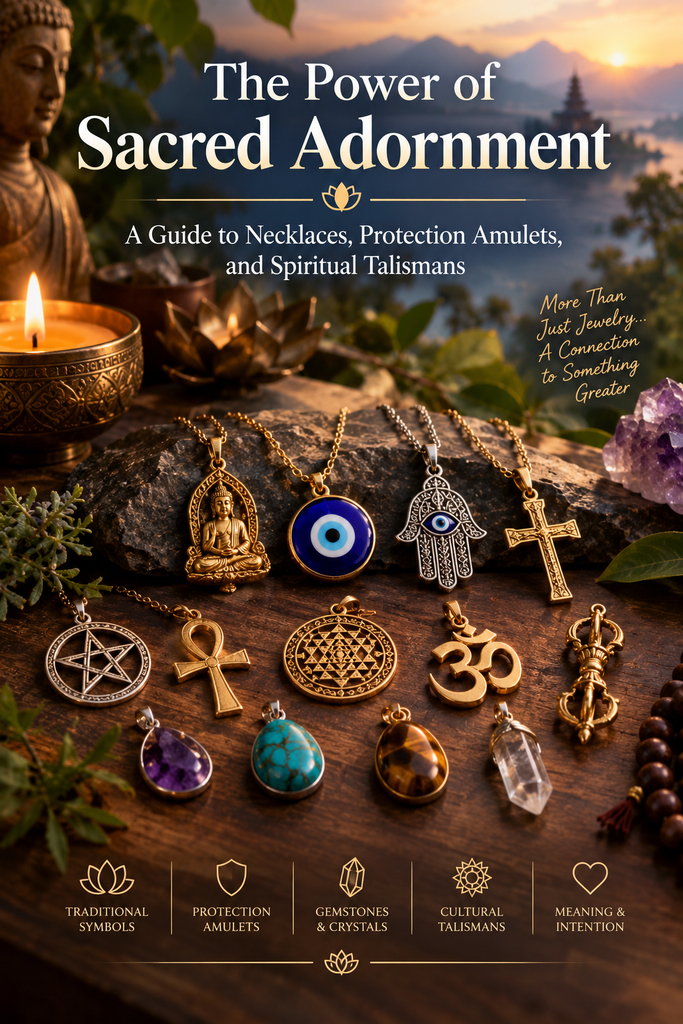
This article explores some of the most fascinating types of necklaces and protection amulets from around the world, their traditional meanings, and how to choose one that resonates with your own spiritual path.
1. The Buddha Pendant: Wisdom, Compassion, and Inner Protection
Buddha pendants are among the most recognizable forms of spiritually inspired jewellery. They are especially popular in Buddhist communities across Thailand, Myanmar, China, Korea, and other parts of Asia.
A Buddha pendant may depict the historical Buddha in meditation, a standing Buddha, or a particular mudra, or symbolic hand gesture.
In Buddhist philosophy, the Buddha represents awakening: the possibility of understanding suffering, overcoming ignorance, and cultivating compassion and wisdom.
Some Buddhist traditions, particularly in Thailand, have a strong culture of wearing Buddha amulets for protection, good fortune, and spiritual reassurance. Different images and forms may carry different traditional associations.
However, it is important to distinguish between the Buddha’s teachings and the cultural practices surrounding amulets. Buddhism does not have one universal position on protective jewellery, and a pendant is not a substitute for ethical conduct, mindfulness, or practical judgment.
What it may symbolize:
- Protection through wisdom and awareness.
- Calmness in difficult circumstances.
- Compassion toward oneself and others.
- A reminder to respond rather than react.
A golden Buddha pendant can be particularly meaningful because gold traditionally symbolizes preciousness, purity, and enduring value in many cultures.
For some wearers, touching or noticing the pendant during a stressful moment becomes a simple grounding ritual. The object reminds them of the qualities they want to embody, even when circumstances become unpredictable.
2. The Evil Eye: Protection Against Envy and the Malevolent Gaze
The evil eye is one of the most widespread protective symbols in the world.
Beliefs about the evil eye appear in various forms across the Mediterranean, the Middle East, North Africa, South Asia, and other regions. The underlying idea is that envy or an ill-intentioned gaze can bring misfortune to another person.
The familiar blue eye-shaped charm is particularly associated with Turkish nazar traditions and related Mediterranean protective practices.
The symbol is often displayed in homes, shops, vehicles, and jewellery. Some people wear it to guard against jealousy, unwanted attention, or negative intentions.
The colour blue is commonly associated with the modern nazar bead, although protective traditions differ considerably across cultures.
What it may symbolize:
- Protection against envy and ill will.
- Maintaining personal boundaries.
- Remaining composed when receiving unwanted attention.
- A reminder not to let other people’s opinions determine one’s self-worth.
Whether or not one believes the evil eye has supernatural efficacy, the symbol can serve as a meaningful reminder to maintain healthy boundaries and avoid becoming consumed by other people’s judgments.
It is also worth remembering that wearing an amulet does not establish that someone is sending negative energy toward you. The symbol can represent reassurance without encouraging suspicion of others.
3. The Hamsa Hand: Protection, Blessings, and Good Fortune
The Hamsa is a hand-shaped symbol associated with protection and blessings in several cultural and religious traditions, particularly in parts of the Middle East and North Africa.
It has connections with Jewish, Muslim, and broader regional folk traditions, although its interpretation varies by community.
The Hamsa is often depicted with an eye in the palm. Like the evil eye, it is traditionally used as a protective symbol. It may also represent good fortune, abundance, fertility, or divine care.
Its five fingers are sometimes given symbolic interpretations, but these meanings are not universal.
What it may symbolize:
- Protection from misfortune.
- Blessings and good fortune.
- Peace within the home.
- A sense of being watched over or spiritually supported.
Hamsa pendants are available in silver, gold, enamel, and gemstone settings. Some are delicate and minimalist, while others feature elaborate patterns and inscriptions.
Because the symbol has significance in living religious traditions, it is worth learning about its cultural context rather than treating it as a generic decorative charm.
4. The Cross: Faith, Sacrifice, and Divine Protection
For Christians, the cross is the central symbol of Jesus Christ’s crucifixion and resurrection. It represents sacrifice, redemption, faith, and the hope of eternal life.
Cross necklaces have been worn for centuries, both as expressions of Christian identity and as reminders of God’s presence.
Some Christians regard a cross or crucifix as a source of spiritual reassurance and protection. In Catholic and Orthodox traditions, blessed religious objects may also have a place in devotional practice, though they are not understood as magical guarantees against harm.
Different forms carry distinctive associations:
- Latin cross: The most widely recognized Christian cross.
- Crucifix: A cross bearing the figure of Christ, emphasizing the Passion.
- Orthodox cross: A form with additional crossbars associated with Eastern Orthodox Christianity.
- Celtic cross: A cross combined with a ring, associated with Celtic Christian art and heritage.
What it may symbolize:
- Faith during uncertainty.
- Hope and perseverance.
- Love expressed through sacrifice.
- Trust in divine guidance.
A cross necklace can be especially meaningful when its wearer sees it as a reminder to act with courage, humility, forgiveness, and compassion.
5. The Pentacle and Pentagram: Balance and Spiritual Boundaries
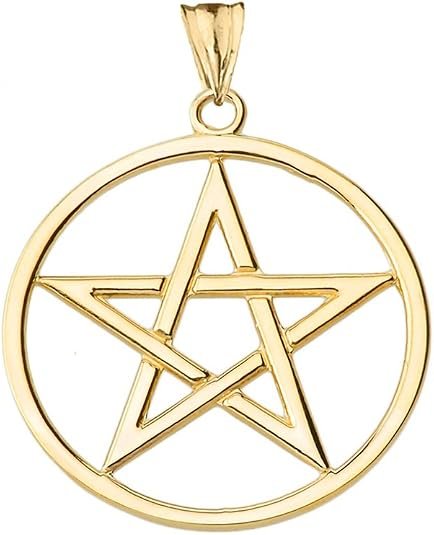
The pentagram is a five-pointed star. When enclosed within a circle, it is commonly called a pentacle in many modern Pagan and Wiccan contexts.
The five points are sometimes associated with earth, air, fire, water, and spirit. In certain traditions, the circle represents unity, continuity, or a boundary enclosing the symbol.
Pentagrams have had many meanings across history, including mathematical, philosophical, religious, and magical associations. They are not inherently symbols of evil; their interpretation depends on cultural and religious context.
In contemporary Wiccan and other Pagan practices, a pentacle may be used as a symbol of spiritual identity, balance, and protection.
What it may symbolize:
- Harmony among different aspects of existence.
- Connection with nature and the elements.
- Spiritual boundaries.
- A commitment to one’s chosen spiritual path.
Some practitioners incorporate pentacles into ritual work, meditation, or altar arrangements. Others wear them simply as an expression of identity.
As with any sacred symbol, its significance depends on the meaning assigned to it within the relevant tradition.
6. The Ankh: Life and the Eternal Spirit
The ankh is an ancient Egyptian symbol resembling a cross with a loop at the top. It is frequently described as the symbol of life.
In ancient Egyptian art, deities are often depicted holding the ankh or presenting it to kings, reflecting its associations with life, vitality, and divine power.
The symbol later became popular in modern jewellery, where it is sometimes interpreted as representing eternal life, spiritual continuity, or the connection between physical and spiritual existence.
What it may symbolize:
- Life and vitality.
- Continuity beyond physical change.
- Spiritual renewal.
- Connection with ancient Egyptian culture and religion.
Ankh pendants can be worn in gold, silver, or other materials. Some are simple geometric designs, while others incorporate hieroglyphic motifs or Egyptian deities.
For people drawn to ancient symbolism, the ankh can be a reminder to value life and approach change with a broader perspective.
7. The Sri Yantra: Sacred Geometry and Divine Abundance
The Sri Yantra, also known as the Shri Chakra, is an important sacred geometric diagram in Hindu traditions, particularly in Shri Vidya.
It consists of interlocking triangles arranged around a central point, or bindu. Its intricate structure has rich theological and contemplative significance, including associations with the divine feminine and the relationship between different aspects of reality.
The Sri Yantra is sometimes used in meditation and ritual worship. It is also incorporated into jewellery and decorative objects.
What it may symbolize:
- The unity underlying apparent multiplicity.
- The relationship between the individual and the cosmos.
- Divine creative power.
- Spiritual realization and, in some traditions, prosperity.
Because the Sri Yantra belongs to a specific and sophisticated religious context, it should not be reduced to a simple diagram that automatically attracts wealth.
For someone interested in Hindu spirituality, wearing it may serve as a reminder to cultivate devotion, concentration, and a balanced relationship with material life.
8. The Om Pendant: The Sound of Universal Consciousness
The Om symbol represents a sacred syllable of great importance in Hinduism and other Indian religious and philosophical traditions.
Often written as Om or Aum, it is associated with sacred sound, meditation, and ultimate reality. Its interpretation varies among philosophical schools.
Om also appears in Buddhist and Jain contexts, including particular mantras and devotional practices.
A pendant bearing the symbol can remind the wearer of meditation, interconnectedness, and the attempt to look beyond immediate distractions.
What it may symbolize:
- The sacred nature of existence.
- Inner stillness.
- Spiritual awareness.
- Connection with a long contemplative tradition.
Some people wear Om pendants as a personal reminder to pause and breathe before reacting to difficult situations.
It is worth treating the symbol respectfully because it is not merely a generic sign for relaxation; it has deep religious significance.
9. The Vajra: Indestructible Wisdom and Strength
The vajra, known in Tibetan as the dorje, is an important ritual object in Vajrayana Buddhism and also has roots in Hindu religious symbolism.
The Sanskrit word can mean both “thunderbolt” and “diamond,” evoking power, clarity, and indestructibility.
In Vajrayana Buddhism, the vajra is associated with indestructible awareness and the union of wisdom and skillful means. Its meaning is much more specific than a generic symbol of personal power.
Vajra-shaped pendants are sometimes worn by practitioners or people interested in Tibetan Buddhist symbolism.
What it may symbolize:
- Unshakable clarity.
- Wisdom that cuts through confusion.
- Spiritual discipline.
- The aspiration to remain steady under pressure.
For someone who values meditation and philosophical inquiry, the vajra may be a reminder that genuine strength is not necessarily forceful. It can also mean remaining clear-minded when confronted with uncertainty.
10. The Lotus: Purity, Resilience, and Spiritual Awakening
The lotus is one of the most widely recognized symbols in Asian religious art.
Its roots grow in muddy water, yet its flower can rise above the surface with remarkable beauty. This natural characteristic has made it a powerful symbol of spiritual development.
In Buddhism, the lotus is associated with awakening and the possibility of transcending ignorance and suffering. It also holds important meanings in Hinduism, including associations with deities such as Lakshmi and Brahma.
What it may symbolize:
- Growth through difficult circumstances.
- Purity and spiritual aspiration.
- The possibility of transformation.
- Beauty that emerges from imperfection.
A lotus pendant may be particularly appropriate for someone who sees spiritual development as a gradual process rather than a sudden achievement.
It suggests that difficult experiences do not have to define us. They can become part of the conditions from which wisdom develops.
11. Gemstone Necklaces: Crystals, Minerals, and Traditional Associations
Gemstone jewellery is popular among people interested in crystal traditions, meditation, and symbolic forms of protection.
Different stones have acquired different meanings across modern spiritual communities. These associations are not universal, and they should not be confused with established scientific evidence that a crystal emits protective energy.
Nevertheless, a gemstone can serve as a meaningful personal symbol, particularly when the wearer associates it with a quality they want to cultivate.
Here are some commonly encountered stones.
Black tourmaline
Black tourmaline is frequently associated in contemporary crystal traditions with grounding and protection.
Its dark colour and substantial appearance make it a popular choice for people who want a discreet pendant that symbolizes steadiness and personal boundaries.
Obsidian
Obsidian is a naturally occurring volcanic glass. In modern spiritual practices, it is often associated with introspection, protection, and confronting uncomfortable truths.
Its reflective black surface can also make it an attractive minimalist accessory.
Tiger’s eye
Tiger’s eye is traditionally associated in modern crystal symbolism with courage, confidence, and discernment.
Its golden-brown bands create a distinctive appearance, making it popular in men’s pendants and bracelets.
Amethyst
Amethyst is commonly associated with calmness, meditation, and spiritual reflection.
It has a long history as a decorative gemstone, and its purple colour has acquired various symbolic meanings across different cultures.
Clear quartz
Clear quartz is often described in modern crystal traditions as a stone of clarity or amplification.
It is widely used in decorative jewellery because of its transparency and versatility.
Jade
Jade has particularly deep cultural significance in Chinese and other East Asian traditions. It has been associated with virtue, refinement, status, longevity, and good fortune.
Jade jewellery may be worn for cultural, aesthetic, familial, or spiritual reasons. Its significance is not limited to contemporary crystal practices.
Lapis lazuli
Lapis lazuli has a long history of use in jewellery and art, including in ancient Egypt and other early civilizations.
Its deep blue colour has made it associated with royalty, wisdom, and sacred imagery in various historical contexts.
Choosing a gemstone
Instead of asking which stone is guaranteed to protect you, consider which qualities you want your jewellery to represent.
If you want a reminder to remain calm, choose a stone whose appearance and symbolism evoke calmness for you. If you want to cultivate courage, select one that represents that aspiration.
The stone can become a physical reminder of your intention without requiring you to believe that it possesses scientifically unverified powers.
12. The Nazar Boncuk, Handcrafted Talismans, and Cultural Amulets
Beyond famous religious symbols, countless cultures have developed their own protective charms.
These objects may incorporate particular colours, inscriptions, materials, shapes, or blessings. Their meanings are often transmitted through family traditions, religious practices, and local customs.
Examples include:
- Turkish nazar beads: Blue glass amulets traditionally associated with protection against the evil eye.
- Thai Buddhist amulets: Images of the Buddha, revered monks, or sacred motifs associated in particular traditions with protection, merit, and good fortune.
- Islamic calligraphic pendants: Jewellery bearing Quranic verses or devotional inscriptions, worn by some people as reminders of faith or as protective objects. Views on wearing such items vary among Muslim communities and scholars.
- Jewish protective jewellery: Pendants incorporating Hebrew inscriptions, the Star of David, or other symbols associated with faith and identity. The Hamsa also appears in some Jewish cultural contexts.
- Native American turquoise jewellery: Turquoise holds important meanings in particular Indigenous cultures, including some Southwestern traditions. Its significance varies by nation and community, so it should not be treated as a universal Indigenous protection symbol.
The most important consideration is context. A charm can have a very different meaning depending on the community that created it.
When choosing a culturally specific amulet, learn about its origins and consider supporting artisans or sellers who understand and respect the tradition.
13. Gold and Silver: Does the Material Matter?
The material of a necklace can carry meaning in its own right.
Gold has been valued for thousands of years because it is durable, corrosion-resistant, visually striking, and relatively rare. Its enduring appearance has led many cultures to associate it with the sun, kingship, divine radiance, prosperity, and immortality.
Silver, meanwhile, has frequently been associated with the moon, purity, reflection, and refinement in historical symbolism.
These associations are cultural rather than universal laws, but they can influence how a piece of jewellery feels to its wearer.
A gold Buddha pendant, for example, combines two layers of symbolism: the Buddha’s association with awakening and the cultural significance of gold as a precious material.
A silver moon pendant might similarly combine lunar imagery with silver’s reflective appearance.
Neither material has been demonstrated to create supernatural protection simply by being worn. Their value can instead lie in their craftsmanship, cultural significance, durability, and personal meaning.
There is also a practical consideration: gold-plated jewellery may wear differently from solid gold, and some alloys can cause skin irritation. Material quality matters if you intend to wear a pendant every day.
14. Can a Protection Amulet Actually Protect You?
This is perhaps the most important question.
Across history, people have worn amulets during journeys, battles, childbirth, illness, and periods of uncertainty. Such objects have sometimes been understood as carrying blessings or providing supernatural protection.
But there is no reliable scientific evidence that a necklace or crystal can create an invisible barrier against accidents, illness, other people’s intentions, or misfortune.
That does not mean an amulet must be meaningless.
There are several ways it may provide a genuine benefit.
Psychological grounding: A familiar object can remind you to breathe, slow down, and return your attention to the present moment.
Confidence and reassurance: Wearing something meaningful may help a person feel more composed when entering an unfamiliar environment.
Values and identity: A religious pendant can remind its wearer of commitments such as honesty, compassion, courage, or patience.
Cultural and spiritual connection: An amulet can connect someone to family, community, religious tradition, or a broader philosophical worldview.
Ritual and reflection: Touching a pendant before meditation or after a difficult interaction can become a deliberate moment of reflection.
These benefits do not require the object to possess supernatural powers. Nor do they disprove the spiritual interpretations held by those who wear amulets.
A balanced approach allows room for personal belief while recognizing that practical protection still matters. A pendant cannot replace a seat belt, medical treatment, sound judgment, or appropriate personal boundaries.
15. How to Choose the Right Necklace for Your Spiritual Path
With so many symbols and traditions available, selecting a necklace can feel overwhelming. A useful starting point is to consider what you want the object to represent.
For grounding and composure: Consider a Buddha pendant, a lotus, or a gemstone that you personally associate with stability.
For protection symbolism: Explore the evil eye, Hamsa, or a culturally appropriate amulet from a tradition you understand and respect.
For faith and devotion: A cross, Om pendant, or another religious symbol may be meaningful if it aligns with your beliefs.
For wisdom and clarity: The vajra or a Sri Yantra pendant may appeal to someone drawn to the contemplative traditions in which these symbols are rooted.
For courage and confidence: Tiger’s eye or a symbol associated with strength may serve as a reminder of the qualities you want to develop.
For personal transformation: The lotus can represent growth through adversity and the continuing process of self-development.
It is also worth asking a few practical questions:
- Do I understand the symbol’s origins and meaning?
- Does wearing it encourage qualities I genuinely value?
- Is it comfortable and durable enough for everyday use?
- Am I buying it because I appreciate it, or because someone has frightened me into believing I need it?
- Does the price reflect the material and craftsmanship, or is the seller charging a premium for unverifiable supernatural promises?
Be especially cautious of sellers who claim that an amulet is guaranteed to remove curses, cure illnesses, or prevent disasters, or who insist that you must purchase increasingly expensive objects to remain protected.
A meaningful spiritual object should support your life, not become a source of fear.
Conclusion: Carrying a Reminder of What Matters
Necklaces and protection amulets occupy a fascinating space between art, religion, culture, and personal psychology.
A Buddha pendant can represent wisdom and compassion. An evil-eye charm can express a wish for protection against envy. A cross can embody faith, while a lotus can symbolize the possibility of growing through adversity. Gemstones and sacred geometric designs offer still more ways for people to express their values and spiritual aspirations.
The meanings differ, but a common theme runs through many of these objects: the desire to feel connected to something larger than the immediate circumstances of everyday life.
For some people, that connection is explicitly divine. For others, it is cultural, philosophical, or deeply personal.
Perhaps the most valuable protection an amulet can offer is not the promise that nothing bad will happen, but the reminder that we can meet life’s uncertainties with greater awareness, courage, and composure.
A necklace rests close to the heart. What makes it meaningful is ultimately not just what it depicts or what material it contains, but what it reminds us to carry within ourselves.
The most powerful symbol is one that helps you remember the kind of person you wish to be, especially when life becomes difficult.