
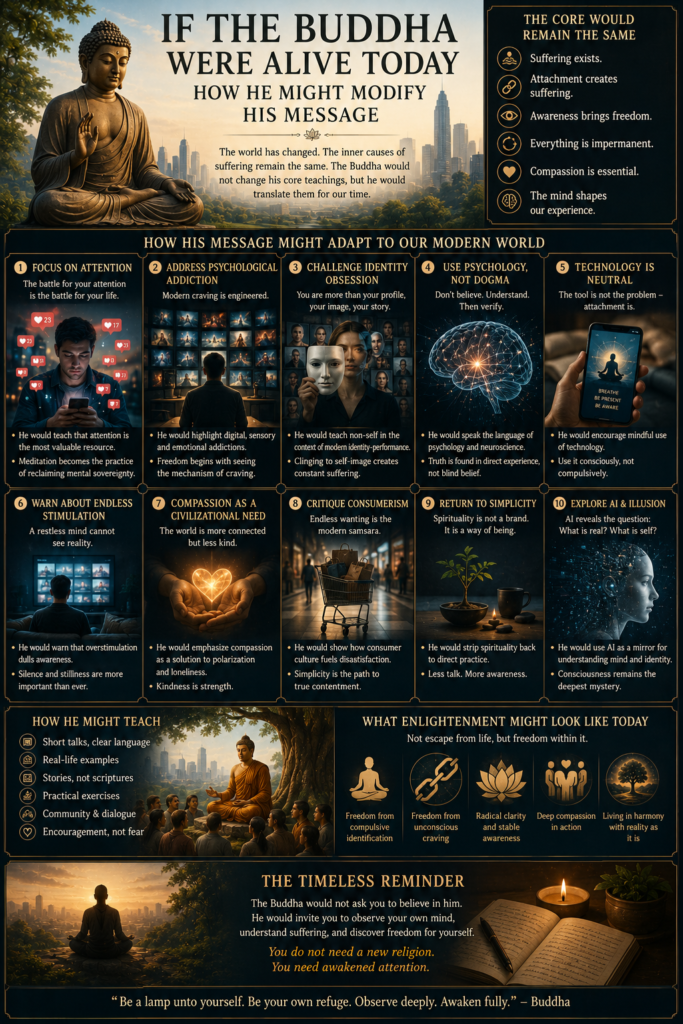
Would the Core Teachings Change?
Probably not.
The central insights associated with Gautama Buddha were rooted in timeless human problems:
- Suffering
- Attachment
- Desire
- Fear
- Ego
- Impermanence
Those problems still exist.
But the form of the message?
That might change dramatically.
Because the modern world presents entirely new conditions:
- Smartphones
- Social media
- Artificial intelligence
- Consumer addiction
- Endless stimulation
- Identity performance
If the Buddha were teaching today, he likely would not abandon his teachings.
He would probably:
translate them into the psychological language of modern life.
The Buddha Would Likely Focus on Attention


In ancient India, distraction existed—but not at modern scale.
Today:
- Attention itself has become commodified
Modern society constantly competes for:
- Your focus
- Your emotions
- Your reactions
The Buddha might say:
“Your mind is no longer merely distracted by desire.
It is being industrially engineered toward distraction.”
Meditation today might therefore be framed not just as:
- Spiritual practice
But as:
→ reclaiming sovereignty over attention.
He Might Speak More About Psychological Addiction
Ancient Buddhism already addressed craving.
But modern life amplifies craving continuously through:
- Algorithms
- Advertising
- Dopamine loops
- Endless comparison
Modern Attachments Might Include:
- Validation through likes
- Digital identity
- Constant stimulation
- Consumer obsession
- Status signaling
The Buddha may have viewed many modern systems as:
→ large-scale engines of attachment.
He Would Probably Critique Identity Obsession


One of Buddhism’s deepest teachings involves:
→ non-self (anatta)
The idea that:
- Identity is fluid
- The ego is constructed
- Clinging to self-image creates suffering
Modern culture often pushes the opposite:
- Build your brand
- Curate your image
- Perform constantly
- Define yourself publicly
The Buddha might see this as:
→ intensified ego attachment.
He Might Use Psychology More Than Religion
Today many people distrust:
- Organized religion
- Dogma
- Institutional authority
So the Buddha might frame teachings through:
- Psychology
- Neuroscience
- Direct experience
Rather than:
- Ritual hierarchy
He often emphasized practical verification anyway:
“Do not believe blindly—observe directly.”
That approach fits modern skepticism surprisingly well.
Technology Would Probably Be Viewed as Neutral


It’s unlikely he would simply condemn technology itself.
The issue would not be:
→ the tool
But:
→ the attachment and unconscious use of the tool.
A smartphone used consciously:
- Could educate
- Connect
- Spread wisdom
Used unconsciously:
- It can intensify craving and mental fragmentation
He Might Warn About Endless Stimulation
Modern people rarely experience:
- Silence
- Stillness
- Solitude
The nervous system is constantly activated.
The Buddha might argue that:
→ overstimulation prevents self-awareness.
Without silence:
- People cannot observe the mind clearly
And without observing the mind:
→ suffering repeats unconsciously.
Compassion Would Probably Become Even More Central


Modern society often produces:
- Isolation
- Loneliness
- Polarization
- Tribal thinking
The Buddha might strongly emphasize:
- Compassion
- Patience
- Emotional understanding
Not as abstract morality…
…but as survival mechanisms for social sanity.
He Might Critique Consumerism as Modern Samsara
In Buddhism:
→ samsara refers to cyclical suffering driven by attachment and ignorance.
Modern consumer culture often operates through:
- Endless wanting
- Endless dissatisfaction
- Endless comparison
The Buddha might interpret this as:
→ technologically accelerated samsara.
He Would Probably Simplify Spirituality


Ironically, modern spirituality itself can become:
- Ego-driven
- Performative
- Commercialized
The Buddha might strip things back toward:
- Direct awareness
- Simplicity
- Presence
- Ethical living
Less:
- Mystical branding
More:
- Actual practice.
He Might Speak About AI and Illusion
Artificial intelligence creates a fascinating modern philosophical issue:
- What is consciousness?
- What is identity?
- What is “self”?
These questions overlap strongly with Buddhist inquiry.
The Buddha might view AI as another mirror revealing:
→ how unstable and constructed identity already is.
Would Enlightenment Be Presented Differently?
Possibly.
Instead of mystical language, it might be framed as:
- Freedom from compulsive identification
- Freedom from unconscious craving
- Radical mental clarity
- Stable awareness amidst chaos
Not escape from life…
But:
→ freedom within it.
The Core Message Probably Wouldn’t Change
Despite all modern complexities, the essential teaching might remain surprisingly familiar:
- Attachment creates suffering
- Awareness creates freedom
- Compassion matters
- The mind shapes experience
- Everything changes
The environment changes.
Human consciousness?
→ less than we think.
Final Thought
If the Buddha were alive today, he probably would not reject modern society entirely.
But he might warn that humanity has created:
- Infinite distraction
- Infinite craving
- Infinite noise
while forgetting:
- Silence
- Presence
- Awareness
- Inner stability
And perhaps his message today would sound something like:
“You do not merely need more information.
You need the ability to sit quietly enough to understand your own mind again.”