
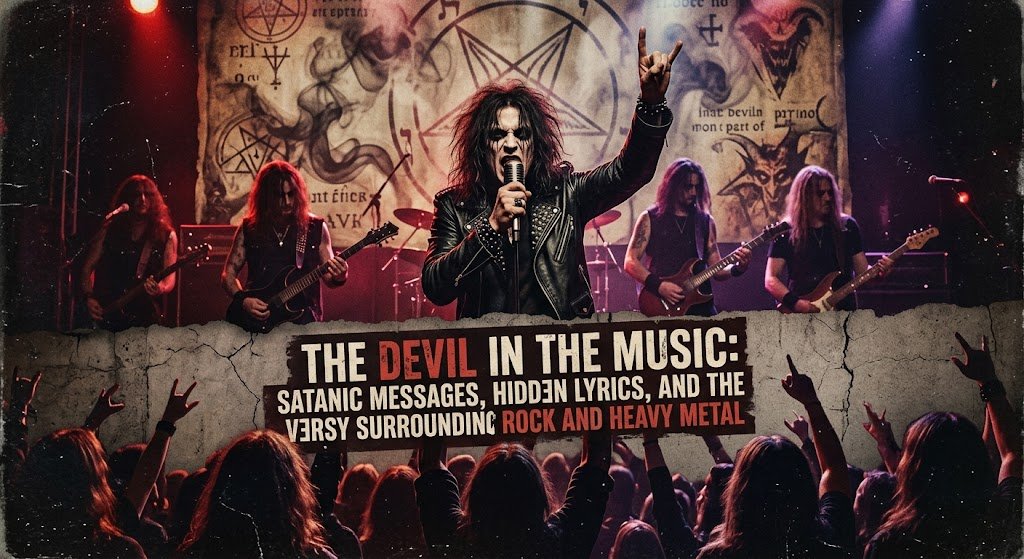
From Led Zeppelin and Black Sabbath to Judas Priest and Ozzy Osbourne, how rock music became entangled in accusations of devil worship, subliminal programming, and secret messages.
For decades, rock and heavy metal have occupied an uneasy place in the public imagination. To some listeners, the music represents rebellion, freedom, theatrical expression, and an escape from social convention. To others, certain bands have appeared to celebrate darkness, glorify Satan, or even conceal messages intended to influence the minds of young listeners.
The controversy became especially intense during the 1970s, 1980s, and early 1990s. Religious groups, concerned parents, television commentators, and politicians began examining record sleeves, song lyrics, album artwork, and music videos for evidence of Satanic influence. Some believed that playing records backwards revealed secret instructions to worship the Devil. Others argued that heavy metal imagery was not merely theatrical, but part of a deliberate attempt to undermine Christianity.
But what actually happened? Did musicians really hide Satanic messages in their recordings? Were certain songs deliberately designed to encourage devil worship? And why did so many people believe that popular music contained a hidden spiritual danger?
To understand the controversy, it helps to examine the specific cases that made rock music one of the most controversial cultural battlegrounds of the twentieth century.
- The Beatles and the birth of the backmasking controversy
One of the techniques that helped fuel the hidden-message debate was called backmasking: recording a sound or message backwards so that it can supposedly be understood when the record is played in reverse.
The Beatles experimented with backwards recordings during the 1960s. Their song Rain, released in 1966, contains reversed vocal passages, while Revolution 9 from the 1968 album The Beatles uses experimental sound collage and unconventional recording techniques.
These experiments were artistic rather than evidence of Satanic activity. Nevertheless, they helped introduce the public to the idea that a record might contain sounds that were not immediately apparent when played normally.
As the technique became more widely discussed, some religious campaigners began searching popular songs for backwards phrases. They argued that musicians could conceal messages that listeners would unconsciously absorb.
The difficulty was that people often disagreed about what the alleged messages actually said. A strange reversed sound could be interpreted in several different ways, depending on what the listener had been told to expect.
This phenomenon would become a defining feature of the Satanic music controversy.
- Led Zeppelin and the mystery of “Stairway to Heaven”
One of the most famous accusations involved Led Zeppelin’s 1971 song “Stairway to Heaven.”
The song became the subject of intense scrutiny after listeners claimed that playing a section backwards revealed a message praising Satan.
The alleged message was commonly interpreted as a reference to Satan and the Devil. Some religious campaigners argued that the song contained a hidden invocation, suggesting that the band was communicating something very different from the words heard when the song was played normally.
The controversy became particularly prominent in the early 1980s, when religious groups began circulating recordings and demonstrations of supposedly hidden messages.
Led Zeppelin denied intentionally inserting Satanic messages into the song. The band also pointed out that backwards speech interpretations were highly subjective.
There is an important distinction here: a recording can contain reversed sounds without those sounds constituting a meaningful message. If listeners are given a suggested phrase before hearing an ambiguous recording, they may become much more likely to perceive that phrase.
Nevertheless, “Stairway to Heaven” became one of the enduring examples of the belief that rock music contained hidden spiritual instructions.
- The Eagles and “Hotel California”
Another famous example was the Eagles’ 1976 hit “Hotel California.”
The song already had an atmosphere of mystery. Its lyrics describe a strange hotel that appears welcoming at first but becomes increasingly disturbing. The imagery of imprisonment, temptation, and an inability to escape encouraged many interpretations.
Some religious campaigners claimed that playing the song backwards revealed a message about Satan and the establishment of a Satanic religion.
The accusations became part of a wider belief that seemingly ordinary pop and rock songs could contain concealed references to devil worship.
However, the song’s lyrics do not establish that the Eagles were promoting Satanism. The band has explained the song in terms of the darker side of the American dream, excess, materialism, and the music industry’s culture.
The mysterious atmosphere was real; the supposed backwards Satanic message was not established as an intentional recording.
- Black Sabbath: the band that seemed to embody the Devil’s music
When discussing Satanism in heavy metal, it is impossible to ignore Black Sabbath.
Formed in Birmingham, England, the band helped establish the sound and visual identity of heavy metal. Their music was darker and heavier than much of the rock that preceded it. Songs explored war, death, fear, evil, and supernatural themes.
Their 1970 debut album, Black Sabbath, opened with a song that featured ominous bells, rain, and a heavy musical atmosphere. The lyrics described a terrifying encounter with a dark supernatural figure.
For many listeners, the music was a form of horror storytelling. For critics, it sounded like an invitation into the world of the Devil.
The band’s second album, Paranoid, and later releases continued to explore disturbing themes. Their music and stage imagery helped create a visual language that later heavy metal bands would develop further.
Yet the popular image of Black Sabbath as a Satanic band was more complicated than it appeared. Guitarist Tony Iommi, singer Ozzy Osbourne, and other members were not simply presenting themselves as representatives of Satanism. Their work frequently depicted evil as something frightening and destructive.
In fact, the song “Black Sabbath” can be understood as a warning about encountering evil rather than an endorsement of it.
This distinction was often lost during the moral panic. For some critics, merely depicting the Devil was equivalent to celebrating him.
- Ozzy Osbourne and the “Suicide Solution” controversy
Ozzy Osbourne became one of the most controversial figures in heavy metal after launching his solo career.
His 1980 album Blizzard of Ozz included a song called “Suicide Solution,” which became the focus of a serious legal controversy.
In 1984, a teenager named John McCollum died by suicide after listening to Osbourne’s music. His family alleged that the song had encouraged his death and brought a lawsuit against the musician.
Osbourne maintained that the song was not an encouragement to commit suicide. He explained that it was about the destructive effects of alcohol, with the word “solution” carrying a double meaning: a liquid solution and a possible answer to a problem.
The case became an important part of the wider debate about whether musicians should be held responsible for the actions of listeners.
The lawsuit was dismissed. The controversy nevertheless helped establish the idea that heavy metal lyrics could be dangerous to vulnerable young people.
It is important to distinguish this case from the later Judas Priest controversy: the Osbourne case centred on the song’s audible lyrics and their alleged influence, rather than a claim that a secret Satanic message had been recorded backwards.
- Judas Priest: the courtroom battle over hidden messages
Perhaps the most famous legal case involving alleged subliminal messages in heavy metal concerned Judas Priest.
In 1990, the British band was taken to court in Nevada by the families of two young men, Raymond Belknap and James Vance.
In December 1985, the two had been involved in a suicide pact. Belknap died, while Vance survived with severe injuries and died several years later.
Their families alleged that Judas Priest’s 1978 album Stained Class contained hidden messages encouraging suicide.
The central accusation concerned the song “Better by You, Better Than Me.” The families claimed that a concealed phrase—“do it”—could be heard within the recording. They also alleged that other sections of the album contained backwards Satanic messages.
During the trial, recordings were played forwards and backwards. A witness claimed to hear several disturbing phrases, including supposed references to suicide and Satan.
Judas Priest’s members rejected the allegations. Singer Rob Halford explained that the sound interpreted as “do it” was actually a combination of breathing and musical sounds.
The judge ultimately ruled in favour of Judas Priest. He concluded that the alleged “do it” phrase was an accidental combination of sounds, not an intentionally recorded command, and that the evidence did not establish that the band had caused the young men’s actions.
There is an interesting detail to this case: Halford acknowledged that Judas Priest had deliberately included a backwards message in a later song, “Love Bites.” He explained that the technique was used as a musical curiosity, not as a hidden instruction to listeners.
The distinction is important. Musicians did sometimes experiment with backwards recordings. That fact did not prove that the alleged messages in Stained Class were intentional.
The case became a landmark example of the conflict between artistic freedom, religious concerns, and claims about subliminal influence.
- Iron Maiden and “The Number of the Beast”
Iron Maiden’s 1982 album The Number of the Beast became another major target of religious criticism.
Its title referred to the biblical number 666, traditionally associated with the Beast in the Book of Revelation.
The cover depicted the band’s mascot, Eddie, controlling a demonic-looking puppet version of the Devil. The artwork was theatrical, provocative, and deliberately disturbing.
The title track included spoken passages and references to biblical imagery, including the Book of Revelation. Its lyrics describe a frightening vision of a Satanic gathering.
Some religious critics interpreted the album as evidence that heavy metal was promoting Satanism. There were reports of protests and record burnings, and the band became associated with the wider Satanic Panic.
Iron Maiden’s singer Bruce Dickinson and other members have explained that the song was inspired by horror films and dramatic storytelling. The band was not presenting the song as a religious declaration of allegiance to Satan.
The controversy illustrates a recurring problem: a song can use religious language and demonic imagery to create a frightening fictional atmosphere without necessarily expressing the beliefs of its creators.
- Mötley Crüe, theatrical rebellion, and Satanic imagery
Mötley Crüe became one of the defining bands of the 1980s glam-metal scene.
Their music and public image combined sex, drugs, rebellion, theatrical excess, and deliberately provocative visual presentation.
Their 1983 album Shout at the Devil was especially controversial. Its title and artwork invited religious interpretations, and the band was frequently associated with the Satanic imagery that critics believed was spreading through heavy metal.
The title itself was sometimes interpreted as a command to worship or praise Satan. However, the band members described the phrase as a rebellious expression rather than a literal religious instruction.
The album’s imagery was designed to shock. It played with the symbols of evil, danger, and rebellion that had become part of heavy metal’s visual identity.
This raises a question that remains relevant today: when musicians use Satanic imagery, are they expressing an actual belief, deliberately provoking religious audiences, or simply using an established artistic vocabulary?
The answer varies from artist to artist. It is not possible to assume that every band using the same symbols shares the same philosophy.
- Music videos: when the controversy became visual
The arrival of MTV in 1981 changed the nature of the debate.
Previously, listeners could examine lyrics and album covers, but music television gave artists a powerful new way to combine sound, imagery, symbolism, and performance.
Heavy metal videos often featured dark landscapes, supernatural characters, monsters, fire, occult-looking decorations, and horror-film imagery. These elements could make a song’s themes much more vivid.
For religious critics, this was alarming. They believed that young people were no longer merely listening to provocative music; they were being exposed to a visual world that appeared to normalize evil.
Iron Maiden’s visual presentation surrounding The Number of the Beast is one example. The band’s artwork, stage performances, and live footage helped turn the song’s demonic imagery into a memorable spectacle.
Other artists used similar horror-inspired aesthetics. Ozzy Osbourne’s solo performances and videos, for example, frequently drew on gothic and supernatural themes.
It is important, however, not to confuse a horror-inspired music video with evidence of a secret Satanic message. A video depicting a demon, a ritual, or a frightening religious scene does not automatically mean that the artist is promoting the practice being depicted.
The same distinction applies to films, theatre, literature, and video games: portraying something is not necessarily endorsing it.
- The PMRC and the campaign against explicit music
In 1985, the Parents Music Resource Center (PMRC) was formed in the United States. The organization sought to draw attention to music it considered unsuitable for children.
The PMRC became particularly associated with its campaign to label albums containing explicit material. Its concerns included sexual content, violence, drug references, and occult or Satanic themes.
The campaign helped lead to the now-familiar parental advisory label.
In September 1985, a Senate hearing examined the influence of music on young listeners. Musicians including Frank Zappa, Dee Snider of Twisted Sister, and John Denver testified.
The debate was not simply about Satanism. It was also about censorship, parental responsibility, artistic freedom, and whether government intervention should determine what music people could hear.
The PMRC controversy demonstrated how heavy metal had become a symbol in a much larger cultural conflict.
For some parents, the music represented a threat to traditional values. For many musicians and fans, the campaign represented an attempt to control artistic expression.
- Were there ever genuine Satanic messages in music?
There is a more complicated answer to this question than either side of the controversy often acknowledged.
Some musicians have genuinely embraced Satanic or occult themes. Some have identified with Satanism as a philosophy or religious position. Others have used Satanic imagery to criticize Christianity, challenge conventional morality, or provoke audiences.
For example, some artists associated with extreme metal have explored Satanism more seriously than the theatrical shock imagery of mainstream glam metal.
Black metal, which emerged as a distinct movement in the 1980s and developed further in the early 1990s, included artists who deliberately used anti-Christian and Satanic themes. In some cases, these were connected to personal ideological commitments; in others, they were part of an artistic identity built around transgression and opposition to established religion.
But this is different from claiming that a band secretly inserted a backwards command into an otherwise ordinary song.
There are at least three distinct categories:
- Open Satanic or occult themes: Lyrics, artwork, and performances that deliberately use Satanic or occult symbolism.
- Provocative theatrical imagery: Artists using the Devil, demons, or religious symbols to create horror, shock, rebellion, or dramatic effect.
- Alleged subliminal messages: Claims that secret phrases or commands have been concealed in recordings and are influencing listeners without their awareness.
The first two are observable artistic choices. The third requires evidence that a message was intentionally created, that listeners can reliably perceive it, and that it has the claimed effect. The historical controversies did not establish those claims.
- Why did people hear Satanic messages when they played records backwards?
Psychology offers a useful explanation for some of the most famous accusations.
Human beings naturally search for patterns in sounds. When we hear an unclear recording, our brains try to organize it into familiar words and phrases. This tendency is sometimes called auditory pareidolia.
If someone tells us that a backwards recording contains the words “Hail Satan,” we may become more likely to hear those words—even when the sound itself is ambiguous.
This is especially powerful when the listener already expects to find something frightening.
Researchers have investigated whether backward messages can influence behaviour. A notable 1985 study by psychologists John Vokey and J. Don Read examined claims about subliminal messages in recordings. Their experiments did not support the idea that hidden backwards messages exerted the extraordinary behavioural influence claimed by popular accounts.
That does not mean every artist avoided experimentation with hidden recordings. It means that the existence of a backwards sound is not proof of supernatural influence, successful subliminal programming, or a secret instruction to the listener.
- The spiritual question: does listening to dark music invite darkness?
Beyond the historical debate, there is a deeper question worth considering.
Can music influence a person’s emotional and spiritual state?
Certainly, music can shape mood, reinforce ideas, and provide an atmosphere in which particular emotions become more prominent. A person who repeatedly listens to music centred on anger, despair, violence, or hatred may find that these themes become more familiar or emotionally significant.
But this is not unique to heavy metal. Music of every genre can encourage different emotional states. A romantic ballad can intensify longing. A national anthem can strengthen collective identity. A religious hymn can deepen devotion. A violent song can reinforce aggression in some listeners, while another person may simply appreciate its rhythm, musicianship, or theatrical character.
From a spiritual perspective, perhaps the more useful question is not whether a particular guitar sound or album cover is demonic. It is what the music cultivates within the listener.
Does it encourage cruelty, contempt, and destructive behaviour? Does it glorify suffering? Or is it simply exploring fear, mortality, rebellion, and the darker aspects of human existence through art?
The distinction between depicting darkness and cultivating it matters.
A horror film can confront people with evil without making them evil. A song about the Devil can be a warning, a fictional narrative, a protest, or an expression of genuine belief. Context and intention matter.
Conclusion: The Devil, the music, and the power of interpretation
The Satanic music controversies of the twentieth century reveal more than a conflict between religious conservatives and rebellious musicians. They reveal how quickly fear can transform ambiguous sounds and provocative images into evidence of something much larger.
There were real musicians who used Satanic imagery. There were artists who deliberately experimented with backwards recordings. There were songs that explored occult themes and videos that borrowed heavily from horror and supernatural storytelling.
But the most sensational claims—that popular rock recordings contained hidden Satanic commands capable of controlling listeners or driving them toward suicide—were never established by the landmark controversies that brought them to public attention.
The Judas Priest trial, the accusations against Ozzy Osbourne, the controversy surrounding Led Zeppelin, and the protests over Iron Maiden all show how music became a battleground for deeper anxieties about religion, youth culture, and social change.
Perhaps the lasting lesson is that we should neither dismiss every spiritual concern as irrational nor accept every frightening interpretation as fact.
Art can challenge religious beliefs. It can explore evil. It can even celebrate darkness. But understanding what a song means requires more than reversing a record and listening for something frightening.
Sometimes the Devil is in the music. Sometimes he is only in the story. And sometimes, what people believe they hear tells us more about the fears of the listener than the intentions of the musician.