
Long before modern hospitals and diagnostic tools, physicians looked to the sky for guidance.
This practice—known as medical astrology—was once a central part of medicine. Doctors used planetary positions to:
- Diagnose illness
- Time treatments
- Understand bodily imbalances
Today, it sits on the edge of relevance—largely abandoned by mainstream medicine, yet still practiced in alternative and holistic circles.
So the real question is:
Can medical astrology still be useful today—and if so, how?
1. What Is Medical Astrology?
Medical astrology is the application of astrological principles to:
- The human body
- Health tendencies
- Disease timing
- Recovery cycles
It is based on the idea that:
The body reflects the same patterns seen in the cosmos
2. The Zodiac and the Body
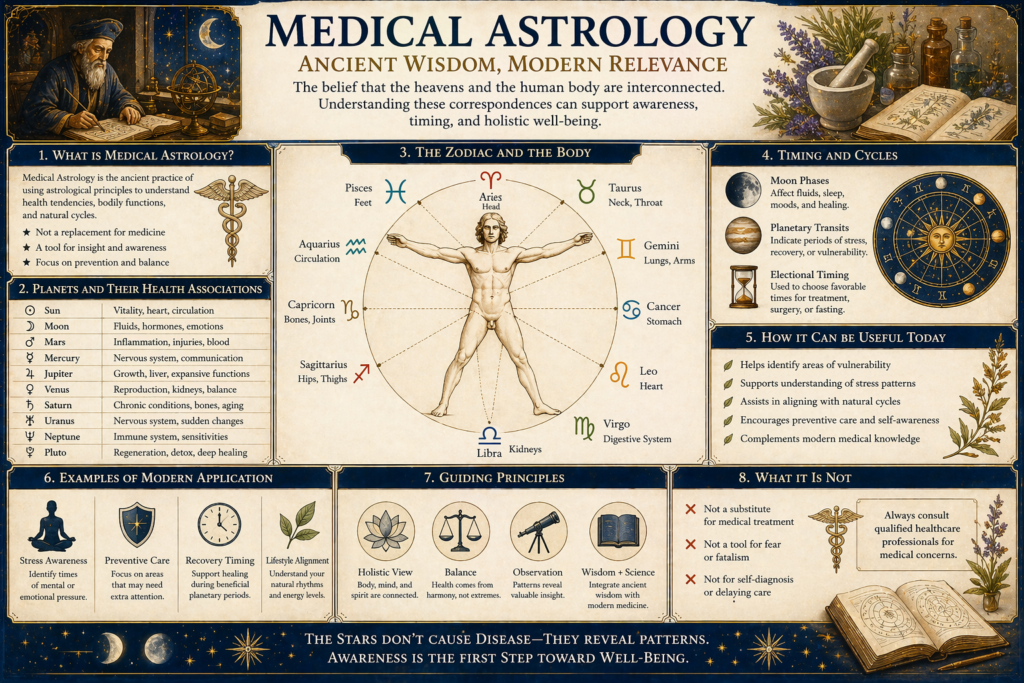
One of the foundational concepts is the correspondence between zodiac signs and body parts.
Zodiac Body Mapping
| Sign | Body Area |
|---|---|
| Aries | Head |
| Taurus | Neck, throat |
| Gemini | Lungs, arms |
| Cancer | Stomach |
| Leo | Heart |
| Virgo | Digestive system |
| Libra | Kidneys |
| Scorpio | Reproductive organs |
| Sagittarius | Hips, thighs |
| Capricorn | Bones, joints |
| Aquarius | Circulation |
| Pisces | Feet |
Diagram: Zodiac Body Correspondence


3. Planetary Influence on Health
Planets are associated with physiological and psychological functions.
Examples
- Sun → vitality, heart
- Moon → fluids, hormones
- Mars → inflammation, injuries
- Saturn → chronic conditions, aging
- Venus → balance, reproductive health
- Mercury → nervous system
4. Historical Use in Medicine
In medieval and Renaissance Europe:
- Physicians were trained in astrology
- Treatment timing was based on planetary positions
- Bloodletting and surgery followed lunar cycles
Astrologers like William Lilly included medical observations in their work.
Why It Was Trusted
- Lack of modern diagnostic tools
- Observed correlations over time
- Integration with philosophy and natural science
5. Why Medical Astrology Declined
With the rise of modern medicine:
- Empirical testing replaced symbolic systems
- Anatomy and biology advanced
- Technology enabled precise diagnosis
Medical astrology could not:
- Consistently meet scientific standards
- Provide measurable, repeatable outcomes
6. Can It Still Be Useful Today?
Medical astrology is not a substitute for modern medicine.
But it can still have value in specific, complementary ways.
7. Where Medical Astrology Can Be Useful
1. Awareness of Health Tendencies
A natal chart may highlight:
- Areas of vulnerability
- Stress patterns
- Behavioral tendencies affecting health
Example
- Strong Mars → tendency toward inflammation or burnout
- Strong Saturn → chronic or long-term conditions
2. Stress and Lifestyle Patterns
Astrology can help identify:
- Emotional triggers
- Work-rest imbalances
- Behavioral cycles
These are highly relevant to modern health issues like:
- Burnout
- Anxiety
- Sleep disruption
3. Timing and Cycles
Astrology can be used to observe:
- Periods of high stress
- Recovery phases
- Energy fluctuations
Example
- Saturn transits → periods of pressure or fatigue
- Jupiter transits → recovery, growth phases
4. Mind-Body Connection
Modern medicine increasingly recognizes:
- The link between mental and physical health
Astrology provides a framework for:
- Understanding emotional patterns
- Connecting them to physical symptoms
5. Preventative Insight
Rather than diagnosing illness, astrology can be used to:
- Encourage preventative care
- Highlight areas to monitor
- Support lifestyle adjustments
8. What It Should NOT Be Used For
To be clear, medical astrology should not:
- Replace medical diagnosis
- Delay treatment
- Be used for serious medical decision-making
Responsible Use
Think of it as:
A support tool, not a primary system
9. A Modern Integration Approach
The most useful approach today is a hybrid model:
Modern Medicine
- Diagnosis
- Treatment
- Emergency care
Astrology
- Pattern awareness
- Timing insight
- Behavioral understanding
10. Why People Still Use It
Despite skepticism, people are drawn to medical astrology because it offers:
- A sense of pattern and meaning
- A personalized perspective
- A holistic view of health
Final Thoughts
Medical astrology is no longer the foundation of healthcare—but it hasn’t disappeared.
It has shifted from:
- A primary diagnostic system
to - A complementary interpretive tool
Its value today lies not in replacing science—but in adding another layer of understanding.
When used responsibly, medical astrology can help people become more aware of their patterns, cycles, and tendencies—while still relying on modern medicine for actual care.