
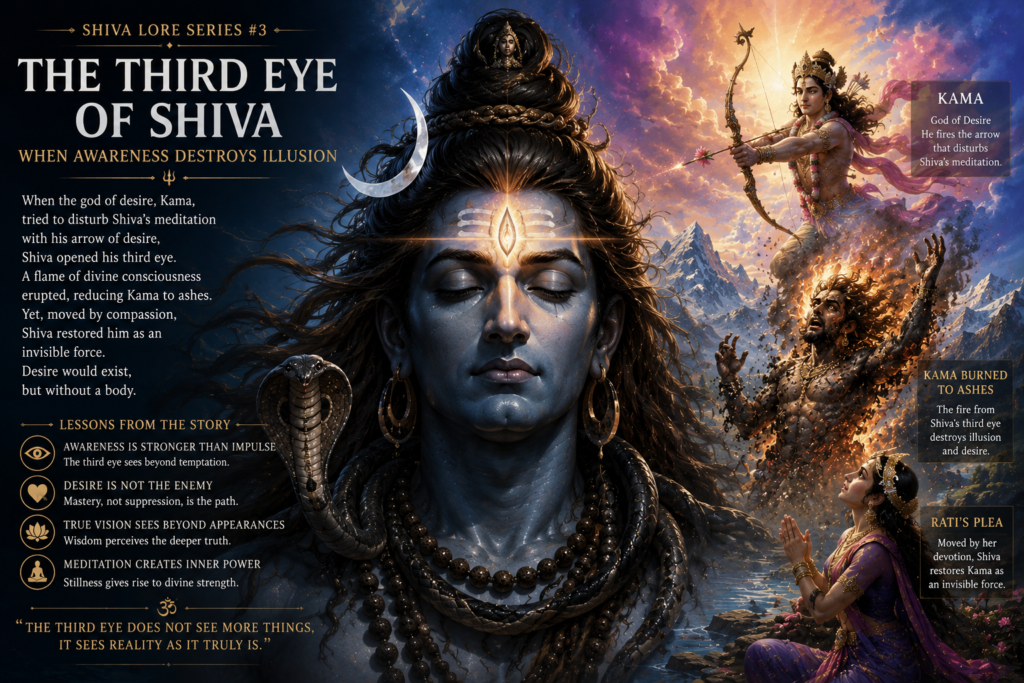
This story introduces one of Shiva’s most recognizable symbols and explores the relationship between desire, discipline, and spiritual awakening.
Shiva Lore Series #3: The Third Eye of Shiva
When Desire Challenged the Lord of Meditation
Among all the symbols associated with Lord Shiva, none is more mysterious than his third eye.
Ancient Hindu tradition teaches that Shiva’s third eye is not merely a physical feature. It represents higher consciousness, divine perception, and the ability to see beyond illusion.
The story begins during a time when Shiva was immersed in deep meditation.
After the death of his first wife, Sati, Shiva had withdrawn from worldly affairs and retreated into profound spiritual practice. His focus was absolute. His mind was still.
Meanwhile, a powerful demon threatened the heavens.
The gods knew that only a future son born to Shiva could defeat this enemy. Yet Shiva remained detached from the world and showed no interest in romance or marriage.
Desperate for a solution, the gods turned to Kama, the god of desire.
Kama possessed a magical bow strung with bees and arrows tipped with flowers. His power was not physical force but attraction itself.
The gods asked Kama to awaken love within Shiva’s heart.
Although he understood the risk, Kama agreed.
As Shiva sat in meditation beneath the Himalayas, Kama drew his bow and released an arrow of desire.
The arrow struck its target.
For a brief moment, Shiva’s meditation was disturbed.
Instantly he recognized what had happened.
Opening his inner eye, Shiva perceived the source of the disturbance.
A brilliant flame erupted from his third eye.
The fire was so intense that Kama was instantly reduced to ashes.
The gods watched in terror.
Desire itself had been destroyed.
Yet the story does not end there.
Kama’s wife, Rati, pleaded with Shiva for mercy.
Moved by compassion, Shiva restored Kama—not in physical form, but as an invisible force.
From that day forward, desire continued to exist within the world, but without a permanent body.
Thus attraction, longing, and love became forces that could influence humanity while remaining unseen.
The Spiritual Meaning
This story is often misunderstood.
It is not teaching that desire is evil.
Instead, it teaches that unconscious desire can distract even the most disciplined mind.
The third eye represents awareness.
When awareness becomes powerful enough, illusion loses its control.
Shiva does not destroy love.
He destroys attachment and unconscious craving.
The story reminds seekers that spiritual growth involves understanding desire rather than being ruled by it.
Lessons for Modern Seekers
Awareness Is Stronger Than Impulse
Most people react automatically to temptation.
The third eye symbolizes the ability to observe before reacting.
Desire Is Not the Enemy
Shiva ultimately allows desire to continue existing.
The goal is mastery, not suppression.
True Vision Sees Beyond Appearances
The third eye represents perception beyond surface-level reality.
Wisdom comes from seeing deeper causes rather than merely external events.
Meditation Creates Inner Power
Shiva’s immense strength comes from stillness.
The story suggests that self-mastery develops through inner discipline rather than external control.
Why This Story Endures
The image of Shiva’s third eye has endured for thousands of years because it symbolizes one of humanity’s greatest challenges.
Every person must learn to balance desire and wisdom.
Too much desire creates attachment.
Too much detachment can isolate us from life.
Shiva demonstrates a higher path.
The awakened mind does not reject the world.
It sees the world clearly.
And through that clarity, freedom becomes possible.
The Third Eye remains one of the most powerful symbols in spiritual traditions because it reminds us that true vision is not seeing more things.
It is seeing reality as it truly is.