
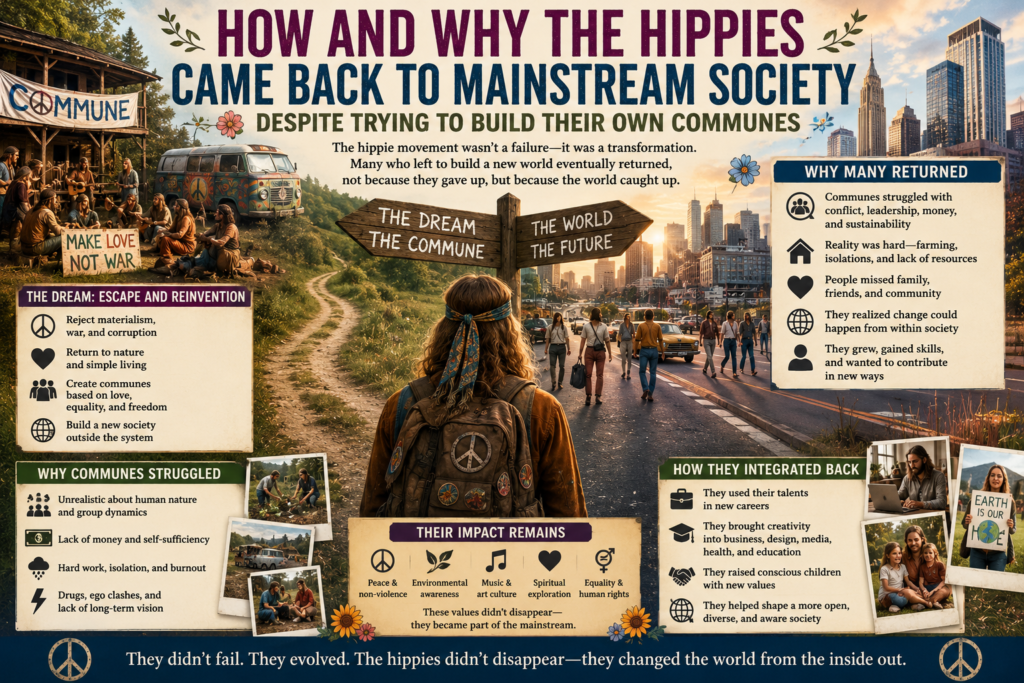
During the late 1960s and early 1970s, the counterculture movement reached a level that genuinely seemed capable of breaking away from mainstream society altogether. The generation commonly known as the “hippies” rejected conventional careers, traditional family structures, consumer capitalism, organized religion, and even the political institutions of the West. Inspired by ideals of peace, freedom, spirituality, and communal living, many believed they were not simply protesting society — they were building an entirely new one.
Yet only a decade later, much of that same generation had returned to ordinary life. Former hippies became teachers, office workers, entrepreneurs, parents, and even corporate executives. So what happened? Why did a generation that attempted to build independent communes eventually reintegrate into the very system they had tried to escape?
The answer reveals an interesting truth about human nature, economics, and the limits of idealism.
The Dream of Leaving Society Behind
The hippie movement emerged largely as a rejection of post-war Western culture, particularly in the Vietnam War era. Young people increasingly saw mainstream society as deeply flawed.
The movement rejected:
- Consumerism and material wealth
- Military conflict and nationalism
- Traditional sexual norms
- Corporate work culture
- Strict religious institutions
- Government authority
Rather than simply protest these systems, many hippies sought complete separation.
This led to the rise of communes — intentional communities where groups attempted to live collectively, share property, grow their own food, and operate outside capitalist structures.
Famous examples included communes in places such as Haight-Ashbury, rural communes in California, New Mexico, and experimental communities like The Farm.
The goal was simple: build a better world by refusing to participate in the old one.
The Economic Reality of Communal Living
One of the biggest problems communes faced was economics.
Modern society functions because specialization creates efficiency. In ordinary civilization, individuals focus on narrow tasks — doctors practice medicine, farmers grow food, engineers build infrastructure.
Communes attempted to replace this with shared labor systems where everyone contributed equally.
The problem was predictable.
Not everyone worked equally hard.
Some individuals naturally became more productive, while others contributed less. Over time resentment developed.
Communities that rejected money still needed money for:
- Land ownership
- Medical care
- Equipment
- Building maintenance
- Transportation
- Legal obligations and taxes
Ironically, many communes discovered that surviving outside capitalism still required participating in capitalism.
Human Nature Resisted Pure Equality
Many communes were built around ideals of radical equality.
But humans naturally organize themselves into informal hierarchies.
Even in groups that rejected leadership, leaders quietly emerged.
Some members became:
- Organizers
- Decision makers
- Spiritual leaders
- Conflict mediators
- Resource controllers
Over time internal conflicts began to develop.
Who works harder?
Who decides community rules?
How should resources be distributed?
What happens when someone refuses responsibility?
The ideal of perfect equality often collided with the reality that groups naturally develop structure.
In some ways, the communes began recreating the same systems they had originally rejected.
The Problem of Raising Families
Living communally may work temporarily for young adults seeking freedom.
But long term life introduces new responsibilities.
As hippies entered their late twenties and thirties, many began having children.
Suddenly priorities shifted.
Parents started thinking about:
- Stable housing
- Reliable income
- Healthcare
- Education
- Personal safety
- Long term security
The uncertainty and instability of communal life became much harder to tolerate.
The same person who can happily live in a tent at age 22 often thinks differently at age 32 with children.
Biology and responsibility gradually pulled many back toward conventional life.
The Counterculture Actually Won in Unexpected Ways
Ironically, hippies did not entirely fail.
Mainstream society slowly absorbed many of their ideas.
By the late 1970s and 1980s, Western society had adopted many counterculture values.
For example:
- Meditation and Eastern spirituality became normalized
- Organic food movements expanded
- Environmental awareness became mainstream
- Sexual freedom increased
- Alternative lifestyles gained social acceptance
- Corporate culture became less rigid
Figures such as Ram Dass and interest in traditions like Buddhism and Yoga entered everyday Western life.
In a strange sense, society itself evolved toward some of the hippies’ ideals.
There was less need to remain separate.
Aging Changes Priorities
Youth often values freedom over stability.
Age often shifts the balance.
Many former hippies eventually discovered that permanent rebellion is psychologically exhausting.
Living outside society requires constant self-management.
No stable paycheck.
No institutions to rely upon.
No predictable future.
Eventually, many realized that modern society, while imperfect, offered conveniences and security difficult to reproduce independently.
The revolutionary spirit faded as ordinary life became more attractive.
The Rise of “The Yuppie” Generation
Perhaps the greatest irony came in the 1980s.
Many former hippies transitioned into what became known as the “yuppie” generation — young urban professionals focused on career success, business, and wealth.
The same generation that once rejected capitalism often became deeply involved in it.
Some historians argue this happened because the entrepreneurial spirit of the hippie movement never disappeared.
Hippies were always highly individualistic.
Once idealism faded, many redirected that same independent thinking toward business creation.
The rebellious artist became the startup founder.
The Final Lesson
The hippie movement revealed an important truth.
It is far easier to criticize society than to replace it.
Civilization is incredibly complex.
Food systems, infrastructure, medicine, transportation, law, and economics require levels of organization that small idealistic communities struggle to sustain.
At the same time, the hippies permanently changed Western culture.
They failed to build a separate civilization.
But they succeeded in transforming the civilization they originally rejected.
In the end, they did not return because their ideals were meaningless.
They returned because completely escaping society proved far harder than changing it from within.
Perhaps the greatest legacy of the hippies is this paradox:
They left society hoping to create a new world.
Instead, they came back and slowly changed the old one.