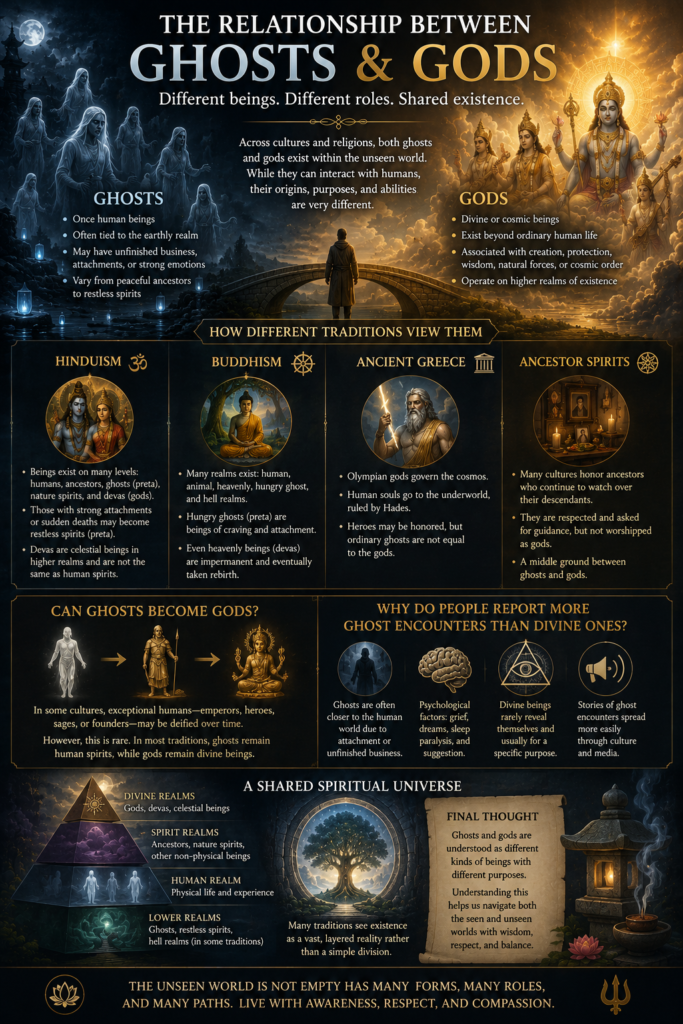
Throughout history, nearly every civilization has believed in both divine beings and the spirits of the dead. Yet these two types of supernatural beings are rarely viewed as the same thing.
Ghosts are generally understood as the spirits of deceased humans, while gods are usually regarded as higher spiritual beings with powers extending far beyond human existence.
But do ghosts and gods exist in the same spiritual world? Can ghosts become gods? Can gods communicate through spirits? Different traditions answer these questions in fascinating ways.
Ghosts and Gods Occupy Different Roles
Although beliefs vary, many religions distinguish ghosts and gods by their origin.
Ghosts are generally believed to have once been human beings.
Gods are viewed as divine or cosmic beings that were never ordinary humans, or that have attained a fundamentally different spiritual status.
This distinction appears across many cultures.
Ghosts are often associated with unfinished earthly matters.
Gods are associated with maintaining cosmic order, creation, protection, wisdom, or natural forces.
The Hindu Perspective
In Hinduism, the universe contains many different levels of existence.
Some traditions describe beings such as:
- Humans
- Ancestors
- Ghosts (preta)
- Nature spirits
- Devas (often translated as gods)
- Enlightened beings
A person who dies peacefully and whose funeral rites are completed is generally believed to continue the cycle of rebirth.
However, some Hindu traditions teach that individuals with intense attachments, sudden deaths, or unresolved karma may temporarily exist as restless spirits known as preta.
These spirits are considered quite different from devas, who are celestial beings associated with higher realms.
The Buddhist Perspective
Buddhism also describes multiple realms of existence.
Depending on the tradition, these may include:
- Human realm
- Animal realm
- Heavenly realms
- Hungry ghost realm
- Hell realms
Hungry ghosts (preta) symbolize beings consumed by craving and attachment.
Meanwhile, heavenly beings, sometimes called devas, enjoy long lives and great happiness but are still considered impermanent.
Even gods eventually exhaust their karma and are reborn.
Only enlightenment ends the cycle completely.
Ancient Greece
In ancient Greek religion, the distinction was also clear.
The Olympian gods, led by Zeus, governed the cosmos.
Human souls journeyed to the underworld after death, ruled by Hades.
While heroes could sometimes receive extraordinary honor after death, ordinary ghosts were not viewed as equal to the gods.
Ancestor Spirits
Many cultures occupy a middle ground between ghosts and gods.
In traditions throughout East Asia, Africa, and elsewhere, ancestors are respected, remembered, and sometimes asked for guidance.
These ancestral spirits are not necessarily worshipped as gods, but they are believed by some traditions to continue caring for their descendants.
This creates a spiritual hierarchy rather than a simple division.
Can Ghosts Become Gods?
Some cultures contain stories in which exceptional humans eventually become revered as divine figures.
Examples include:
- Deified emperors
- Cultural heroes
- Legendary founders
- Protective local deities
However, this is generally understood as exceptional rather than the normal fate of human souls.
In most traditions, ghosts remain human spirits.
Gods remain divine beings.
Why Do People Report More Ghost Encounters Than Divine Ones?
Many paranormal reports involve ghosts rather than gods.
There are several possible explanations.
From a spiritual perspective, some traditions suggest that ghosts remain closer to the human world because of attachment or unfinished business.
From a psychological perspective, experiences interpreted as ghosts may arise from grief, dreams, sleep paralysis, or other natural phenomena.
Meanwhile, many religions describe divine beings as revealing themselves only rarely and usually for specific purposes.
A Shared Spiritual Universe?
Many traditions envision reality as containing multiple levels of existence.
Rather than imagining ghosts and gods occupying completely separate universes, they are often understood as existing within a broader spiritual cosmos, each with different roles and levels of awareness.
In this view:
- Humans live physical lives.
- Ghosts represent certain deceased beings.
- Divine beings govern or inhabit higher realms.
- Enlightened beings transcend the cycle altogether.
The exact structure varies from one tradition to another.
Final Thoughts
The relationship between ghosts and gods has fascinated humanity for thousands of years.
Across cultures, a common theme emerges: ghosts and gods are usually understood as different kinds of beings with different purposes.
Ghosts are generally associated with the human journey after death.
Gods represent higher cosmic powers, guardians, creators, or celestial intelligences.
Whether one approaches these ideas through religion, philosophy, folklore, or personal belief, they all point toward humanity’s enduring desire to understand what lies beyond the visible world.
Perhaps the greatest lesson shared across many traditions is that the unseen universe—whatever its true nature—is imagined not as a single category of spirits, but as a vast and layered reality filled with many different forms of existence.