
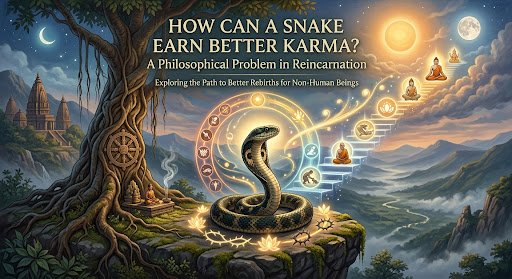
One of the most intriguing problems in the Hindu theory of reincarnation can be expressed with a surprisingly simple question:
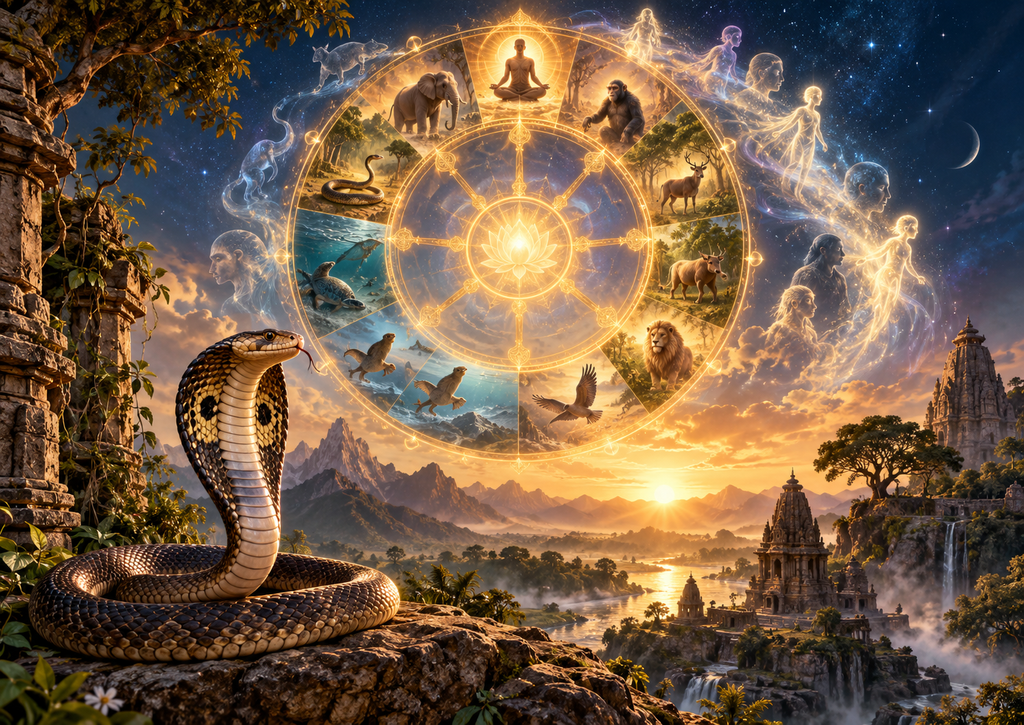
If bad karma can lead to rebirth as a lower life-form, how is that animal supposed to improve its karma?
Imagine that a human being lives selfishly, violently or ignorantly.
According to some traditional interpretations of karma and rebirth, those tendencies can contribute to a less favorable future birth.
Perhaps the person is reborn as an animal.
A snake, for example.
But now the philosophical difficulty becomes obvious.
What exactly constitutes being a good snake?
Should the snake refuse to bite?
Should it become compassionate toward mice?
Should it donate food?
Meditate?
Practice charity?
Clearly this begins sounding absurd.
A snake behaves largely according to snake nature.
It hunts.
Defends itself.
Reproduces.
Responds instinctively to danger.
It cannot realistically be expected to perform the kinds of consciously moral actions upon which karma is supposedly based.
So if the snake cannot accumulate enough good karma to escape being a snake, does reincarnation create a spiritual trap?
The question exposes an important weakness in the simplified version of karma commonly presented as:
Do good things → move upward.
Do bad things → move downward.
Classical Hindu traditions are considerably more complicated than that.
And one possible answer is particularly interesting:
rebirth may represent an evolution of consciousness rather than merely a cosmic reward-and-punishment system.
The Popular Version of Karma Is Too Simple
Karma is often explained in modern language almost like a spiritual credit score.
Help someone:
+10 karma.
Hurt someone:
−20 karma.
Accumulate enough positive points and receive a better life.
Accumulate enough negative points and perhaps return as an animal or enter some unfortunate condition.
That explanation is easy to understand.
But it creates serious philosophical problems.
Among them:
What happens when the new life-form lacks the mental capacity necessary for moral action?
Traditional Hindu thought actually contains multiple understandings of karma, and modern scholarship strongly cautions against speaking as though there were one single Hindu reincarnation doctrine. Different Hindu philosophical schools and texts explain the mechanics differently.
The general principle is that actions and dispositions affect future circumstances.
But that does not necessarily mean every incarnation is a moral examination conducted under identical conditions.
Hindu Scriptures Really Do Speak of Animal Rebirth
The animal problem cannot simply be dismissed by claiming that Hinduism never taught such a thing.
Some early Hindu sources explicitly connect karma with births among humans and animals.
The Chandogya Upanishad, for example, describes favorable and unfavorable future births in relation to previous conduct; one ancient passage includes birth as a dog or pig among unfavorable destinations.
The Bhagavad Gita also describes beings dominated by tamas—the guna associated with inertia, ignorance and obscuration—as descending toward lower conditions of existence. Traditional commentaries on Gita 14.15 and 14.18 interpret these passages as potentially including animal births.
So the difficulty is genuine.
If an individual consciousness can descend into animal existence, how does it climb back?
Animals May Not Be Full Moral Agents
One answer begins by distinguishing moral responsibility from karmic experience.
A human being possesses unusual abilities.
Humans can consciously ask:
Should I do this?
Is this right?
Will this hurt someone?
Should I control this desire?
Can I sacrifice my own interest for another person?
Most animals appear to possess much less capacity for reflective moral decision-making.
A snake does not normally deliberate:
“Killing this mouse would violate ahimsa, so perhaps I should fast tonight.”
Its behavior emerges mainly through biological drives.
That suggests animal life in the karmic system may not function primarily as a place for generating large quantities of new moral karma.
Instead, it may function more as a condition in which previous karma is experienced or exhausted.
This distinction changes the problem considerably.
Not Every Life Has to Be a Moral Exam
Imagine karma less as:
every lifetime is another examination
and more as:
some lifetimes are periods in which previously generated tendencies are being expressed and experienced.
Human existence offers unusual moral freedom.
Animal existence provides much less.
The snake therefore does not necessarily need to consciously earn its way back into humanity.
Its animal incarnation may simply have a finite karmic trajectory.
When the conditions sustaining that birth are exhausted, consciousness proceeds onward.
This resembles the way many Hindu traditions describe temporary heavenly or hellish states.
A person may experience the consequences of previous karma there without remaining eternally trapped.
Animal existence could operate similarly.
Human Birth Is Special Precisely Because Humans Can Choose
A recent philosophical survey of Hindu karma traditions notes that many Hindu schools regard human birth as especially valuable precisely because it provides unusual opportunities for moral and spiritual development. Animals and plants possess far more limited moral agency, while celestial beings may have so much pleasure that they lack incentive to seek liberation.
That produces a hierarchy based not merely upon biological superiority, but upon capacity for conscious transformation.
An animal experiences.
A human can experience and examine the experience.
A human can ask:
Why am I angry?
Why am I attached?
What causes suffering?
What is consciousness?
What is right action?
What is the Self?
What is God?
That reflective capacity makes human birth especially important.
The purpose of obtaining human birth would therefore not simply be enjoying superior circumstances.
It would be gaining access to a much more sophisticated spiritual instrument.
A Snake Does Not Need to Be a Morally Heroic Snake
Under this interpretation, the original question—
“How does a snake earn good karma?”
—may contain a mistaken assumption.
The snake may not need to.
Its principal task may simply be to live through snake consciousness.
Hunt.
Hide.
Mate.
Survive.
Experience hunger.
Experience danger.
Experience sensory existence.
Eventually die.
What matters is not that the snake performs philanthropy.
What matters is that consciousness passes through a particular mode of existence.
This is where reincarnation begins looking less like a courtroom and more like an evolutionary process of consciousness.
Karma May Shape Consciousness, Not Just External Rewards
Hindu philosophical discussions of karma frequently include the concept of samskaras—latent mental impressions or tendencies created by action.
Repeated actions influence character.
Perform anger repeatedly and anger becomes easier.
Practice generosity repeatedly and generosity becomes easier.
Habits create tendencies.
Those tendencies influence future behavior.
Some Hindu thinkers therefore describe karma not only as an external mechanism giving rewards and punishments, but also as an internal process through which consciousness becomes conditioned.
This gives reincarnation a psychologically sophisticated interpretation.
Bad karma does not merely mean:
God punishes you with an unpleasant birth.
It can mean:
your consciousness becomes increasingly shaped by the qualities you repeatedly cultivate.
Eventually the kind of consciousness one has developed determines the environment appropriate to it.
The Three Gunas Make This Easier to Understand
The Bhagavad Gita frequently describes nature through three gunas:
Sattva — clarity, harmony, illumination.
Rajas — passion, desire, restless activity.
Tamas — inertia, obscuration, ignorance.
Gita 14.18 gives a directional image:
those established in sattva move upward;
those dominated by rajas remain in the middle;
those dominated by tamas descend.
This can be interpreted less as a divine judge assigning punishments and more as consciousness gravitating toward the state corresponding to its qualities.
A consciousness increasingly dominated by:
awareness,
discipline,
compassion,
clarity
moves toward greater conscious possibility.
A consciousness increasingly dominated by:
compulsion,
unconsciousness,
violence,
inertia
moves toward more restricted forms.
That interpretation fits the snake problem considerably better.
“Lower” Could Mean Less Reflective Consciousness
The language of higher and lower life-forms can easily sound insulting when viewed biologically.
A snake is extraordinarily well adapted to being a snake.
A hawk may possess visual abilities humans can barely imagine.
A dog possesses sensory abilities far beyond ours.
Evolutionary biology does not place organisms onto a simple ladder whose summit is Homo sapiens.
But Hindu spiritual hierarchy is making a different claim.
The issue is not:
Which animal is biologically better?
It is:
Which embodiment provides the greatest opportunity for reflective spiritual awareness?
From that perspective, human existence is considered valuable because humans possess unusual capacities for:
self-awareness,
ethical reflection,
meditation,
philosophical inquiry,
and deliberate spiritual practice.
“Lower” therefore need not mean worthless.
It can mean:
less freedom for conscious spiritual self-direction.
The Animal Birth Could Be More Like a Restricted Consciousness
Imagine consciousness operating through different biological interfaces.
A human nervous system permits:
language,
abstract thought,
long-term planning,
moral philosophy,
meditation,
mathematics,
self-examination.
A snake nervous system permits another range of experiences.
The consciousness operating through it encounters a much narrower cognitive environment.
If reincarnation were true, an animal birth could therefore be understood as something like consciousness entering a more constrained vehicle.
That would itself constitute the consequence.
The punishment, if that word is even appropriate, would not need to consist of suffering imposed externally.
The limitation itself is the karmic result.
Karma as Resonance Rather Than Punishment
This leads toward the energetic interpretation.
Suppose karma operates more like resonance.
A person’s behavior gradually conditions consciousness toward particular qualities.
Someone habitually cultivating:
rage,
brutality,
compulsion,
fear,
greed,
or unconsciousness
develops a consciousness dominated by those frequencies, to use spiritual language.
At death, that pattern does not simply disappear.
It gravitates toward another form of existence compatible with it.
This does not require imagining a cosmic bureaucrat saying:
“You committed 72 bad actions. You are therefore assigned to Snake Department.”
Instead:
like attracts like.
Or more precisely:
consciousness manifests through conditions corresponding to its accumulated tendencies.
That is much closer to how many spiritual interpretations of karma operate.
The Snake’s Consciousness Can Still Develop
Even without abstract moral reasoning, an animal experiences the world.
Fear.
Safety.
Bonding.
Aggression.
Curiosity.
Comfort.
Pain.
Territory.
Attachment.
Different animal species obviously possess vastly different degrees of social and cognitive complexity.
Some display:
cooperation,
mourning,
caregiving,
play,
problem-solving,
and social bonds.
So consciousness need not be completely static during an animal incarnation.
But its development would not necessarily occur through moral philosophy.
It may happen through experience itself.
The consciousness moves through a different level of embodiment.
Eventually it becomes capable of another.
Spiritual Evolution May Be More Important Than Moral Accounting
This interpretation has appeared especially strongly among some modern Hindu thinkers.
Modern figures such as Swami Vivekananda, Sri Aurobindo and Sarvepalli Radhakrishnan developed more evolutionary interpretations of karma and rebirth, emphasizing ethical or spiritual development rather than seeing karma entirely as retributive punishment.
That changes the metaphor completely.
Reincarnation becomes less like:
courtroom → sentence → reward
and more like:
school → development → increasing consciousness.
Some lessons require human moral choices.
Other forms of existence may simply represent stages or conditions through which consciousness passes.
But Does Consciousness Automatically Move Upward?
Not necessarily in all Hindu traditions.
The Bhagavad Gita certainly contains imagery of both ascent and descent.
Consciousness can become more sattvic.
It can also become more tamasic.
The spiritual path is therefore not always depicted as a guaranteed straight line upward.
A human being has freedom.
Freedom makes greater development possible.
It also makes regression possible.
That produces an interesting paradox:
humans have the greatest opportunity partly because humans have the greatest capacity to misuse that opportunity.
A snake cannot build a concentration camp.
A snake also cannot become a Buddha-like sage.
Human consciousness contains both possibilities.
Animals May Accumulate Less Karma Precisely Because They Have Less Freedom
This provides another elegant solution.
Karma should arguably correspond to agency.
If an animal acts mostly through instinct, its actions may not carry the same moral weight as deliberate human actions.
Consider a tiger killing a deer.
We do not normally call the tiger evil.
The tiger is feeding itself.
Now compare a human deliberately torturing someone for pleasure.
The physical result may involve suffering in both cases.
But intentionality is radically different.
Karmic traditions generally place enormous importance upon intention and attachment.
Therefore instinctive animal actions would not necessarily accumulate karma in the same way as deliberate human choices.
The animal is not failing the moral test.
The full moral test is largely unavailable to it.
Then How Does the Animal Ever Leave Animal Birth?
Several possibilities exist within the broader Hindu framework.
The simplest is:
the karma producing that animal embodiment eventually exhausts itself.
When that karmic condition ends, another birth becomes possible.
Another interpretation would say that subtle tendencies continue evolving across incarnations until conditions permit a more developed form of consciousness.
Still another approach sees the process as ultimately governed by divine order or grace rather than by a purely mechanical karma machine.
Hindu schools disagree considerably about the exact mechanics.
The important point is that animal existence need not require the creature consciously to accumulate moral merit sufficient to escape.
The Prison Sentence Analogy
Consider someone serving a finite prison sentence.
The person does not necessarily have to earn enough points to cease being imprisoned.
The sentence itself eventually ends.
Similarly, under one interpretation, an animal birth can be a temporary karmic condition.
The consciousness experiences that embodiment.
The causal force responsible for it eventually runs out.
Then another configuration arises.
This solves much of the logical problem.
But an even better analogy may be a developmental stage rather than a prison.
The School Analogy
Imagine consciousness progressing through increasingly complex educational environments.
A child in kindergarten is not morally failing because they cannot perform calculus.
The capacity simply isn’t available yet.
Likewise, a snake would not be spiritually failing because it cannot practice metaphysical inquiry.
Its form of consciousness is working within the capacities available to it.
Human incarnation represents the moment when the curriculum changes dramatically.
Now questions of deliberate moral responsibility become possible.
Now karma becomes much more consequential.
The Real Karmic Question May Be “What Are You Becoming?”
This may be more useful than asking:
“How many good deeds have you performed?”
Imagine two people each give money to charity.
Person A gives because they genuinely care about relieving suffering.
Person B gives because cameras are watching and they want admiration.
Externally:
same action.
Internally:
very different consciousness.
If karma is partly about samskaras and character, the internal transformation matters enormously.
Person A reinforces compassion.
Person B may reinforce vanity.
The deeper karmic question becomes:
What quality of consciousness did this action cultivate?
That interpretation fits spiritual evolution much better than simplistic reward points.
Good Karma May Mean Increasing Conscious Complexity
From this viewpoint, compassion matters because it requires an expansion of identity.
At the most primitive level:
Only my immediate survival matters.
A more developed level recognizes:
my family.
Then:
my community.
Then:
strangers.
Then:
animals.
Then perhaps:
all living beings.
Consciousness becomes capable of taking increasingly broad perspectives.
Compassion therefore represents more than being “nice.”
It may be evidence of expanded consciousness.
Likewise, meditation develops the ability to observe impulses rather than obey them automatically.
Self-control creates distance between stimulus and action.
Wisdom increases the number of perspectives a person can hold simultaneously.
All of these represent increasing psychological complexity.
Tamas, Rajas and Sattva Can Be Read Developmentally
The guna system can even be interpreted this way.
Tamas represents consciousness dominated by inertia and automatic reaction.
Rajas introduces striving, ambition and activity.
Sattva brings greater clarity, balance and awareness.
The goal ultimately lies beyond even sattva, but the movement itself resembles increasingly reflective consciousness.
In that model, reincarnation is not simply:
bad person → animal.
It is:
consciousness dominated by particular tendencies gravitates toward forms and conditions reflecting those tendencies.
That is philosophically richer.
The Caste Problem Makes the Same Issue More Serious
Traditional karma teachings have also historically been connected with social birth.
The Chandogya Upanishad contains an ancient passage linking previous conduct with later birth into socially ranked groups, including Brahmin, Kshatriya and Vaishya births on one side and marginalized or animal births on the other.
This has understandably become deeply controversial.
Such ideas can be—and historically have been—used to rationalize social hierarchy:
“You were born into difficult circumstances because you deserved them from a previous life.”
That is a dangerous conclusion.
It can transform karma from a philosophy of personal responsibility into a justification for refusing compassion to suffering people.
It can effectively say:
Your suffering is your own fault.
That contradicts another central spiritual impulse found throughout Hindu traditions:
compassion, service and recognition of the divine or Self in others.
Karma Should Not Become an Excuse for Discrimination
Even if someone believes that karma influences birth circumstances, they cannot logically know the complete karmic history of another person.
Therefore saying:
“This poor person must have been bad in a previous life”
is speculation.
Worse, it can become a convenient excuse for maintaining injustice.
The Bhagavad Gita itself contains another strand that complicates rigid hierarchy: Krishna says that those taking refuge in him can attain the highest spiritual goal regardless of categories that classical society regarded as disadvantaged.
Whatever one thinks of the ancient social language, the larger spiritual message is that liberation is not monopolized by social status.
A Low Social Position Is Not the Same as Low Consciousness
This is especially important if reincarnation is understood developmentally.
Social rank and spiritual consciousness are obviously not identical.
A wealthy or high-status person can be:
cruel,
ignorant,
vain,
and deeply unconscious.
A poor or marginalized person can be:
compassionate,
wise,
disciplined,
and spiritually profound.
Therefore any system that mechanically equates:
high caste = advanced soul
and
low caste = inferior soul
quickly encounters both ethical and empirical problems.
An evolutionary interpretation of karma works better when it evaluates consciousness and character, not social privilege.
The Same Applies to Wealth, Beauty and Health
A simplistic karmic worldview might assume that favorable circumstances automatically indicate good karma.
Rich?
Good karma.
Beautiful?
Good karma.
Healthy?
Good karma.
Poor?
Bad karma.
Disabled?
Bad karma.
That quickly becomes spiritually grotesque.
A wealthy person may use wealth destructively.
A person living with severe hardship may develop enormous compassion.
The spiritually significant issue is not simply:
What circumstances were you given?
It is:
What happens to consciousness within those circumstances?
Karma may shape conditions.
But spiritual development concerns the relationship with those conditions.
Reincarnation Makes More Sense as a Multidimensional System
Perhaps the biggest mistake is imagining a single ladder:
stone → plant → insect → snake → dog → poor human → rich human → priest → heaven.
Real Hindu thought is far more diverse.
A better model would involve many dimensions:
awareness,
attachment,
compassion,
ignorance,
desire,
self-control,
wisdom,
devotion,
and karmic tendencies.
Different births create different possibilities.
The journey is not simply socioeconomic promotion.
It is transformation of consciousness.
The Snake Problem Actually Improves the Theory
This is why the apparently silly question—
“How can a snake be a good snake?”
—is philosophically useful.
It exposes the weakness of the childish version of karma.
If karma means only:
do morally good actions and receive rewards,
then animal reincarnation creates a major problem.
But if karma means:
actions condition consciousness; consciousness carries tendencies; different incarnations express and exhaust those tendencies; human birth provides unusual moral freedom; spiritual growth eventually transcends the entire cycle,
then the system becomes much more coherent.
The snake does not need to perform charity.
Its existence belongs to a different part of the process.
Karma Is Ultimately Not About Getting Promoted
There is another important Hindu answer.
The ultimate goal is not to climb endlessly through better reincarnations.
Hindu traditions generally describe the final objective as moksha—liberation from samsara altogether.
That means even excellent karma is not the final destination.
Good karma may produce favorable circumstances.
But favorable circumstances remain within samsara.
The deeper spiritual objective is to transcend attachment to the whole mechanism.
This changes the metaphor again.
Life is not a corporate ladder where the spiritual goal is becoming CEO.
It is recognizing that one eventually wants to leave the corporation.
Good Deeds Are Valuable, but Consciousness Is the Deeper Issue
Acts of compassion matter.
Truthfulness matters.
Generosity matters.
Nonviolence matters.
But their deepest purpose may not simply be accumulating cosmic reward.
They transform the person performing them.
Practice generosity and the grip of possessiveness weakens.
Practice compassion and the boundary around the ego expands.
Practice truthfulness and consciousness becomes less divided.
Meditate and automatic reactions become more visible.
Practice nonattachment and external conditions gain less control over inner life.
That is karma operating as spiritual psychology.
The action changes the world.
But it also changes the actor.
Perhaps Consciousness Evolves Through Increasing Freedom
This suggests an elegant interpretation of reincarnation.
The key variable may be freedom from automatic behavior.
At one extreme:
pure reaction.
Stimulus appears.
The organism responds.
As consciousness becomes more reflective, a gap develops.
Stimulus.
Awareness.
Choice.
Response.
That gap is spiritually enormous.
A snake has little space for ethical deliberation.
A human has much more.
A spiritually developed human attempts to expand that space further through:
meditation,
discipline,
awareness,
and wisdom.
The journey is therefore from:
compulsion
toward
conscious choice.
And ultimately perhaps from conscious choice toward liberation itself.
The Best Reinterpretation of the Reincarnation Ladder
The strongest version of the theory may therefore be:
A consciousness develops tendencies through action.
Those tendencies help shape future experience.
Some states of consciousness are more contracted, reactive or unconscious.
Others are increasingly reflective, compassionate and aware.
Different embodiments provide different capacities.
Animal incarnations are not necessarily moral punishments requiring animals to perform human ethics.
They may represent restricted or transitional states within a much larger karmic process.
Human birth becomes especially valuable because it allows consciousness to participate deliberately in its own transformation.
And the final goal is not simply a higher biological species, social caste or comfortable life.
It is liberation from ignorance.
So How Does a Snake Become Human Again?
Within this interpretation, the answer is surprisingly simple:
It does not need to behave like a morally virtuous human trapped inside a snake.
It needs to complete the karmic conditions associated with that form of life.
The consciousness continues.
The particular embodiment eventually ends.
The karmic configuration changes.
Another birth becomes possible.
When human existence eventually returns, conscious ethical and spiritual development again becomes much more available.
The responsibility therefore lies primarily with the human incarnation.
That is when consciousness possesses the tools to ask:
What am I becoming?
What tendencies am I strengthening?
Am I becoming more conscious or less?
More compassionate or more self-absorbed?
More free or more compulsive?
Those questions may be far closer to the heart of karma than keeping a tally of good and bad deeds.
Reincarnation as Evolution of Consciousness
The most compelling philosophical version of Hindu reincarnation may therefore not be a giant cosmic punishment system.
It may instead be an account of consciousness moving through forms, experiences and levels of freedom.
An action matters because it leaves an imprint.
An imprint influences consciousness.
Consciousness influences future action.
Those accumulated tendencies influence future existence.
More conscious forms provide greater opportunity for deliberate transformation.
Eventually consciousness becomes capable of seeing through the entire cycle.
Then liberation becomes possible.
Under that interpretation, the snake problem is no longer fatal to reincarnation.
It actually reveals the difference between two very different concepts of karma.
The crude version says:
Be good and the universe rewards you.
The deeper version says:
Everything you repeatedly think, desire and do shapes what consciousness becomes.
And reincarnation, if it exists, would be the continuation of that process beyond the boundaries of one physical lifetime.
The question is therefore not really:
“How can a snake perform enough good deeds?”
It is:
“What kind of consciousness exists in each form, what possibilities does that form provide, and how does consciousness gradually move from compulsion toward awareness?”
That is a much more difficult question.
But it is also a far more interesting one.