When people hear the word “phoenix,” they often imagine the Western firebird that dies in flames and rises again from its ashes. This image is powerful: death, rebirth, transformation, and victory over destruction.
But in Korean culture, the phoenix has a different meaning.
The Korean phoenix is called bonghwang — 봉황, written with the Chinese characters 鳳凰. It is related to the East Asian fenghuang, a sacred bird found across Chinese, Korean, Japanese, and Vietnamese cultural traditions. In Korea, the word combines bong, traditionally referring to the male phoenix, and hwang, traditionally referring to the female phoenix.
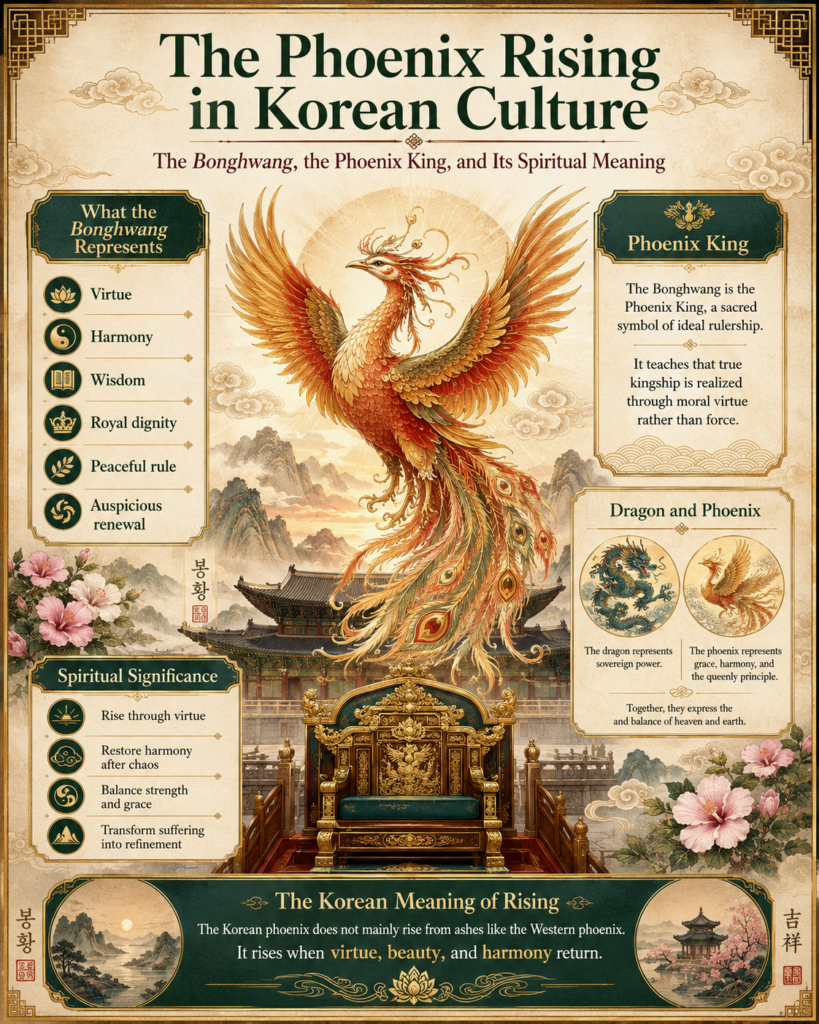
Unlike the Western phoenix, the Korean bonghwang is not mainly a bird of fire and ashes. It is a bird of virtue, harmony, wisdom, royal dignity, and peaceful rule.
In this sense, the Korean phoenix does not simply “rise” because it survives destruction.
It rises because moral order returns.
The Bonghwang: Korea’s Sacred Phoenix
The bonghwang is one of the most noble mythical creatures in Korean symbolism. Like the dragon, turtle, and qilin, it belongs to the world of sacred animals connected with heaven, rulership, and cosmic order. The National Palace Museum of Korea notes that the dragon, phoenix, qilin, and turtle are grouped among the four mythical guardian spirits in East Asian palace symbolism.
But while the dragon often represents power, command, and kingly authority, the phoenix represents something softer and more refined.
The bonghwang symbolizes:
- Virtue
- Wisdom
- Peace
- Harmony
- Beauty
- Moral leadership
- Auspicious fortune
- The arrival of a better age
This makes it different from a predator bird, war bird, or monster. The bonghwang is not feared because of violence. It is respected because of nobility.
Spiritually, it is the bird that appears when heaven and earth are in balance.
The Phoenix as the King of Birds
In East Asian thought, the phoenix is often described as the ruler or king of birds. This does not mean it rules through aggression. It rules through excellence.
The phoenix is above ordinary birds because it represents a higher pattern of existence.
It combines beauty with virtue.
Grace with authority.
Heavenly elegance with moral discipline.
This is why the bonghwang became connected with royal imagery in Korea. It represented not only political power, but the ideal of a ruler who should be wise, balanced, and worthy of heaven’s favor.
In Korean palaces, phoenix designs appear in important royal spaces. The National Palace Museum of Korea explains that phoenix motifs in palace architecture symbolize the king’s great virtue and deep wisdom, with the hope that the ruler would govern an age of peace and stability.
This is the deeper idea of the “phoenix king.”
A true king is not merely someone who dominates.
A true king is someone whose inner virtue brings harmony to the realm.
The Phoenix Throne
In Korean royal culture, the king’s seat is sometimes referred to in English as the Phoenix Throne. The phrase identifies the throne of Korean monarchs and, more abstractly, the authority of the Joseon king or Korean emperor. The phoenix motif was strongly associated with Korean royalty and symbolized supreme royal authority.
This is spiritually significant.
A throne is not only a chair.
In traditional royal symbolism, a throne is the axis between heaven, earth, and society. The king sits in the center, representing order. Behind the king, palace screens often showed cosmic images such as the sun, moon, and mountains. Around the throne, dragons and phoenixes communicated the idea that rulership was not merely administrative — it was cosmic.
The phoenix on or near the throne reminded people that the king was supposed to embody wisdom, virtue, and refined moral power.
The king should not simply rule.
He should harmonize.
The Phoenix and the Queenly Principle
In many East Asian traditions, the phoenix is often paired with the dragon.
The dragon represents yang energy: active power, command, heaven, masculinity, and sovereign force.
The phoenix often represents yin refinement: beauty, grace, harmony, fertility, elegance, and the queenly principle.
This does not mean the phoenix is weak. In fact, it represents a different kind of power.
The dragon conquers chaos.
The phoenix civilizes it.
The dragon commands.
The phoenix harmonizes.
Together, they form a symbolic marriage of power and grace.
This is why dragon-and-phoenix imagery is often used in royal, wedding, and auspicious contexts across East Asia. Spiritually, the pair represents the union of masculine and feminine forces, heaven and earth, authority and beauty, strength and peace.
The Phoenix Rising in a Korean Context
The phrase “phoenix rising” usually comes from Western symbolism, where the phoenix burns and is reborn from ashes. Korea’s bonghwang does not traditionally center on that exact fire-and-ashes myth.
But the idea of rising still fits beautifully if understood in a Korean way.
In Korean symbolism, the phoenix rises when:
- Chaos becomes harmony
- Suffering becomes wisdom
- A fallen society restores virtue
- A ruler becomes worthy
- The inner self becomes refined
- Beauty returns after hardship
- Peace emerges after conflict
So the Korean phoenix is not only about surviving destruction.
It is about rising into a higher state of order.
The Western phoenix says:
“I was destroyed, but I live again.”
The Korean bonghwang says:
“When virtue returns, heaven sings again.”
The Bonghwang in Modern Korea
The bonghwang is not only an ancient palace symbol. It still appears in modern Korean national imagery.
South Korea’s national seal uses a pair of seated phoenixes, with a fully opened mugunghwa, the Rose of Sharon, resting on their backs.
The presidential office logo has also used two phoenixes together with the mugunghwa. According to Korea.net, the logo represents freedom, peace, and prosperity, with the phoenix symbol connected to the presidency.
This shows how the bonghwang continues to carry political and spiritual meaning.
It is not just a decorative bird.
It remains a symbol of legitimate leadership, national harmony, and the hope that authority should be guided by virtue.
Spiritual Significance of the Bonghwang
Spiritually, the bonghwang represents the elevation of the soul.
It is not raw instinct.
It is not ego power.
It is not domination.
It is refined consciousness.
The bonghwang teaches that true spiritual rising is not merely escaping suffering. It is becoming more beautiful, more ethical, more balanced, and more aligned with heaven.
Its lessons include:
Rise through virtue.
Power without morality becomes tyranny. The phoenix rises because it is worthy.
Bring harmony where there is conflict.
The phoenix is a peaceful ruler. Its presence suggests order restored.
Balance masculine and feminine forces.
When paired with the dragon, the phoenix reminds us that strength needs grace, and action needs wisdom.
Transform suffering into refinement.
The Korean phoenix does not need to burn dramatically. It transforms by becoming noble.
Let beauty become spiritual discipline.
The bonghwang is beautiful, but its beauty is not shallow. It reflects inner harmony.
The Inner Phoenix King
On a personal level, the “phoenix king” can be understood as the awakened ruler within the self.
Every person has an inner kingdom: thoughts, emotions, instincts, desires, fears, memories, and dreams.
When that inner kingdom is chaotic, the person feels scattered.
When the inner king is weak, impulses rule.
When the inner queen is wounded, beauty and emotional flow disappear.
The phoenix king represents the moment when the higher self returns to the throne.
This does not mean becoming arrogant or superior.
It means becoming internally ordered.
Your mind becomes clearer.
Your emotions become calmer.
Your desires become purified.
Your presence becomes more graceful.
You no longer rule yourself through force.
You rule yourself through wisdom.
That is the spiritual meaning of the phoenix rising in a Korean sense.
Final Thoughts
The Korean bonghwang is often translated as “phoenix,” but it is not exactly the same as the Western phoenix.
The Western phoenix is a symbol of death and rebirth.
The Korean bonghwang is a symbol of virtue, harmony, royal dignity, and peaceful order.
Its rising is not only a return from ashes.
It is the return of wisdom after chaos.
It is the restoration of balance after disorder.
It is the appearance of beauty when the world becomes morally aligned again.
In Korean culture, the phoenix king is not simply the strongest bird.
It is the most noble bird.
And spiritually, it reminds us that the highest form of power is not domination.
It is harmony guided by virtue.