Numerology usually works with whole numbers. Birth dates, names, house numbers, phone numbers, business names, and important calendar dates are normally reduced into single digits, compound numbers, or master numbers. In most common systems, the number is simplified until its symbolic “essence” is reached.
However, modern numerologists and spiritually minded people sometimes ask a more unusual question:
Can numerology work with fractions or decimal numbers?
For example, what about 2.5, 3.14, 11.11, 7.8, or 1/2?
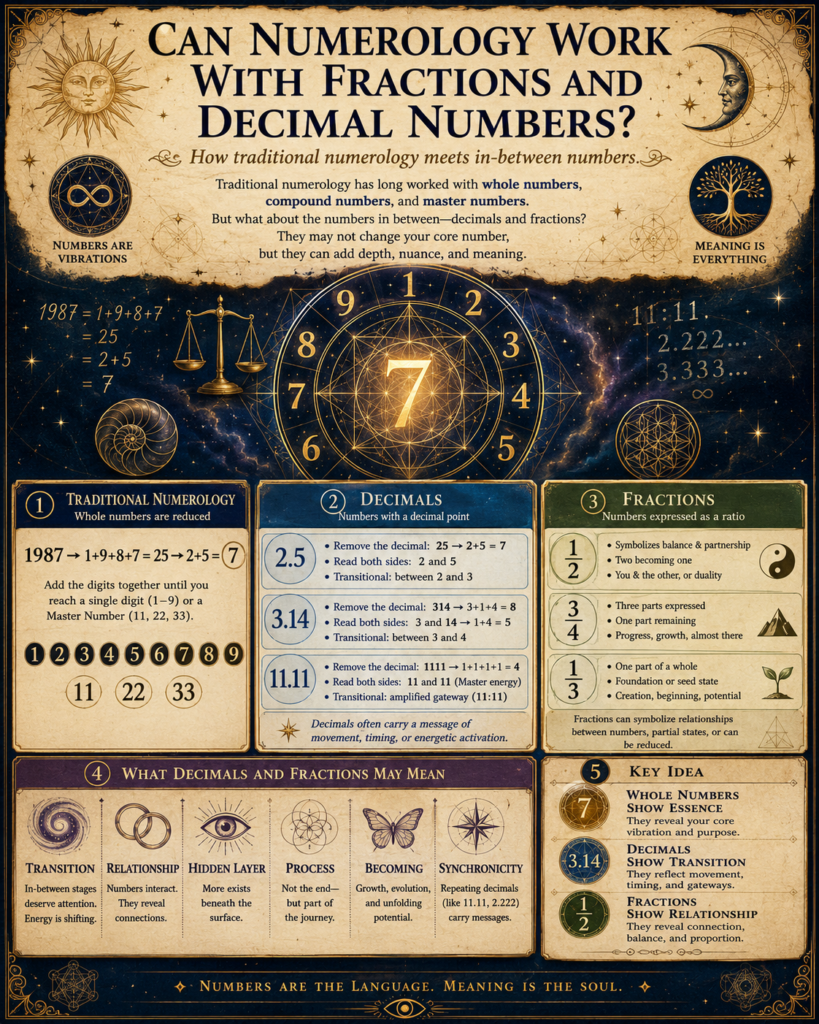
The short answer is yes — but usually in a more experimental, symbolic, or intuitive way. Fractions and decimals are not the foundation of traditional numerology, but they can still be interpreted if we understand what kind of number we are looking at.
Traditional Numerology Prefers Whole Numbers
Most numerology systems are based on whole-number reduction. In common numerology, names and birth dates are converted into numbers, then reduced to their core vibration. Encyclopedia.com describes numerology as a belief that numbers carry occult or symbolic power, with combinations of numbers often reduced to basic single-digit essence.
For example:
1987 → 1 + 9 + 8 + 7 = 25
25 → 2 + 5 = 7
So the final number becomes 7.
This is why numerology usually feels clean and direct. It takes complexity and reduces it to symbolic essence.
Pythagorean and Chaldean Systems
Two of the most common numerology systems are Pythagorean numerology and Chaldean numerology.
Pythagorean numerology usually reduces numbers to single digits, except for certain master numbers. Chaldean numerology gives more attention to compound numbers before reducing them.
For example, in Chaldean-style interpretation, 23 may not simply become 5. The compound number 23 may have its own meaning first, then the final 5 gives the inner essence. Some modern Chaldean sources describe compound numbers between 10 and 52 as having traditional interpretations before reduction.
This matters because decimals and fractions also contain layers.
They may not be traditional, but they can be read as layered numbers.
What Happens With Decimal Numbers?
A decimal number is a number with a point inside it, such as:
2.5
7.8
3.14
11.11
12.34
In strict traditional numerology, the decimal point usually has no formal role. Most systems were developed around names, dates, and whole-number symbolism, not modern decimal notation.
But there are several ways a modern numerologist might approach decimals.
Method 1: Ignore the Decimal Point
The simplest method is to remove the decimal point and reduce the digits.
For example:
2.5 becomes 25
2 + 5 = 7
So 2.5 carries the vibration of 7.
Another example:
3.14 becomes 314
3 + 1 + 4 = 8
So 3.14 reduces to 8.
This method treats the decimal as a visual separator rather than a spiritual boundary.
The advantage is simplicity.
The disadvantage is that it may ignore the symbolic difference between the number before the decimal and the number after it.
Method 2: Read Both Sides Separately
A more nuanced method is to interpret the number before and after the decimal separately.
For example:
2.5 can be read as:
2 before the decimal
5 after the decimal
The 2 may represent the main visible energy: partnership, sensitivity, balance, cooperation.
The 5 may represent the hidden or modifying energy: change, movement, freedom, instability, experimentation.
So 2.5 could be interpreted as:
“A cooperative or relational energy being pushed toward change, movement, and freedom.”
This is more interesting than simply reducing 2.5 to 7.
Method 3: Treat the Decimal as a Bridge
A decimal can also be interpreted as a bridge between two states.
For example, 2.5 is halfway between 2 and 3.
Symbolically, this could mean a transition from 2 energy into 3 energy.
2 represents sensitivity, duality, cooperation, and receptivity.
3 represents expression, creativity, communication, and social energy.
So 2.5 may symbolize someone moving from emotional sensitivity toward creative expression.
This approach is especially useful when interpreting measurements, prices, percentages, ratings, or anything that naturally exists between whole numbers.
Method 4: Reduce the Whole Number and Decimal Separately
Another method is to reduce each side.
For example:
12.34
Before the decimal:
1 + 2 = 3
After the decimal:
3 + 4 = 7
So 12.34 could be read as a 3/7 combination.
The outer energy is 3: communication, creativity, expression.
The inner detail is 7: analysis, spirituality, privacy, research, depth.
Together, this may suggest:
“Creative expression guided by deeper analysis or spiritual reflection.”
This method works especially well for repeating decimals or symbolic numbers such as 11.11.
What About 11.11?
Decimals become especially interesting when they repeat.
11.11 is often interpreted spiritually as an “angel number” or awakening number in modern numerology culture.
Traditional numerology does give special importance to master numbers such as 11, 22, and 33 in many modern systems. World Numerology, for example, describes 11, 22, and 33 as master numbers with intensified symbolic qualities.
So 11.11 can be read as:
11 mirrored by 11
A portal-like number
Double intuition
Double awakening
A symbol of alignment or synchronicity
Even though the decimal point itself is not classical, the repetition makes the number feel symbolically powerful.
What About Fractions?
Fractions are even more interesting.
A fraction is not only a number. It is a relationship between numbers.
For example:
1/2
3/4
5/8
7/9
In numerology, this can be interpreted in several ways.
Method 1: Add the Top and Bottom Numbers
The simplest method is to add the numerator and denominator.
For example:
1/2 → 1 + 2 = 3
So 1/2 carries the vibration of 3.
Another example:
3/4 → 3 + 4 = 7
So 3/4 carries the vibration of 7.
This works if you want a basic symbolic reduction.
Method 2: Read the Fraction as a Relationship
A deeper method is to interpret the top number and bottom number separately.
For example:
1/2
The 1 represents self, individuality, independence, identity, and beginning.
The 2 represents relationship, balance, cooperation, and reflection.
So 1/2 could symbolize:
“The individual self learning through relationship.”
Another example:
3/4
The 3 represents creativity and expression.
The 4 represents structure, work, discipline, and foundation.
So 3/4 could symbolize:
“Creative expression needing structure to become real.”
This method is more spiritually meaningful than simply reducing the fraction.
Method 3: Convert the Fraction Into a Decimal
Fractions can also be converted into decimals.
For example:
1/2 = 0.5
3/4 = 0.75
1/3 = 0.333…
Then the decimal can be read numerologically.
1/3 becomes 0.333…, emphasizing repeated 3 energy.
That could symbolize creativity, expression, communication, or expansion repeating continuously.
This method is especially useful when the fraction creates a repeating decimal.
Repeating decimals can feel symbolically similar to repeating angel numbers.
The Problem With Decimals and Fractions
The challenge is that decimals and fractions can become too flexible.
If every possible format receives a mystical meaning, numerology can become vague.
For example, 2.5 could be read as:
25 → 7
2 and 5 together
Halfway between 2 and 3
A 2 modified by a 5
A decimal ratio
A measurement-based symbol
All of these can be interesting, but they may not all be equally useful.
This is why intention matters.
Before interpreting a decimal or fraction, ask:
Why does this number matter?
Where did it appear?
Is it a price, time, measurement, percentage, date, rating, or repeating sign?
Did it appear randomly, or in a meaningful context?
Numerology works best when the context is clear.
When Decimal Numerology Makes Sense
Decimal numerology may be useful when interpreting:
Prices
Stock prices
Measurements
Ratings
Percentages
Repeating digital numbers
Angel numbers
Coordinates
Astrology degrees
Sports scores
Time stamps
Scientific constants used symbolically
For example, someone who repeatedly sees 3.14 may interpret it not only mathematically as pi, but symbolically as 3 + 1 + 4 = 8.
The 8 may suggest power, structure, karma, cycles, money, or manifestation.
But because 3.14 is also connected with circles and pi, it could carry a symbolic meaning of infinity, cycles, and the hidden order of creation.
This is where numerology becomes more intuitive and symbolic.
When Decimal Numerology Does Not Matter Much
Decimals may matter less when the number is purely technical or arbitrary.
For example:
A random file size
A software version number
A machine-generated decimal
A temporary price fluctuation
A meaningless measurement error
Not every number needs interpretation.
Numerology becomes more useful when a number appears repeatedly, emotionally, synchronistically, or in a meaningful life context.
Fractions as Spiritual Symbols
Fractions can also be spiritually powerful because they represent incompleteness, division, proportion, and relationship.
A whole number feels complete.
A fraction feels partial.
This can symbolize:
A lesson still unfolding
A relationship between two forces
A state of transition
A divided self
An incomplete cycle
A movement toward wholeness
For example:
1/2 may represent duality.
1/3 may represent creative trinity.
1/4 may represent grounding and structure.
3/4 may represent something almost complete but not fully finished.
7/8 may represent spiritual progress close to completion.
So fractions can be read symbolically, especially when they appear in dreams, visions, rituals, measurements, or repeated synchronicities.
The Spiritual Meaning of “In-Between” Numbers
Whole numbers are stable.
Decimals and fractions are in-between.
That is their spiritual power.
They may represent:
Transition
Process
Becoming
Unfinished lessons
Subtle adjustment
Movement from one vibration to another
A hidden layer beneath the obvious number
A whole number says:
“This is the essence.”
A decimal says:
“This is the movement between essences.”
A fraction says:
“This is the relationship between parts.”
That is why decimals and fractions may work best in more advanced or intuitive numerology.
Final Thoughts
Traditional numerology usually works with whole numbers, single-digit reductions, compound numbers, and master numbers.
Decimals and fractions are not usually the foundation of classic systems.
However, they can still be interpreted in modern numerology if approached carefully.
Decimals can be read by:
Removing the decimal point
Reading both sides separately
Treating the number as a transition
Reducing each side into a combined meaning
Fractions can be read by:
Adding numerator and denominator
Reading the top and bottom as symbolic forces
Converting them into decimals
Interpreting them as relationships or partial states
The key is not to force meaning onto every number.
The key is to ask whether the number appears with significance, repetition, emotion, or spiritual timing.
Whole numbers show essence.
Decimals show transition.
Fractions show relationship.
And in that sense, yes — numerology can work with fractional and decimal numbers, but usually as a more intuitive and experimental layer beyond traditional practice.