Musicians often describe a strange experience when creating their best work.
A melody appears almost fully formed.
Lyrics arrive faster than they can be written.
A chord progression seems to “want” to go somewhere.
A song takes an unexpected direction that the musician never consciously planned.
Hours disappear.
The person eventually listens back and thinks:
“Where did that come from?”
For some artists, this is simply creativity.
For others, it feels like something more.
They describe themselves not as the creator of the music, but as the receiver.
The song seems to move through them.
This raises a fascinating spiritual possibility:
Can writing music be a form of spirit channeling?
There is no scientific way to establish that a melody literally comes from a spirit, deity, ancestor, or nonphysical intelligence. Psychology can explain many aspects of musical inspiration through memory, pattern recognition, emotion, unconscious processing, and flow states.
Yet throughout history, music has also been treated as one of humanity’s most powerful methods of contacting the sacred.
Perhaps music sits precisely at the boundary between psychology and spirituality.
The brain may produce the notes.
But the experience of receiving them can still feel profoundly transcendent.
The Difference Between Creating and Receiving
Most ordinary work feels intentional.
You decide what you want to accomplish.
You make a plan.
You perform the steps.
Music can work this way too.
A songwriter might deliberately decide:
“I want a chorus in E minor.”
“I need an eight-bar verse.”
“This song should have a darker rhythm.”
That is conscious construction.
But many musicians report another kind of creativity.
They begin playing.
Something appears.
One note suggests another.
A rhythm emerges.
Words arrive.
The musician follows rather than directs.
The strange part is that the resulting work may feel more intelligent than the conscious plan.
This is where the language of channeling becomes useful.
Instead of:
“I am making this.”
the experience becomes:
“I am allowing this to come through.”
The Musician as an Antenna
One spiritual metaphor is to imagine consciousness as an antenna.
The ordinary mind is constantly broadcasting its own noise:
Plans.
Anxiety.
Ego.
Self-consciousness.
Judgment.
Desire for approval.
Fear of failure.
But when those signals quiet down, the musician becomes more receptive.
Something subtle can then be heard.
Call it:
Spirit.
The unconscious.
God.
Collective consciousness.
The muse.
An ancestor.
Archetypal intelligence.
Creative intuition.
The label depends upon the worldview.
The important experience is similar:
The musician stops forcing and starts listening.
Why Inspiration Often Appears in Silence
Great musical ideas frequently arrive at inconvenient times.
In the shower.
While driving.
During meditation.
Immediately before sleep.
While walking.
In dreams.
During repetitive physical activity.
Why?
These are moments when the analytical mind may be less dominant.
The mind that normally says:
“Is this good?”
“Will people like it?”
“Has this already been done?”
“Does this fit the genre?”
temporarily becomes quieter.
That creates space.
Psychology might describe this as unconscious processing entering awareness.
A spiritual interpretation might say the receiver has finally become quiet enough to hear the transmission.
Either way, receptivity matters.
Flow State Feels Like Channeling
Psychology uses the concept of flow to describe moments of intense absorption in which action and awareness merge.
Musicians know this state intimately.
You stop noticing the clock.
The fingers seem to move automatically.
Self-consciousness decreases.
The music becomes the centre of awareness.
There may no longer feel like there is:
A musician.
A guitar.
A song.
There is simply playing.
From a spiritual perspective, this resembles temporary ego dissolution.
The usual identity recedes.
And when ego becomes quieter, creativity may become freer.
This explains why musicians sometimes say:
“The song wrote itself.”
Perhaps that statement should not always be dismissed as metaphor.
At the very least, it accurately describes how authorship can feel from inside the experience.
The Muse Was Originally Spiritual
Modern culture often uses the word muse casually.
“That person is my muse.”
“I found my muse.”
But historically, inspiration was frequently imagined as something external to the artist.
The ancient Greeks personified artistic inspiration through the Muses.
Poetry and music were not always seen simply as products of individual genius.
They could be gifts.
The artist received inspiration from a divine source.
This idea appears across cultures.
Sacred songs.
Chants.
Mantras.
Drumming.
Hymns.
Vision songs.
Ritual music.
Music repeatedly appears wherever human beings attempt to communicate with realities beyond ordinary consciousness.
Perhaps that is because sound itself feels invisible yet powerful.
You cannot hold music in your hand.
But it can completely alter consciousness.
Sound Is Invisible Force
Music is physically vibration.
Air moves.
The eardrum responds.
The nervous system interprets the pattern.
Emotion changes.
Memory activates.
The body may move.
This already makes music unusual.
An invisible vibration enters the body and changes consciousness.
That is not mystical speculation.
That is simply what sound does.
Spiritual traditions extended this observation further.
If vibration can affect consciousness, perhaps particular sounds can tune consciousness toward particular spiritual states.
This is one reason sacred traditions developed:
Mantras.
Chants.
Bells.
Singing bowls.
Gongs.
Drums.
Church hymns.
Gregorian chant.
Quranic recitation.
Bhajans.
Kirtan.
Shamanic songs.
Music becomes a bridge between invisible vibration and internal experience.
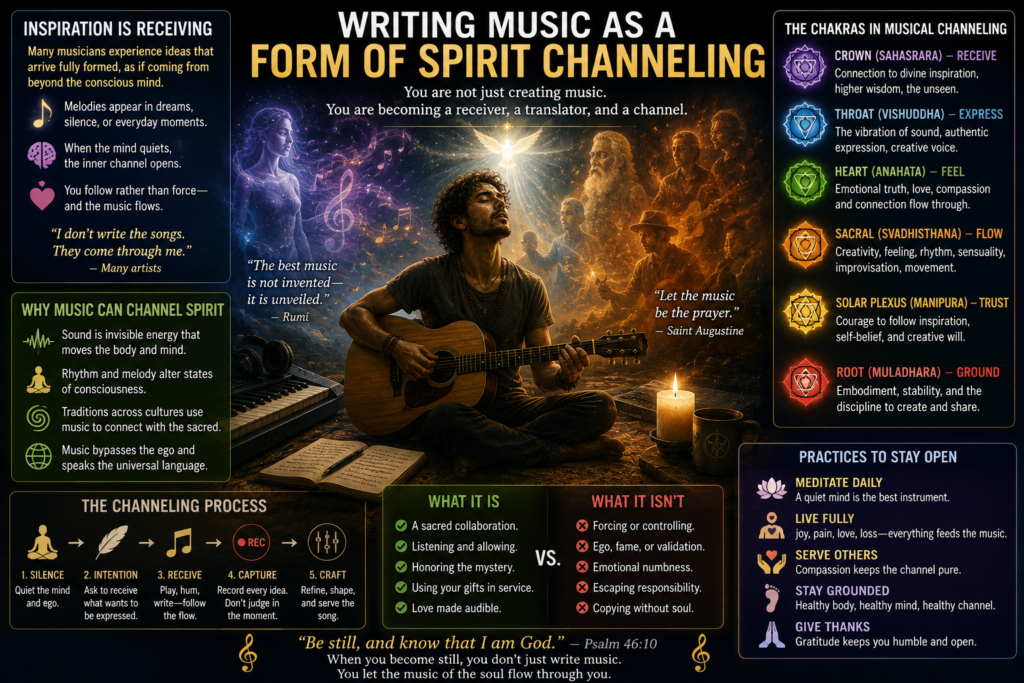
The Throat Chakra and Musical Channeling
In chakra symbolism, music is naturally associated with the throat chakra, Vishuddha.
The throat chakra relates to:
Expression.
Truth.
Communication.
Voice.
Creative transmission.
Authenticity.
When a musician channels something internally and turns it into sound, the throat chakra metaphor becomes especially appropriate.
Something exists inside consciousness.
It has no physical form.
Then through voice, instrument, rhythm, or composition, it becomes perceivable by others.
The invisible becomes audible.
That is essentially what artistic expression does.
A blocked throat chakra might symbolically appear as:
Fear of expressing yourself.
Constantly censoring ideas.
Imitating others instead of developing a voice.
Writing only what you believe an audience wants.
Being unable to communicate emotion.
A more balanced throat chakra allows the musician to ask:
What is actually trying to come through me?
The Crown Chakra: Receiving From Above
If the throat chakra expresses the music, the crown chakra can symbolize reception.
Sahasrara is associated with:
Higher consciousness.
Spiritual connection.
Transcendence.
Unity.
Inspiration.
Connection beyond the ordinary ego.
Artists sometimes describe musical inspiration using almost classic crown-chakra language.
“The song came down.”
“It was given to me.”
“I heard it in my head.”
“It arrived fully formed.”
“I don’t know where it came from.”
Symbolically, the crown receives and the throat expresses.
The creative channel becomes:
Inspiration → consciousness → expression → sound.
Whether that inspiration literally originates outside the individual cannot be proven.
But the energetic metaphor is remarkably coherent.
The Heart Chakra Gives Music Emotional Truth
Technical musicianship alone does not always create moving music.
A musician can play perfectly and communicate very little.
Another person may play something extremely simple and bring listeners to tears.
Why?
Because music does not communicate only structure.
It communicates emotion.
This brings in the heart chakra, Anahata.
The heart relates to:
Love.
Grief.
Compassion.
Longing.
Connection.
Vulnerability.
When the heart opens, music often becomes more emotionally honest.
A musician channeling grief after a loss may produce something they could never have written intellectually.
Someone deeply in love may suddenly understand melodies that previously felt inaccessible.
Emotion becomes information.
The heart does not necessarily decide the notes consciously.
It changes what the musician can hear internally.
The Sacral Chakra Creates the Flow
The sacral chakra, Svadhisthana, relates to:
Creativity.
Pleasure.
Flow.
Sensuality.
Emotion.
Improvisation.
Music strongly activates this centre.
Rhythm enters the body.
Melody moves.
Improvisation requires flexibility.
The musician responds rather than controls.
This is especially obvious in:
Jazz.
Blues.
Jam sessions.
Electronic improvisation.
Drumming.
Dance music.
Freestyle vocal performance.
The sacral chakra does not want creativity to become rigid.
It wants movement.
When spiritual inspiration enters through the crown, the sacral centre may help transform it into something alive rather than merely intellectual.
The Solar Plexus Determines Whether You Trust the Music
Inspiration may arrive, but another chakra decides whether you act on it.
The solar plexus chakra, Manipura, relates to confidence, willpower, self-trust, and personal power.
Imagine hearing a strange melody internally.
Your rational mind says:
“That is weird.”
“Nobody will like that.”
“That doesn’t fit the genre.”
“People will think this is stupid.”
The song disappears.
The channel may have been open.
But confidence was not.
A healthy solar plexus allows the musician to say:
“I don’t completely understand this yet, but I trust it enough to follow.”
This is important.
Channeling requires receptivity.
Artistic creation requires courage.
Music Can Feel Like Contact With the Dead
Another powerful dimension of music is its relationship with memory.
A song can instantly bring back someone who has died.
Their face.
Voice.
A room.
A time in life.
A relationship.
Sometimes a musician may write after losing someone and feel that the person is somehow present during the process.
A melody may seem connected with them.
A lyric may appear that feels like a message.
There is no reliable way to prove that the deceased person literally transmitted the song.
But spiritually, the experience can be meaningful without requiring certainty.
The dead continue existing psychologically within memory.
Their influence remains.
The phrases they used.
The emotions they created.
The values they transmitted.
The musician’s mind contains traces of that person.
So even from a non-supernatural perspective, the dead can continue “speaking” through art.
A spiritual interpretation simply takes the possibility further.
Dreams Can Become Musical Channels
Some musicians receive music in dreams.
This phenomenon is particularly interesting because dream consciousness operates differently from waking analytical thought.
A melody may appear complete.
Sometimes the artist wakes and rushes to record it before it disappears.
From a psychological perspective, the sleeping brain has continued processing musical material.
From a spiritual perspective, dreams have historically been treated as a space where ordinary boundaries of consciousness become thinner.
Perhaps dream composition is one of the clearest examples of why artistic channeling feels external.
The conscious ego did not seem to create the idea.
It woke up and found the idea waiting.
Improvisation Is Almost Pure Channeling
Improvisation provides perhaps the best laboratory for musical channeling.
During improvisation, there is no completed script.
The musician must respond moment by moment.
If they think too much, the performance becomes stiff.
If they stop listening, the connection breaks.
The ideal state is alert but relaxed.
Aware but not controlling.
This resembles meditation.
A thought arises.
You observe it.
A musical phrase arises.
You play it.
Another musician responds.
You respond again.
The composition is being created collectively in real time.
No individual completely controls it.
The music appears between the musicians.
That “between” is spiritually fascinating.
Groups Can Channel Something No Individual Could Create
Bands often experience this.
One musician plays a riff.
The drummer unexpectedly changes rhythm.
The bass responds.
The vocalist improvises.
Suddenly everyone realizes:
Something just happened.
Nobody individually planned it.
Yet the group created something coherent.
This can feel like a collective intelligence entered the room.
Psychology might call it coordination, shared attention, prediction, and musical synchrony.
Spiritually, it can feel like the group became one organism.
The individual egos temporarily relaxed.
The music became larger than any single member.
This resembles the spiritual idea of collective consciousness.
Why Ego Can Block the Channel
The strongest enemy of musical channeling may be excessive self-consciousness.
The ego asks:
Will this impress people?
Will this sell?
Will this go viral?
Does this sound sophisticated?
Am I technically good enough?
Is someone else better?
These questions may be useful later during editing or production.
But during the initial creative state, they can close the channel.
The creative mind requires permission to produce things before judging them.
A songwriter who edits every line before the next one arrives may interrupt the flow.
Spiritually, we could say the ego keeps stepping in front of the receiver.
Channel First, Edit Later
This creates a useful two-stage musical process.
Stage One: Channel
Receive.
Play.
Hum.
Write.
Record.
Do not judge too quickly.
Allow strange ideas.
Follow intuition.
Capture everything.
Stage Two: Craft
Edit.
Arrange.
Correct.
Rewrite.
Mix.
Remove weak material.
Add structure.
This balances intuition and intellect.
Pure channeling may create raw inspiration.
Craftsmanship makes that inspiration communicable.
The spirit may provide the spark.
The musician still has to build the fire.
Technique Makes You a Better Receiver
Spiritual inspiration does not eliminate the need for skill.
In fact, skill may increase your ability to translate inspiration.
Imagine receiving a complex musical idea but lacking the ability to play it.
The message is there.
The instrument is inadequate.
Musical training expands the vocabulary available to consciousness.
Harmony.
Rhythm.
Ear training.
Instrumental control.
Production knowledge.
These become channels through which inspiration can take form.
A skilled musician has more ways to translate whatever arrives.
This is similar to learning a language.
The deeper your vocabulary, the more precisely you can express an internal experience.
The Musician as Translator
Perhaps the musician is not merely a receiver.
Perhaps they are a translator.
Something arises that is initially beyond words.
An emotion.
Image.
Atmosphere.
Intuition.
Memory.
Spiritual sensation.
The musician translates it into:
Pitch.
Rhythm.
Harmony.
Tone.
Words.
Dynamics.
Silence.
The listener then translates the music back into inner experience.
This is extraordinary.
Something invisible passes from one consciousness to another through vibration.
That alone can feel spiritual.
Lyrics Can Feel Like Automatic Writing
Songwriting sometimes resembles automatic writing.
A phrase appears.
Then another.
The writer may not understand what the lyric means until later.
Months afterward, an event happens and suddenly the lyric seems prophetic.
This can make songwriting feel like channeling.
Again, caution is useful.
Human beings are exceptionally good at finding meaning retrospectively.
Not every mysterious lyric predicts the future.
But creative intuition can sometimes notice emotional patterns before conscious reasoning does.
The unconscious may understand something that the conscious mind has not yet articulated.
Spiritually, this can feel like receiving knowledge from somewhere beyond the ego.
Psychologically, it may be knowledge arising from deeper levels of the self.
Those explanations are not necessarily mutually exclusive for someone with a spiritual worldview.
Music Can Channel Archetypes
Some songs seem larger than the individual who wrote them.
They embody:
The warrior.
The lover.
The grieving mother.
The trickster.
The rebel.
The mystic.
The hero.
The destroyer.
The healer.
Carl Jung used the language of archetypes to describe recurring symbolic patterns appearing across human cultures.
Music can activate these patterns powerfully.
A musician may write a song that feels almost mythological without consciously trying.
Perhaps the artist has tapped into a pattern that has existed in human consciousness for thousands of years.
A spiritual interpretation might describe this as channeling a universal energy or spirit.
A psychological interpretation might describe it as archetypal material emerging from the unconscious.
Either way, the music feels bigger than biography.
Religious Music Was Always a Form of Channeling
Consider how many traditions use music to approach the divine.
Christians sing hymns.
Hindus practise bhajan and kirtan.
Buddhists chant sutras and mantras.
Sufis use devotional music.
Indigenous traditions employ drums and sacred songs.
Shamanic cultures use rhythm to alter consciousness.
Why does music appear so consistently?
Because music bypasses part of the analytical mind.
A theological statement must be understood intellectually.
A melody can affect you before you understand anything.
Music reaches the body and emotion directly.
That makes it uniquely suited to spiritual practice.
Repetition Alters Consciousness
Repeated rhythm and melody can produce trance-like states.
This is one reason spiritual music frequently uses repetition.
Mantras.
Drumming patterns.
Chanting.
Simple melodic cycles.
Repeated phrases.
The repetition gradually reduces ordinary discursive thought.
The listener stops analysing each repetition.
Consciousness settles into the rhythm.
At that point, music is no longer merely entertainment.
It becomes a technology of consciousness.
The musician generating the sound may enter the same altered state as the listener.
This creates ideal conditions for experiences interpreted as channeling.
Can Negative Spirits Be Channeled Through Music?
If someone accepts the possibility of spiritual channeling, the next question naturally appears:
Could music channel destructive energies as well?
Some traditions would say yes.
But this idea should be handled carefully.
Dark music does not automatically mean demonic influence.
Aggressive metal.
Industrial music.
Horror soundtracks.
Dissonance.
Angry lyrics.
These can simply be artistic explorations of fear, anger, shadow, trauma, or theatrical imagery.
The better spiritual question is:
What state of consciousness is the music cultivating?
Does creating it leave you:
More aware?
More integrated?
More honest?
More compassionate?
Or increasingly compulsive, hateful, paranoid, and psychologically destabilized?
The emotional effect may matter more than the genre.
Channeling Requires Discernment
If a musician genuinely believes inspiration comes from a spiritual source, discernment becomes important.
Not every inner voice deserves obedience.
Not every intense sensation is sacred.
Not every coincidence is a message.
A useful spiritual test is the fruit of the experience.
Does the inspiration produce:
Clarity?
Beauty?
Compassion?
Truth?
Healing?
Courage?
Deeper awareness?
Or does it produce:
Fear?
Grandiosity?
Obsession?
Hatred?
Compulsion?
The belief that you have been specially chosen above everyone else?
Healthy spirituality should make the artist more grounded, not less.
Do Not Romanticize Mental Instability
Artistic history sometimes celebrates the idea of the tortured genius.
The musician must suffer.
Use drugs.
Sleep badly.
Become manic.
Destroy relationships.
Then greatness will appear.
That mythology can be dangerous.
Altered states can sometimes coincide with creativity, but psychological instability is not a spiritual prerequisite for making meaningful music.
A healthy channel needs a healthy instrument.
Sleep.
Nutrition.
Exercise.
Grounding.
Relationships.
Silence.
Discipline.
These can improve creativity rather than destroy it.
Cannabis, Psychedelics, and Musical Channeling
Some musicians report feeling more connected with sound while using psychoactive substances.
Patterns may feel more intense.
Time perception changes.
Associations emerge more freely.
Music can feel spiritually alive.
But substances also alter judgment.
An idea that feels profound while intoxicated may sound ordinary later.
The safest principle is:
If the channel is real, you should eventually be able to access it sober.
Spiritual practice should expand consciousness, not make creativity dependent upon a chemical doorway.
Meditation, rhythmic repetition, breathwork, solitude, and deep musical practice can all alter consciousness without requiring intoxication.
Meditation Can Improve Musical Channeling
Meditation may be one of the most useful practices for musicians interested in channeling.
Sit for ten or twenty minutes before writing.
Allow mental noise to settle.
Do not decide what the song should be.
Then pick up the instrument.
Play the first thing that feels natural.
Follow it.
Do not immediately ask whether it is commercially useful.
This practice shifts the musician from manufacturing toward receiving.
The quieter the surface mind becomes, the easier it may be to notice subtle ideas underneath it.
A Simple Music Channeling Practice
Try this:
Step 1: Silence
Sit quietly for five to ten minutes.
No phone.
No music.
No external stimulation.
Step 2: Intention
Ask internally:
“What wants to be expressed today?”
Do not demand an answer.
Step 3: Open the Instrument
Play one note.
Then another.
Allow the sound itself to suggest what comes next.
Step 4: Record Everything
Do not rely on memory.
Capture the session.
Step 5: Do Not Judge Immediately
Wait.
Listen later.
Step 6: Ask What the Music Feels Like
Not:
“Is this technically impressive?”
Instead:
“What emotion or presence does this contain?”
Step 7: Develop the Strongest Material
Now bring the analytical mind back.
Structure what arrived.
This allows intuition and craftsmanship to work together.
You May Be Channeling Yourself
There is another possibility that is no less profound.
Perhaps the “spirit” being channeled is your deeper self.
Not the everyday social personality.
Not the person managing emails, bills, obligations, and reputation.
But the larger reservoir of memory, emotion, intuition, and unconscious intelligence beneath ordinary awareness.
Music may allow that deeper self to speak.
This explains why a person can write lyrics that reveal something they did not consciously know they felt.
The song becomes a message from one layer of the self to another.
That itself is a form of channeling.
You May Be Channeling the Collective
Music also emerges from culture.
Every musician carries thousands of previous sounds internally.
Songs heard in childhood.
Religious music.
Television themes.
Street sounds.
Parents’ records.
Club music.
National rhythms.
Advertising jingles.
Genres.
The musician’s brain contains a massive library.
During creativity, these influences combine in ways the conscious mind cannot trace.
A new song appears.
It feels mysterious because no single source explains it.
In that sense, the artist is channeling not only themselves, but the culture that formed them.
They become a point where thousands of previous musical lives converge.
You May Be Channeling Something Beyond Both
And then there remains the possibility that spiritual traditions have suggested for millennia:
Perhaps consciousness is not completely isolated.
Perhaps inspiration can occasionally emerge from something larger than individual psychology.
There is currently no reliable method for proving this.
But neither can the subjective experience simply be dismissed.
Artists throughout history have repeatedly described receiving rather than inventing.
Perhaps the wisest approach is neither blind belief nor automatic rejection.
Simply notice the experience.
Remain curious.
Stay grounded.
Let the music reveal what it becomes.
The Best Songs Often Surprise Their Creators
This may be the strongest evidence—not of spirits specifically, but of creativity exceeding conscious control.
An artist can intentionally attempt to write a masterpiece and fail.
Another day, while barely trying, something extraordinary appears.
This demonstrates an uncomfortable truth for the ego:
The conscious mind is not the only intelligence participating in creativity.
Something below, beyond, or around ordinary awareness is contributing.
Psychology calls it unconscious processing.
Spirituality may call it inspiration.
Artists call it the muse.
Whatever we call it, the experience is real.
The Artist’s Job Is to Become Available
Perhaps this is the deepest lesson.
You cannot command inspiration.
But you can make yourself available to it.
Practise the instrument.
Keep equipment ready.
Record ideas immediately.
Create quiet.
Meditate.
Read.
Live.
Love.
Travel.
Grieve.
Observe people.
Listen to other music.
Spend time in nature.
Develop technical ability.
Then when something arrives, you are ready.
This is similar to spiritual practice generally.
You cannot force enlightenment.
You can cultivate the conditions in which insight becomes more likely.
You cannot order the muse to appear.
But you can keep the door open.
Music as Prayer
A musician does not need lyrics mentioning God for the act of creation to become prayer.
Playing with complete presence can itself be devotional.
The musician disappears into the act.
Time disappears.
Ego quiets.
Attention becomes total.
For those minutes, there is no demand for reward.
Only creation.
That resembles prayer.
Prayer is not merely asking God for things.
At its deepest, prayer is becoming receptive.
Listening.
Offering.
Surrendering.
Music can do exactly that.
Music as Offering
A song can also be understood as an offering.
Not:
“Look how talented I am.”
But:
“Something beautiful passed through me, and now I give it to you.”
This changes the relationship between musician and audience.
The audience no longer exists merely to validate the artist.
The artist becomes a servant of the music.
The song matters more than the ego that produced it.
This may be one of the healthiest forms of artistic spirituality.
Conclusion: The Musician as Receiver, Translator, and Channel
Is writing music literally a form of spirit channeling?
We cannot establish that scientifically.
Musical inspiration can be explained through unconscious processing, memory, pattern recognition, emotion, improvisation, and flow states.
But those explanations do not eliminate the spiritual dimension of the experience.
Something fascinating happens when musicians create at their deepest level.
The ego becomes quieter.
Time changes.
Ideas arrive unexpectedly.
Emotion becomes sound.
Invisible inner experience becomes physical vibration.
One person’s consciousness enters another person’s consciousness through music.
That process is extraordinary even without supernatural assumptions.
And perhaps that is why musicians across cultures have repeatedly described inspiration as something received.
The crown chakra receives.
The heart gives the music emotional truth.
The sacral chakra creates flow.
The solar plexus gives courage to follow the idea.
The throat chakra expresses it.
The hands and voice translate it into the physical world.
The musician stands between worlds:
Silence and sound.
Emotion and form.
Invisible and visible.
Individual and collective.
Conscious and unconscious.
Perhaps spirit and matter.
Maybe the artist does not entirely write the song.
Maybe the artist meets the song halfway.
And perhaps the greatest skill in spiritual creativity is learning when to stop asking:
“What should I create?”
and instead becoming quiet enough to ask:
“What is trying to come through?”