
For many people, Christianity and church have become almost inseparable.
To seek Christ, they are told to attend church.
To understand Christ, listen to a priest or pastor.
To receive spiritual guidance, join a denomination.
To worship, enter a building.
To belong to Christ, become part of an institution.
Yet the figure of Jesus existed before Christianity became a global institution.
He prayed alone.
He withdrew into the wilderness.
He taught on hillsides.
He spoke beside lakes.
He ate with ordinary people.
He challenged religious authorities.
He told people that love of God and love of neighbour mattered more than outward displays of righteousness.
For someone who feels drawn to Jesus but alienated from organized Christianity, an important question therefore arises:
Can you connect with the spirit of Christ without belonging to a church?
Yes—at least in the sense that Christian spiritual practice does not require every encounter with Christ to be mediated through an institution.
Church communities can offer valuable things: fellowship, teaching, ritual, historical continuity, charity, accountability, and shared worship.
But the spiritual life described by Jesus also includes something intensely personal.
Prayer.
Silence.
Forgiveness.
Compassion.
Service.
Humility.
Transformation of the heart.
If someone wants to encounter what might be called the spirit of Christ, these qualities may be the most important place to begin.
First, What Does “The Spirit of Christ” Mean?
Different Christian traditions will define this differently.
Some Christians would understand the phrase literally through the Holy Spirit—the presence of God working within the believer.
Others might use it more symbolically to describe the consciousness, character, and way of life embodied by Jesus.
In practical terms, the spirit of Christ can be associated with:
- Compassion
- Mercy
- Forgiveness
- Courage
- Humility
- Love of enemies
- Service to the vulnerable
- Truthfulness
- Sacrifice
- Detachment from status
- Trust in God
- Inner transformation
Connecting with Christ therefore does not necessarily begin by mastering theology.
It can begin by asking:
What kind of consciousness did Jesus try to cultivate in people?
Jesus Frequently Left the Crowd
One of the most interesting things about Jesus is that he did not remain constantly surrounded by followers.
He repeatedly withdrew.
He went into the wilderness.
He prayed alone.
He sought quiet places.
This matters because modern religion can sometimes become extremely noisy.
Meetings.
Sermons.
Debates.
Denominational disagreements.
Religious politics.
Social pressure.
Arguments over doctrine.
Online apologetics.
Yet the inner spiritual life often develops in silence.
If you want to connect with Christ outside the church, one of the simplest practices is to deliberately create periods in which there is nobody between you and God.
No preacher.
No religious influencer.
No theological argument.
Just silence.
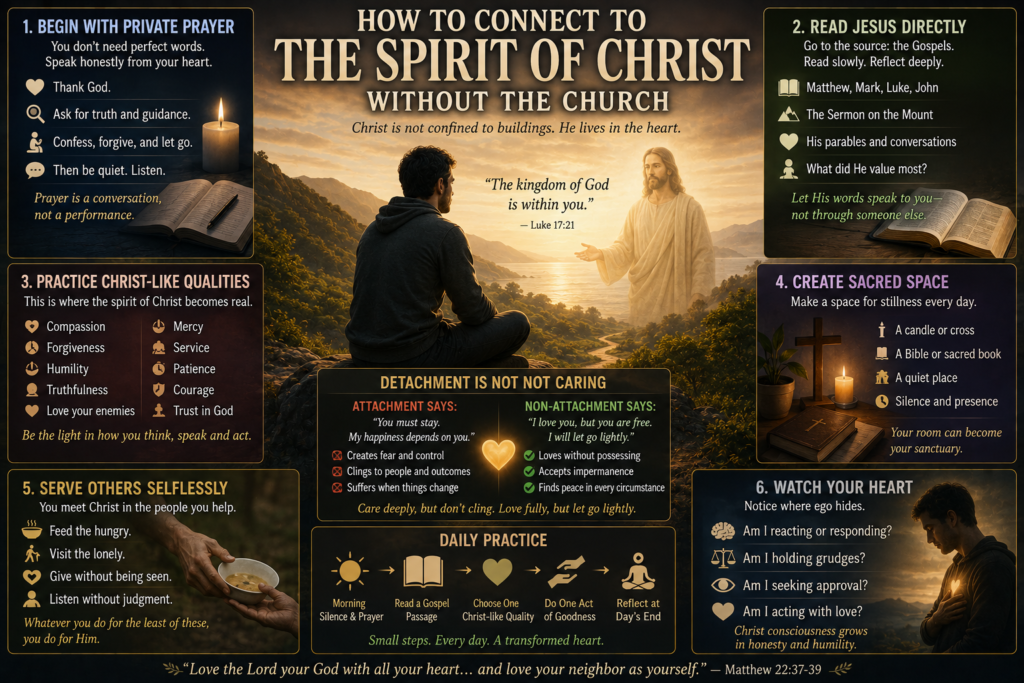
Begin With Private Prayer
Jesus himself emphasized private prayer.
Prayer does not require special language.
It does not need to sound impressive.
You do not need to speak in archaic religious vocabulary.
You can simply sit quietly and say:
God, help me understand what is true.
Christ, show me how to love better.
Help me see where ego is controlling me.
Help me forgive what I am carrying.
Help me recognize what I need to change.
Then remain silent.
Prayer does not always need to be continuous talking.
Sometimes the most meaningful part begins after you stop speaking.
Talk to Christ as Though He Is Present
For someone approaching Christianity experientially rather than institutionally, one practice can be surprisingly powerful:
Speak inwardly to Christ as though you were speaking to a trusted spiritual teacher sitting beside you.
Not necessarily because you must immediately settle every metaphysical question about how prayer works.
But because the exercise forces the mind to orient itself toward the qualities associated with Jesus.
Ask:
How would Christ want me to respond here?
Am I acting from love or ego?
Am I telling myself the truth?
Am I showing mercy where mercy is appropriate?
Am I allowing fear to control me?
Over time, this can become an inner spiritual compass.
Read Jesus Directly Before Reading About Jesus
A great deal of Christianity consists of people explaining Jesus.
Sometimes it is useful to bypass all of that temporarily and read the Gospel accounts directly.
Matthew.
Mark.
Luke.
John.
Read slowly.
Not as homework.
Not as an argument for or against Christianity.
Read as though encountering an unfamiliar spiritual teacher.
Ask:
What does he repeatedly emphasize?
Who makes him angry?
Who receives his compassion?
What does he say about wealth?
What does he say about hypocrisy?
What does he say about forgiveness?
What does he say about prayer?
What does he say about enemies?
What does he say about the poor?
What does he seem to care about most?
You may discover that the Jesus of the Gospels is sometimes more challenging—and more interesting—than the cultural version presented by religious institutions.
Focus on the Sermon on the Mount
If someone wanted a concentrated introduction to the spiritual consciousness of Jesus, the Sermon on the Mount is one of the best places to start.
Its teachings include:
Blessed are the merciful.
Blessed are the peacemakers.
Love your enemies.
Pray for those who persecute you.
Do good without performing goodness for attention.
Forgive.
Do not obsess over material insecurity.
Examine your own faults before condemning others.
Treat others as you would want to be treated.
These teachings do not require a church building to practise.
They require a life.
Love of Enemies Is Perhaps the Hardest Christ Practice
Many people love the comforting image of Jesus.
Far fewer practise his most difficult teachings.
One of the most radical is love of enemies.
This does not mean allowing abusive people unlimited access to you.
It does not mean eliminating boundaries.
It does not mean pretending harmful behaviour is acceptable.
It means refusing to allow hatred to transform you into the thing you oppose.
You can oppose someone.
Leave them.
Report wrongdoing.
Set boundaries.
Protect yourself.
And still refuse to cultivate obsessive hatred.
This is very close to Buddhist teachings on compassion and non-hatred.
Christ asks the practitioner to break the cycle.
Someone gives you hatred.
You do not automatically return hatred.
That is spiritual power.
Forgiveness Is a Direct Way to Practise Christ Consciousness
Few qualities are more strongly associated with Jesus than forgiveness.
But forgiveness is often misunderstood.
Forgiving does not necessarily mean:
Trusting again.
Reconciling.
Forgetting.
Removing consequences.
Allowing someone back into your life.
Forgiveness can simply mean:
I refuse to make this person’s action the permanent centre of my consciousness.
You release your attachment to revenge.
You stop mentally reenacting the wound.
You stop allowing another person’s past action to create new suffering inside you every day.
This is one of the clearest ways to connect with the spirit of Christ without any church involvement whatsoever.
Practise Compassion Before Theology
A person can know enormous amounts about Christian doctrine and still behave terribly.
Another person may know very little theology but quietly feed someone who is hungry, forgive an enemy, care for an elderly relative, and comfort someone who is grieving.
Which person is closer to Christ?
Christian traditions will answer doctrinal questions differently.
But Jesus repeatedly redirects attention toward how human beings actually treat one another.
If you want to connect with his spirit, begin with behaviour.
Help someone without advertising it.
Call someone lonely.
Give anonymously.
Defend someone being humiliated.
Feed someone.
Visit someone who is isolated.
Listen without immediately making the conversation about yourself.
Spirituality becomes real when compassion becomes behaviour.
Christ Consciousness and the Heart
In chakra language, Jesus is very naturally associated with the heart chakra.
The heart chakra represents:
- Love
- Compassion
- Forgiveness
- Emotional openness
- Selfless service
- Connection
- Mercy
- Unity
Christianity does not historically use chakra terminology, so this is an interpretive bridge rather than traditional Christian doctrine.
But the symbolism is powerful.
Jesus continually brings spirituality back to the heart.
Not merely outward ritual.
Not reputation.
Not public displays of holiness.
But what exists internally.
Resentment.
Mercy.
Pride.
Compassion.
Intentions.
Love.
From this perspective, connecting with Christ means opening the heart while also developing discernment.
Do Not Confuse Christ With Christian Culture
This distinction can be liberating.
Christian culture includes many things that developed historically around Jesus.
Denominations.
Architecture.
Clothing.
Music.
Political movements.
Institutional hierarchies.
Doctrinal disputes.
National traditions.
Some of these may be beautiful.
Some may be useful.
Some may be harmful.
But none should automatically be confused with Christ himself.
A person can reject a particular church and still remain interested in Jesus.
They can reject religious hypocrisy without rejecting compassion.
They can question institutions without abandoning prayer.
They can dislike Christian politics while still finding profound meaning in the teachings of Christ.
Separating Christ from the institution can sometimes make it easier to see him clearly.
Jesus Himself Criticized Religious Hypocrisy
This is important for people who left church because of hypocrisy.
Jesus was not gentle toward religious leaders who used spirituality for prestige, control, or moral superiority.
He repeatedly criticized outward holiness without inward transformation.
That does not mean he rejected religious community itself.
But he clearly rejected the idea that institutional status automatically makes someone spiritually advanced.
This distinction remains relevant.
A priest can be spiritually immature.
A person outside a church can be deeply compassionate.
Institutional membership and spiritual development are not identical.
Create a Personal Christ Practice
Without church structure, people sometimes drift because there is no rhythm to spiritual life.
So create one.
For example:
Morning
Sit quietly for five or ten minutes.
Read a short Gospel passage.
Ask:
What quality of Christ can I practise today?
Perhaps patience.
Forgiveness.
Courage.
Mercy.
Truthfulness.
During the Day
When something difficult happens, pause.
Ask:
What response keeps my heart clean?
Not:
What response makes me look weak?
What response wins?
What response punishes the other person?
But:
What response combines truth, compassion, and appropriate boundaries?
Evening
Review the day.
Where did ego control you?
Where did you act from fear?
Where did you show love?
Where could you have responded better?
Then release the day.
This can become a powerful spiritual discipline.
Meditation and Christ Are Not Opposites
Some Christians are suspicious of meditation because they associate it exclusively with Buddhism or Hinduism.
But Christian contemplative traditions have existed for centuries.
Silence.
Repetitive prayer.
Contemplation.
Watching thoughts.
Resting in the presence of God.
These practices appear throughout Christian mystical history.
A person interested in Buddhism can therefore practise meditation while also contemplating Christ.
Sit quietly.
Breathe.
Allow thoughts to arise and pass.
Then hold a simple phrase:
“Let me become more loving.”
or:
“Christ, open my heart.”
or:
“Not my fear, but truth.”
The technique may resemble meditation, but the spiritual orientation can be Christian.
Use the Jesus Prayer
Eastern Christianity developed a simple contemplative prayer:
“Lord Jesus Christ, have mercy on me.”
Traditionally it is repeated slowly, sometimes synchronized with breathing.
For someone seeking Christ outside institutional structures, this can function almost like a Christian mantra.
The repetition gradually quiets discursive thought.
The prayer moves from intellectual language toward feeling.
Even if you do not belong to an Orthodox church, the spiritual principle is easy to understand:
Bring the mind repeatedly back to humility, mercy, and Christ.
Spend Time in Nature
Church buildings can be beautiful.
But nature can also become sacred space.
Jesus taught outdoors constantly.
Mountains.
Lakes.
Fields.
Gardens.
The wilderness.
A quiet walk can become prayer.
Instead of headphones, allow silence.
Look carefully.
Trees.
Wind.
Sky.
Water.
Birds.
Your own breathing.
Then contemplate:
What if creation itself is enough of a sanctuary for this moment?
The point is not to reject churches.
It is to remember that God, if God exists, is not contained inside buildings.
Learn From Christian Mystics
If institutional Christianity feels too rigid, Christian mysticism may offer a very different doorway.
Mystics historically emphasized direct experience of God rather than mere intellectual belief.
Figures worth exploring include:
Meister Eckhart.
St. Teresa of Ávila.
St. John of the Cross.
Julian of Norwich.
The Desert Fathers and Mothers.
The author of The Cloud of Unknowing.
Brother Lawrence.
Thomas Merton.
Some of their writings can sound surprisingly familiar to people experienced in Buddhism or meditation.
Silence.
Emptiness.
Surrender.
Nonattachment.
Contemplation.
Dissolution of ego.
Presence.
The vocabulary differs, but the inner terrain sometimes overlaps.
Thomas Merton Is an Especially Useful Bridge
Thomas Merton was a Catholic monk deeply interested in contemplative dialogue with Buddhism and other Asian traditions.
He did not believe Christianity needed to become Buddhism.
Nor did he believe spiritual traditions had nothing to learn from one another.
For someone drawn simultaneously toward Christ and Buddhist practice, Merton can be especially useful.
He represents the possibility that Christian contemplation can become very deep without requiring hostility toward Eastern spirituality.
Connect With Christ Through Service
If prayer feels abstract, service makes it concrete.
Volunteer.
Feed someone.
Help an elderly neighbour.
Mentor someone.
Donate quietly.
Offer practical assistance.
Jesus consistently connects spiritual life with how people treat the vulnerable.
In that sense, one of the strongest ways to encounter Christ may be to go where compassion is required.
You may experience more of the spirit of Christ while helping someone who is suffering than while arguing online about Christianity.
Reduce Ego-Based Spirituality
There is a subtle danger in all religion:
Spirituality can become another ego identity.
“I am more awakened.”
“I understand Jesus better than church people.”
“I am spiritual but not religious.”
“I understand Buddhism and Christianity.”
“I see through institutional religion.”
These identities can become just another form of pride.
Christ repeatedly attacks spiritual pride.
So if you leave organized religion, do not replace church superiority with anti-church superiority.
The goal is not:
“I am spiritually better because I do not need a church.”
The goal is:
“I want to become more truthful, loving, and conscious.”
You Can Appreciate the Church Without Depending on It
Leaving institutional religion does not require hostility toward every church.
There are churches that genuinely provide:
Community.
Charity.
Beautiful ritual.
Music.
Education.
Support during grief.
Opportunities for service.
Historical continuity.
You can appreciate these things without believing your entire spiritual relationship with Christ depends upon them.
You may occasionally attend a service.
Visit a cathedral.
Light a candle.
Listen to sacred music.
Participate in Christmas or Easter.
And still maintain a primarily personal contemplative practice.
Spiritual life does not have to fit neatly into “church member” or “anti-church.”
The Eucharist Is a Different Question
For some Christians, especially Catholics and Orthodox Christians, sacramental life is central.
The Eucharist is not understood merely as symbolic community activity.
It is a sacred participation in Christ.
If someone accepts that theology, then complete separation from church institutions becomes more difficult because the sacraments are administered through the church.
But someone can still develop a deep personal relationship with Christ outside formal worship while deciding separately what they believe about sacramental theology.
The spiritual and institutional questions do not have to be resolved simultaneously.
Don’t Build Your Spirituality Only Around Emotion
Another danger is expecting to “feel Christ” constantly.
People sometimes believe spiritual connection must produce:
Warmth.
Tears.
Visions.
Goosebumps.
Peace.
Synchronicities.
Energetic sensations.
These experiences can be meaningful.
But spiritual practice should not become dependent upon them.
There will be days when prayer feels empty.
Meditation feels ordinary.
Nothing dramatic happens.
This does not necessarily mean the connection is gone.
Sometimes spiritual maturity develops through quiet repetition.
Christ Is Found in Behaviour More Than Sensation
A useful test may be:
Are you becoming more forgiving?
More courageous?
More honest?
Less obsessed with status?
Less hateful?
More compassionate?
Better at setting clean boundaries?
More willing to help others?
More capable of admitting when you are wrong?
If yes, then something Christ-like may be developing regardless of whether you experience dramatic spiritual sensations.
The fruit matters more than the performance.
The Buddhist-Christian Connection
For someone familiar with Buddhism, connecting with Christ does not necessarily require discarding everything Buddhist practice has taught.
There are significant differences between Christianity and Buddhism.
Christianity emphasizes God, creation, grace, Christ, resurrection, and relationship with the divine.
Buddhism emphasizes suffering, impermanence, non-self, dependent origination, karma, meditation, and liberation from samsara.
But there are also powerful points of contact.
Buddha:
Release hatred.
Christ:
Love your enemies.
Buddha:
Observe attachment.
Christ:
Do not make treasure the centre of your heart.
Buddha:
Cultivate compassion.
Christ:
Love your neighbour.
Buddha:
Reduce ego identification.
Christ:
Deny the egoistic self and serve.
Buddha:
Practise mindfulness.
Christ:
Remain spiritually awake.
These are not identical teachings.
But a person can use the similarities as bridges.
Christ and the Bodhisattva Ideal
There is also an interesting comparison with Mahayana Buddhism.
A bodhisattva dedicates themselves to relieving suffering and helping beings awaken.
Christ gives himself in service to others, extending compassion even toward enemies and those who reject him.
The theological explanations are completely different.
But spiritually, both archetypes embody:
I will not live only for myself.
That may be one of the deepest points where Buddhist and Christian spirituality meet.
Watch How You Treat Difficult People
If you want a direct test of your relationship with Christ, do not examine how spiritual you feel while meditating.
Examine how you behave when someone annoys you.
When someone insults you.
When someone disappoints you.
When someone cannot benefit you.
When someone socially ranks below you.
When someone makes a mistake.
That is where spirituality becomes visible.
It is easy to feel Christ-like while sitting peacefully alone.
The harder practice begins when the ego is challenged.
Use Boundaries Without Hatred
Christ-like compassion does not require passivity.
Jesus himself could be extremely direct.
He confronted hypocrisy.
He overturned tables in the Temple.
He refused manipulation.
He walked away from people.
So connecting with Christ does not mean becoming endlessly agreeable.
Compassion and boundaries can coexist.
You can say:
No.
You can leave.
You can refuse access.
You can oppose wrongdoing.
The challenge is doing it without allowing hatred to consume the heart.
Gratitude Can Become Christian Prayer
A simple gratitude practice can become a direct Christ-oriented spiritual exercise.
Every morning, name several things for which you are grateful.
Then instead of treating gratitude only as psychology, direct it toward God:
Thank you for another day.
Thank you for this body.
Thank you for food.
Thank you for people who care about me.
Thank you for the chance to correct yesterday’s mistakes.
Gratitude shifts consciousness from scarcity toward receptivity.
It can become worship without requiring a building.
Create Sacred Space at Home
You can create a simple contemplative space.
Perhaps:
A candle.
A cross.
An icon of Christ.
A Bible.
A meditation cushion.
A small plant.
Nothing elaborate is necessary.
The purpose is psychological as much as spiritual.
When you sit there, the mind learns:
This is where I stop performing and become honest.
You can pray.
Meditate.
Read.
Journal.
Reflect.
The space becomes a personal chapel.
Journaling With Christ
One unusual practice is to write a question and then answer it from the perspective of Christ’s teachings.
For example:
What am I afraid of?
Write honestly.
Then:
How would Christ ask me to respond?
Or:
Who am I refusing to forgive?
Where am I acting from pride?
Who needs compassion from me?
Where do I need stronger boundaries?
This is not claiming that every written thought is literally divine revelation.
It is a structured way of bringing Christ’s moral framework into your self-reflection.
Beware of Replacing Church Authority With Internet Authority
Leaving church can create another problem.
Instead of listening to one pastor, a person begins listening to twenty influencers.
YouTube preachers.
TikTok prophets.
Conspiracy channels.
Spiritual personalities.
Algorithmic theology.
The result may actually produce more confusion.
Direct spiritual practice requires discernment.
Read primary sources.
Think carefully.
Compare interpretations.
Notice fear-based manipulation.
Be suspicious of anyone who tells you that only they possess spiritual truth.
A healthy Christ connection should gradually increase freedom, not dependency on another personality.
The Inner Church
There is an ancient spiritual idea that the true temple is inward.
The external building can symbolize something internal.
A sanctuary of conscience.
Awareness.
Prayer.
Love.
Silence.
From this perspective, the deepest church is not made from stone.
It is the place inside you where ego becomes quiet enough for truth to be heard.
This does not invalidate external churches.
It simply prevents them from becoming the only possible doorway to spiritual life.
You May Eventually Want Community Again
Some people leave church because they need distance from unhealthy religion.
Years later, they may find a healthier community.
That is not failure.
Human beings benefit from spiritual companionship.
The key is not to join blindly.
Look for communities where:
Questions are allowed.
Leaders are accountable.
Fear is not used as control.
Money is handled transparently.
Compassion matters more than social status.
People are not pressured to surrender independent judgment.
Doubt is not treated as moral failure.
You may eventually discover that the problem was not community itself.
It was unhealthy community.
But Solitude Can Also Be Sacred
Other people may remain primarily solitary practitioners.
They pray.
Meditate.
Read scripture.
Serve others.
Visit sacred spaces occasionally.
Maintain friendships with spiritually serious people.
That can also become a meaningful path.
The essential question is whether solitude deepens the heart or becomes avoidance.
If isolation makes you increasingly compassionate, peaceful, disciplined, and honest, it may be serving spiritual growth.
If it makes you increasingly cynical, superior, suspicious, and disconnected, something may need correcting.
A Simple Daily Practice to Connect With Christ
Try this for thirty days.
Morning — Five Minutes of Silence
Sit.
Breathe.
Say internally:
“Christ, teach me how to love today.”
Remain quiet.
Read Five Minutes From the Gospels
Read slowly.
Choose one sentence that stands out.
Carry it with you.
Choose One Christ-Like Quality
For example:
Compassion.
Forgiveness.
Courage.
Humility.
Patience.
Generosity.
Perform One Invisible Act of Goodness
Do something beneficial that nobody needs to know about.
This directly weakens the ego’s desire for recognition.
Notice One Moment of Anger
Do not suppress it.
Observe it.
Ask:
Can I respond without multiplying suffering?
Evening Reflection
Ask:
Where did I act like Christ today?
Where did I act from ego?
Who do I need to forgive?
What should I do differently tomorrow?
Then release the day.
That is already a substantial spiritual practice.
No church building is required.
Conclusion: Christ Was Never Confined to a Building
Churches can preserve traditions.
They can offer community.
They can protect teachings.
They can provide ritual and continuity.
But no building owns Christ.
No denomination possesses a monopoly on compassion.
No institution can perform your inner transformation for you.
If you want to connect with the spirit of Christ outside the church, begin where Jesus repeatedly pointed:
The heart.
Silence.
Prayer.
Forgiveness.
Compassion.
Service.
Truth.
Humility.
Love of enemies.
Freedom from excessive attachment to money and status.
Care for people who are ignored.
Honesty about your own hypocrisy.
And trust in something greater than the ego.
You do not necessarily need to reject Christianity in order to move beyond institutional Christianity.
You may simply need to separate Christ from the machinery that accumulated around Christ.
Then encounter him again.
Not first as a denomination.
Not as a political identity.
Not as a cultural argument.
But as a spiritual teacher asking an extremely difficult question:
Can you become the kind of person who loves when hatred would be easier?
If you practise that seriously, you may discover that connecting with Christ was never primarily about entering a church.
It was about allowing the qualities associated with Christ to enter you.