
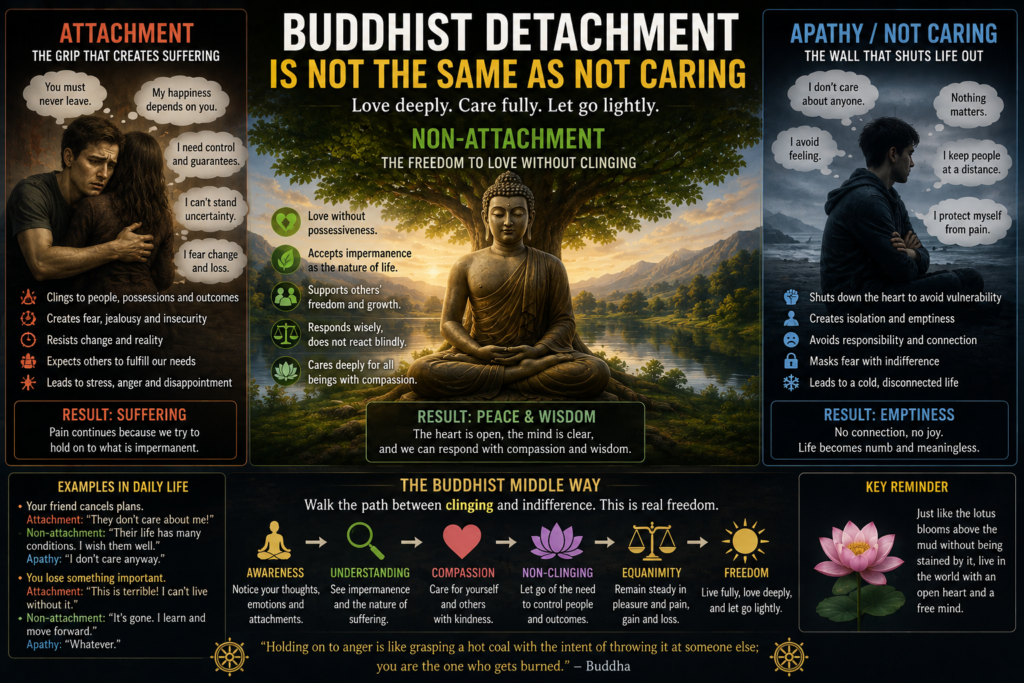
One of the most misunderstood ideas in Buddhism is detachment.
Someone hears that Buddhists are supposed to become detached and imagines a person who no longer cares about anything.
No attachment to relationships.
No attachment to possessions.
No attachment to success.
No attachment to pleasure.
No attachment even to life itself.
Taken superficially, Buddhism can begin to sound emotionally cold:
“If nothing is permanent, why care?”
But this is almost the opposite of what Buddhist practice is trying to produce.
Buddhist detachment does not mean becoming indifferent to life.
It means learning to care without clinging.
You can love someone deeply without believing you own them.
You can work hard without making your self-worth dependent upon success.
You can enjoy pleasure without becoming addicted to it.
You can grieve a loss without allowing that loss to destroy the rest of your life.
You can help another person without needing them to behave exactly as you want afterward.
The Buddhist ideal is therefore not emotional numbness.
It is love with freedom.
“Non-Attachment” Is Usually a Better Word
The English word detachment can create confusion because it often implies emotional distance.
Someone described as detached may appear:
Cold.
Uninterested.
Unresponsive.
Disconnected.
Emotionally unavailable.
That is not the Buddhist goal.
A better term is often non-attachment.
Non-attachment means that an experience can be present without the mind immediately trying to possess it, freeze it, control it, or build an identity around it.
You can enjoy something while recognizing:
This will change.
You can love someone while recognizing:
This person is not mine to control.
You can succeed while recognizing:
This achievement does not define my entire existence.
You can feel sadness while recognizing:
This emotion is real, but it is not permanent.
That is very different from saying:
“I do not care.”
Attachment Says, “You Must Stay”
Imagine two people in love.
Both may experience genuine affection.
But attachment adds another layer:
You must remain exactly as I need you to be.
You must continue loving me.
You must never change.
You must not leave.
My happiness depends upon you.
Now love has become mixed with fear.
The more important the person becomes, the more frightening change becomes.
Jealousy appears.
Control appears.
Anxiety appears.
Possessiveness appears.
The Buddhist problem is not the love.
It is the demand hidden inside the love.
Non-attachment says:
“I love you deeply, but I recognize that you are an independent being and that everything in life is impermanent.”
That love may actually become cleaner because less fear is mixed into it.
Not Caring Is Usually Avoidance
Sometimes people claim to be detached when they are actually protecting themselves from vulnerability.
They say:
“I don’t care what anyone thinks.”
“I don’t need anybody.”
“If someone leaves, whatever.”
“I don’t get attached.”
“I can cut people off instantly.”
This can look superficially Buddhist.
But psychologically, it may be the opposite.
The person may care enormously.
They simply do not want to feel the pain associated with caring.
So they shut the heart before anyone can hurt it.
That is not liberation from attachment.
It is attachment to emotional safety.
True non-attachment does not require closing the heart.
It allows the heart to remain open without demanding guarantees.
The Buddha Did Not Teach Indifference
Buddhism places enormous emphasis on compassion.
A tradition centred on not caring would make very little sense alongside teachings such as:
Metta — loving-kindness.
Karuna — compassion toward suffering.
Mudita — sympathetic joy at the happiness and success of others.
Upekkha — equanimity.
These four attitudes are traditionally called the Brahmaviharas, or sublime states.
Notice what is happening here.
Three of the four are explicitly relational.
Love people.
Care about suffering.
Celebrate other people’s happiness.
The fourth—equanimity—prevents those caring states from becoming unstable attachment.
That combination is crucial.
Buddhism does not say:
“Stop caring.”
It says:
“Care without losing your balance.”
Equanimity Is Not Apathy
Upekkha, often translated as equanimity, is particularly easy to misunderstand.
Apathy says:
“I don’t care what happens.”
Equanimity says:
“I care, but I will try to remain clear enough to respond wisely.”
Imagine a doctor treating an injured patient.
If the doctor feels absolutely nothing, that may be concerning.
But if the doctor becomes so emotionally overwhelmed that they cannot perform the treatment, compassion has become ineffective.
The ideal is:
Concern without collapse.
This is very close to Buddhist equanimity.
You remain human.
You feel.
But feeling does not destroy your ability to act wisely.
Detachment Can Actually Make Compassion Stronger
Attachment often makes compassion selective.
We care intensely about:
Our family.
Our partner.
Our tribe.
Our political group.
Our religion.
Our nation.
Our friends.
But we may feel nothing toward people outside those categories.
Why?
Because attachment often contains an element of mine.
My child.
My partner.
My people.
Buddhist compassion tries to expand beyond that.
A stranger’s suffering also matters.
An enemy’s suffering matters.
An animal’s suffering matters.
Someone you dislike can still be suffering.
This does not mean treating everyone identically.
It means recognizing that compassion need not depend entirely upon personal attachment.
In this sense, reducing attachment can actually increase caring.
The heart becomes less tribal.
Loving Someone Without Owning Them
This may be one of the clearest examples.
Attachment tends to treat love as possession.
“My girlfriend.”
“My husband.”
“My friend.”
“My child.”
The language is normal, but psychologically it can become dangerous when the word my starts implying ownership.
People change.
Children grow up.
Friends develop other friendships.
Partners need autonomy.
People sometimes leave.
Death eventually separates everyone.
Non-attachment means loving the person while remembering:
They are participating in my life, but they are not my property.
That understanding can reduce jealousy and control.
You appreciate the relationship more precisely because you understand it is not guaranteed forever.
Buddhism Does Not Ask You to Stop Grieving
If someone you love dies, Buddhist non-attachment does not require saying:
“Everything is impermanent, so I feel nothing.”
That would not necessarily indicate enlightenment.
It might indicate suppression.
Grief is a natural human response to losing someone important.
Buddhist practice instead asks us to understand grief.
There was love.
There was attachment.
There was expectation of continued presence.
Now conditions have changed.
Pain arises.
You observe it.
You allow it.
You do not need to create additional suffering by believing:
“This should never have happened.”
“Life can never be worthwhile again.”
“I refuse to accept reality.”
The first pain is loss.
The second layer is the mind’s resistance to loss.
Buddhism works heavily on that second layer.
You Can Prefer Something Without Clinging to It
Another misunderstanding is that Buddhists should have no preferences.
That would make ordinary life almost impossible.
You can prefer:
Good health over sickness.
A comfortable home over homelessness.
Kind people over abusive people.
Success over failure.
Pleasant weather over terrible weather.
A peaceful relationship over constant conflict.
Non-attachment does not mean pretending all outcomes are equally desirable.
It means understanding that your internal stability should not depend completely upon getting your preferred outcome.
You can say:
“I strongly prefer this.”
without adding:
“If I don’t get this, I cannot be okay.”
That difference is enormous.
Buddhist Detachment and Relationships
Relationships provide one of the best laboratories for non-attachment.
Suppose a friend becomes distant.
Attachment may produce:
“What did I do?”
“Why aren’t they paying attention to me?”
“Who are they spending time with instead?”
“How do I make them come back?”
“After everything I did for them, they owe me.”
Non-attachment asks something different:
Is the friendship still reciprocal?
Can I communicate honestly?
Can I appreciate what existed without forcing what no longer exists?
Can I let the person make their own choices?
Can I remain open to connection without chasing?
The detached response is not necessarily:
“Forget them. I never cared.”
It may be:
“I care about them, but I will not abandon my peace trying to control their behaviour.”
That is far more mature.
Detachment Is Particularly Important in Romantic Love
Romantic relationships often combine love with enormous attachment.
People become afraid of:
Abandonment.
Infidelity.
Replacement.
Loss of attraction.
Changing feelings.
Being alone.
These fears can create behaviours that damage the very relationship someone wants to preserve.
Checking phones.
Demanding reassurance.
Controlling friendships.
Constantly testing the partner.
Threatening separation.
Becoming jealous of every interaction.
Buddhist non-attachment attempts to remove the fear-driven grasping around love.
You can still value commitment.
You can still expect loyalty.
You can still establish boundaries.
You can still leave if betrayal occurs.
But your entire identity does not have to collapse if another person makes a choice you dislike.
You are committed without being spiritually owned by the relationship.
Detachment Does Not Mean Accepting Mistreatment
This distinction is extremely important.
People sometimes misuse spiritual teachings to tolerate behaviour they should stop tolerating.
“My partner lies, but I’m practising detachment.”
“My friend constantly disrespects me, but I shouldn’t judge.”
“My family manipulates me, but Buddhism says I should have compassion.”
That is not necessarily wisdom.
Non-attachment can actually make boundaries easier.
When you are less attached to maintaining a particular relationship, you can evaluate it more clearly.
You may realize:
I love this person, but I should not remain in this dynamic.
You do not need hatred to leave.
You do not need revenge.
You do not need to prove they are evil.
You simply recognize:
These conditions are unhealthy, so I will stop participating.
That can be a very Buddhist response.
Detachment From Outcomes
Another major area is work.
Suppose you build a business.
You should care.
You should make intelligent decisions.
You should work seriously.
But if your psychological state becomes completely dependent upon every metric, every customer response, every sale, and every fluctuation, work becomes suffering.
Non-attachment means:
Do the best work you can while recognizing that results depend upon many conditions.
Your actions matter.
Other people’s actions matter.
Markets matter.
Timing matters.
Chance matters.
Economic conditions matter.
You control only part of the causal chain.
So Buddhism encourages strong action without the illusion of total control.
This creates a strange combination:
High effort, lower anxiety.
The Bhagavad Gita Expresses a Similar Principle
Although the Bhagavad Gita belongs to the Hindu tradition rather than Buddhism, it contains a closely related teaching:
Perform action without becoming attached to the fruits of action.
This idea resonates strongly with Buddhist non-attachment.
Work.
Act.
Serve.
Create.
But do not allow the outcome to become your master.
You can care enormously about what you do without insisting that reality reward you exactly as expected.
Detachment From Praise and Criticism
Many people claim not to care what others think.
Yet one compliment can elevate them and one insult can ruin the day.
That means the mind remains attached to reputation.
Buddhist practice asks us to see praise and criticism as unstable.
People praise you today.
They misunderstand you tomorrow.
Someone thinks you are brilliant.
Someone else thinks you are foolish.
If your identity depends upon these evaluations, you become controlled by other people’s minds.
Non-attachment does not mean refusing feedback.
Useful criticism should be examined.
Praise can be enjoyed.
But neither needs to become your identity.
You ask:
Is there truth here?
Then respond accordingly.
Detachment From Being Right
This may be even more difficult than detachment from possessions.
People become enormously attached to opinions.
Politics.
Religion.
Spiritual beliefs.
Social interpretations.
Historical narratives.
Personal arguments.
Once an opinion becomes part of identity, disagreement feels like an attack on the self.
Then the person stops investigating reality and starts defending ego.
Buddhist practice encourages holding views more carefully.
You can have strong conclusions while remaining willing to revise them.
The important question becomes:
What is true?
rather than:
How can I prove that I was right?
That is intellectual non-attachment.
Detachment From the Self
Eventually Buddhism becomes more radical.
It does not only ask you to detach from possessions, relationships, and outcomes.
It asks you to investigate attachment to the idea of me itself.
My identity.
My reputation.
My personality.
My history.
My suffering.
My achievements.
My beliefs.
My body.
My story.
Buddhism’s teaching of anatta, or non-self, challenges the assumption that these changing components form a permanent independent entity.
This does not mean that you stop existing in ordinary practical terms.
It means that the self becomes less rigid.
You do not have to defend every part of your identity constantly.
This can create extraordinary psychological freedom.
“I Don’t Care” Can Actually Be Attachment to Ego
There is another paradox.
Sometimes the statement:
“I don’t care.”
is itself intensely ego-driven.
The person wants to appear:
Independent.
Strong.
Untouchable.
Superior.
Emotionally invulnerable.
They become attached to the identity of being someone who does not care.
Then anything that exposes vulnerability becomes threatening.
True non-attachment does not need to advertise itself.
You can simply care where caring is appropriate and release where release is appropriate.
The Middle Way Between Clinging and Indifference
Buddhism repeatedly emphasizes a Middle Way.
Regarding relationships and emotion, we can imagine two extremes.
Extreme One: Clinging
“I need you.”
“You cannot leave.”
“My happiness depends upon you.”
“I must control the outcome.”
“This must last forever.”
Extreme Two: Indifference
“I need nobody.”
“People don’t matter.”
“If you leave, I feel nothing.”
“I refuse to become vulnerable.”
“Nothing matters anyway.”
Buddhist non-attachment exists between these.
“I love you, but I do not own you.”
“I care, but I can survive change.”
“I will invest in this relationship without demanding permanence.”
“I will feel grief if it ends without turning grief into my identity.”
That is not emotional weakness.
It requires considerable inner strength.
A Lotus Is a Good Symbol for Non-Attachment
The lotus is one of Buddhism’s most famous symbols.
It grows from muddy water but rises above the surface.
The symbolism is often interpreted as purity emerging from difficult conditions.
But it also provides a useful metaphor for detachment.
The lotus does not need to destroy the mud.
It grows through it.
Similarly, Buddhist practice does not require fleeing the world.
You can have:
Relationships.
Money.
Responsibilities.
Ambitions.
Possessions.
Pleasure.
Family.
Work.
The question is whether you are buried inside them or capable of remaining conscious while participating in them.
The Difference Between Love and Need
Perhaps Buddhist non-attachment becomes easiest to understand through one simple distinction.
Love says:
“I want you to be well.”
Attachment says:
“I need you to behave in a way that keeps me comfortable.”
Love asks:
“What is good for you?”
Attachment asks:
“How do I keep you?”
Of course, real human relationships contain mixtures of both.
Nobody becomes perfectly non-attached overnight.
The practice is simply to notice when care becomes possession.
Detachment Can Make Love More Genuine
This seems paradoxical.
Wouldn’t being less attached make love weaker?
Not necessarily.
Imagine knowing that another person stays with you because they freely choose to rather than because you pressure them.
Imagine loving someone without constantly monitoring whether they might leave.
Imagine supporting their growth even when that growth does not directly benefit you.
Imagine appreciating someone today because you know life is temporary.
This can create a deeper form of love.
Attachment says:
“Do not change.”
Love says:
“I will try to meet you as you actually are.”
Buddhism Does Not Want You to Become a Stone
A stone is extremely detached.
It does not become jealous.
It does not crave money.
It does not fear death.
It does not become angry.
But it is also unconscious.
Obviously that is not enlightenment.
The goal of Buddhism is not to eliminate feeling by reducing consciousness.
It is to increase awareness so greatly that emotions no longer automatically control behaviour.
An enlightened being is traditionally portrayed as deeply compassionate, not emotionally dead.
The heart remains alive.
The grasping around the heart decreases.
Caring Without Carrying
A useful modern phrase might be:
Care without carrying everything.
Someone you love is suffering.
You help.
You listen.
You support.
But you cannot live their life for them.
You cannot make every decision.
You cannot force them to change.
Eventually their karma remains their own.
Non-attachment allows compassion without assuming total responsibility for another person’s existence.
This is especially important for people who habitually rescue others.
Compassion says:
“I will help where I reasonably can.”
Attachment says:
“I must fix you.”
The second can destroy both people.
Detachment From Other People’s Choices
Much suffering comes from wanting to control how others behave.
Why did they say that?
Why don’t they understand me?
Why do they keep making that mistake?
Why won’t they change?
Buddhist detachment eventually recognizes:
Other people possess their own causes, conditioning, desires, fears, and karma.
You can influence them.
You can communicate.
You can set consequences.
But you cannot operate their mind.
Accepting that reality can produce enormous peace.
It does not mean approving of everything they do.
It means recognizing where your control ends.
Boundaries May Become Easier With Non-Attachment
This is one of the least appreciated aspects of Buddhist detachment.
People often imagine detachment means tolerating everything.
In reality, attachment often makes boundaries harder.
You tolerate disrespect because you are afraid of losing the person.
You remain in a bad situation because you are attached to history.
You chase someone because you need their validation.
You forgive repeatedly because you cannot imagine life without them.
Non-attachment changes the equation.
You can say:
“I care about you, but I do not need this relationship badly enough to accept ongoing harm.”
That is both compassionate and strong.
The Buddhist Test: What Happens When Conditions Change?
You can often measure attachment by observing your reaction when circumstances change.
If someone stops praising you, what happens?
If money decreases, what happens?
If a relationship ends, what happens?
If your body ages, what happens?
If someone disagrees with your worldview, what happens?
If your plan fails, what happens?
Strong suffering often reveals where the mind had quietly made a contract with reality:
“This must remain the way I want it.”
Non-attachment gradually removes those invisible contracts.
Detachment Is Not Instant
Someone who studies Buddhism may understand all of this intellectually and still become devastated by rejection tomorrow.
That is normal.
Non-attachment is not a belief.
It is training.
Meditation allows us to watch desire arise.
Relationships expose attachment.
Loss exposes attachment.
Success exposes attachment.
Conflict exposes attachment.
Every event becomes an opportunity to observe the mind.
You gradually notice clinging earlier.
Then you release it slightly faster.
That is practice.
A Simple Meditation on Non-Attachment
Choose something or someone important to you.
Hold them gently in awareness.
Notice the affection.
Then silently acknowledge:
This person changes.
I change.
Our circumstances change.
Nothing guarantees how long this relationship will remain in its current form.
Then add:
Because it is temporary, I will appreciate it while it is here.
This is very different from pessimism.
Impermanence can increase gratitude.
If everything lasted forever, today would not feel precious.
The Ultimate Goal Is Freedom, Not Emotional Emptiness
The purpose of non-attachment is freedom.
Freedom to love without possessing.
Freedom to enjoy without becoming addicted.
Freedom to succeed without becoming arrogant.
Freedom to fail without becoming worthless.
Freedom to grieve without remaining permanently trapped in grief.
Freedom to help without controlling.
Freedom to leave when something becomes unhealthy.
Freedom to stay when staying is worthwhile.
Freedom to change your mind.
Freedom to let other people change theirs.
This is not the absence of caring.
It is caring without enslavement.
Conclusion: Buddhism Asks You to Care More Wisely
Buddhist detachment is not the same as not caring.
In many ways, Buddhism asks you to care more deeply.
But it asks you to remove the fear, ownership, ego, and control that often become mixed into caring.
Apathy says:
“Nothing matters.”
Attachment says:
“This matters so much that I cannot survive without controlling it.”
Buddhist non-attachment says:
“This matters to me deeply, and precisely because it matters, I will try to love it without imprisoning it.”
You can love while knowing love changes.
You can build while knowing everything eventually passes.
You can commit without pretending permanence is guaranteed.
You can feel deeply without surrendering control of your entire consciousness to every emotion.
You can care about another person’s suffering while recognizing that you cannot live their life.
You can protect your boundaries without hatred.
You can lose something and still continue living.
Perhaps the simplest distinction is this:
Not caring closes the heart.
Attachment grips the heart..
Buddhist non-attachment opens the heart—and then loosens the hand.
That is the balance Buddhism is trying.