
When people hear the word meditation, they often think immediately of Buddhism, yoga or modern mindfulness.
But Islam also developed a rich contemplative tradition, particularly within Sufism, the mystical dimension of Islam.
Sufi practice can include:
silent meditation,
repetition of the names of God,
attention to the heart,
awareness of the breath,
contemplation,
sacred music,
poetry,
movement,
service,
and—in the famous Mevlevi tradition—whirling.
Yet the purpose is not simply relaxation.
The central Sufi objective is remembrance of God.
The seeker attempts to move from a state of ghaflah—forgetfulness or spiritual heedlessness—toward increasing awareness of the Divine.
One of the most beautiful Sufi meditation instructions expresses this movement very simply:
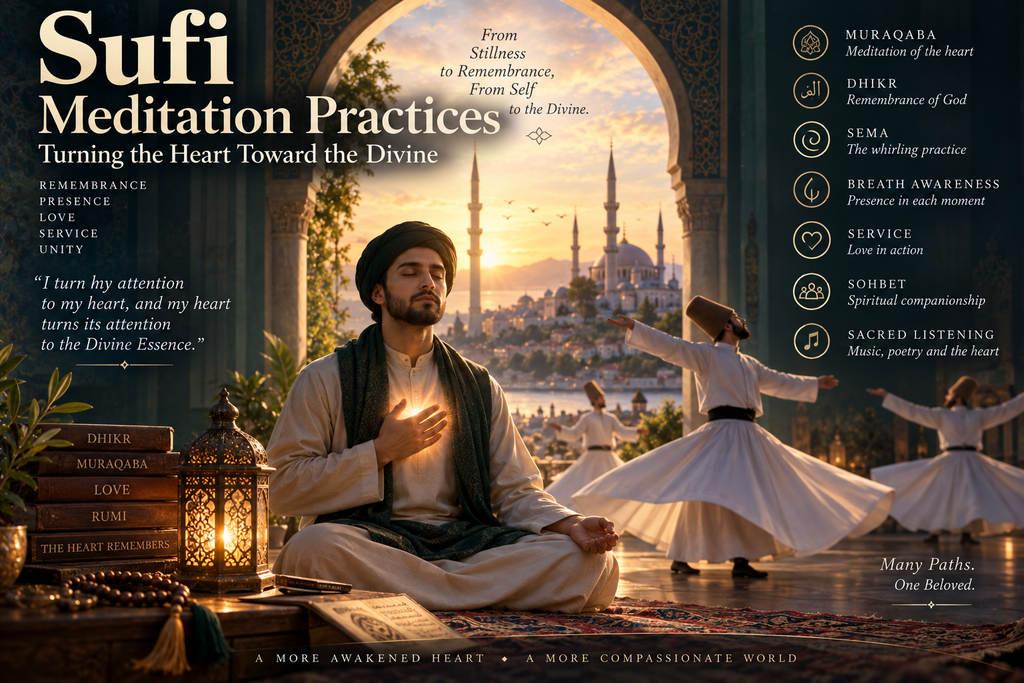
“I turn my attention to my heart, and my heart turns its attention to the Divine Essence.”
That sentence contains an entire philosophy of meditation.
You are not merely trying to empty your mind.
You are redirecting consciousness.
First inward.
Then upward—or perhaps more accurately, deeper.
The mind turns toward the heart.
The heart turns toward God.
And eventually the hope is that remembrance becomes so natural that the heart continues remembering even while the person goes about ordinary life.
Sufism Is Not One Single Meditation System
Before discussing techniques, it is important to understand that Sufism contains many orders and lineages.
Among them are:
Naqshbandi,
Qadiri,
Chishti,
Shadhili,
Mevlevi,
and many others.
Their practices overlap, but they are not identical.
Some emphasize silent remembrance.
Others perform vocal group dhikr.
Some use music extensively.
Some avoid it.
Some emphasize meditation of the heart.
Others emphasize recitation, breath, service, study or the relationship with a spiritual guide.
So there is no single universal “Sufi meditation technique.”
There is instead a family of practices aimed at the same basic transformation:
turning the human being away from forgetfulness and toward remembrance of the Divine.
Muraqaba: Sufi Meditation
The practice most directly comparable to what modern people call meditation is muraqaba.
The Arabic root carries meanings connected with watching, observing and maintaining vigilant awareness.
In Sufi practice, muraqaba involves becoming inwardly attentive to God.
A practitioner may sit quietly, withdraw attention from ordinary activities and turn awareness toward the Divine.
Different lineages teach this differently.
The School of Sufi Teaching, which teaches a Naqshbandi-Mujaddidi approach, describes muraqaba specifically as turning one’s attention away from worldly activity and toward the Divine Essence, beginning with meditation centered upon the heart.
This closely matches the formula:
“I turn my attention to my heart, and my heart turns its attention to the Divine Essence.”
That wording is especially associated with a heart-centered form of Naqshbandi-Mujaddidi meditation.
Is That Sentence a Mantra?
You could understandably call it a mantra because it functions as a mental formula before meditation.
But within an Islamic and Sufi context, intention—niyyah or niyyat—may be the more accurate concept.
The sentence is not necessarily meant to be repeated hundreds of times.
Instead, it establishes the direction of consciousness.
You are telling yourself:
This is where my attention is going.
The mind turns toward the spiritual heart.
Then the heart is allowed to orient itself toward God.
The sentence therefore acts almost like setting the compass before beginning the journey.
Why Turn Attention Toward the Heart?
Modern culture tends to locate consciousness almost entirely in the brain.
Sufi traditions frequently speak differently.
The qalb, the spiritual heart, is treated as an important center of spiritual perception.
This does not simply mean the physical organ pumping blood.
The heart represents the inward center capable of:
remembrance,
love,
intuition,
receptivity,
and knowledge of God.
Naqshbandi teachings describe wuquf qalbi—awareness of the heart—as directing the seeker’s heart toward the Divine Presence.
The practice is therefore not:
“Think harder about God.”
It is closer to:
“Allow the heart to become aware of God.”
That distinction is subtle but important.
The Mind Turns Toward the Heart
Consider the first half:
“I turn my attention to my heart…”
Ordinarily, attention is scattered.
It is thinking about:
work,
money,
relationships,
messages,
memories,
plans,
worries,
and everything happening outside.
The first movement of meditation is therefore a gathering.
Instead of letting awareness scatter in twenty directions, you bring it inward.
Not forcefully.
Not necessarily by trying to eliminate every thought.
You simply keep returning attention toward the heart.
The School of Sufi Teaching specifically warns that the objective is not aggressive concentration. The emphasis is on awakening the heart rather than fighting every thought that appears.
That can make Sufi meditation feel surprisingly gentle.
Thoughts appear.
You do not need to wrestle with them.
You return to the orientation.
Then the Heart Turns Toward the Divine Essence
The second half is more mysterious:
“…and my heart turns its attention to the Divine Essence.”
This changes the practice completely.
You are not merely observing your heart.
The heart itself becomes the observer.
The mind points toward the heart.
The heart points toward God.
And crucially, traditional teaching warns against turning God into a mental image.
The Divine Essence is understood as beyond physical form, color and ordinary conceptual qualities.
The practitioner therefore does not need to visualize God as:
a person,
a light,
a face,
or an object floating somewhere in space.
The intention is directed toward That which cannot be reduced to an image. The School of Sufi Teaching explicitly states that attention should be toward the Divine Essence rather than toward some imagined spiritual form or color.
That is a remarkably sophisticated meditation principle.
You Are Not Trying to Visualize God
This distinguishes muraqaba from many visualization practices.
If you try to imagine what God looks like, you have created a mental object.
But the entire Sufi understanding of the Divine is that God exceeds mental representation.
Therefore the practice becomes one of receptivity rather than construction.
You are not manufacturing an experience.
You are waiting.
Listening.
Turning.
Opening.
The emphasis becomes:
attention rather than imagination.
Waiting Is Part of Muraqaba
This is another major difference from achievement-oriented meditation.
Modern people frequently approach meditation like a workout:
I meditated for thirty minutes.
Did something happen?
Did I feel energy?
Did I reach a state?
Did my thoughts stop?
Sufi muraqaba can involve something closer to waiting before God.
You orient yourself toward the Divine and remain receptive.
Perhaps nothing dramatic happens.
That does not necessarily mean the meditation failed.
The spiritual discipline is simply remaining turned in the right direction.
This can be compared to sitting quietly with someone you deeply love.
You do not need conversation every second.
Presence itself becomes meaningful.
Dhikr: The Heart of Sufi Practice
If muraqaba is contemplation, perhaps the most universally recognizable Sufi practice is dhikr.
Dhikr means remembrance.
The practitioner remembers God through repeating sacred phrases or Divine Names.
Common forms include:
Allah
or
La ilaha illa Allah
—“There is no god but God.”
Some forms are spoken aloud.
Some are whispered.
Some are performed in groups.
Some are entirely silent.
Naqshbandi traditions are particularly famous for silent dhikr, while other Sufi orders may use powerful rhythmic vocal remembrance.
Naqshbandi teaching describes remembrance as something eventually centered within the heart itself.
Dhikr Is More Than Repetition
A person could repeat the word “Allah” thousands of times mechanically.
The Sufi objective goes deeper.
The goal is that the repetition eventually produces remembrance.
The tongue says the Name.
Then the mind remembers the Name.
Then the heart remembers.
Eventually, ideally, remembrance becomes less dependent on conscious repetition.
The person begins carrying awareness into ordinary existence.
This is why muraqaba and dhikr work beautifully together.
Dhikr gives attention something sacred to return to.
Muraqaba creates the receptive inner state in which that remembrance can deepen.
One source describing muraqaba makes essentially this distinction: dhikr provides remembrance, while muraqaba provides the quality of inward awareness accompanying it.
Silent Dhikr of the Heart
One of the most beautiful Sufi practices is silent remembrance.
You might sit quietly.
No one around you knows anything is happening.
Internally, the heart remembers:
Allah.
There is no need for dramatic movement.
No performance.
No external display.
This fits the famous Naqshbandi ideal sometimes described as “solitude in the crowd.”
The practitioner may participate fully in ordinary society while maintaining an inward orientation toward God.
You could be:
walking,
working,
shopping,
traveling,
or sitting among hundreds of people.
Externally, you remain in the world.
Internally, part of the heart remains turned toward the Divine.
That is a powerful spiritual idea.
Meditation Does Not End When You Stand Up
This may actually be the true objective.
Anyone can become peaceful in a quiet room.
The deeper question is:
Can remembrance continue when life resumes?
Can you maintain some inner awareness while:
someone irritates you,
your phone rings,
you become busy,
you experience attraction,
you become angry,
you earn money,
you deal with traffic?
A Sufi teaching on muraqaba describes the ideal as having the heart remain attentive to God even while the hands continue ordinary work.
That transforms meditation from an activity into a state of orientation.
Awareness of the Breath
Some Sufi traditions also work consciously with breathing.
Naqshbandi practice contains the principle known as hosh dar dam, often translated as awareness of the breath.
The principle is that the seeker should not allow breathing to occur entirely in heedlessness.
The breath becomes a reminder.
You inhale.
You remember.
You exhale.
You remember.
Not because breathing itself is worshipped, but because breath is constantly available.
As long as you are alive, the practice is available.
That makes breathing a natural anchor for remembrance.
Breath as a Spiritual Teacher
Every breath contains an obvious spiritual truth:
You do not permanently possess it.
You receive the breath.
You release the breath.
Another arrives.
Eventually one breath will be your last.
So conscious breathing naturally creates:
gratitude,
presence,
humility,
and awareness of mortality.
This makes breath-awareness compatible with one of Sufism’s deepest themes:
everything belongs ultimately to God.
La Ilaha Illa Allah as Contemplative Practice
Another powerful Sufi practice involves repeating:
La ilaha illa Allah.
Usually translated:
“There is no god but God.”
On one level, this is the central Islamic affirmation of Divine unity.
Mystically, however, Sufis can contemplate it very deeply.
La ilaha — there is no god.
Negation.
Everything falsely treated as absolute falls away.
Money.
Status.
Ego.
Desire.
Fear.
Possessions.
Identity.
Then:
illa Allah — except God.
Affirmation.
The Absolute remains.
Certain Naqshbandi dhikr methods explicitly emphasize this rhythm of negation and affirmation.
Spiritually, the phrase becomes almost like clearing the altar of the heart.
What have I placed there that does not belong there?
The Ego and Fana
This brings us to one of Sufism’s most famous mystical concepts:
fana.
Fana is often translated as annihilation or passing away.
It does not ordinarily mean physical destruction.
It refers to the diminishing or dissolution of the ego’s claim to independent existence.
Ordinary consciousness says:
I did this.
I possess this.
I control this.
I am important.
I am separate.
The Sufi path gradually challenges that orientation.
Eventually, in mystical language, the separate ego becomes less central before the reality of God.
The formula:
“I turn my attention to my heart, and my heart turns its attention to the Divine Essence”
contains the beginning of that movement.
Attention leaves the scattered ego.
It enters the heart.
Then the heart turns beyond itself.
Love Is the Engine of Sufi Meditation
Sufi spirituality is often described through love.
God is not merely something to be intellectually understood.
God becomes the Beloved.
That changes meditation.
You are not simply observing consciousness.
You are turning toward someone—or more accurately, toward the ultimate Reality—you love.
This is why Sufi poetry is full of language such as:
Beloved,
wine,
intoxication,
longing,
union,
separation,
and burning.
The language sounds romantic because human love provides one of the closest metaphors we possess for overwhelming spiritual longing.
Rumi and the Language of Longing
No figure represents this better in the Western imagination than Jalal al-Din Rumi.
Rumi’s poetry repeatedly transforms longing into spiritual practice.
The pain of separation becomes the desire to return to the Divine source.
This is why Sufi meditation sometimes feels less like detached observation and more like:
remembering someone you have forgotten but deeply love.
The heart is not merely becoming quiet.
It is becoming homesick.
Sema: The Whirling Dervish Practice
Then we come to perhaps the most visually famous Sufi practice:
whirling.
Images of white-robed dervishes spinning with one hand raised and the other lowered have become almost synonymous with Sufism.
But Sufi whirling is not simply:
“spin around until you enter a trance.”
The best-known form is the Mevlevi Sema, associated with the order that developed around Rumi’s spiritual legacy.
The Mevlevi Order describes Sema as a formal ritual in which every element has symbolic meaning and which is connected with service and spiritual discipline.
It involves:
music,
movement,
bowing,
turning,
symbolism,
and remembrance.
It is a ceremony, not merely an exercise.
Why Spin?
Whirling contains beautiful cosmic symbolism.
Everything in nature revolves.
Electrons were historically imagined as orbiting nuclei.
Planets orbit stars.
Moons orbit planets.
Galaxies rotate.
Seasons cycle.
The Earth itself spins continuously.
The dervish enters that imagery physically.
Instead of standing still as an isolated ego, the body becomes part of a larger movement.
The turning can symbolize the human being surrendering individual rigidity and entering the rhythm of creation.
One Hand Up, One Hand Down
The famous whirling posture also carries symbolic meaning.
One hand is traditionally opened upward.
The other extends downward.
The symbolism is often understood as:
receiving from the Divine and giving to creation.
The dervish does not hoard grace.
What is received flows through the person into the world.
That symbolism contains an important lesson:
Mysticism should produce service.
If your spiritual practice only makes you fascinated with your own mystical experiences, something is missing.
The point is not merely to receive.
It is to become useful.
Service Is Also a Sufi Practice
This sometimes gets overlooked because whirling, poetry and mystical states are more glamorous.
But many Sufi traditions emphasize khidma—service.
The Mevlevi Order explicitly places service among its central practices, presenting service as a way of learning humility and expressing interconnectedness.
Cook for people.
Help someone.
Clean.
Teach.
Support the community.
Carry something.
Listen.
Serve tea.
The ego wants to be spiritually important.
Service says:
Wash the dishes.
That may be one of the best spiritual corrections available.
Sohbet: Spiritual Conversation
Another Sufi practice is sohbet—spiritual conversation or companionship.
A teacher or group discusses:
the path,
spiritual challenges,
stories,
ethics,
God,
and everyday experience.
The Mevlevi tradition describes sohbet as discussion combined with deep listening through which teaching is transmitted.
This reminds us that spiritual practice is not always solitary.
Sometimes consciousness changes through company.
You sit with people who orient themselves toward the Divine.
Over time, their way of seeing affects yours.
Sama: Listening as Meditation
Sufism also developed the concept of sama, spiritual listening.
Music.
Poetry.
Chanting.
Qur’anic recitation.
Rather than treating sound as entertainment alone, the seeker listens for something that awakens remembrance.
A poem can become meditation.
A melody can open the heart.
A sung Divine Name can produce powerful concentration.
The important question is not merely:
“Do I like this music?”
but:
“What does this awaken in me?”
The Lataif: Subtle Centers of Consciousness
Some Sufi systems, particularly certain Naqshbandi-Mujaddidi teachings, work with lataif, subtle centers of consciousness.
The singular is latifa.
These can be compared loosely—though never perfectly—with concepts such as chakras.
The heart, qalb, is particularly important.
The School of Sufi Teaching describes a system of subtle centers in which the heart is central to the beginning stages of contemplative practice.
The purpose is not necessarily manipulating “energy” in the modern New Age sense.
The lataif function more as subtle capacities of spiritual perception and transformation within that Sufi framework.
Why the Heart Formula Is So Powerful
Now return to the sentence:
“I turn my attention to my heart, and my heart turns its attention to the Divine Essence.”
Notice the sequence.
Step 1: “I turn my attention…”
You exercise intention.
Instead of allowing consciousness to wander automatically, you choose its direction.
Step 2: “…to my heart…”
You move from conceptual thinking toward the deeper center of feeling, intuition and spiritual receptivity.
Step 3: “…and my heart turns…”
Something subtle happens.
You are no longer doing everything through mental effort.
The heart itself begins participating.
Step 4: “…its attention to the Divine Essence.”
The goal is no longer self-observation.
It is transcendence of self-reference.
The heart faces God.
That sequence beautifully describes the movement from:
mind → heart → Divine.
The Phrase Is an Intention, Not a Magical Spell
This is important.
The words themselves do not mechanically produce spiritual realization.
If they are recited while your attention remains completely elsewhere, they are merely words.
The phrase establishes niyyah.
Intention.
Direction.
Orientation.
It is essentially saying:
“This is where I am going.”
The practice then consists of patiently remaining oriented there.
What If Thoughts Keep Coming?
They almost certainly will.
You remember something embarrassing.
You think about food.
You plan tomorrow.
You replay a conversation.
You wonder whether the meditation is working.
This does not necessarily mean anything has gone wrong.
In some Naqshbandi-Mujaddidi approaches, practitioners are explicitly told not to become preoccupied with eliminating every thought. The emphasis remains upon turning toward the Divine and allowing the heart gradually to awaken.
The practice becomes very simple:
wander,
notice,
return.
Wander,
notice,
return.
Again and again.
A Simple Heart-Centered Sufi Meditation
If you have already been taught the practice within your lineage, your teacher’s instructions should take priority.
But conceptually, the method can be understood like this.
Sit comfortably.
You do not necessarily need an elaborate posture.
Allow the body to become still.
Close or lower the eyes if that helps.
Then establish the intention:
“I turn my attention to my heart, and my heart turns its attention to the Divine Essence.”
Allow attention to rest inwardly around the spiritual heart.
Do not imagine God as an object.
Do not force thoughts away.
Do not chase sensations.
Simply remain receptive.
If thoughts pull you away, gently return.
You may silently remember:
Allah.
Or remain wordlessly attentive, depending on the method you have been taught.
Then finish with gratitude or prayer.
The School of Sufi Teaching describes its introductory heart-centered muraqaba as a quiet sitting lasting roughly 35–45 minutes, although practice length and method vary considerably among Sufi lineages.
Do Not Become Obsessed With Sensations
Some practitioners report:
warmth,
movement,
tingling,
lightness,
peace,
or other sensations around the heart during muraqaba. Such reports are explicitly mentioned within contemporary Naqshbandi-Mujaddidi teaching material.
But sensations are not necessarily the objective.
A tingling chest does not mean you have reached sainthood.
A meditation with no sensation does not mean nothing happened.
This parallels other contemplative traditions.
Interesting experiences occur.
Observe them.
Do not build an identity around them.
The Sufi destination is God-consciousness, not collecting spiritual special effects.
Dhikr While Walking
A very accessible practice is remembrance while walking.
Walk naturally.
Allow breathing to become steady.
Silently repeat:
Allah
or another dhikr appropriate to your practice.
Notice your feet.
Notice your breath.
Notice your surroundings.
But maintain a thread of remembrance.
Eventually you discover that spiritual practice does not require withdrawing completely from physical life.
You can remember while moving.
Dhikr Before Sleep
The period before sleep is another natural contemplative window.
The external world is becoming quieter.
The day’s obligations are finished.
Instead of filling the final minutes with social media, you can turn inward.
Repeat the Divine Name gently.
Let attention settle into the heart.
Then sleep.
In that sense, remembrance becomes the last direction consciousness takes before entering dreams.
Muraqaba and Buddhist Meditation: Similar but Different
Someone familiar with Buddhism may notice similarities.
Both practices can involve:
stillness,
attention,
observing thoughts,
reduced identification with mental chatter,
and long periods of silence.
But their theological orientation differs significantly.
Many Buddhist meditation systems investigate:
impermanence,
suffering,
non-self,
emptiness,
or the nature of awareness.
Sufi muraqaba is explicitly theocentric.
The final object is not simply consciousness itself.
It is the relationship between consciousness and God.
The practitioner is not merely becoming aware.
The practitioner is becoming aware of the Divine Presence.
Sufi Meditation Is a Practice of Relationship
This may be the most important distinction.
Sufism frequently treats spiritual practice as a relationship.
The seeker.
The Beloved.
The heart.
The remembrance.
The longing.
The return.
Meditation is therefore less like observing a laboratory specimen and more like turning toward someone deeply loved.
The question becomes:
How much of my attention belongs to everything except the One I claim to love most?
That can become a powerful spiritual examination.
From Meditation to Constant Remembrance
Ultimately, sitting meditation is training.
The deeper objective is continuous remembrance.
At first:
You meditate for twenty minutes.
Then forget God for ten hours.
Eventually perhaps:
you remember during work,
during walking,
during meals,
during conversations,
during difficulty.
The outer activity continues.
But the inner compass remains oriented.
This is why Naqshbandi teachings place such emphasis on remembrance amid ordinary life.
The spiritual achievement is not escaping society permanently.
It is remaining inwardly connected while living within it.
Perhaps That Is the Meaning of the Heart Turning
At first, you turn your attention to the heart.
That requires effort.
You remember the instruction.
You sit down.
You deliberately redirect attention.
But after sufficient practice, perhaps something changes.
Instead of constantly forcing the heart toward God, the heart develops its own tendency to turn there.
Like a compass needle returning north.
The practice becomes less:
“I must remember God.”
and more:
“Something in me naturally remembers.”
That may be the deeper promise contained inside the sentence you learned:
“I turn my attention to my heart, and my heart turns its attention to the Divine Essence.”
At first, the mind leads the heart.
Eventually the heart may begin leading the person.
And perhaps that is what Sufi meditation is ultimately trying to accomplish.
Not simply creating a peaceful mind.
Not producing mystical sensations.
Not escaping ordinary life.
But awakening a heart whose natural orientation has changed.
A heart that remembers.
A heart that loves.
A heart that receives.
A heart that serves.
A heart that can remain in the marketplace while facing somewhere deeper.
In Sufi language, the path is not merely about thinking about God.
It is about gradually becoming the kind of person for whom forgetting God becomes more difficult than remembering Him.