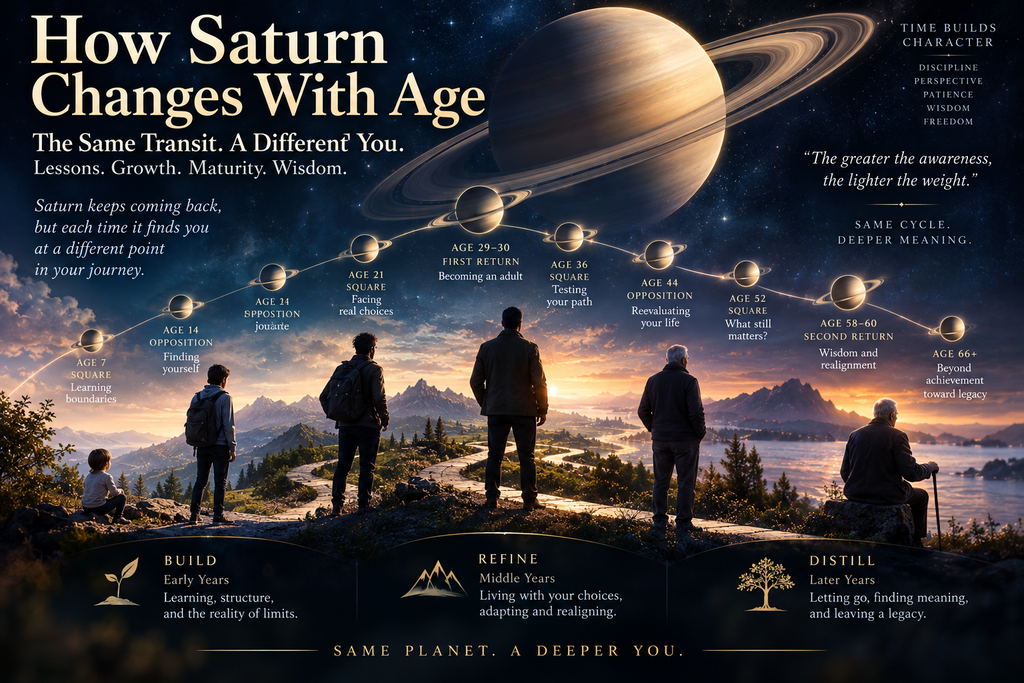
One of the most fascinating things about Saturn in astrology is that it keeps coming back.
Saturn takes about 29.4 Earth years to orbit the Sun, which creates the famous Saturn-return cycle.
But the Saturn return is only one part of a much larger pattern.
Throughout a lifetime, Saturn repeatedly makes:
conjunctions,
squares,
oppositions,
and other aspects
to the same planets in your birth chart.
A Saturn square you experience in your twenties may return in a different form in your early fifties.
A Saturn opposition experienced around age fourteen can return around forty-four.
Your natal Saturn itself receives its first return around age 29, its second around 58–59, and—if you live long enough—its third around 88.
Astrologically, the geometry repeats.
But you do not.
That may be the key to understanding how Saturn changes with age.
The first time Saturn brings a lesson, it may feel like something the world is doing to you.
The second time, you often recognize the pattern and have considerably more authority over how you respond.
By the third cycle, Saturn may become less about building a life and more about deciding what remains when everything unnecessary is stripped away.
In that sense, perhaps Saturn itself does not change.
Our relationship with Saturn changes.
Saturn Is the Planet of Time
This is especially appropriate because Saturn is traditionally associated with:
time,
age,
limits,
responsibility,
discipline,
consequences,
structure,
authority,
patience,
maturity,
and mortality.
No other major astrological archetype is so closely connected with the experience of getting older.
Saturn frequently asks:
What lasts?
What is real?
What have you built?
What are you responsible for?
What can no longer be postponed?
What happens when there are consequences?
These questions mean something very different at twenty-two than they do at fifty-two.
That is why the same Saturn aspect cannot be interpreted exactly the same way every time it returns.
The Saturn Cycle: Roughly Seven-Year Chapters
Because Saturn takes approximately 29.4 years to orbit the Sun, the major quarter points of its cycle occur roughly every seven years.
Astrologers commonly associate the cycle with approximately:
Age 7 — Saturn square Saturn
Age 14–15 — Saturn opposition Saturn
Age 21–22 — Saturn square Saturn
Age 29–30 — First Saturn return
Then the cycle begins again:
Age 36–37 — Saturn square Saturn
Age 43–45 — Saturn opposition Saturn
Age 51–52 — Saturn square Saturn
Age 58–60 — Second Saturn return
And again:
Age 66–67 — Saturn square Saturn
Age 73–74 — Saturn opposition Saturn
Age 80–82 — Saturn square Saturn
Age 88–89 — Third Saturn return
The exact ages vary because Saturn’s apparent motion is not perfectly uniform from Earth’s perspective and retrograde motion can create several exact contacts during a single transit.
Astrological writers have long treated these quarter-cycle passages as developmental thresholds rather than viewing only the Saturn return as important.
First Saturn Cycle: Learning What Reality Is
The first Saturn cycle, from birth until roughly age thirty, is largely concerned with constructing the individual.
You begin life with very little personal authority.
Other people provide Saturn for you.
Parents tell you:
Go to bed.
Do your homework.
You cannot do that.
You have to go to school.
Teachers impose deadlines.
Society imposes rules.
Eventually employers, institutions and financial realities enter the picture.
During the first Saturn cycle, Saturn frequently appears as external authority.
You are learning that reality contains limits.
You cannot simply want something and automatically receive it.
Actions have consequences.
Time is finite.
Skills require repetition.
Money has to come from somewhere.
Other people will judge your competence.
This is Saturn 101.
Age Seven: The First Saturn Square
Around age seven, Saturn makes its first square to its natal position.
Astrologically, this has traditionally been associated with an early confrontation with structure and responsibility.
Children around this period become increasingly aware that life has rules.
School becomes more serious.
Performance can be measured.
Adults expect more.
The child begins discovering:
“I cannot simply exist. I am expected to do things.”
Saturn is still largely outside the child.
Parents and teachers represent authority.
Age Fourteen: The First Saturn Opposition
Around fourteen or fifteen comes the first Saturn opposition.
This coincides symbolically with adolescence.
Now something fascinating happens.
The person has begun developing their own authority, but external authority is still extremely powerful.
Hence the classic teenage conflict:
“You can’t tell me what to do.”
Parents say:
Actually, we still can.
Astrologically, the opposition represents tension between:
external authority and emerging internal authority.
An Astro.com discussion of the Saturn cycle describes the first opposition in precisely this developmental sense—the adolescent beginning to confront external restrictions while glimpsing their own future adult authority.
Age Twenty-One or Twenty-Two: Reality Arrives
The waning Saturn square around twenty-one or twenty-two can feel very different.
Now adulthood is becoming real.
Perhaps university is ending.
Perhaps work begins.
Maybe rent must be paid.
Relationships become more serious.
Choices start producing long-term consequences.
The question moves from:
“What kind of adult will I be?”
to:
“What am I actually doing with my life?”
The world becomes less hypothetical.
Then Saturn continues toward the famous first return.
The First Saturn Return: Approximately 29–30
The first Saturn return occurs when transiting Saturn reaches approximately the same zodiacal position it occupied at your birth.
Astronomically, the timing derives from Saturn’s roughly 29.4-year orbit.
Astrologically, this is often interpreted as the transition into full adult authorship.
Before thirty, you can often still feel as though life is something you are preparing for.
After the first Saturn return, that excuse becomes harder to maintain.
You begin asking:
Is this really my career?
Is this relationship going somewhere?
Where am I living?
What have I built?
What am I committing to?
Which ambitions were actually mine?
Which ones came from my parents?
What isn’t working anymore?
The first Saturn return can therefore coincide with:
career changes,
marriage,
divorce,
moving,
financial restructuring,
taking responsibility,
leaving immature situations,
or committing seriously to a path.
It does not necessarily produce dramatic external events.
The deeper symbolism is:
the transfer of authority from the outside world to yourself.
Saturn stops being merely your father, boss, teacher or society.
Saturn increasingly becomes your own internal authority.
Then Saturn Starts Going Around Again
This is where Saturn becomes much more interesting.
After your first Saturn return, the planet does not disappear.
It begins the same cycle again.
The same mathematical aspects will eventually recur.
But now you have already lived through one entire Saturnian year.
You possess something you didn’t have before:
experience.
This changes the interpretation enormously.
The Second Saturn Cycle: Living With Your Own Decisions
The first cycle asks:
“What kind of life will you build?”
The second cycle increasingly asks:
“How well is the life you built actually working?”
That is a very different Saturn.
Suppose you chose a career around thirty.
At thirty-seven, Saturn may test how sustainable it is.
At forty-four, you may seriously confront whether that path still reflects who you are.
At fifty-two, you may begin eliminating what no longer deserves your remaining time.
Then around fifty-nine comes the second Saturn return:
What has thirty years of adulthood actually produced?
Saturn is no longer asking a beginner.
Saturn is auditing an experienced adult.
Why the Second Saturn Square Is Different From the First
Compare the Saturn squares.
Around age 21–22, you may experience:
“I need to figure out what I’m going to do.”
Around age 51–52, the question can become:
“Do I actually want to continue doing what I’ve been doing?”
Same Saturn-Saturn square.
Completely different stage of consciousness.
At twenty-two, the anxiety may involve lack of structure.
At fifty-two, the anxiety may involve too much structure.
At twenty-two:
“How do I build a career?”
At fifty-two:
“Is my career imprisoning me?”
At twenty-two:
“Who will I become?”
At fifty-two:
“How much time do I really have left to become who I wanted to be?”
Astrological commentary on the second waning Saturn square often emphasizes aging, mortality, changing professional roles and the realization that young adulthood itself is ending.
The aspect repeats.
The existential question evolves.
The Second Saturn Opposition: Around 43–45
This may be one of the most psychologically interesting Saturn phases.
Remember the first opposition around fourteen?
You were confronting your parents’ authority.
Around forty-four, the opponent can become much more subtle.
Now you may confront the adult identity you created for yourself.
You became:
the lawyer,
the businessman,
the mother,
the engineer,
the husband,
the dependable employee,
the successful professional.
And suddenly part of you asks:
“Is this actually me?”
This is why the Saturn opposition in the forties can overlap symbolically with the broader phenomenon popularly called the midlife crisis.
The first Saturn opposition says:
“My parents don’t understand who I am.”
The second may say:
“I’m not sure the person I became understands who I am.”
That is Saturn at a higher octave of experience.
The Second Saturn Return: Approximately 58–60
The second Saturn return is profoundly different from the first.
At twenty-nine, Saturn asks:
“What are you going to build?”
At fifty-nine, Saturn may ask:
“What did you build—and was it worth building?”
By this point, many people have experienced:
career successes and failures,
long relationships,
breakups,
parenthood,
death of older relatives,
financial cycles,
health changes,
and the accumulated consequences of decades of choices.
Saturn is no longer teaching the concept of consequence.
You have lived consequences.
That makes the second return potentially less shocking but more profound.
Astrological writers sometimes describe it as a kind of “second adulthood,” because another major restructuring of identity can occur around 58–60.
The questions may become:
What do I still need?
What responsibilities can I release?
What do I want the next thirty years to mean?
Do I continue working?
What happens when my children no longer need me?
Who am I without my professional title?
What does aging mean to me?
What unfinished business remains?
Where is my time best spent now?
The first return establishes adulthood.
The second can establish eldership.
First Return: Building the Structure
The first Saturn return often says:
Build it.
Commit.
Choose.
Accept responsibility.
Become competent.
Create foundations.
Second Return: Inspecting the Structure
The second Saturn return can say:
Now inspect what you built.
Does this marriage still contain life?
Does this career still matter?
Do these possessions serve you?
Do these ambitions still mean anything?
Which responsibilities remain genuinely yours?
What can be simplified?
You may discover that the mature expression of Saturn is no longer adding structure.
Sometimes it is removing unnecessary structure.
That is important.
People sometimes associate Saturn exclusively with limitation and accumulation of responsibility.
But old Saturn can become extraordinarily minimalist.
Saturn eventually asks:
What is essential?
The Third Saturn Cycle: Legacy and Essence
If someone reaches approximately age 88–89, Saturn returns for a third time.
At this stage, the symbolism changes again dramatically.
The first Saturn return asks:
What will you build?
The second asks:
What has your life built?
The third may ask:
What remains?
Career ambition may no longer dominate.
Sexual competition may matter less.
Status may have lost significance.
Possessions may increasingly be distributed or simplified.
People you once competed against may no longer even be alive.
Saturn’s association with mortality becomes impossible to avoid.
Yet this does not necessarily make the third Saturn return negative.
Potentially, it is Saturn in one of its purest expressions:
wisdom through limitation.
You know time is finite.
Therefore trivial things become easier to recognize as trivial.
That is Saturnian mastery.
Young Saturn Wants Achievement; Old Saturn Wants Meaning
This may be one of the biggest transformations.
Young Saturn says:
I need qualifications.
I need money.
I need credibility.
I need a home.
I need status.
I need to establish myself.
Middle Saturn says:
How do I maintain what matters?
What responsibilities are genuinely mine?
What needs restructuring?
Old Saturn says:
What was all of this actually for?
Eventually Saturn removes the luxury of pretending that time is unlimited.
Paradoxically, this can produce freedom.
Once you genuinely understand that you cannot do everything, you can finally concentrate on what matters.
The Same Transit Can Repeat Three Times in a Lifetime
This principle applies not only to Saturn aspecting your natal Saturn.
Suppose you have the Sun at 10° Virgo.
Every roughly 29½ years, transiting Saturn will eventually return to the same zodiacal positions and recreate major aspects to that Sun.
You could therefore experience:
Saturn conjunct Sun,
Saturn square Sun,
Saturn opposite Sun,
then another Saturn square Sun,
over and over through successive Saturn cycles.
The astrological geometry repeats.
But the meaning changes because your life circumstances have changed.
Example: Saturn Conjunct the Sun at 25, 54 and 84
Imagine the same Saturn-Sun conjunction occurring at three different ages.
At 25, it might coincide symbolically with:
career pressure,
doubting yourself,
having to establish competence,
conflict with authority,
or realizing adulthood requires discipline.
At 54, the same conjunction might involve:
leadership responsibility,
career culmination,
healthier limits,
reconsidering ambition,
or deciding whether your professional identity still matters.
At 84, it could instead concern:
physical limits,
legacy,
authority within the family,
accepting mortality,
or distilling your identity down to its essence.
Same Saturn.
Same Sun.
Same conjunction.
Different life.
Saturn Does Not Transit an Empty Chart
There is another major reason repeated Saturn transits differ.
Even if transiting Saturn reaches exactly the same natal planet again thirty years later, everything else in the sky is different.
Jupiter is elsewhere.
Uranus is elsewhere.
Neptune is elsewhere.
Pluto is elsewhere.
Your progressed chart has changed.
Solar arcs have changed.
Your solar return is different.
Your circumstances are different.
Therefore no astrological transit ever repeats perfectly.
Saturn may return to the same natal degree.
But it returns to a different you, living inside a different astrological environment.
This is why simply saying:
“Last time Saturn crossed this point, X happened, so X will happen again”
is usually too simplistic.
The theme may repeat.
The event does not have to.
Saturn May Repeat the Lesson Until You Learn It
There is also a more spiritual interpretation.
Suppose your natal chart contains a difficult Saturn-Venus configuration.
During your first Saturn cycle, relationship issues might revolve around:
fear of rejection,
insecurity,
difficulty opening up,
or seeking approval.
Thirty years later, Saturn may return to the same configuration.
But perhaps by then you have learned something.
The second transit may no longer manifest as:
“Nobody loves me.”
Instead it becomes:
“Which relationships are actually worth maintaining?”
The external situation appears different because the inner Saturn has matured.
This leads to an important astrological principle:
A transit does not merely happen to the natal chart. It interacts with the level at which the natal chart is being lived.
Saturn Rewards Previous Saturn Work
Saturn has a reputation as a punishing planet.
But that interpretation is incomplete.
Saturn also represents accumulation through time.
Suppose you spend thirty years:
saving money,
developing expertise,
maintaining your health,
building trustworthy relationships,
learning patience,
and establishing a stable life.
When Saturn returns again, you possess the results.
Saturn may therefore feel less like:
punishment
and more like:
harvest.
You did the work.
The structure exists.
Saturn often appears harsh when reality exposes something weak.
But when the structure is strong, Saturn can represent:
durability,
authority,
mastery,
respect,
and permanence.
Saturn Becomes More Internal With Age
This may be the most important transformation of all.
When you are young, Saturn frequently appears externally.
Your father.
Your teacher.
Your boss.
The government.
The bank.
The rules.
Someone saying:
No.
As you mature, ideally you internalize Saturn.
You become capable of saying:
I should save this money.
I should leave now.
I need to finish this.
This relationship is unhealthy.
My body needs rest.
I don’t need to prove this.
I need boundaries.
I made a commitment.
I will keep it.
You become your own Saturn.
And something remarkable happens:
external Saturn becomes less frightening.
The person who already has discipline needs less discipline imposed upon them.
This Is Why Saturn Often Improves With Age
Many people fear Saturn when they first learn astrology.
Restrictions.
Delays.
Loneliness.
Hard work.
Consequences.
But Saturn may actually be the planet whose symbolism becomes more comfortable as we age.
At twenty, patience can feel unbearable.
At forty, patience can feel strategic.
At sixty, patience can feel natural.
At twenty:
“Why isn’t this happening immediately?”
At fifty:
“Some things take ten years. That’s fine.”
That is Saturnian consciousness.
Time itself teaches Saturn.
Saturn Can Move From Fear to Authority
Young Saturn often expresses itself through fear:
What if I fail?
What if I’m rejected?
What if I’m not good enough?
What if I don’t succeed?
Mature Saturn can turn those questions into:
What is required?
What can I realistically control?
What needs work?
What is the consequence of doing nothing?
What am I willing to commit to?
Fear becomes responsibility.
That transformation may be one of the deepest gifts of aging.
The Spiritual Saturn: Time as a Teacher
Spiritually, Saturn’s greatest lesson may be that incarnation occurs inside time.
You cannot remain physically young forever.
You cannot pursue every possible life.
You cannot keep every relationship.
You cannot postpone everything.
Every choice closes other possibilities.
Every year removes time from the future and turns it into the past.
At first, this sounds depressing.
But limitation is also what gives life meaning.
If you had infinite time, there would be no urgency to love someone today.
No urgency to create.
No urgency to forgive.
No urgency to practice.
No urgency to become anything.
Mortality creates value.
Saturn’s limitation makes choices meaningful.
Saturn’s Three Great Questions
We could therefore summarize the three Saturn cycles this way.
First Saturn Cycle: Birth to Approximately 29
What are you going to build?
Learn boundaries.
Develop competence.
Separate from external authority.
Construct adulthood.
Second Saturn Cycle: Approximately 29 to 59
Is what you built actually sustainable and meaningful?
Live with your choices.
Revise structures.
Develop mastery.
Become your own authority.
Third Saturn Cycle: Approximately 59 to 88
What is essential enough to carry forward?
Simplify.
Teach.
Preserve what matters.
Accept limits.
Develop wisdom.
Prepare a legacy.
And around the third return:
What remains when almost everything temporary falls away?
Saturn Does Not Become Softer—You Become Better at Saturn
Perhaps that is the clearest way to understand the planet’s changing effect.
Saturn may still bring:
delays,
limits,
responsibility,
aging,
consequences,
and reality checks.
But the thirty-year-old encountering Saturn is not the sixty-year-old encountering Saturn.
The first time, you might ask:
“Why is this happening to me?”
The second time:
“I’ve seen this pattern before.”
The third time:
“I know what this is teaching.”
Eventually Saturn stops looking only like the old man blocking the doorway.
You realize he was also the architect.
The builder.
The clockmaker.
The teacher.
And eventually—
you become him.
That may be Saturn’s deepest relationship with age.
The planet does not merely represent getting older.
It represents the possibility that time can turn experience into wisdom.
The aspects repeat.
The wheel turns again.
Saturn eventually returns to exactly where it started.
But ideally, you do not.