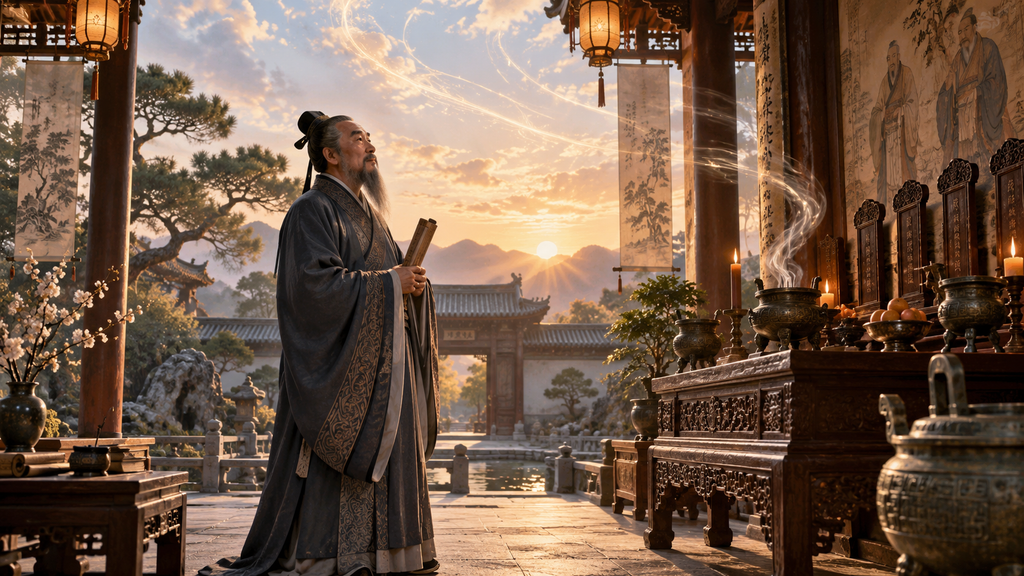
Confucianism is often described as one of the world’s least mystical major traditions.
When people think of Confucius, they usually think about:
respecting parents,
education,
social harmony,
proper behaviour,
hierarchy,
responsibility,
good government,
and moral character.
It can almost sound like an elaborate system of ethics and etiquette rather than spirituality.
Compare Confucius with the Buddha meditating toward enlightenment, Laozi describing the mysterious Dao, Hindu yogis pursuing liberation, or Christians seeking union with God, and Confucianism initially appears extremely grounded.
But that impression is incomplete.
Confucianism contains a genuine spiritual dimension involving:
Heaven (Tian), ancestors, ritual, spirits, moral destiny, self-cultivation, cosmic harmony, qi, and the relationship between human character and the order of the universe.
Confucius simply approached spirituality differently.
Instead of asking primarily:
“How do I escape the ordinary world?”
Confucianism asks something closer to:
“How do I make ordinary human life sacred?”
And that may be its distinctive spiritual contribution.
Confucius Was Not Simply an Atheist
One of the biggest misconceptions about Confucius is that because he rarely speculated about gods or the afterlife, he rejected spirituality altogether.
The Analects presents a much subtler picture.
Confucius inherited a Chinese religious world filled with:
ancestor rites,
sacrifices,
spirits,
divination,
and reverence for Tian—Heaven.
Scholarly treatments of Confucius note that he continued to respect sacrifices and inherited religious practices while generally refusing to make speculation about supernatural beings the center of his teaching.
His attitude might be summarized as:
Respect the spiritual world—but concentrate on becoming a better human being.
That is very different from saying:
“There is no spiritual world.”
What Was Tian—Heaven?
Perhaps the most important spiritual concept in early Confucianism is Tian (天).
The word literally means Heaven or Sky, but in early Chinese philosophy it could represent much more than the physical sky.
Tian could signify:
cosmic order,
moral order,
destiny,
the source of legitimate political authority,
or something approaching divine providence.
Earlier Zhou rulers developed the concept of the Mandate of Heaven—Tianming.
A ruler did not possess unlimited divine right simply because of birth.
If rulers became corrupt and destructive, Heaven could withdraw its mandate.
Political legitimacy therefore had a moral-cosmic dimension.
Confucius inherited this worldview.
For him, Heaven was mysterious, but it was not irrelevant.
He sometimes spoke as though his own mission had been entrusted to him by Heaven.
This introduces something surprisingly spiritual into Confucian philosophy:
Your life may possess a moral calling larger than your private desires.
Heaven Does Not Necessarily Speak
The Confucian concept of Heaven is interesting precisely because it sits somewhere between a personal God and an impersonal cosmic principle.
Confucius does not generally portray Heaven as constantly issuing supernatural commands.
Instead, Heaven’s order becomes visible through:
nature,
morality,
human relationships,
history,
and proper conduct.
The Internet Encyclopedia of Philosophy describes Confucian Tian as aligned with a moral order that human beings must help bring into reality.
That creates a distinctly Confucian form of spirituality.
Instead of waiting for God to repair society, the good person is expected to embody Heaven’s order through conduct.
You become part of the divine or cosmic order by behaving correctly.
Spirituality Through Daily Life
This may be the most radical thing about Confucianism.
Many spiritual traditions create a contrast between:
the sacred and ordinary,
monastery and marketplace,
heaven and earth,
priest and layperson.
Confucianism tends to spiritualize ordinary social existence.
Your relationship with:
your parents,
your children,
your spouse,
your friends,
your teachers,
your colleagues,
and your community
becomes part of your moral cultivation.
You do not necessarily need to retreat to a mountain.
Your family may be your monastery.
Your workplace may be your practice hall.
Your everyday interactions become the spiritual exercise.
Filial Piety Becomes Spiritual
This helps explain the enormous importance Confucianism gives to filial piety—xiao (孝).
Respecting one’s parents is not merely being polite.
Parents represent the immediate link between the individual and the larger chain of life.
You came from someone.
They came from someone.
Eventually the chain disappears into ancestors whose names you no longer know.
Confucian family ethics therefore naturally connects the living with the dead.
The family exists not merely horizontally among people currently alive but vertically across generations.
This is where Confucian ethics and ancestor spirituality become deeply intertwined.
Ancestor Worship Was Already Part of the World Confucius Inherited
Ancestor veneration long predates Confucius.
Early Chinese religious practice included offerings to ancestors because ancestors were believed to continue participating in the life of the family.
Confucianism preserved and systematized much of this ritual culture.
The concept of li (禮)—ritual propriety—originally referred partly to formal ceremonies, including offerings of food and wine to ancestral spirits, before expanding to encompass etiquette and moral conduct more broadly.
That history tells us something important.
What eventually became:
“good manners”
had roots in:
sacred ritual.
The line between ethics and religion was not as sharp as modern Western categories sometimes imply.
Why Ancestor Rituals Matter
Imagine bowing before the tablet or grave of your grandfather.
You offer food.
You remember his name.
You remember that you exist partly because he existed.
Your children watch you.
Eventually they may perform the same ritual for you.
Suddenly morality is no longer only about:
“What do I want?”
You experience yourself as one link in a much larger chain.
There were people before you.
There may be people after you.
Your actions affect both the reputation you inherited and the world your descendants inherit.
That is profoundly spiritual.
Ancestor practice teaches:
You are not an isolated individual.
Confucius and Spirits: Respect Without Obsession
Confucius is famous for passages in which he avoids extensive speculation about ghosts, spirits and death.
When asked about serving spirits, he effectively redirects attention toward learning how to serve human beings first.
When asked about death, he redirects toward understanding life.
This sometimes gets interpreted as skepticism.
But another passage shows the balance more clearly.
Confucius emphasized performing sacrifices with the proper seriousness—as though the spiritual recipient were genuinely present.
Scholars therefore generally resist reducing his position to simple disbelief in spirits.
His attitude is almost:
Do the ritual sincerely, respect the mystery, but don’t become obsessed with supernatural speculation.
That is arguably a very mature spiritual stance.
“Respect the Spirits, But Keep Your Distance”
One famous Confucian attitude can be paraphrased as:
respect spiritual beings while maintaining appropriate distance from them.
This captures Confucianism beautifully.
It does not necessarily deny spirits.
But it refuses to make spiritual phenomena the center of one’s life.
You do not spend all day:
summoning entities,
chasing visions,
predicting the future,
or attempting to escape into supernatural worlds.
Instead:
honour the ancestors,
perform appropriate ritual,
respect Heaven,
and then return to cultivating character.
In modern language, Confucius might say:
Don’t let spirituality become escapism.
Li: Ritual as Spiritual Technology
One of Confucianism’s deepest ideas is li, usually translated as ritual, ritual propriety or proper conduct.
At first glance, ritual can seem artificial.
Why bow this way?
Why perform ceremonies?
Why follow forms?
Confucius believed ritual could reshape the person.
Repeatedly performing respectful actions trains:
emotion,
attention,
self-control,
and moral instinct.
Ritual therefore operates almost like a spiritual technology.
You begin by consciously performing the form.
Eventually the appropriate attitude becomes internal.
For example, funeral rituals create a socially recognized space for grief.
Ancestor rituals cultivate gratitude.
Forms of greeting cultivate respect.
Music and ceremony cultivate harmony.
The outer form gradually transforms the inner character.
Ritual Without Feeling Is Empty
But Confucius did not simply want robotic obedience.
He criticized ritual performed without genuine emotion.
Scholarly accounts of the Analects emphasize that appropriate feeling—such as genuine sorrow during mourning—is essential to correct ritual practice.
That creates an important spiritual principle:
The ritual is not magic by itself.
The external action and internal state should align.
That sounds surprisingly similar to many other spiritual traditions.
Prayer without sincerity becomes empty words.
Meditation without awareness becomes merely sitting.
Ritual without reverence becomes theatre.
Confucianism understood this problem very clearly.
Ren: Becoming Fully Human
Another central Confucian concept is ren (仁).
It is translated variously as:
humaneness,
benevolence,
human-heartedness,
or humanity.
Ren describes the deeply cultivated ability to respond to others with moral sensitivity.
It is not merely following rules.
A genuinely cultivated person begins to feel appropriately.
Compassion becomes natural.
Respect becomes natural.
Responsibility becomes natural.
From a spiritual perspective, ren resembles the gradual refinement of consciousness.
The goal is not simply:
“Obey moral laws.”
It is:
“Become the kind of person from whom good actions naturally emerge.”
That is a much deeper transformation.
The Junzi: The Spiritually Cultivated Person
The Confucian ideal is often called the junzi (君子).
Originally the term referred to someone of noble social status.
Confucius transformed it into something closer to:
a noble person because of character.
The junzi develops:
wisdom,
integrity,
self-control,
respect,
courage,
benevolence,
and proper conduct.
This resembles spiritual cultivation in other traditions.
The Buddhist seeks enlightenment.
The Christian seeks holiness.
The Daoist seeks alignment with the Dao.
The Confucian seeks to become fully cultivated as a human being.
Different language.
Similar underlying question:
What is the highest form a human consciousness can take?
The Great Confucian Spiritual Experiment
Confucianism makes an extraordinary claim.
If you cultivate yourself properly, the effects can spread outward.
Your character affects your family.
Your family affects the community.
The community affects the state.
The state affects the world.
The classical Confucian tradition therefore imagines a chain running from:
inner cultivation → family harmony → social harmony → political order → harmony under Heaven.
Spiritual development and political development are connected.
A corrupt society is ultimately composed of human beings whose moral cultivation has failed.
A harmonious society therefore begins partially inside the individual.
The Mandate of Heaven and Moral Leadership
This is why political leadership became almost sacred in Confucian thought.
The ruler’s job was not merely administration.
The ruler was expected to embody de (德)—moral virtue or moral power.
According to the Confucian model, a ruler of extraordinary virtue influences society through example.
The ruler becomes like a moral center of gravity.
The Internet Encyclopedia of Philosophy describes Confucius as believing in the almost contagious character of de: moral parents encourage moral children and moral rulers encourage moral subjects.
This resembles the spiritual concept of vibration in an interesting metaphorical way.
The state of one person’s consciousness affects the environment around them.
Confucius simply expressed it ethically rather than esoterically.
Confucianism and Qi
The spiritual dimension becomes even more obvious later.
During the development of Neo-Confucianism, especially beginning around the Song dynasty, Confucian thinkers created sophisticated metaphysical systems involving li (理) and qi (氣).
Be careful here because there are two different words pronounced li.
Li 禮 = ritual propriety.
Li 理 = principle, pattern or coherence.
Neo-Confucian thinkers asked:
What gives reality its structure?
What is everything made from?
How does human morality connect with cosmic order?
Suddenly Confucian philosophy becomes unmistakably metaphysical.
Qi: The Vital Stuff of Reality
In Neo-Confucian cosmology, qi represents the vital material-energy through which things exist and change.
Human beings are not fundamentally separated from nature.
The same cosmic processes that produce:
mountains,
water,
animals,
plants,
weather,
and planets
also produce us.
Different Neo-Confucian philosophers understood qi differently, but it became central to their explanations of the physical and moral world.
This makes Confucianism surprisingly compatible with an energetic spiritual worldview.
Human beings exist within the same field of generative reality as everything else.
Li: The Pattern Behind Reality
Neo-Confucians also developed the idea of li (理)—the principle or pattern through which things possess coherent form.
One simplified way of imagining it is:
Qi is the energy-stuff.
Li is the pattern expressed through it.
The Stanford Encyclopedia of Philosophy notes that Neo-Confucian thinkers understood li as patterns of coherence immanent in reality and continually debated its relationship with qi.
This creates a spiritual cosmology.
The universe is not simply meaningless matter.
It possesses pattern.
And the human mind can learn to recognize and align itself with that pattern.
Moral Cultivation Becomes Cosmic Cultivation
This is where Neo-Confucianism becomes especially interesting spiritually.
Suppose the same underlying patterns operate throughout reality.
Then cultivating your character is not merely becoming socially polite.
You are bringing your own mind and behaviour into greater alignment with the structure of the cosmos itself.
Neo-Confucian self-cultivation therefore acquired a strongly metaphysical dimension.
Stanford’s discussion of Chinese metaphysics describes this tradition as treating self-cultivation partly as the process through which the human being more perfectly expresses and participates in li.
That is unmistakably spiritual.
Confucianism Absorbed Challenges From Buddhism and Daoism
There is a historical irony here.
Buddhism entered China with enormous spiritual and philosophical sophistication.
Daoism already provided powerful cosmological and mystical traditions.
Confucianism therefore faced competition.
Could a philosophy focused on family and government really answer questions about:
the universe,
human nature,
consciousness,
and ultimate reality?
Neo-Confucian thinkers responded by developing their own sophisticated metaphysics.
Their thought was influenced by centuries of interaction with Buddhism and Daoism, even while they deliberately distinguished their own tradition from both.
Confucianism became much more explicitly cosmic.
Confucianism Versus Buddhism: Stay in the World
One of the greatest differences between Confucianism and Buddhism involves the attitude toward ordinary society.
Buddhist monastic traditions offer a path in which someone can leave:
marriage,
family obligations,
career,
and ordinary social status
to seek liberation.
Confucianism historically viewed this kind of withdrawal with suspicion.
Why abandon your parents?
Why abandon society?
Why leave human relationships in order to become spiritually perfected?
The Confucian answer is almost the reverse:
Your relationships are the practice.
You cultivate patience because you have difficult relatives.
You cultivate responsibility because people depend upon you.
You cultivate integrity because society gives you opportunities to cheat.
You cultivate compassion because other people suffer.
You cultivate humility because you must live among equals.
Society becomes the spiritual laboratory.
Confucianism Versus Daoism: Cultivation Through Form
Daoism often emphasizes spontaneity, naturalness and allowing things to unfold according to their inherent nature.
Confucianism puts greater emphasis on:
education,
ritual,
discipline,
social roles,
and conscious cultivation.
Using a rough metaphor:
Daoism may ask:
“What happens when you stop interfering with your natural nature?”
Confucianism may ask:
“What happens when you deliberately cultivate your nature?”
Both seek harmony.
Their methods differ.
Is Confucianism a Religion?
This question remains debated partly because the Western category religion does not map perfectly onto traditional Chinese culture.
Confucianism has functioned at different times as:
philosophy,
ethical system,
political ideology,
educational tradition,
ritual tradition,
and something resembling civil religion.
Confucius himself became the focus of state ceremonies and temples.
Families influenced by Confucian values maintained ancestral rites.
Concepts such as Heaven provided a cosmic framework for morality.
Yet Confucianism generally lacks some characteristics associated with many Western religions:
a creator God at the center,
a universal priesthood,
a single revelation,
or salvation primarily through faith.
So asking:
“Is Confucianism religious or secular?”
may impose a distinction that Confucian civilization itself did not always make.
Perhaps a better question is:
“Does Confucianism contain spiritual dimensions?”
Clearly, yes.
Ancestors Connect Heaven and Earth
Perhaps ancestor worship best demonstrates the spiritual genius of Confucian culture.
Consider the structure:
Heaven exists above.
Ancestors came before.
You stand in the present.
Descendants may come after.
You exist at an intersection between:
past, present and future.
Your duty is to receive what previous generations gave you, improve it where possible, and hand something worthwhile to those who follow.
That turns morality into something larger than individual preference.
You become a temporary steward of the family lineage.
This may explain why ancestor rites remained so important in Confucian societies such as China and Korea.
The ritual says:
“I did not begin with myself.”
That sentence alone contains a profound spiritual philosophy.
Confucian Spirituality Is Grounded Rather Than Escapist
Confucianism rarely promises dramatic mystical experiences.
There is no requirement to:
open the third eye,
leave the body,
communicate with spirits,
or reach an altered state.
Its spirituality is unusually grounded.
Wake up.
Treat your parents properly.
Keep your promises.
Educate yourself.
Control your impulses.
Perform rituals sincerely.
Take responsibility.
Become trustworthy.
Contribute to society.
Respect the dead.
Understand your place under Heaven.
At first this can seem less spiritual than mystical traditions.
But perhaps that is exactly the point.
Confucianism asks:
What good is enlightenment if you cannot treat your family properly?
The Sacredness of Ordinary Behaviour
Imagine someone who meditates for three hours every day but:
lies constantly,
treats their parents terribly,
exploits employees,
breaks promises,
and behaves selfishly.
From a strongly Confucian perspective, claims of spiritual enlightenment would be almost irrelevant.
Character is demonstrated through relationships and action.
This provides an important counterweight to spirituality that becomes excessively concerned with extraordinary experiences.
Seeing visions does not automatically make you virtuous.
Feeling energy does not automatically make you compassionate.
Knowing astrology does not automatically make you wise.
Having mystical experiences does not automatically make you reliable.
Confucianism continually brings spirituality back to a difficult question:
What kind of person are you actually becoming?
Confucianism and the Heart-Mind
Another beautiful Chinese concept is xin (心)—literally the heart, but philosophically often translated as heart-mind.
Traditional Chinese thought did not always create the sharp Western division between:
emotion and reason,
heart and intellect.
The heart-mind can think and feel.
Moral cultivation therefore involves educating not only your intellectual beliefs but your emotional responses.
The goal is not merely knowing that compassion is good.
Eventually, you should naturally feel compassion.
This resembles spiritual transformation far more than simple rule-following.
The entire inner person changes.
Wang Yangming: The Principle Is Already Within You
Later Neo-Confucian philosopher Wang Yangming developed an especially inward form of Confucian spirituality.
He emphasized the unity of moral knowledge and action and argued that people possess an innate capacity for moral knowing.
Neo-Confucian debates eventually produced different schools, some emphasizing investigation of the principles manifest throughout the world and others emphasizing direct examination of one’s own heart-mind.
This can sound remarkably similar to contemplative traditions.
The truth is not merely somewhere outside you.
You examine consciousness itself.
But then comes the distinctly Confucian test:
Does that realization change how you behave?
Spirituality Without Escaping Humanity
Perhaps this is ultimately Confucianism’s greatest spiritual contribution.
Many spiritual systems ask human beings to look upward:
toward heaven,
toward gods,
toward enlightenment,
toward liberation.
Confucianism repeatedly brings the gaze back down:
to your parents,
your children,
your neighbours,
your responsibilities,
your behaviour.
But it does not necessarily abandon Heaven.
Instead it creates a vertical connection:
Heaven → moral order → human character → family → society.
The divine or cosmic becomes meaningful through human conduct.
Heaven Is Experienced Through Harmony
From this perspective, spirituality is not necessarily about supernatural phenomena.
You experience alignment with Heaven when:
your mind becomes orderly,
your relationships become harmonious,
your actions become sincere,
and your character becomes trustworthy.
The sacred appears through proper relationship.
This may be why ritual matters so much.
Ritual connects:
inner state,
human society,
ancestral continuity,
and cosmic order.
Everything is brought into alignment.
Perhaps Confucianism Is Spirituality for the Earth Element
If we borrow the language of astrology or the five elements metaphorically, Confucianism almost feels like an earth-based spirituality.
It emphasizes:
structure,
responsibility,
tradition,
family,
continuity,
discipline,
order,
and the consequences of behaviour.
It is much less interested in escaping physical existence than in making physical existence worthy.
A Daoist sage might disappear into the mountains.
A Buddhist monk might leave household life.
The Confucian sage ideally returns to society and asks:
How can I help make this world function properly?
That is spiritual work too.
The Confucian Temple Is the Relationship
Perhaps the clearest summary is this:
Confucianism does have spirituality.
It simply puts the sacred in places modern people might overlook.
The altar is the ancestor table.
The spiritual exercise is self-cultivation.
The divine order is Heaven.
The energetic substance is qi.
The cosmic principle is li.
The meditation hall is sometimes the family home.
The spiritual test is how you treat other people.
The enlightened person is the cultivated junzi.
And the spiritual objective is not necessarily leaving this world.
It is becoming sufficiently wise, compassionate and disciplined that your presence makes this world more harmonious.
That may explain why Confucianism can appear almost entirely secular while simultaneously possessing such a deep spiritual foundation.
Confucius did not spend much time describing what ghosts looked like.
He did not provide detailed maps of heaven.
He did not make supernatural experiences the measure of spiritual achievement.
Instead, he asked something potentially harder:
Can you embody Heaven’s order in the way you actually live?
Perhaps that is Confucian spirituality in one sentence.
Not escaping humanity to find the sacred—
but making humanity itself sacred through cultivation, ritual, responsibility and harmony.