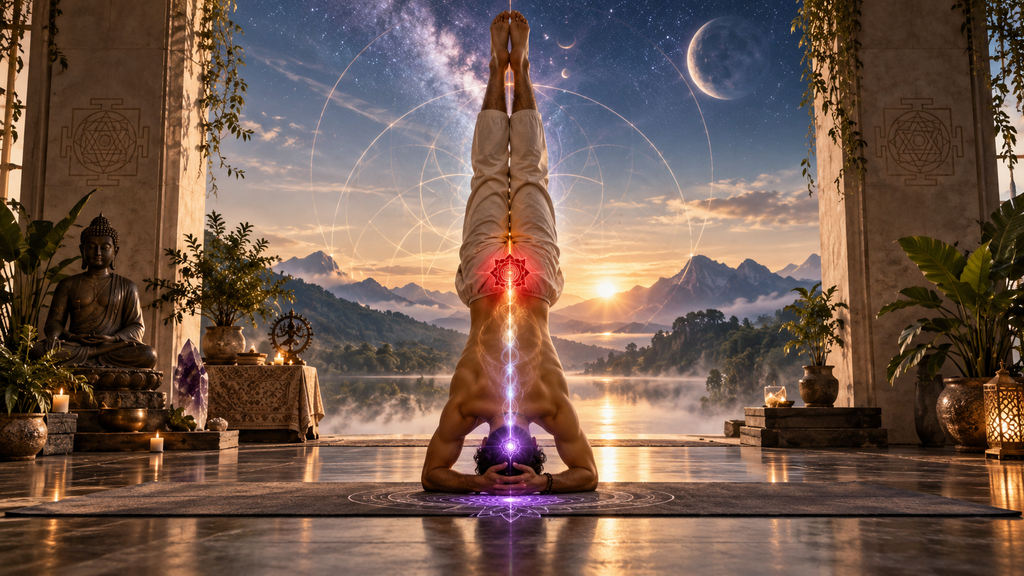
Yoga inversions are often interpreted spiritually as crown-chakra practices.
That makes intuitive sense.
In poses such as:
headstand,
forearm stand,
shoulder stand,
or even downward-facing dog,
our ordinary relationship with gravity changes.
The head moves downward.
The feet rise.
Blood flow, balance, orientation, and perception all feel different.
Symbolically, the practitioner is taking the part of the body traditionally associated with higher consciousness—the head—and placing it closer to the Earth.
This creates an interesting paradox.
An inversion may appear to emphasize the crown chakra, yet at the same time it can produce a powerful relationship with the root chakra.
The crown touches the ground.
The root rises toward the sky.
For a moment, the energetic hierarchy of the body is reversed.
And spiritually, that reversal may teach something profound:
perhaps the highest consciousness and the deepest roots are not opposites at all.
Perhaps they are two ends of the same axis.
The Crown and Root Are Usually Seen as Opposites
The chakra system is often imagined vertically.
At the bottom:
Muladhara — the root chakra.
At the top:
Sahasrara — the crown chakra.
The root symbolizes:
grounding,
survival,
ancestry,
security,
the body,
and physical existence.
The crown symbolizes:
transcendence,
higher consciousness,
spiritual awareness,
the divine,
and connection with something beyond the individual ego.
At first glance, they appear to point in opposite directions.
Root says:
Earth.
Crown says:
Heaven.
Root asks:
“Where do I come from?”
Crown asks:
“What am I connected to beyond myself?”
But the chakra system is not really seven isolated compartments.
It is a vertical continuum.
The lower and upper centers continually influence one another.
A person cannot remain spiritually “high” forever without eventually returning to the body.
And a person who is completely trapped in survival may struggle to experience transcendence.
The path is not choosing Earth or Heaven.
It is learning to connect them.
An Inversion Literally Reverses the Axis
Standing normally, the body is arranged in a familiar pattern:
head above,
feet below.
The feet contact the ground.
The crown points toward the sky.
Then an inversion changes everything.
In a headstand:
the crown or surrounding head area approaches the Earth,
while the legs and feet rise upward.
Symbolically, it is almost as though:
the crown becomes the root
and
the root becomes the crown.
This is one reason inversions can feel psychologically unusual even before any spiritual interpretation is added.
The nervous system suddenly receives a different map of space.
Up becomes down.
Down becomes up.
The body must reorganize its understanding of balance.
And the mind is forced out of its ordinary perspective.
The Head Becomes Grounded
This may be the most interesting part.
Normally, people describe being “in their head” as the opposite of being grounded.
Thinking.
Analyzing.
Planning.
Ruminating.
The head becomes associated with abstraction.
But during an inversion, the head itself moves toward the floor.
In a supported headstand, the upper body suddenly experiences the ground directly.
Symbolically, this says:
even thought must eventually touch Earth.
The rational mind does not need to control everything from above.
It can surrender.
It can become supported.
It can allow something deeper to hold it.
That is where the root-chakra interpretation becomes powerful.
Grounding What You Cannot Rationally Understand
The root chakra is sometimes reduced to:
money,
security,
food,
home.
Those are important.
But root symbolism also extends into deeper layers:
family,
ancestry,
instinct,
lineage,
and the ancient biological memory of being a living creature.
Much of this exists below conscious thought.
You did not consciously choose:
your ancestors,
your nervous system,
your early family patterns,
your body,
your instincts.
They were already present before the rational mind developed.
Inversion can therefore become a symbolic practice of saying:
“I do not need to understand everything intellectually in order to be supported by it.”
The head touches the ground.
The analytical mind temporarily gives up its normal position of control.
The Root Contains What Came Before You
Ancestry is a particularly interesting part of root symbolism.
Your body is not an isolated event.
It emerged through:
parents,
grandparents,
earlier generations,
and ultimately an enormous biological lineage.
Much of what shaped you existed before “you” consciously appeared.
That makes the root chakra an appropriate symbol for ancestral continuity.
During an inversion, the crown—the center associated with individual consciousness—moves physically toward Earth.
One can interpret this contemplatively as:
consciousness bowing toward its own roots.
The mind acknowledges:
I did not create myself.
I emerged from something older.
Spirits and Ancestors as Spiritual Symbolism
Some spiritual traditions would extend this further.
They may interpret the ground, ancestry, and root energy as connected not only with biological lineage but with:
ancestors,
spirits,
or unseen presences.
There is no scientific evidence that placing one’s head on the floor allows literal communication with spirits.
But as a spiritual practice, the symbolism can still be meaningful.
One might use inversion as a contemplative gesture:
“I allow myself to receive what lies beneath ordinary conscious thought.”
That may include:
ancestral memory,
intuition,
dream material,
emotional patterns,
or spiritual ideas that cannot easily be explained rationally.
The important distinction is that the pose can support a receptive state without proving any particular supernatural interpretation.
Inversion Weakens the Ego’s Usual Orientation
The ego likes orientation.
I know where I am.
I know what is above.
I know what is below.
I know how my body works.
An inversion temporarily disrupts that certainty.
The body says:
No. Recalculate.
That can be spiritually useful.
Many contemplative practices deliberately destabilize habitual perception.
Zen koans disrupt logic.
Meditation disrupts identification with thought.
Pilgrimage disrupts routine.
Inversion disrupts spatial identity.
The world has not changed.
Your relationship to it has.
That is a powerful spiritual lesson.
Headstand as an Embodied Koan
In that sense, a headstand can function almost like a physical koan.
The question is:
What happens when the place I normally call “above” becomes “below”?
The intellect cannot solve the experience merely by thinking about it.
You must enter the pose.
Balance.
Breathe.
Adjust.
Surrender.
The body teaches something that words cannot fully capture.
That is why yoga is not simply philosophy.
It is embodied philosophy.
The Crown Is Not Only About Escaping Upward
Another common misunderstanding is that the crown chakra means leaving the physical world behind.
Higher consciousness is sometimes imagined as:
rising upward,
escaping matter,
transcending the body.
But mature spirituality often works differently.
The crown opens not by rejecting the root but by becoming integrated with it.
Otherwise transcendence becomes dissociation.
A person may talk endlessly about:
spirituality,
energy,
enlightenment,
or cosmic consciousness
while being unable to manage:
ordinary life,
relationships,
finances,
or the body.
That is not necessarily spiritual development.
It may simply be imbalance.
Inversion Makes the Crown Humble
This is one of the most beautiful symbolic interpretations.
Normally the crown is the highest point of the body.
In inversion, it becomes the lowest.
The supposedly “highest” chakra is brought down.
It touches Earth.
Spiritually, this can symbolize:
humility.
True spirituality eventually bows.
The person who believes they have reached some elevated consciousness still has to:
eat,
sleep,
walk,
pay bills,
care for others,
and live inside a body.
The crown cannot remain above everything forever.
It must meet the ground.
The Root Is Also Lifted Up
At the same time, something happens to the root.
The pelvis rises.
The legs rise.
The feet rise.
The lower body, normally associated with:
instinct,
survival,
sexuality,
ancestry,
and physicality,
is symbolically elevated.
This suggests the opposite movement:
the physical is not spiritually inferior.
Body can rise toward spirit.
Instinct can become conscious.
Ancestral material can be illuminated.
The root does not need to be abandoned.
It can be transformed.
Earth and Heaven Exchange Places
This creates an almost Daoist image.
Heaven descends.
Earth rises.
The opposites exchange positions.
Neither disappears.
This resembles yin and yang.
Within yin exists yang.
Within yang exists yin.
The crown contains something of the root.
The root contains something of the crown.
Inversion physically dramatizes this idea.
The body becomes a temporary symbol of cosmic reversal.
Muladhara and Sahasrara as One Axis
In many modern yogic interpretations, chakra energy is imagined moving through the central channel, Sushumna, from the root toward the crown.
Kundalini symbolism describes dormant spiritual energy awakening from the lower center and rising upward.
Whether one treats that literally or symbolically, the axis matters.
Root and crown are connected because they define the two poles of the system.
You could imagine the entire chakra column as something like:
Earth ↕ consciousness ↕ Heaven.
An inversion does not destroy the axis.
It flips its orientation relative to gravity.
That can remind the practitioner:
the internal axis remains even when the external world changes.
This Is Why Balance Matters So Much
Inversions demand balance.
You cannot rely solely on strength.
Too much tension can destabilize the pose.
Too little engagement can collapse it.
The body must find a middle point.
This has a direct spiritual parallel.
Root energy provides:
stability.
Crown energy provides:
openness.
Too much root can become:
rigidity,
fear,
attachment.
Too much crown can become:
ungrounded abstraction.
The inversion requires both.
You must be stable enough to surrender.
And surrendered enough to remain stable.
The Feet in the Sky Carry Root Energy Upward
The feet are often experienced as extensions of root energy because they normally connect directly with the Earth.
In an inversion they leave the ground.
This can create an interesting symbolic exercise.
Imagine that the grounding you normally receive through the feet is no longer dependent solely upon physical orientation.
Can you remain grounded while the feet are above you?
If so, grounding becomes more than:
“My feet are touching the floor.”
It becomes:
“I carry an inner sense of stability regardless of orientation.”
That is psychologically much more sophisticated.
True Grounding Must Travel With You
A person is not genuinely grounded only because circumstances are stable.
Real grounding means maintaining an inner center when circumstances change.
You travel.
Move house.
Lose a job.
Enter a relationship.
Leave one.
Stand upright.
Turn upside down.
The external configuration changes.
But some internal axis remains.
Yoga inversion makes this principle physical.
The body enters an unusual arrangement and discovers:
I can still breathe here.
That realization can transfer psychologically.
Inversion and Fear
Inversions also often reveal fear.
Fear of:
falling,
injury,
losing control,
or being upside down.
That immediately activates root-chakra themes.
The root is strongly associated symbolically with:
safety,
survival,
and fear.
So although an inversion may appear visually crown-oriented, the psychological experience can strongly activate the root.
The practitioner must repeatedly ask the nervous system:
Am I safe enough to remain here?
That is pure root territory.
Learning Trust Through the Body
Once a safe inversion becomes familiar, something changes.
The practitioner learns:
my arms can hold me.
My shoulders can support me.
My balance can adjust.
The ground is still there.
I do not immediately fall.
This develops embodied trust.
The root chakra is fundamentally about trust in physical existence.
Not abstract trust.
Bodily trust.
Inversions can therefore become a surprisingly direct root practice.
Inversion Can Reveal Where Control Lives
A person may enter headstand and immediately:
hold the breath,
clench the jaw,
tighten the shoulders,
and panic.
The body is saying:
control everything.
But successful balance often requires reducing unnecessary tension.
This becomes another spiritual lesson.
Control is not the same as stability.
Sometimes overcontrol creates instability.
That parallels the root chakra beautifully.
A healthy root says:
I am secure enough to relax.
An anxious root says:
I must control everything in order to be safe.
The Crown Learns From the Root
The crown often symbolizes openness to:
mystery,
God,
universal consciousness,
or something beyond rational comprehension.
But one cannot truly surrender to mystery if one feels fundamentally unsafe.
The root therefore supports crown opening.
This is why the two chakras may be more connected than they initially appear.
The root says:
“You are supported.”
Only then can the crown comfortably say:
“I can let go.”
Inversion physically combines those messages.
Letting the Head Be Supported
Modern people live heavily through the head.
Screens.
Analysis.
Information.
Planning.
Language.
Ideas.
Even spirituality can become intellectual.
We read about meditation.
Watch videos about yoga.
Discuss chakras.
Analyze consciousness.
An inversion can symbolically reverse this pattern.
Instead of the head controlling the body, the head becomes supported by the ground and the rest of the body.
That is a powerful shift.
The mind stops being the unquestioned ruler.
The Body Knows Things the Mind Does Not
This does not mean the body possesses supernatural knowledge.
It means that much human functioning happens outside conscious reasoning.
Balance.
Posture.
Breathing.
Emotion.
Instinct.
Memory.
The nervous system continually processes information before conscious thought catches up.
A yoga inversion can make this obvious.
You cannot verbally reason your way through every micro-adjustment required for balance.
The body makes countless corrections automatically.
That can teach humility toward the rational mind.
Ancestral Knowledge Can Be Understood the Same Way
When people speak spiritually about ancestral knowledge, one interpretation is literal spirit communication.
Another is psychological and biological.
We inherit:
genes,
temperamental tendencies,
family stories,
cultural habits,
fear patterns,
and social expectations.
Much of this shapes us before we consciously understand it.
So “listening to the ancestors” can also mean becoming aware of what has been transmitted through the body and family system.
Inversion can become a symbolic way of saying:
I am willing to listen downward as well as upward.
Crown Spirituality Usually Looks Up
Many spiritual systems associate transcendence with looking upward.
Heaven.
Sky.
Stars.
God above.
But inversion changes the direction.
Now the crown points toward Earth.
This creates an intriguing mystical question:
What if the sacred is not only above us?
What if it is also:
beneath,
within,
behind,
and inherited?
Perhaps the inversion teaches:
God can be found upward, but also downward into embodiment.
The Root Is Not Less Sacred
This is important because spiritual traditions can sometimes become suspicious of:
the body,
sexuality,
money,
food,
and physical life.
But the chakra system begins with a root for a reason.
There is no crown without a body to carry it.
There is no meditation without breathing.
There is no spiritual lineage without physical ancestors.
The material world is not simply something to escape.
It is part of the path.
Inversion Becomes a Symbol of Integration
Seen this way, inversion is not merely:
“activate the crown.”
It becomes a conversation between:
crown and root,
Heaven and Earth,
thought and instinct,
spirit and body,
future and ancestry,
consciousness and unconscious material.
The pose literally reverses their normal positions so the practitioner can experience them differently.
This is why it can feel so psychologically fresh.
Not Every Inversion Needs to Be a Headstand
The symbolism does not require an advanced pose.
Different inversions can produce similar contemplative effects.
Downward-facing dog.
Standing forward fold.
Legs-up-the-wall.
Supported shoulder stand.
Dolphin pose.
A gentle supported inversion may be more appropriate than forcing an advanced headstand.
The spiritual value does not increase automatically with physical difficulty.
Headstand Should Be Approached Carefully
This matters especially with Sirsasana, or headstand.
The cervical spine is not something to experiment with recklessly.
Good technique, adequate shoulder strength, appropriate preparation, and qualified instruction matter.
People with certain:
neck,
eye,
blood-pressure,
cardiovascular,
or other medical conditions
may need to avoid particular inversions or seek professional guidance.
Spiritual symbolism is never a reason to ignore physical safety.
In fact, protecting the body is itself a root-chakra principle.
The Wall Can Become a Teacher
Using a wall for support can also have spiritual symbolism.
Some people think using support makes a pose less authentic.
But yoga is not a performance.
A wall can allow the nervous system to experience inversion without excessive fear.
That lets the practitioner explore:
breath,
orientation,
surrender,
and awareness
rather than spending the entire pose terrified of falling.
Support is not weakness.
Sometimes support is precisely what allows deeper opening.
A Simple Root-Crown Inversion Meditation
For someone already comfortable with a safe inversion, the practice can become contemplative.
Enter the pose.
Then notice three things.
First:
Where am I physically supported?
Feel the ground.
Second:
What happens when I stop trying to understand everything?
Let thought quiet.
Third:
What does it feel like for my crown to approach Earth while my root rises upward?
Do not force an answer.
Simply experience the reversal.
Then return upright slowly.
Stand quietly afterward.
Notice the feet.
This final stage matters.
You return to ordinary orientation—but perhaps with a slightly different relationship to it.
The Return Is Part of the Practice
Every inversion ends.
You come back upright.
That is spiritually significant.
The purpose is not to live upside down.
You enter another perspective.
Learn something.
Then return.
This is similar to:
meditation,
retreat,
dreaming,
or mystical experience.
The practitioner eventually comes back to ordinary life.
The question becomes:
What did you bring back?
That is where integration occurs.
Crown Without Root Can Become Escapism
This is one of the strongest reasons to think about inversions as root-crown practices rather than crown practices alone.
A person fascinated only with crown energy may become obsessed with:
psychic experiences,
visions,
ascension,
higher dimensions,
or spiritual transcendence.
But spiritual development that ignores:
body,
ancestry,
ordinary responsibility,
and emotional stability
can become ungrounded.
The inversion almost physically corrects this misunderstanding.
The crown itself is forced to touch Earth.
Root Without Crown Can Become Fear
The opposite imbalance is also possible.
Someone focused entirely on:
money,
security,
tribe,
survival,
and physical control
may become psychologically rigid.
The root needs the crown because life requires:
meaning,
perspective,
and transcendence.
In the inversion, the root rises.
Symbolically:
survival looks upward toward meaning.
Again, both poles need each other.
The Human Being Is the Bridge
Perhaps this is the deepest symbolism.
The chakra system places the human body between:
Earth
and
Heaven.
We are neither purely physical nor purely abstract.
We are embodied consciousness.
The root connects downward.
The crown opens upward.
The spine becomes the bridge.
During inversion, that bridge remains.
Only its orientation changes.
This reveals something important:
the spiritual axis is internal.
The world may turn upside down.
Your relationship with the axis can remain.
The Tree Turned Upside Down
There is a beautiful image here.
Imagine a tree.
Its roots descend into Earth.
Its branches reach toward Heaven.
Now imagine the tree inverted.
The roots rise.
The crown touches the soil.
Yet it is still the same organism.
Yoga inversion temporarily turns the human tree upside down.
For a few breaths, the practitioner experiences something that ordinary posture conceals:
root and crown belong to one living system.
The Highest Point Learns From the Lowest
Perhaps this is ultimately why inversions can feel spiritually profound.
The part of us associated with:
reason,
identity,
and higher awareness
is brought downward.
The part associated with:
instinct,
ancestry,
and embodiment
is lifted upward.
Neither wins.
They exchange positions.
And through that exchange the body may communicate a very simple lesson:
Do not become so spiritual that you lose the Earth.
Do not become so grounded that you forget the sky.
The crown needs the root.
The root needs the crown.
And sometimes the fastest way to understand that relationship is simply to turn the whole body upside down.