
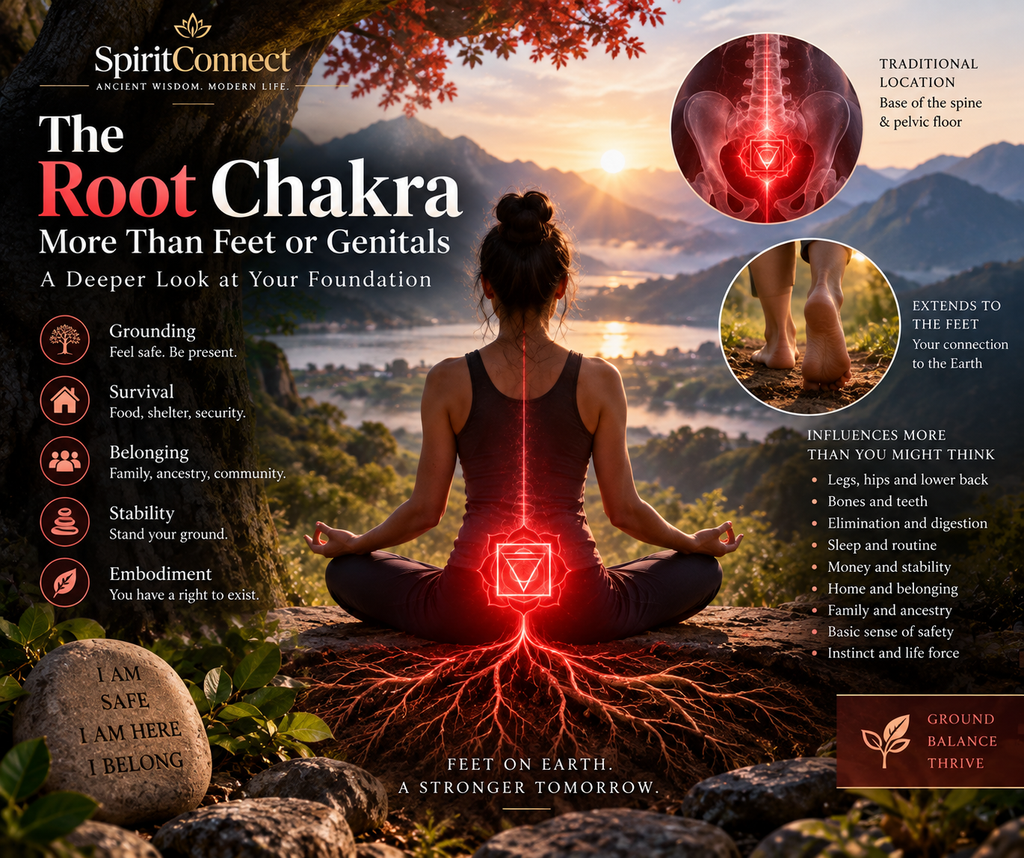
The root chakra, or Muladhara, is often described as the chakra of grounding, survival, stability, physical existence, and our connection to the Earth.
But there is a common point of confusion.
If the root chakra represents our connection to the ground, shouldn’t it be associated mainly with the feet?
Yet many chakra diagrams place it at the base of the spine or pelvic floor, very close to the reproductive organs.
So which is correct?
The best answer is:
The traditional energetic center is at the base of the body, but its grounding function can extend through the legs and feet.
In other words, the root chakra is not simply “the feet chakra,” nor is it primarily a sexual chakra.
Its deeper symbolism is about:
embodiment, survival, physical security, ancestry, instinct, gravity, and belonging to the material world.
The feet are one of its strongest extensions because they physically connect us to the ground.
Where Is the Root Chakra Traditionally Located?
In traditional Indian chakra systems, Muladhara is usually placed at the base of the spine, around the pelvic floor or perineal region.
The Sanskrit word muladhara can be translated roughly as:
root support
or
foundation.
That name is extremely revealing.
The chakra represents the energetic foundation upon which the rest of the system is built.
If the higher chakras concern:
emotion,
identity,
love,
communication,
intuition,
and spiritual consciousness,
the root asks the most basic question first:
“Am I safely here?”
Before enlightenment, there is embodiment.
Before philosophy, there is food.
Before spirituality, there is survival.
Why the Pelvic Floor?
The pelvic floor is symbolically appropriate because it forms the lower foundation of the torso.
It supports the internal organs.
It sits at the base of the spine.
It is also closely connected with:
posture,
stability,
movement,
and bodily containment.
From a chakra perspective, this makes it an ideal symbolic location for the body’s foundational energy center.
The root chakra therefore concerns the sense:
“I inhabit this body.”
Not just:
“I think.”
Or:
“I feel.”
But:
“I physically exist.”
Is the Root Chakra Connected to the Genitals?
There is some overlap, but the distinction is important.
The reproductive organs are generally associated more strongly with the sacral chakra, or Svadhisthana, which is linked symbolically with:
sexuality,
pleasure,
desire,
creativity,
and emotional flow.
The root chakra is located nearby, but its emphasis is different.
Root is:
survival and grounding.
Sacral is:
pleasure and creation.
This is why the lower two chakras can sometimes be confused.
They are physically close and psychologically related.
Sexuality itself contains both.
There is a root aspect:
instinct,
survival,
reproduction,
physical attraction.
And a sacral aspect:
pleasure,
intimacy,
desire,
sensuality,
creativity.
So sexual energy can involve both chakras, but the genitals are not best understood as belonging exclusively to the root.
The Root Chakra May Be Better Understood as the Pelvic Base
Rather than thinking:
root chakra = genitals,
it may be more useful to think:
root chakra = the base of the body.
That includes the energetic symbolism of:
the pelvic floor,
the coccyx,
the lower spine,
the hips,
the legs,
and eventually the feet.
The root is therefore not one tiny point.
It is more like a grounding system.
Why the Feet Feel So Root-Chakra Related
The feet deserve special attention because they literally touch the Earth.
When you stand barefoot:
your weight travels downward,
gravity pulls you toward the ground,
the soles of the feet receive pressure,
and the body continuously adjusts balance.
This is grounding in the most literal possible sense.
That is why spiritual practices often associate the feet with:
grounding,
stability,
humility,
and connection with the Earth.
Even if the energetic center of Muladhara is traditionally placed higher at the base of the spine, the feet can be understood as its contact points with the physical world.
The Root Chakra Has Roots Like a Tree
A useful metaphor is a tree.
The trunk begins above the ground.
But its root system extends downward and outward.
Likewise, the root chakra can be imagined as centered near the base of the spine while its grounding energy extends through:
hips,
legs,
ankles,
and feet.
The feet then become like the ends of the roots.
The chakra itself is the foundation.
The legs and feet are how that foundation connects to the Earth.
Walking Can Therefore Be a Root-Chakra Practice
This explains why walking can feel so grounding.
Especially walking:
slowly,
barefoot where safe,
through grass,
forest paths,
or natural ground.
The repetitive contact between the feet and Earth brings attention out of the head and back into the body.
A person who has been:
thinking too much,
scrolling,
working at a computer,
or living mainly in mental activity
may suddenly feel calmer after walking.
From a spiritual perspective, this can be described as energy descending toward the root.
From an ordinary psychological perspective, it also makes sense:
movement,
rhythm,
sensory input,
and physical contact
all pull attention back toward the present body.
The Legs Are Also Part of Root Symbolism
The legs represent something spiritually important:
support.
They carry you.
They keep you upright.
They allow movement.
They determine whether you can physically stand your ground.
That phrase itself is revealing:
“stand your ground.”
Language repeatedly connects physical stability with psychological stability.
Strong root energy symbolically says:
“I can stand here.”
“I belong here.”
“I am not easily knocked over.”
The legs embody that message physically.
Knees and Flexibility
Even the knees can be understood symbolically within root energy.
To remain standing, the body cannot be completely rigid.
The knees must bend.
This gives us an interesting spiritual lesson.
Grounding is not the same as stiffness.
A well-rooted person can:
adapt,
bend,
shift weight,
and remain balanced.
This is very similar to Taoist symbolism.
The stable person is not necessarily rigid.
They are stable because they can adjust.
Bones and the Root Chakra
Many modern chakra traditions associate the root chakra with the skeletal system.
The symbolism is easy to understand.
Bones provide:
structure,
support,
form,
and durability.
Without a skeleton, the body has no stable framework.
Likewise, psychologically, the root chakra represents the structures that support life:
home,
money,
food,
routine,
family,
health,
and physical security.
Bones therefore symbolize the body’s architecture.
The root chakra symbolizes life’s architecture.
Teeth Can Also Fit the Symbolism
Some chakra traditions also associate the root with teeth.
Again, this is symbolic rather than medically established.
Teeth are:
hard,
mineralized,
physical,
and connected with survival through eating.
They belong to the most material side of human existence.
This is why root symbolism often includes parts of the body that feel:
dense,
structural,
and physically grounded.
The Lower Back and Base of the Spine
The lower spine is another obvious root area.
The spine connects the entire body vertically.
The chakra system itself is usually imagined along this central axis.
Muladhara sits at the base.
Symbolically, if the root is unstable, everything above it becomes harder to support.
This creates an important spiritual principle:
higher consciousness cannot completely replace physical stability.
Someone can meditate for hours.
But if they:
cannot sleep,
cannot eat properly,
feel unsafe,
have no stable home,
or live in constant financial panic,
their nervous system will continually be pulled back toward survival.
The root comes first for a reason.
The Root Chakra and Survival Instinct
This is perhaps its most important function.
The root governs the symbolic question:
“Will I survive?”
That includes concern with:
food,
shelter,
physical safety,
money,
health,
and protection.
These may seem mundane compared with:
third-eye intuition
or
crown-chakra spirituality.
But they are foundational.
A person who feels physically threatened has difficulty contemplating enlightenment.
The body prioritizes survival.
That is root energy.
Fear Is One of the Main Root-Chakra Emotions
In chakra symbolism, fear is often associated with imbalance in the root.
This does not mean all fear is bad.
Fear is essential.
It protects us.
The problem appears when the nervous system cannot stop feeling threatened.
Then root energy becomes dominated by:
insecurity,
hypervigilance,
scarcity,
and constant anticipation of danger.
The person may possess enough resources objectively but still feel:
“It could all disappear.”
That is a psychological expression of unstable grounding.
Money Has a Strong Root-Chakra Dimension
People sometimes assume money is purely solar-plexus energy because it involves:
power,
achievement,
and status.
But money also has a very strong root dimension.
Money provides:
housing,
food,
transportation,
healthcare,
and security.
For that reason, financial instability can strongly affect one’s sense of grounding.
Someone can be spiritually advanced and still feel anxious if they cannot pay rent.
That is not a spiritual failure.
The body understands that resources support survival.
Home Is Root-Chakra Energy
Few things express Muladhara more clearly than the idea of:
home.
Home tells the nervous system:
this is where I sleep.
This is where my things are.
This is where I return.
This space belongs to me.
A stable home creates a physical anchor.
This is why moving frequently, displacement, war, or homelessness can be deeply destabilizing.
The root asks:
“Where is my place?”
Family and Ancestry
The root chakra is also commonly associated with:
family,
ancestry,
lineage,
and tribal identity.
This makes sense.
Your physical body came through a lineage.
You did not appear independently.
Your:
genetics,
language,
family habits,
and early worldview
were inherited through others.
Spiritually, the root connects downward not only into Earth but backward into ancestry.
This is why ancestor traditions can feel deeply root-oriented.
The Root Chakra and Cultural Identity
The same principle extends beyond family.
People often feel grounded through:
national identity,
ethnic traditions,
local community,
religion,
or regional culture.
These structures answer:
“Who are my people?”
This can create:
stability,
belonging,
and continuity.
But when root energy becomes overly rigid, belonging can turn into:
tribalism,
xenophobia,
or fear of outsiders.
Again, every chakra has both gift and shadow.
Routine Is Root Energy
A surprisingly important root-chakra practice is simply:
having a routine.
Wake up around the same time.
Eat regularly.
Sleep properly.
Exercise.
Maintain the home.
Handle finances.
Complete basic responsibilities.
These practices sound almost boring.
But that is precisely why they are root-oriented.
They create a reliable base.
Higher spiritual practices become easier when ordinary life is not constantly chaotic.
The Root Chakra and the Nervous System
Chakras are not medically established anatomical structures, so they should not be confused with nerves or endocrine glands.
But symbolically, root-chakra language overlaps strongly with what psychology might describe as:
felt safety.
When the nervous system perceives the environment as safe, the person can:
relax,
socialize,
create,
and explore.
When it perceives danger, attention narrows toward survival.
This is why grounding practices can feel so powerful.
They remind the body:
I am here.
The ground is beneath me.
At this moment, I am safe enough.
Elimination Is Also Root Symbolism
This area is less obvious.
Some chakra traditions associate the root with the lower digestive and elimination systems.
Symbolically, this makes sense.
Survival requires:
taking in what the body needs
and
releasing what it no longer needs.
The root is not only about holding.
It is also about letting go physically.
This creates an interesting spiritual metaphor.
A stable person needs to know both:
what to keep
and
what to release.
Clinging to everything is not grounding.
Sometimes grounding means releasing what is no longer useful.
Smell Is Traditionally Linked to the Root
In classical chakra correspondences, Muladhara is associated with the element Earth and the sense of smell.
This is a beautiful connection.
Smell is primitive and immediate.
A scent can instantly evoke:
home,
food,
danger,
childhood,
soil,
rain,
or another person.
Smell connects strongly with memory and instinct.
It is less abstract than sight or thought.
That makes it an appropriate sense for the chakra of embodiment.
Earth Is the Root Element
The root chakra’s classical element is Earth.
Earth represents:
weight,
stability,
density,
structure,
and physical reality.
This is why grounding practices frequently involve:
walking,
gardening,
sitting on the ground,
touching trees,
or spending time in nature.
Again, one does not need to believe literal chakra energy enters through soil.
The symbolism itself can be powerful.
Earth says:
slow down.
Become present.
Feel the body.
Food Is Also Root-Chakra Energy
Food is sometimes overlooked because people focus on mystical practices.
But eating is one of the most fundamental root activities.
Food tells the body:
you are supported.
Warm, nourishing meals can feel grounding partly because they address one of life’s most ancient survival needs.
Cooking can also become a root practice.
Preparing food says:
I am taking care of the body that carries me.
Sleep Is Root Energy Too
Sleep may be one of the most important grounding practices.
A person can perform:
meditation,
breathwork,
visualization,
and spiritual ritual,
but if they are chronically sleep-deprived, the entire system becomes unstable.
The root chakra reminds spirituality that consciousness has a biological foundation.
The body matters.
Rest matters.
The Root Chakra and Sexuality: Instinct Versus Pleasure
It is worth returning to sexuality because the distinction between root and sacral is subtle.
The root aspect of sexuality involves:
instinct,
physical drive,
survival,
reproduction,
and bodily presence.
The sacral aspect involves:
pleasure,
attraction,
sensuality,
emotional flow,
and creative energy.
They overlap.
But they are not identical.
One way to think about it is:
Root says: “I am alive.”
Sacral says: “I enjoy being alive.”
That distinction is simple but surprisingly useful.
The Feet May Be the Best Practical Gateway to the Root
Although the traditional center is higher, the feet may be one of the easiest ways to work with root symbolism.
Why?
Because feet give immediate sensory feedback.
You can feel:
pressure,
texture,
temperature,
weight,
and balance.
When people feel mentally scattered, simply bringing awareness to the feet can help.
Try standing and noticing:
the heel,
the outer edge,
the ball of the foot,
the toes.
Feel where the body places its weight.
This can immediately pull attention downward.
Barefoot Grounding: Spiritual Meaning Versus Scientific Claims
Some modern wellness circles claim that walking barefoot on the Earth transfers electrons into the body and produces specific health effects.
Research on “earthing” remains limited and controversial, so strong medical claims should be treated cautiously.
But the psychological and spiritual grounding value of barefoot walking does not depend on those claims.
Bare feet create:
strong sensory input,
slower movement,
attention to the ground,
and direct contact with nature.
That alone can make the practice meaningful.
Squatting Is Deeply Root-Oriented
The deep squat brings the body physically closer to Earth.
It also engages:
hips,
legs,
ankles,
and pelvic floor.
Symbolically, it compresses awareness downward.
Many traditional cultures historically spent much more time:
squatting,
sitting on floors,
or working close to ground level
than modern chair-based societies.
A deep squat therefore has an interesting grounding quality.
The body literally lowers its center of gravity.
Yoga and the Root Chakra
Several yoga postures naturally emphasize root energy.
Standing poses.
Mountain Pose.
Warrior poses.
Squats.
Forward folds.
Seated poses.
These emphasize:
feet,
legs,
balance,
and physical stability.
The spiritual lesson is simple:
before reaching upward, learn to stand.
The Root Chakra and Posture
Posture itself can reveal a lot symbolically.
Someone who feels grounded often appears:
settled,
stable,
and physically present.
Someone anxious may:
shift constantly,
raise the shoulders,
hold the breath,
or seem physically disconnected.
Of course posture does not diagnose chakra health.
But body language often reflects inner state.
Root work frequently means allowing the body to occupy space comfortably.
Grounding Does Not Mean Being Heavy
A balanced root does not mean:
stubborn,
materialistic,
or immovable.
It means stable enough to move freely.
Think again of a tree.
Its roots are stable.
Its branches move constantly.
Without roots, the wind carries the whole tree away.
With roots, flexibility becomes possible.
This is one of the most important chakra principles.
Higher freedom requires lower stability.
An Overactive Root Chakra
The root can also become excessively dominant.
This may symbolically appear as:
obsession with money,
hoarding,
fear of change,
rigid routines,
extreme attachment to property,
tribalism,
or constant concern with security.
The person becomes so determined to remain safe that life becomes small.
Root energy is supposed to provide a base.
It is not supposed to become a bunker.
An Underactive Root Chakra
An underactive root might symbolically appear as:
feeling ungrounded,
chaotic routines,
difficulty committing,
constant movement,
financial instability,
disconnection from the body,
or feeling that nowhere truly feels like home.
Again, chakra language here is symbolic rather than diagnostic.
But it can provide a useful framework for asking:
What is missing from my foundation?
Spiritual People Sometimes Neglect the Root
This is a common mistake.
People become interested in:
third-eye opening,
astral projection,
kundalini,
crown chakra,
psychic abilities,
or mystical experiences
while neglecting:
sleep,
money,
health,
relationships,
and ordinary responsibilities.
That can create imbalance.
Spirituality should not require escaping physical life.
A mature spiritual system integrates the body.
The root says:
Before you leave Earth spiritually, make sure you know how to live here.
The Root Chakra Is About Permission to Exist
Perhaps this is its deepest psychological meaning.
The root chakra asks:
“Do I feel that I have a right to exist?”
Can I:
take up space,
eat,
rest,
have needs,
protect myself,
and belong somewhere?
People who grew up in unstable environments may sometimes feel they must constantly justify their presence.
Root healing, symbolically, can involve developing the feeling:
I do not need to apologize for being here.
That is extremely powerful.
The Root Is Where Spirituality Meets Gravity
The higher chakras often sound more glamorous.
Vision.
Intuition.
Spiritual transcendence.
But every mystical experience occurs while the practitioner is still:
breathing,
sitting,
standing,
eating,
and existing inside a body.
The root chakra reminds us that spirituality begins with gravity.
Something holds us here.
The feet touch Earth.
The pelvis supports the body.
The spine rises upward.
Only then can consciousness move toward the crown.
Root and Crown Are Opposites That Need Each Other
This creates one of the chakra system’s most beautiful balances.
Root says:
Earth.
Crown says:
Heaven.
Root says:
I am embodied.
Crown says:
I am connected to something beyond myself.
Too much root without crown can become:
materialism.
Too much crown without root can become:
disconnection from ordinary life.
The mature spiritual path connects both.
Feet on Earth.
Awareness open toward Heaven.
A Simple Root-Chakra Practice
A practical grounding exercise can be extremely simple.
Stand comfortably.
Let the knees remain slightly soft.
Feel the full soles of both feet.
Take slow breaths.
Notice gravity pulling downward.
Imagine the base of the spine becoming heavy and stable.
Then imagine that heaviness extending through:
hips,
legs,
ankles,
and feet.
You do not need to visualize anything supernatural.
The point is simply to bring awareness downward.
Then ask:
What in my life makes me feel secure?
What currently makes me feel unstable?
What practical foundation needs attention?
That last question may be more valuable than any visualization.
The Root Chakra Is More Practical Than Mystical
This is perhaps the biggest misconception.
The root chakra is not primarily about dramatic spiritual experiences.
It is about:
home,
food,
sleep,
money,
body,
family,
safety,
routine,
belonging,
and physical presence.
That may sound ordinary.
But ordinary life is where spirituality begins.
The root chakra teaches:
the sacred does not start above the body.
It starts by fully inhabiting the body.
So: Feet or Pelvis?
The cleanest answer is:
Traditionally, the root chakra is centered at the base of the spine and pelvic floor.
The feet are better understood as important extensions of root energy, because they connect the body physically with the ground.
The reproductive organs sit nearby but are more strongly associated with the sacral chakra, especially when the focus is:
sexuality,
pleasure,
and creative desire.
So rather than choosing one body part, it may be better to imagine an entire root network:
base of spine → pelvis → hips → legs → feet → Earth.
That explains why practices involving:
walking,
standing,
squatting,
nature,
bare feet,
routine,
home,
ancestry,
food,
sleep,
and financial stability
can all feel profoundly grounding.
The root chakra is ultimately not about one anatomical point.
It is about the entire human experience of being securely embodied in the physical world.
And perhaps that is why the feet feel so important.
The chakra may begin at the base of the spine.
But the feet are where the body finally meets the Earth.