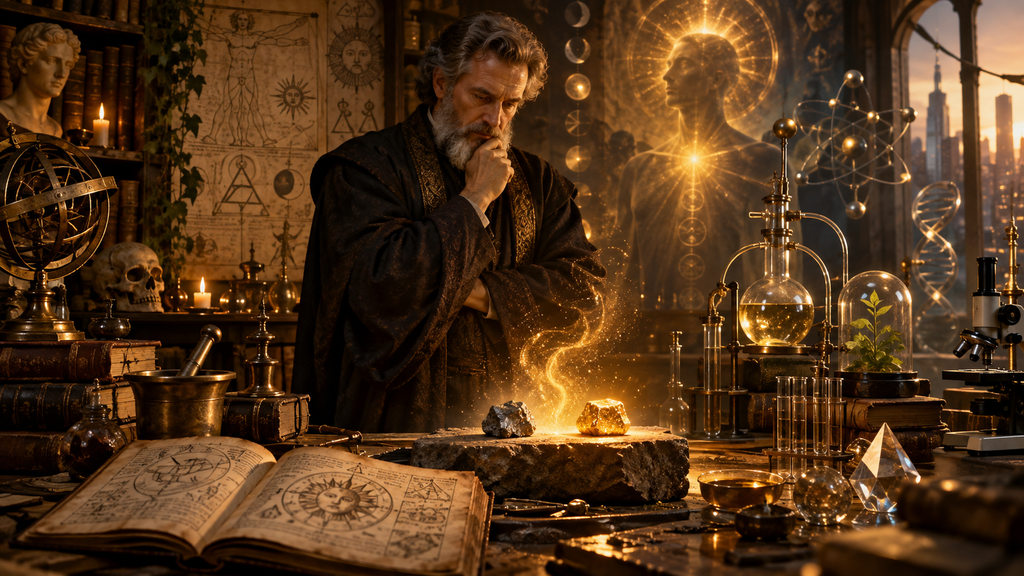
Alchemy seems, at first glance, like a dead science.
We imagine:
medieval laboratories,
strange symbols,
boiling flasks,
secret manuscripts,
the Philosopher’s Stone,
and mysterious men trying to turn lead into gold.
Modern chemistry appears to have replaced all of that.
We understand atoms.
We have the periodic table.
We can identify chemical reactions precisely.
No modern chemist needs to invoke Mercury, Sulfur and mystical correspondences to explain ordinary laboratory processes.
So has alchemy become useless?
Not exactly.
In fact, alchemy remains surprisingly relevant today—but not always for the reasons the original alchemists expected.
Alchemy survives in at least three important ways:
as an ancestor of modern chemistry,
as a symbolic language for psychological and spiritual transformation,
and as a philosophy of transformation itself.
And strangely enough, modern nuclear physics has even accomplished one of the old alchemists’ impossible dreams:
scientists can literally transform one element into another—including lead into gold.
The irony is that doing so is far more difficult and expensive than simply buying gold.
So perhaps modern science completed part of the alchemical experiment while leaving its deeper spiritual question untouched:
Can the person performing the transformation also be transformed?
What Was Alchemy Actually Trying to Do?
Popular culture reduces alchemy to one objective:
turn lead into gold.
That was certainly important.
But historical alchemy was much broader.
Alchemists experimented with:
metals,
minerals,
pigments,
medicines,
distillation,
fermentation,
acids,
salts,
glass,
and numerous other substances.
The Science History Institute describes alchemy as an important part of the heritage of chemistry, involving practical experimentation alongside philosophical, theological and commercial goals. Alchemists contributed to areas including metallurgy, pharmacy and material processing.
Alchemy therefore existed at an unusual intersection.
It was simultaneously:
science,
craft,
medicine,
philosophy,
spirituality,
and symbolism.
The modern separation between chemistry and mysticism simply did not yet exist in the same way.
Alchemists Were Genuine Experimenters
We should therefore avoid imagining every alchemist as a deluded magician.
Alchemy helped develop practical laboratory knowledge.
Historical alchemists learned how to:
distill substances,
separate metals,
control heat,
produce pigments,
create medicines,
work with acids,
and manufacture glass and other materials.
The Science History Institute’s current historical work emphasizes that alchemists carried out real chemical transformations and developed processes such as distillation long before chemistry emerged as a distinct modern science.
Even figures associated with the Scientific Revolution participated in alchemy.
Robert Boyle—often remembered as an important founder of modern chemistry—was seriously involved in alchemical research. The Royal Society preserves a 1676 alchemical paper published by Boyle under a pseudonym.
Isaac Newton also devoted considerable attention to alchemy.
The clean historical story in which:
alchemy was superstition, then science arrived and replaced it
is therefore too simple.
Modern chemistry partly grew out of alchemical practice.
So Is Laboratory Alchemy Still Useful?
If by alchemy you mean:
“Should modern laboratories return to medieval theories of matter?”
then generally no.
Modern chemistry explains substances and reactions far more accurately.
We understand elements through:
atomic number,
electrons,
nuclear structure,
chemical bonding,
thermodynamics,
and quantum mechanics.
The old alchemical theories are no longer competitive scientific explanations of matter.
Trying to make medicines according to unsupported ancient alchemical claims instead of modern pharmacology could also be dangerous.
So literal alchemy should not replace chemistry.
But its historical methodology still teaches something valuable.
The alchemist approached matter with the assumption:
Things can be transformed.
That idea remains at the heart of chemistry.
Modern Chemistry Is Alchemy Without the Mystical Cosmology
Consider what modern chemists do.
They take substances.
Heat them.
Cool them.
Separate them.
Combine them.
Purify them.
Dissolve them.
Crystallize them.
Change their properties.
Create entirely new compounds.
That would look astonishingly alchemical to someone living a thousand years ago.
The chemical industry now produces:
medicines,
plastics,
fertilizers,
semiconductors,
battery materials,
synthetic fibers,
dyes,
and thousands of other materials through controlled transformation.
Alchemy’s great fascination was:
How much hidden potential does matter contain?
Modern chemistry answered:
An extraordinary amount.
The Science History Institute even describes alchemy and chemistry as interconnected historical stories rather than completely separate traditions.
And We Actually Can Turn Lead Into Gold
Here history becomes beautifully ironic.
Medieval alchemists lacked one crucial insight.
Chemical reactions change electrons and molecular arrangements.
But an element’s identity depends on the number of protons inside its nucleus.
Lead has 82 protons.
Gold has 79.
So ordinary chemistry cannot turn lead into gold.
To do that, you must alter the atomic nucleus.
Modern nuclear physics can.
In 2025, CERN’s ALICE collaboration reported measurements of lead nuclei being converted into gold nuclei during near-miss collisions at the Large Hadron Collider.
So technically:
the dream of elemental transmutation was not impossible.
The alchemists simply lacked nuclear physics.
But there is a catch.
Producing gold this way is spectacularly impractical.
The quantities are tiny.
The equipment costs vastly more than the gold produced.
So modern science solved the alchemical problem—and simultaneously demonstrated why it was never going to make anyone rich.
That is almost an alchemical joke worthy of the old masters.
Perhaps the Real Gold Was Never Gold
This brings us to the more interesting interpretation.
Alchemy gradually accumulated an enormous symbolic dimension.
Lead represented something:
heavy,
dark,
impure,
undeveloped.
Gold represented:
incorruptibility,
perfection,
illumination,
the Sun,
the highest state.
The question therefore becomes:
Was the transformation of lead into gold also a metaphor for transforming the human being?
Not every historical alchemist understood the work primarily in this psychological way, and we should be careful not to project modern ideas backward onto all of them.
But alchemical literature unquestionably developed rich spiritual and philosophical interpretations of transformation.
The laboratory became a mirror.
As matter was purified, perhaps the alchemist was also supposed to become purified.
Jung Rediscovered Alchemy as Psychology
One of the most influential modern revivals of alchemy came through psychiatrist Carl Jung.
Jung spent years studying alchemical manuscripts.
Why would a twentieth-century psychologist care about medieval experiments involving furnaces and metals?
Because Jung believed the symbols described something happening inside the human psyche.
He interpreted alchemical transformation as a symbolic parallel to individuation—the process through which fragmented parts of the personality become integrated into a more complete self.
Jungian scholarship describes his reading of the Philosopher’s Stone as analogous to the discovery of a deeper psychic center, while the transformation of base material into gold became a symbolic image of psychological integration.
This may be where alchemy becomes most relevant for modern spirituality.
Lead as the Untransformed Self
Imagine yourself as the alchemical material.
Your “lead” might include:
anger,
fear,
trauma,
jealousy,
shame,
ego,
addiction,
confusion,
unconscious habits.
The objective is not to throw these things away.
Alchemy teaches something subtler:
transform them.
Anger can become courage.
Fear can become caution and wisdom.
Pain can become compassion.
Sexual energy can become creativity.
Ambition can become disciplined purpose.
Isolation can become contemplative solitude.
The base material already contains energy.
The work involves refining that energy.
That may be one of alchemy’s greatest spiritual lessons.
Nigredo: The Blackening
One of the best-known symbolic stages of alchemy is nigredo, the blackening.
It is associated with:
decomposition,
darkness,
breakdown,
decay,
and dissolution.
Spiritually, nigredo can represent the moment when the existing personality stops working.
Depression.
Loss.
Failure.
Identity crisis.
A relationship ending.
A career collapsing.
A worldview breaking apart.
Everything seems to be getting worse.
But in alchemical symbolism, decomposition is not necessarily the end.
It may be the beginning of transformation.
Something must sometimes lose its old form before a new form becomes possible.
The Spiritual Value of the Dark Phase
Modern culture constantly tells us:
feel better,
recover quickly,
stay positive,
keep moving.
Alchemy offers almost the opposite wisdom.
Sometimes the black stage needs to happen.
The old identity may need to die symbolically.
You may need to admit:
this relationship is finished,
this belief was wrong,
this career no longer fits,
this part of me cannot continue.
That can feel like failure.
But the alchemical interpretation asks:
What is decomposing—and what might eventually emerge from it?
This makes alchemy a surprisingly useful framework for difficult life transitions.
Albedo: Washing and Clarification
After darkness comes albedo, commonly associated with whitening or purification.
Symbolically, this can represent:
clarity,
cleansing,
reflection,
discernment.
After something collapses, you begin separating what matters from what does not.
Perhaps you start:
meditating,
going to therapy,
simplifying life,
changing habits,
setting boundaries,
or seeing yourself more clearly.
The emotional chaos begins settling.
You can finally distinguish:
what belonged to you,
what belonged to someone else,
what was ego,
what was fear,
what actually matters.
This is psychological purification.
Citrinitas: The Dawning Light
Some alchemical systems include citrinitas, the yellowing.
It represents something like dawn.
Insight begins appearing.
The person does not merely understand what went wrong.
They begin understanding what comes next.
The darkness produced wisdom.
You begin seeing:
why the experience happened,
what it revealed,
what you need to change.
The Sun begins rising internally.
Rubedo: The Reddening
Then comes rubedo, the reddening.
This can symbolize integration or completion.
The transformed insight becomes embodied.
You no longer merely understand something intellectually.
You live differently.
Someone who intellectually understands boundaries has not completed the process.
Someone who calmly says:
“No, I won’t participate in this anymore.”
has embodied the insight.
Rubedo is therefore not:
“I had a spiritual realization.”
It is:
“The realization changed how I live.”
That makes alchemy surprisingly practical.
The Philosopher’s Stone as the Integrated Self
The legendary Philosopher’s Stone supposedly possessed extraordinary powers.
Most famously, it could transform base metals into gold.
It was also sometimes associated with healing or the elixir of life.
In psychological symbolism, the Stone becomes something very different.
It represents the stable center produced after repeated transformation.
You are no longer endlessly thrown around by:
desire,
fear,
approval,
rejection,
and circumstance.
Something solid has formed.
Jung interpreted the Stone in connection with the emergence of the integrated Self.
Perhaps the symbolic Philosopher’s Stone is therefore:
the part of you that remains centered regardless of what is happening outside.
Solve et Coagula: Dissolve and Re-form
One of alchemy’s most useful principles is often summarized by the Latin expression:
solve et coagula
—dissolve and coagulate.
Break something apart.
Then re-form it differently.
This pattern appears everywhere.
Muscle training:
break down → rebuild stronger.
Therapy:
deconstruct belief → reconstruct identity.
Meditation:
observe ego → loosen identification → develop greater awareness.
Business:
old model fails → restructure.
Relationships:
old dynamic breaks → establish healthier one.
Spirituality:
old worldview collapses → deeper worldview emerges.
Alchemy recognizes that transformation is not simply adding something new.
Often you must first dissolve the existing structure.
This Makes Alchemy Highly Relevant to Personal Development
Much modern self-help focuses on acquisition.
Gain confidence.
Gain money.
Gain skills.
Gain relationships.
Gain followers.
Alchemy offers a different question:
What must be removed, purified or transformed?
Maybe you don’t need more motivation.
Maybe you need less distraction.
Maybe you don’t need another relationship.
Maybe you need to transform your fear of solitude.
Maybe you don’t need more information.
Maybe you need to digest the information you already have.
Alchemy is therefore not merely about accumulation.
It is about refinement.
Gold is not valuable because there is more material.
Gold represents purified material.
Alchemy and Meditation
Alchemy also maps surprisingly well onto meditation.
Sit long enough and you begin encountering your own raw material.
Thoughts.
Cravings.
Memories.
Irritation.
Fantasy.
Fear.
The meditator essentially places consciousness inside a psychological vessel.
Heat is applied through sustained attention.
Patterns begin revealing themselves.
At first the process can become uncomfortable.
That resembles nigredo.
Then greater clarity appears.
Albedo.
Insight develops.
Citrinitas.
Eventually the practice may integrate into daily behaviour.
Rubedo.
The analogy is not historically exact across all traditions, but spiritually it works remarkably well.
The Alchemical Furnace as Spiritual Discipline
Alchemy required a vessel capable of containing heat.
Symbolically, a person also requires a container for transformation.
That container may be:
meditation,
therapy,
religious practice,
a disciplined routine,
martial arts,
yoga,
creative work,
or even a difficult project.
Without a container, emotional energy simply scatters.
With discipline, the same energy can cook.
This is another important alchemical idea:
Transformation requires both heat and containment.
Heat without containment produces chaos.
Containment without heat produces stagnation.
Relationships Can Be Alchemical Vessels
Relationships can also perform this function.
Someone irritates you.
Jealousy emerges.
Attachment appears.
Fear surfaces.
You discover unconscious parts of yourself that solitude never revealed.
The other person becomes an alchemical reagent.
They trigger material.
What happens next determines whether transformation occurs.
You can project everything outward:
“They are the problem.”
Or ask:
“Why did this affect me so strongly?”
The relationship then becomes a laboratory for consciousness.
The Sacred Marriage: Coniunctio
Another powerful alchemical symbol is the coniunctio, the union of opposites.
Sun and Moon.
Male and female.
King and queen.
Sulfur and Mercury.
Spirit and matter.
Jung found this especially important because psychological development often involves integrating things we falsely treat as opposites.
Strength and compassion.
Reason and intuition.
Masculine and feminine qualities.
Body and spirit.
Individuality and relationship.
Darkness and light.
The mature person is not necessarily someone who destroyed one side.
They found a way for apparently conflicting elements to coexist within a larger whole.
That is spiritual alchemy.
Alchemy May Be Especially Relevant in an Age of Extremes
Modern society often encourages polarization.
Choose:
science or spirituality.
masculine or feminine.
capitalism or socialism.
tradition or progress.
individualism or community.
Alchemy has a different instinct:
What happens when opposites interact?
The goal is not always compromise.
Sometimes contact between opposites creates an entirely new state.
Hydrogen and oxygen are both gases.
Combine them correctly and you get water.
The product has qualities neither ingredient possessed alone.
That is almost the definition of an alchemical worldview:
true transformation creates something more than the sum of its ingredients.
Alchemy and Creativity
Artists frequently experience this.
An unpleasant emotion becomes:
music.
A breakup becomes:
poetry.
Trauma becomes:
a novel.
Anger becomes:
painting.
Loneliness becomes:
a game world.
Something psychologically “base” becomes aesthetically valuable.
That is almost literal emotional alchemy.
The original experience does not disappear.
It is transformed into another form.
Alchemy and Shadow Work
Alchemy also maps naturally onto what modern spiritual communities call shadow work.
The mistake in shadow work is thinking:
I need to remove everything dark inside me.
Alchemy suggests a more interesting approach.
The darkness may contain raw material.
Aggression can contain:
assertiveness.
Jealousy can reveal:
desire.
Fear can reveal:
what matters.
Narcissism can conceal:
deep insecurity.
The shadow cannot simply be thrown away.
It must be examined, separated and transformed.
Lead becomes gold.
Not by pretending lead never existed.
Can Alchemy Still Be Practiced Literally?
Yes—but the answer depends on what we mean.
Someone can reconstruct historical alchemical experiments.
Historians of science do this.
Modern scholars have recreated historical laboratory processes to understand what alchemists actually observed, and contemporary scholarship has shown that many reported alchemical procedures involved real chemical transformations.
That kind of experimental history is extremely useful.
Likewise, artists and craftspeople can study historical techniques involving:
pigments,
glass,
metallurgy,
and distillation.
But if someone claims:
“I have discovered a secret medieval chemical formula that will cheaply transform kilograms of lead into gold,”
extraordinary skepticism is justified.
Modern nuclear physics explains why ordinary chemical reactions cannot accomplish that.
The Elixir of Life Also Survives—In a Different Form
Another major alchemical goal was extending life.
The legendary elixir promised extraordinary longevity or immortality.
Modern medicine has not discovered immortality.
But consider what modern science actually does:
vaccinations,
antibiotics,
surgery,
cancer therapy,
organ transplantation,
public sanitation,
blood-pressure medication.
Millions of people live longer because chemistry and medicine succeeded in ways an alchemist would have considered miraculous.
So again, part of the alchemical dream survives—but through science rather than magic.
The search for longevity has simply moved into:
biogerontology,
genetics,
regenerative medicine,
and molecular biology.
Where Modern Alchemy Becomes Dangerous
Alchemy becomes less useful when symbolism is confused with chemistry.
For example:
Mercury may symbolize transformation in an esoteric system.
Physical mercury is also a toxic element.
Lead may have spiritual symbolism.
Physical lead can poison you.
Historical alchemical substances may contain:
arsenic,
mercury,
lead,
antimony,
or corrosive chemicals.
Trying to recreate laboratory alchemy without appropriate chemical knowledge can be dangerous.
Spiritual symbolism should never override material reality.
In fact, that itself could be considered an alchemical lesson:
Respect matter for what it actually is.
Do Not Drink the Symbol
This is perhaps the simplest rule for modern spiritual alchemy.
If an old book says a substance represents immortality, that does not mean swallowing it will make you immortal.
Use the symbol symbolically.
Use chemistry chemically.
Alchemy’s modern value comes largely from recognizing which level you are working on.
Alchemy as a Philosophy of Transformation
Perhaps this is where alchemy remains most useful.
Alchemy teaches that nothing has to remain in its current form.
Matter changes.
People change.
Relationships change.
Pain can change.
Identity can change.
But transformation requires a process.
First:
recognize the raw material.
Then:
contain it.
Apply heat.
Separate what does not belong.
Purify.
Combine.
Integrate.
Repeat.
That is a remarkably sophisticated model of personal development.
The Alchemist Does Not Throw Away the Lead
This may be the deepest lesson of all.
Modern spirituality sometimes tries to become “high vibration” by rejecting everything unpleasant.
No anger.
No ego.
No sadness.
No sexuality.
No darkness.
Alchemy would find that suspicious.
Because the alchemist needs base material.
The work begins precisely with what appears impure.
You do not become whole by pretending the shadow does not exist.
You become whole by transforming your relationship with it.
Perhaps that is why Jung became so fascinated with alchemy.
It offers a spirituality that does not require escaping matter.
Instead:
matter itself becomes the site of transformation.
So Is Alchemy Still Relevant Today?
As literal chemistry?
Mostly no.
Modern chemistry and physics have replaced alchemical theories as scientific explanations of matter.
As history?
Absolutely.
Alchemy was deeply involved in the emergence of experimental chemistry and materially contributed to techniques involving distillation, metallurgy, pharmacy and manufacturing.
As psychology?
Very much so.
Jung’s use of alchemical symbolism gave modern psychology a powerful vocabulary for integrating unconscious material and understanding transformation.
As spirituality?
Perhaps more than ever.
Alchemy provides an unusually rich model for working with:
shadow,
pain,
ego,
desire,
relationships,
failure,
and personal transformation.
Its usefulness comes not from pretending medieval science is superior to modern science.
It comes from understanding the extraordinary metaphor the alchemists left behind.
The Greatest Alchemical Experiment Is Still Running
The medieval alchemist stood over a furnace asking:
Can this substance become something higher?
Modern science eventually learned to transform matter with a precision the alchemists could barely imagine.
We split atoms.
Rearrange molecules.
Synthesize new materials.
And yes—even produce tiny amounts of gold from other elements.
But the older question remains strangely unresolved.
Can:
fear become wisdom?
pain become compassion?
anger become courage?
ego become consciousness?
confusion become clarity?
Can the human being become something more refined than the person who entered the laboratory?
Perhaps that is why alchemy refuses to disappear.
The chemistry became chemistry.
The medicine became medicine.
The metallurgy became materials science.
The nuclear transmutation became physics.
But the symbol survived.
Because human beings still possess lead.
And we are still trying to discover what inside us can become gold.