
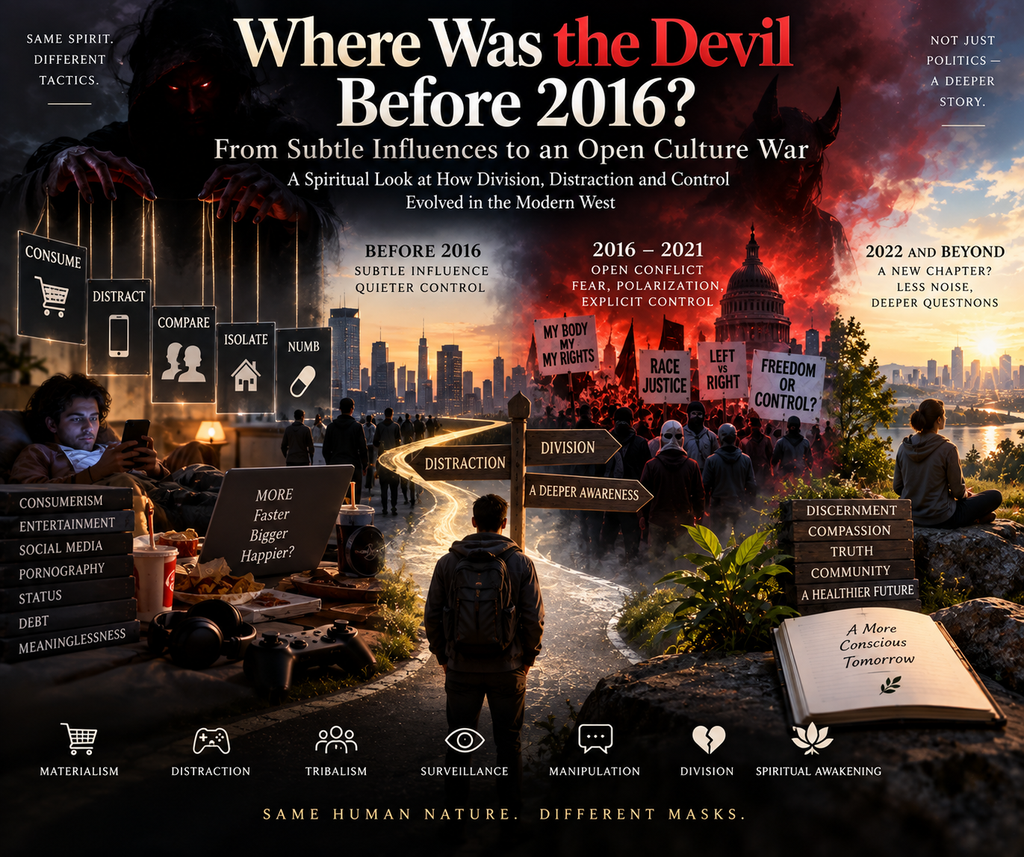
When people think of evil in historical terms, they often imagine something dramatic: war, famine, dictatorship, persecution, social collapse, or open violence.
But what happens in a prosperous society where those conditions are comparatively rare?
If the Devil is understood symbolically as an archetype of division, deception, temptation, inversion, domination, and separation from one’s higher nature, then evil would not necessarily need to appear openly. In a stable society, its most effective forms might be almost invisible.
Instead of attacking civilization directly, it could work through:
distraction,
consumerism,
envy,
addiction,
loneliness,
materialism,
social comparison,
cynicism,
and the gradual weakening of community.
By the time the political polarization of the late 2010s became impossible to ignore, many of these forces had already been developing for decades.
Perhaps the years before 2016 were not spiritually calmer because destructive influences were absent.
Perhaps they were simply better disguised.
Evil Does Not Always Need Chaos
A society does not need to be collapsing in order for people to become spiritually unhealthy.
In fact, comfort can create its own vulnerabilities.
When basic survival becomes relatively secure, human attention shifts toward:
status,
pleasure,
recognition,
consumption,
entertainment,
and comparison.
The battlefield moves inward.
Rather than controlling people primarily through physical force, a society can increasingly shape behavior through desire.
This is an important spiritual distinction.
Fear says:
“Do this or you will suffer.”
Temptation says:
“Do this and you will finally be satisfied.”
The second can be much harder to recognize.
Consumerism: The Endless Promise of Completion
One of the strongest pre-2016 spiritual forces was consumerism.
Modern advertising depends upon a simple psychological mechanism:
something is missing.
Perhaps you are not:
attractive enough,
successful enough,
interesting enough,
comfortable enough,
young enough,
or socially impressive enough.
Then a product appears.
Buy this and the feeling of incompleteness may disappear.
For a while, perhaps it does.
Then another desire appears.
This creates an endless cycle:
lack → consumption → temporary satisfaction → new lack.
From a spiritual perspective, this closely resembles traditional warnings about craving.
The object changes.
The underlying mechanism does not.
The person continually searches outside themselves for the feeling of completion that no purchase can permanently provide.
Material Success Became a Substitute for Meaning
Western prosperity also encouraged another subtle equation:
successful life = materially successful life.
A good life increasingly became measured through:
income,
career,
property,
travel,
cars,
clothing,
and visible lifestyle.
Again, none of these things is inherently wrong.
Money provides freedom and security.
Comfort is valuable.
But spiritually, problems arise when means become ends.
A person begins working to live.
Then gradually begins living to work.
The career originally existed to support life.
Eventually life exists to support the career.
This is precisely the kind of inversion that religious traditions have repeatedly warned against.
The servant becomes the master.
Debt Made Desire Extend Into the Future
Consumer culture acquired another powerful tool:
credit.
People no longer needed to possess the money required for the lifestyle they desired.
Future income could be spent in advance.
This transformed desire psychologically.
Instead of:
“I cannot afford this yet.”
the question became:
“Can I manage the payment?”
Debt is economically useful when used intelligently.
But on a cultural level it can create a strange spiritual condition:
the future becomes obligated to the present.
A person may spend years working to repay desires already satisfied months or years earlier.
In that sense, consumption can begin owning time itself.
Advertising Became a Science of Insecurity
The advertising industry became increasingly sophisticated at understanding human psychology.
Marketing does not merely ask:
“What does this person need?”
It can ask:
“What does this person fear about themselves?”
A beauty advertisement may sell more than cosmetics.
It may sell freedom from feeling unattractive.
A luxury car can sell more than transportation.
It can sell status.
A fashion brand can sell belonging.
The spiritual danger lies not in the object itself but in the message underneath:
you are insufficient as you are.
Religious and contemplative traditions frequently teach almost the opposite:
your deepest worth cannot be purchased.
Consumer psychology thrives when people forget that.
Entertainment Became Continuous
Another major change occurred through entertainment.
Earlier generations certainly had:
television,
music,
movies,
games,
and nightlife.
But digital technology progressively removed periods in which stimulation simply stopped.
There was always:
another episode,
another website,
another game,
another video,
another message.
Eventually boredom itself began disappearing.
That sounds like progress.
But boredom has an overlooked spiritual function.
When stimulation stops, consciousness is forced to encounter itself.
Questions arise.
What am I doing with my life?
Why am I unhappy?
What do I actually want?
What am I avoiding?
Continuous entertainment can postpone those questions indefinitely.
Distraction Can Be More Effective Than Oppression
An authoritarian system must stop people from thinking forbidden thoughts.
A culture of unlimited distraction may achieve something similar without prohibition.
Nobody needs to tell you:
“Do not contemplate your life.”
There is simply always something more entertaining available.
That is a very subtle form of spiritual danger.
Nothing has been taken away.
Something has merely occupied the space where reflection might otherwise occur.
Internet Pornography Changed the Structure of Desire
The rise of internet pornography represents another major pre-2016 transformation.
Sexual imagery became:
instant,
private,
cheap,
and effectively unlimited.
Whatever moral position one takes toward pornography, its technological significance is enormous.
Historically, sexuality usually required some combination of:
courtship,
social interaction,
risk,
reciprocity,
and relationship.
Digital pornography separated sexual stimulation from most of those things.
Desire could increasingly be satisfied alone.
Spiritually, this raises an important question:
What happens when one of humanity’s strongest relational drives becomes increasingly detached from relationship?
Something that traditionally drew people toward another human being can become an isolated consumption experience.
Social Media Initially Looked Like Pure Connection
The early promise of social media was extremely attractive.
Reconnect with old friends.
Share photographs.
Find communities.
Meet people across the world.
All of those benefits were real.
But social media also introduced something psychologically unprecedented:
social approval became measurable.
Likes.
Followers.
Views.
Comments.
Shares.
Popularity was no longer merely sensed.
It could be counted.
The Persona Became Quantified
Carl Jung used the term persona for the social mask presented to the world.
Social media gave the persona a dashboard.
How many people responded?
How many people follow me?
How attractive does my life appear?
Suddenly people were not simply living experiences.
They were also imagining how the experiences would appear to observers.
A vacation could become:
both a vacation
and
content proving one had an interesting life.
The spiritual danger is subtle.
The external image begins competing with the internal experience.
Comparison Became Global
Before the internet, most people compared themselves primarily with those nearby.
Friends.
Coworkers.
Neighbors.
Family.
Social media expanded the comparison pool toward the entire planet.
Someone living an ordinary life could compare themselves daily with:
celebrities,
millionaires,
models,
entrepreneurs,
travel influencers,
and carefully edited versions of strangers’ lives.
The result can be:
envy,
insecurity,
resentment,
and chronic dissatisfaction.
Nothing tangible has happened to the person.
Their life may objectively be perfectly good.
But comparison can make abundance feel like deprivation.
Envy Is an Ancient Spiritual Problem
This is why the spiritual consequences of social media are not completely new.
Technology magnified an ancient weakness.
The biblical tradition warned about coveting.
Buddhist traditions warned about craving.
Other philosophies warned about comparison and vanity.
The smartphone did not invent these impulses.
It placed them on an industrial scale.
Smartphones Brought the Attention Economy Everywhere
The smartphone completed another transition.
The internet no longer remained on the computer.
It traveled inside the pocket.
Then:
into bed,
onto the dinner table,
onto public transportation,
into conversations,
and eventually into almost every quiet moment.
Companies discovered that human attention itself had enormous economic value.
The more time someone spent looking at a screen, the more opportunities existed to:
advertise,
collect data,
recommend content,
and shape future behavior.
Attention became a commodity.
Spiritually, this is significant because attention is also one of the foundations of consciousness.
Where attention goes, life follows.
The Most Valuable Resource Was Becoming the Mind
Money can be lost and recovered.
Time cannot.
Every hour consumed by something becomes an hour unavailable for something else.
Relationships.
Meditation.
Reading.
Exercise.
Creativity.
Silence.
Nature.
The attention economy therefore competes not merely for clicks.
It competes for pieces of human life.
That may be one of the most important spiritual developments of the pre-2016 era.
Surveillance Became Voluntary
Older visions of surveillance imagined something imposed from above.
Police files.
Informants.
Government cameras.
Modern digital surveillance evolved differently.
People willingly carried devices capable of recording enormous amounts of information about:
location,
interests,
purchases,
communication,
and behavior.
This happened primarily because the devices were extraordinarily useful.
Maps.
Messaging.
Photography.
Entertainment.
Banking.
Shopping.
The spiritual lesson is interesting:
control does not always arrive through something unpleasant.
Sometimes it arrives through convenience.
Convenience Can Create Dependency
Modern technology solved countless real problems.
But every removed difficulty can also weaken a corresponding ability.
Navigation becomes easier.
Memory becomes less necessary.
Entertainment becomes effortless.
Food can arrive without leaving home.
Communication requires almost no delay.
The larger spiritual question becomes:
At what point does convenience stop serving the person and begin shaping the person?
The answer is rarely obvious.
That is precisely why subtle temptations are difficult.
Loneliness Grew Inside a Connected Society
Perhaps one of the strangest contradictions of the digital era was that people became technologically connected while many traditional forms of community weakened.
Extended families became more geographically dispersed.
Religious participation declined in many places.
People changed cities more frequently.
Neighborhood relationships often became weaker.
Friendships increasingly moved online.
Someone could have:
hundreds of contacts,
thousands of followers,
and nobody they felt comfortable calling during a serious crisis.
This produced a particularly modern form of loneliness:
being surrounded by communication but lacking deep connection.
Isolation Creates Spiritual Vulnerability
Human beings need belonging.
When traditional belonging weakens, people search for substitutes.
Online communities.
Fan cultures.
Political movements.
Identity groups.
Subcultures.
These can provide genuine friendship and meaning.
But they can also make people vulnerable to tribalism.
A lonely person may attach intensely to any group that says:
“You belong with us.”
The need itself is not pathological.
It is human.
The question is what kind of community receives that need.
Cynicism Became a Form of Intelligence
Another important pre-2016 cultural current was cynicism.
To appear sophisticated often meant demonstrating that one could see through everything.
Religion?
Manipulation.
Politics?
Corruption.
Love?
Chemistry.
Charity?
Virtue signaling.
Marriage?
A contract waiting to fail.
Spirituality?
Superstition.
Cynicism can be valuable when it exposes hypocrisy.
But taken too far, it destroys the ability to believe in anything sincerely.
Nothing becomes sacred.
Everything becomes ironic.
Irony Can Protect the Ego From Belief
Believing deeply in something creates vulnerability.
You might be disappointed.
You might look foolish.
Irony provides protection.
If everything is a joke, nothing can break your heart.
But the cost is enormous.
A person can eventually lose the ability to experience:
devotion,
wonder,
reverence,
and commitment.
Spiritually, this may be one of the quieter paths toward nihilism.
Not:
“Nothing matters.”
But:
“Caring too much is embarrassing.”
The Crisis of Meaning Was Already Underway
Western societies became extraordinarily good at answering:
How?
How do we build faster computers?
How do we increase productivity?
How do we make transportation easier?
How do we entertain ourselves?
But technological societies are not automatically good at answering:
Why?
Why am I alive?
What constitutes a good life?
What obligations do I have?
What deserves sacrifice?
What should I do with suffering?
Traditional religions once supplied widely shared answers.
As their cultural authority weakened, many people gained freedom.
But freedom also meant constructing meaning individually.
Some succeeded.
Others drifted.
Politics Can Fill a Spiritual Vacuum
Human beings do not stop needing:
belonging,
moral purpose,
ritual,
heroes,
villains,
and narratives
simply because traditional religion declines.
Those psychological needs can migrate into secular systems.
Politics can begin functioning like religion.
Political figures become heroic or demonic.
Movements develop sacred language.
Disagreement becomes heresy.
Public apology becomes confession.
Expulsion from a community becomes excommunication.
This process was visible before 2016.
The later political polarization merely made it dramatically more obvious.
The Seeds of the Culture Wars Were Already Present
Arguments surrounding:
race,
gender,
sexuality,
immigration,
religion,
national identity,
and political correctness
did not begin in 2016.
They had been developing through universities, media, activist movements, conservative counter-movements, talk radio, cable news, and online communities for years.
What changed was partly scale.
The internet brought cultural arguments directly into everyone’s daily attention.
Issues previously discussed primarily by:
politicians,
academics,
journalists,
or activists
could suddenly consume ordinary social relationships.
Political Correctness Contained Two Opposing Possibilities
Political correctness itself illustrates how a concept can contain both a constructive and destructive expression.
At its healthiest:
consider the dignity of other people.
Do not casually humiliate someone.
Recognize that language affects social reality.
That is simply compassion.
But the same impulse can become:
fear of speaking,
public shaming,
ritualized language policing,
or status competition over ideological purity.
The spiritual distinction lies between:
compassion
and
control.
They can look superficially similar while operating through completely different energies.
Identity Can Become a Substitute for Character
Another subtle shift occurred when personal identity became increasingly central to public discourse.
Identity matters.
Race, sex, religion, nationality, and social background genuinely influence people’s experiences.
But spirituality has traditionally asked another question:
Who are you beneath the labels?
When identity becomes everything, the person risks becoming an abstraction.
People begin encountering:
a race,
a gender,
a political tribe,
or a demographic category
before encountering the individual human being.
That increases the possibility of division even when the stated intention is justice.
Division Rarely Announces Itself as Division
This is important.
Groups rarely say:
“Let us become more tribal.”
They usually say:
“We are defending justice.”
“We are defending freedom.”
“We are protecting our people.”
“We are correcting oppression.”
Some of those goals may be completely legitimate.
But moral certainty can still become psychologically dangerous when it produces:
dehumanization,
hatred,
or refusal to consider opposing evidence.
The spiritual temptation is believing:
our side possesses goodness itself.
Right and Left Both Have Shadows
A serious spiritual analysis cannot locate evil entirely within one political camp.
The left can fall into:
moral absolutism,
coercive conformity,
class or racial resentment,
and ideological purity tests.
The right can fall into:
nationalistic hostility,
conspiratorial thinking,
authoritarian nostalgia,
and resentment toward outsiders.
Different language.
Similar shadow mechanisms.
If the Devil symbolizes division, he does not particularly care whether division arrives wearing a progressive or conservative uniform.
The result is what matters.
The Post-9/11 Era Had Already Raised the Question of Freedom Versus Security
The political atmosphere before 2016 was also shaped profoundly by September 11, 2001 and the subsequent War on Terror.
Western societies debated:
surveillance,
military intervention,
torture,
terrorism,
civil liberties,
and national security.
The underlying question was already present:
How much freedom should society surrender in exchange for safety?
That tension became part of the cultural background long before later political crises.
It also normalized a much larger security infrastructure.
Fear Makes Exceptional Power Easier to Accept
This is an ancient political pattern.
During emergencies, people tolerate things they would resist under normal conditions.
Sometimes that is necessary.
Real emergencies require coordinated responses.
But emergency powers always create a spiritual and political question:
When does temporary necessity become permanent habit?
The early twenty-first century repeatedly forced Western societies to confront that tension.
The Financial Crisis Deepened Distrust
The 2008 financial crisis produced another important fracture.
People watched:
banks fail,
homes disappear,
employment collapse,
governments intervene,
and wealthy institutions receive extraordinary assistance.
Whatever one’s economic interpretation, the psychological consequence was substantial.
Trust declined.
A generation began asking whether institutions actually served ordinary people.
This distrust later became fertile ground for movements across both left and right.
The political explosions of the late 2010s therefore had economic roots as well as cultural ones.
The Devil as the Great Distractor
If all these threads are combined, perhaps the central pre-2016 spiritual archetype was not open domination.
It was distraction.
Keep the person:
busy,
entertained,
consuming,
comparing,
working,
scrolling,
desiring,
and worrying.
Not enough time remains to ask:
Who am I?
What actually matters?
What kind of relationships am I building?
Why am I doing any of this?
What happens when I die?
What do I owe other people?
What is sacred?
A person does not need to reject spirituality consciously.
They can simply become too occupied to encounter it.
The Devil as Fragmentation
Perhaps an even deeper theme is fragmentation.
Work becomes separated from meaning.
Sex becomes separated from intimacy.
Communication becomes separated from relationship.
Entertainment becomes separated from rest.
Political identity becomes separated from individual thought.
Technology becomes separated from conscious use.
People become surrounded by:
information
without necessarily possessing wisdom.
Connection
without necessarily possessing intimacy.
Choice
without necessarily possessing purpose.
This is spiritual fragmentation.
The Most Effective Cage Is One That Feels Like Freedom
That may be the defining paradox of the period.
People gained extraordinary freedom.
Choose almost any entertainment.
Buy almost anything.
Communicate with almost anyone.
Travel almost anywhere.
Construct almost any identity.
Yet unlimited choice can itself become exhausting.
Freedom without orientation can become drift.
A person may possess thousands of options and have no idea what deserves choosing.
Spiritual traditions historically supplied some form of compass.
When the compass disappears, freedom alone cannot tell someone where to go.
Before Open Polarization Came Quiet Disconnection
This may be the clearest way to understand the pre-2016 period spiritually.
The era was not primarily defined by people screaming at one another over politics.
Its deeper problems were quieter.
People became:
more stimulated,
more materially comfortable,
more technologically connected,
and simultaneously vulnerable to:
comparison,
addiction,
loneliness,
meaninglessness,
and shallow forms of connection.
The conflict was already occurring.
It simply happened largely inside the individual.
The Devil Did Not Need to Be Obvious
If the Devil is understood symbolically as the force that separates human beings from:
truth,
one another,
their deeper nature,
and ultimately the sacred,
then perhaps open evil is actually the less sophisticated method.
The more elegant method is to make spiritual disconnection feel completely ordinary.
Do not tell people:
“Reject your soul.”
Tell them:
“Check one more notification.”
Do not say:
“Forget your family.”
Say:
“You’re too busy this week.”
Do not say:
“Become envious.”
Show them someone else’s perfect life.
Do not say:
“Worship material possessions.”
Say:
“You deserve an upgrade.”
Do not say:
“Become isolated.”
Give them unlimited digital connection without intimacy.
Do not say:
“Nothing matters.”
Simply keep them entertained long enough that they never seriously ask what does.
That is subtlety.
The Spiritual Lesson of the Pre-2016 Era
The great spiritual problem of the period may therefore have been unconscious participation.
Most destructive systems did not require overt coercion.
People participated because the systems offered real benefits.
Consumerism offered comfort.
Technology offered connection.
Entertainment offered pleasure.
Credit offered access.
Social media offered community.
Convenience offered freedom from effort.
None of these things was inherently evil.
The danger appeared when the tool quietly became the master.
That is why spiritual discernment matters.
The correct question is rarely:
“Is this thing evil?”
A better question is:
“What is this doing to my consciousness over time?”
Does it make me:
more awake or more distracted?
more grateful or more envious?
more connected or more isolated?
more free or more dependent?
more compassionate or more tribal?
more human or more performative?
Those questions reveal far more than the surface appearance.
Perhaps the Devil Was Hiding in Normality
Before the political temperature rose, destructive tendencies may have been easiest to overlook precisely because they looked so normal.
Go to work.
Buy things.
Watch television.
Scroll.
Compare.
Upgrade.
Repeat.
There is nothing dramatic enough to inspire a rebellion.
But spiritually, a life can become empty through a thousand perfectly ordinary decisions.
That may be one of the deepest lessons of the era.
Evil does not always arrive announcing itself as evil.
Sometimes it arrives as:
convenience,
status,
entertainment,
comfort,
and distraction.
Its success lies not in making people obviously miserable.
It lies in keeping them occupied enough that they never notice what is missing.
And perhaps that is the clearest answer to the question:
Where was the Devil before 2016?
Not necessarily hiding inside one government, party, or ideology.
But symbolically present wherever human beings gradually surrendered:
attention,
meaning,
community,
discernment,
and inner freedom
without realizing that they were giving anything away.
Category: Spirituality & Modern Society