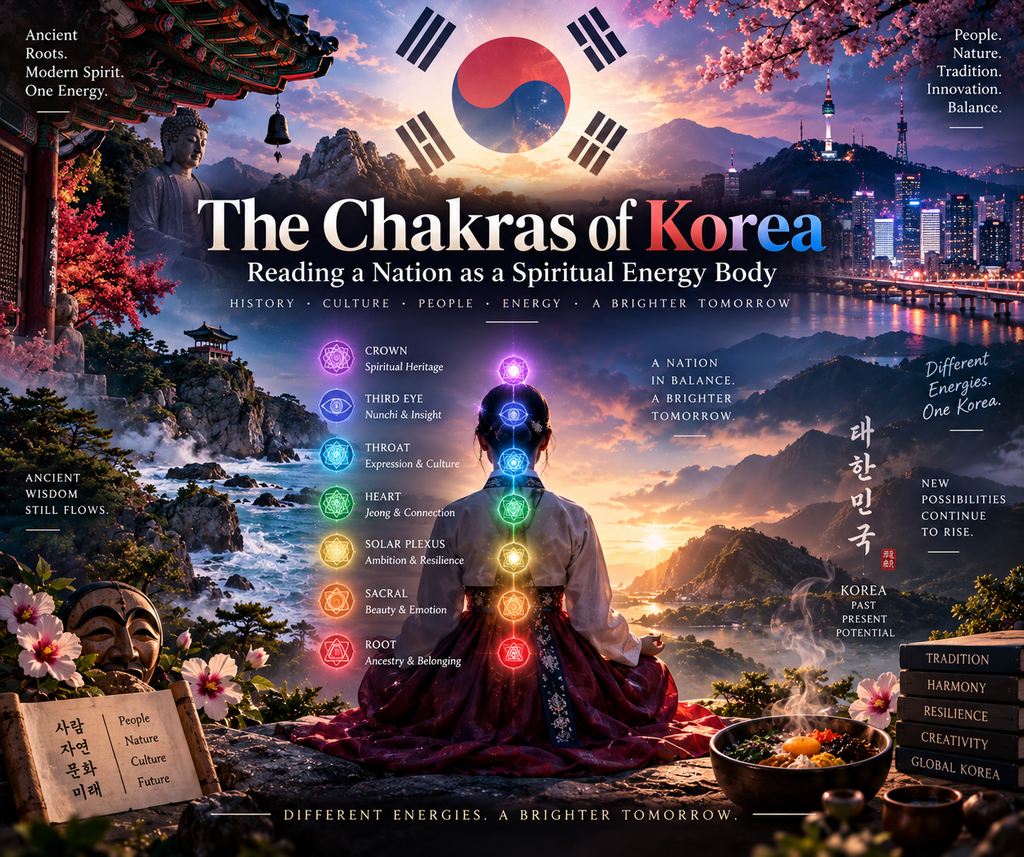
A country can be understood in many ways.
Politically.
Economically.
Historically.
Culturally.
But there is also a more symbolic possibility:
What if a civilization can be read almost like a human energy body?
The Indian chakra system describes seven major centers representing different dimensions of human existence—from physical survival and sexuality to communication, intuition and spiritual transcendence.
Korea does not traditionally organize its culture around the Indian seven-chakra system. Korean spirituality developed through its own mixture of:
shamanism,
Buddhism,
Confucianism,
Daoist ideas,
ancestor reverence,
folk religion,
and modern Christianity.
So it would be historically inaccurate to say that Koreans traditionally understood their country through chakras.
But as a modern spiritual metaphor, the comparison becomes surprisingly revealing.
Korea is a particularly interesting country to read this way because it contains enormous contrasts.
Ancient temples beside skyscrapers.
Strict hierarchy beside hypermodern technology.
Collectivism beside fierce personal ambition.
Emotional restraint beside intense romance.
Confucian seriousness beside K-pop flamboyance.
Military discipline beside beauty culture.
Mountain spirituality beside neon nightlife.
Rather than contradictions, perhaps these represent different energy centers of the Korean collective psyche.
And when those centers become balanced—or unbalanced—they reveal something fascinating about Korea’s spiritual character.
A Nation Can Have an Energy Pattern
When we describe a place as having:
good energy,
heavy energy,
fast energy,
romantic energy,
competitive energy,
or peaceful energy,
we are already speaking symbolically.
We do not necessarily mean that scientists have measured a literal chakra underneath Seoul.
We mean that environments produce recognizable psychological and emotional patterns.
Cities certainly do.
Countries do too.
A culture trains millions of people to value certain behaviors repeatedly.
Those behaviors generate an atmosphere.
Over generations, the atmosphere becomes almost like a collective personality.
In Jungian language, we might call aspects of this a collective psyche.
Using chakra language, we could call it an energy body.
Root Chakra: Korea’s Deep Need for Belonging
The root chakra — Muladhara concerns:
survival,
security,
ancestry,
home,
tribe,
and belonging.
Korea’s root chakra may be one of its strongest centers.
Korean identity is deeply connected with:
family lineage,
ancestral roots,
homeland,
regional identity,
age hierarchy,
and belonging to groups.
The individual rarely exists entirely alone.
You belong to:
a family,
a school,
a workplace,
a generation,
a neighborhood,
a hometown,
a military cohort,
or a friendship circle.
Even language constantly reminds people where they stand relationally.
Are you older?
Younger?
Senior?
Junior?
Close enough to speak casually?
The root chakra asks:
“Where do I belong?”
Korean society asks that question constantly.
Ancestors Strengthen the Korean Root
Ancestor reverence deepens this even further.
Traditional Korean rites such as jesa connect the living family with previous generations.
Spiritually, this creates an unusually strong vertical root.
You do not simply belong to the people alive around you.
You belong to a lineage extending backward.
The family tree becomes almost like an energetic root system.
The message is:
You did not begin with yourself.
That is profoundly root-chakra oriented.
Korea’s Root Trauma
But Korea’s root chakra also contains historical trauma.
Colonial occupation.
War.
National division.
Poverty.
Displacement.
Rapid reconstruction.
The Korean War literally tore the ancestral homeland into two political systems.
Families were separated.
Cities were destroyed.
Millions experienced insecurity.
That can create a collective root-chakra response:
survive first.
Build.
Work.
Study.
Protect the family.
Become economically strong.
Never become vulnerable again.
Modern Korean intensity may partly grow from that survival memory.
The Root Chakra Became Hyperactive
A strong root creates:
loyalty,
community,
stability,
and resilience.
But an overactive root can create:
fear of exclusion,
conformity,
tribalism,
status anxiety,
and excessive attachment to social approval.
This may help explain why belonging can sometimes feel so important in Korea.
Being outside the group can feel unusually uncomfortable.
A person may think:
What will everyone think?
Do I fit?
Am I behaving appropriately?
Have I embarrassed the group?
The root chakra protects community.
But too much root can make the tribe feel like a cage.
Sacral Chakra: Korea’s Suppressed Sensuality
The sacral chakra — Svadhisthana concerns:
pleasure,
sexuality,
creativity,
emotion,
sensuality,
and flow.
Korea’s sacral chakra is fascinating because it sometimes appears simultaneously highly active and highly controlled.
Consider modern Korean culture.
Fashion.
Beauty.
Dating.
Romance dramas.
K-pop choreography.
Cosmetics.
Photography.
Cafés.
Nightlife.
Food.
Visual aesthetics.
There is enormous sensual creativity.
And yet traditional Korean culture has historically been comparatively conservative about overt sexuality.
So the sacral energy often emerges indirectly.
Through:
fashion,
romantic tension,
beauty,
dance,
flirtation,
food,
music,
and aesthetic presentation.
The energy is clearly there.
But it has often been channeled into culturally acceptable forms.
Korean Romance Is Extremely Sacral
Korean romantic culture frequently ritualizes intimacy.
Couple rings.
Anniversaries.
100-day celebrations.
Matching clothing.
Café dates.
Flowers.
Carefully staged romantic gestures.
There is an almost ceremonial quality to romance.
This is sacral-chakra energy given social structure.
Rather than sexuality existing only as physical desire, it becomes:
emotion,
symbolism,
memory,
aesthetic expression,
and relationship ritual.
That makes the Korean sacral chakra especially interesting.
It is not simply erotic.
It is romanticized desire.
Spicy Food and Sacral Fire
Even Korean food carries an unusual sensory intensity.
Spicy flavors.
Fermentation.
Heat.
Strong smells.
Shared dishes.
Food is highly social and sensory.
The common Korean question:
“Have you eaten?”
can function almost like emotional care expressed through the body.
This connects sacral nourishment with heart energy.
Food becomes affection.
Pleasure becomes relationship.
Solar Plexus: Korea’s Enormous Drive to Achieve
If there is one chakra that appears almost unmistakably strong in modern South Korea, it may be the solar plexus — Manipura.
This chakra represents:
will,
ambition,
discipline,
achievement,
competition,
status,
and personal power.
South Korea transformed itself in only a few generations from a war-devastated and relatively poor country into one of the world’s major industrial and technological economies.
That requires extraordinary collective will.
The Korean solar plexus says:
Work harder.
Study harder.
Improve.
Compete.
Do not fall behind.
This energy appears everywhere.
Education.
Corporate life.
Beauty.
Technology.
Sports.
Gaming.
Entertainment.
Even hobbies can become competitive.
Ppalli-Ppalli Is Solar Plexus Energy
The famous Korean ppalli-ppalli culture—“quickly, quickly”—could almost be read as a solar-plexus mantra.
Move.
Finish.
Improve.
Deliver.
Optimize.
Do not waste time.
That mentality helped create extraordinary economic development.
But overactivation has a cost.
A solar plexus that never rests can become:
anxiety,
perfectionism,
burnout,
status obsession,
and fear of failure.
Korea’s tremendous strength may therefore also produce some of its greatest pressures.
Heart Chakra: Jeong
If one Korean concept maps especially beautifully onto the heart chakra, it may be jeong — 정.
Jeong is difficult to translate precisely.
It can involve:
affection,
attachment,
warmth,
bonding,
shared history,
and emotional connection built gradually over time.
Jeong is not always dramatic love.
It is often something quieter.
You have eaten together.
Worked together.
Struggled together.
Known each other for years.
Something accumulates.
That accumulated emotional bond becomes jeong.
The heart chakra does something similar.
It transforms relationship from:
exchange
into:
connection.
Jeong Often Exists Beneath Korean Reserve
Korean social behavior can sometimes appear restrained or formal initially.
But once someone enters the inner circle, considerable warmth may emerge.
Food is shared.
People look after one another.
Friends may become deeply involved in one another’s lives.
This creates an interesting pattern.
The heart is not necessarily displayed immediately.
It is protected.
Trust opens it.
So Korea’s heart chakra may be less outwardly expressive than some Western cultures but exceptionally powerful after relational security develops.
The Shadow Side of Jeong
Heart attachment can also become difficult.
Jeong may keep people emotionally connected even after a relationship has become unhealthy.
People can feel obligation because of:
history,
family,
loyalty,
or shared hardship.
The heart says:
“We have too much history simply to walk away.”
That can be beautiful.
It can also become emotionally binding.
Again, every chakra contains both gift and shadow.
Throat Chakra: Korea’s Complicated Relationship With Expression
The throat chakra — Vishuddha concerns:
speech,
truth,
expression,
communication,
and having a voice.
Korea presents an intriguing paradox here.
Modern Korea is extraordinarily expressive.
K-pop.
Film.
Television.
Internet culture.
YouTube.
Fashion.
Gaming.
Online communities.
Yet traditional social communication can be highly contextual.
Age matters.
Hierarchy matters.
Tone matters.
Who is speaking matters.
Who is listening matters.
One does not always say everything directly.
Instead, communication involves nunchi.
Nunchi Can Replace Direct Speech
Nunchi is the ability to sense:
atmosphere,
social dynamics,
unspoken expectations,
and other people’s feelings.
From a Western throat-chakra perspective, this can appear indirect.
Why not simply say what you mean?
But spiritually, Korea developed something more complicated:
communication without constant verbalization.
The throat does not operate alone.
It communicates with the third eye.
You speak less because you are expected to sense more.
That creates a distinctive Korean energetic pattern.
The Throat Chakra Can Become Constricted by Hierarchy
There is also a shadow.
If someone constantly thinks:
Can I say this?
Will I offend my senior?
Will the group disapprove?
Will this embarrass someone?
Then genuine expression can become difficult.
The throat chakra begins filtering itself excessively.
Unspoken frustration accumulates.
This may eventually emerge through:
alcohol,
anonymous online spaces,
private conversation,
or sudden emotional outbursts.
The throat needs diplomacy.
But it also needs truth.
K-Pop May Be a Collective Throat Opening
Modern Korean entertainment offers an interesting counterpoint.
Korean artists now project:
music,
fashion,
dance,
film,
stories,
and cultural identity
across the entire world.
A country once heavily occupied and influenced by stronger neighboring powers now exports its own voice globally.
Symbolically, the Korean throat chakra has become international.
The Korean Wave—Hallyu—can therefore be read spiritually as cultural self-expression on a massive scale.
Korea is no longer merely absorbing global culture.
It is speaking back.
Third Eye Chakra: Nunchi and Social Intuition
The third eye — Ajna represents:
intuition,
perception,
pattern recognition,
and awareness beyond literal appearances.
This may be one of the most characteristically Korean chakras.
Again we return to nunchi.
Nunchi means noticing what is not explicitly being said.
Who has power?
Who is uncomfortable?
What is the emotional atmosphere?
What does this person actually mean?
Should I speak?
Should I wait?
This requires continuous social pattern recognition.
A Korean child may therefore receive significant training in something resembling relational intuition.
Nunchi Is Almost Social Clairvoyance
Of course, nunchi is not literally psychic ability.
But metaphorically it can feel similar.
Someone with excellent nunchi walks into a room and understands:
something happened,
these two people are uncomfortable,
that person wants to leave,
this person has higher status,
this topic should not be mentioned.
Nobody explicitly explained any of it.
The person sensed the pattern.
That is classic third-eye symbolism:
seeing beyond what is immediately visible.
But Intuition Can Become Hypervigilance
An overactive third eye can also become:
overthinking,
anxiety,
or constantly interpreting hidden meanings.
Did that person’s expression mean something?
Why did they use that word?
Was that a subtle insult?
Is the group unhappy with me?
Social sensitivity can become exhausting.
The gift of nunchi needs the grounding of the root and the clarity of the throat.
Otherwise intuition becomes paranoia.
Crown Chakra: Korea’s Forgotten Spiritual Ceiling
The crown chakra — Sahasrara concerns:
transcendence,
God,
ultimate meaning,
and connection to something larger than the ego.
Korea’s crown chakra has extraordinarily deep historical roots.
Before modern skyscrapers and technology, Korea contained:
mountain spirits,
shamanic rituals,
Buddhist temples,
Confucian ancestral rites,
Daoist cosmology,
and deeply spiritual relationships with landscape.
Korea remains filled with sacred mountains and temples.
Yet modern Korea can appear highly:
materialistic,
competitive,
career-focused,
and technologically driven.
The crown therefore creates an interesting tension.
The country’s spiritual architecture remains everywhere.
But modern consciousness may not always look upward.
Mountains May Be Korea’s Crown-Chakra Temples
Korea is extraordinarily mountainous.
Mountains have long held spiritual importance.
Buddhist temples frequently sit in mountain landscapes.
Traditional beliefs recognize powerful mountain spirits.
The Korean mountain functions symbolically as a place where:
Earth rises toward Heaven.
That is nearly perfect crown-chakra imagery.
You leave:
traffic,
commerce,
hierarchy,
and social pressure
below.
You climb.
The air changes.
The noise decreases.
Perspective widens.
Whether interpreted religiously or psychologically, the mountain reorients consciousness.
Korean Shamanism Connects Several Chakras at Once
Traditional Korean shamanism—Muism—also complicates any simple chakra map.
The mudang works through:
ritual,
music,
movement,
trance,
ancestors,
spirits,
emotion,
and community.
This is not Indian chakra practice.
But energetically it involves the entire human system.
Root:
ancestors.
Sacral:
dance and emotion.
Solar plexus:
ritual power.
Heart:
healing family relationships.
Throat:
chant and song.
Third eye:
spiritual perception.
Crown:
communication with the spirit world.
In that sense, Korean shamanism could symbolically be viewed as an indigenous method of whole-energy integration.
Confucianism Grounds the Upper Chakras
Confucianism may initially seem unspiritual compared with Buddhism or shamanism.
But it performs an important energetic function.
It asks:
What good is spiritual realization if you cannot:
respect your parents,
keep promises,
fulfill responsibilities,
or behave ethically?
This pulls crown energy downward.
Heaven must become conduct.
Insight must become responsibility.
The spiritual must become social.
That is an extremely grounding philosophy.
Buddhism Opens Korea’s Crown
Buddhism contributes another layer.
Meditation.
Impermanence.
Compassion.
Nonattachment.
Mindfulness.
Korean Seon Buddhism emphasizes direct awareness and meditation.
This gives Korean culture an ancient tradition of turning consciousness inward.
The modern Korean person may spend the weekday surrounded by:
screens,
traffic,
hierarchy,
and competition,
then visit a mountain temple where silence has been practiced for centuries.
Those realities coexist surprisingly close together.
Daoist Influence Creates Flow Between the Chakras
Korea also absorbed significant Daoist ideas over the centuries.
Harmony.
Yin and yang.
Nature.
Vital energy.
Flow.
The Taegeuk at the center of the South Korean flag itself resembles the yin-yang principle.
Spiritually, this gives Korea a powerful national symbol of balance between complementary forces.
That symbol may actually provide the key to understanding the entire Korean chakra body.
The goal is not maximizing one center.
It is balance.
Korea’s National Flag Is Almost an Energy Diagram
Consider the Taegeukgi.
At its center is the red-and-blue Taegeuk.
Opposing energies circulate together.
Around it appear trigrams from the I Ching tradition, representing cosmic principles.
The flag therefore does something unusual.
It symbolically places the nation inside a cosmological pattern.
Heaven.
Earth.
Fire.
Water.
Polarity.
Balance.
Change.
Few modern national flags contain such an explicitly philosophical representation of cosmic order.
Even without invoking chakras, Korea literally carries energy balance in its national symbolism.
Korea’s Greatest Chakra Imbalance May Be Solar Plexus Dominance
If we wanted to diagnose modern Korea spiritually, one possible imbalance stands out.
The solar plexus may be working overtime.
Achievement.
Status.
Speed.
Education.
Competition.
Career.
Beauty standards.
Improvement.
These forces have made South Korea extraordinarily successful.
But energy concentrated too heavily in one center pulls resources away from others.
The heart may become exhausted.
The sacral may struggle to relax.
The throat may become overly careful.
The crown may become forgotten.
The person succeeds but asks:
Why am I doing all of this?
That question signals the need for energy to begin moving upward again.
The Healing May Be Sacral and Heart Reopening
One spiritual direction for modern Korea could involve recovering:
play,
creativity,
emotional honesty,
rest,
intimacy,
and community
without needing every experience to become competitive.
The sacral chakra says:
Enjoy.
The heart says:
Connect.
The solar plexus says:
Achieve.
All three are necessary.
The problem begins when achievement dominates every other dimension.
Korea’s Spiritual Future May Be Integration
Perhaps Korea’s next transformation will not be primarily economic.
The country already demonstrated extraordinary ability to:
industrialize,
educate,
compete,
and export culture.
The next question may be:
Can the same civilization integrate its emotional and spiritual inheritance with its technological future?
Ancient mountain spirituality.
Buddhist meditation.
Confucian responsibility.
Shamanic ancestral consciousness.
Daoist balance.
Modern technology.
Global culture.
These do not necessarily need to compete.
They could form something new.
Korea as a Phoenix Energy
There is another useful spiritual symbol for Korea: the phoenix.
Korean tradition contains the bonghwang, the sacred phoenix-like bird associated historically with virtue, harmony, and auspicious rule.
Symbolically, Korea’s modern history also contains extraordinary cycles of:
destruction,
survival,
rebuilding,
and transformation.
Colonization.
War.
Division.
Poverty.
Industrialization.
Democratization.
Global cultural expansion.
The country repeatedly appears to burn through one form and emerge in another.
That is transformational energy.
In chakra language, perhaps Korea’s energy body has been repeatedly forced to reorganize itself under enormous pressure.
Its challenge now may be less survival than integration.
The Seven-Chakra Korea
If we summarize the symbolic map:
Root — Ancestry and belonging
Family, lineage, homeland, hierarchy and collective identity.
Sacral — Beauty and emotional desire
Romance, fashion, food, dance, sexuality and creativity.
Solar Plexus — Achievement
Competition, education, technology, speed and national ambition.
Heart — Jeong
Deep attachment, loyalty, affection and relational warmth.
Throat — Expression through restraint and culture
Hierarchical communication alongside extraordinary artistic expression.
Third Eye — Nunchi
Reading atmosphere, subtle social intuition and contextual awareness.
Crown — Ancient spirituality
Buddhism, mountain traditions, shamanism, ancestral consciousness and cosmic balance.
Seen this way, Korea becomes more than a successful modern country.
It becomes a fascinating example of multiple layers of human consciousness existing simultaneously.
The Spiritual Lesson Korea Offers
Perhaps Korea’s deepest lesson is that modernization does not completely erase ancient spiritual structures.
They remain underneath.
A skyscraper can rise beside a temple.
Someone can work in advanced technology and still bow before ancestral rites.
A society can become internationally modern while continuing to communicate through concepts shaped centuries earlier.
The old energy does not necessarily disappear.
It changes form.
And perhaps that is exactly how chakras work symbolically.
Energy does not simply vanish.
It moves.
It becomes blocked.
It becomes excessive.
It finds another route.
It eventually asks for balance.
A Nation Seeking Its Center
Korea has already demonstrated enormous strength through its lower and middle chakras:
survival,
belonging,
creation,
ambition,
relationship,
and expression.
The next stage may involve asking what all that achievement ultimately serves.
Does success create:
more meaning?
more connection?
more freedom?
more consciousness?
That is where the upper chakras return.
A civilization can become extremely powerful while still needing to ask:
Who are we becoming?
Perhaps the spiritual evolution of Korea will therefore resemble the movement of kundalini itself.
Not abandoning the roots.
Not rejecting physical life.
But carrying everything learned through:
survival,
desire,
achievement,
love,
and communication
toward greater awareness.
Korea’s spiritual challenge may not be choosing between:
ancient and modern,
East and West,
technology and spirit.
It may be learning to let those energies move through one integrated body.
And perhaps that is why Korea is such a fascinating country to view through the chakra system.
Its contradictions are not necessarily signs that something is wrong.
They may simply reveal a civilization in the middle of an enormous energetic transformation.