
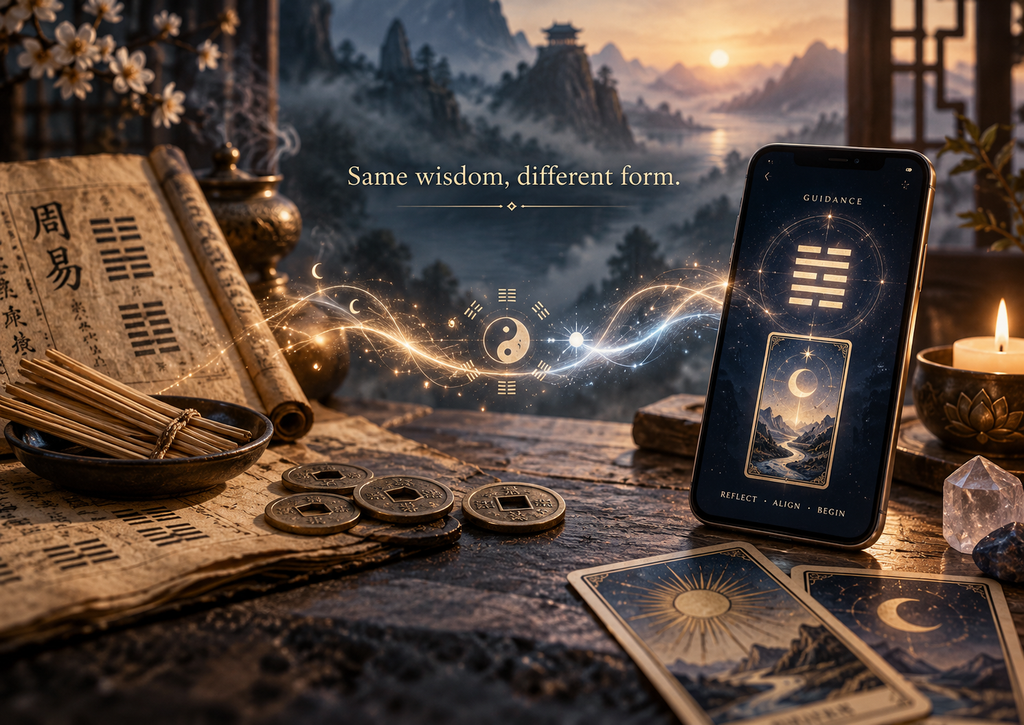
For thousands of years, divination has involved physical objects.
Yarrow stalks.
Coins.
Bones.
Cards.
Stones.
Dice.
The physical act seems important.
You hold the objects.
You formulate a question.
You shuffle.
You cast.
Something falls into place.
Then the oracle is interpreted.
Today, however, the same process may be reduced to something almost absurdly simple:
tap a phone screen.
An I Ching app generates Hexagram 29.
A tarot app draws The Hermit.
No coins were thrown.
No yarrow stalks were divided.
No physical deck was shuffled.
So does the divination still “count”?
Can synchronicity operate through a computer?
Can a digital card carry the same symbolic or spiritual significance as a physical one?
And if one believes divination can connect with something beyond ordinary conscious reasoning, could that connection pass through an app just as easily as through physical objects?
There is no scientific evidence demonstrating that either physical or digital divination literally channels spirits or supernatural energy.
But within the spiritual logic of synchronicity, there is actually a strong argument that the physical tool may be less important than we assume.
The history of the I Ching itself gives us an excellent example.
The I Ching Already Survived One Major Technological Change
The ancient method of consulting the I Ching involved yarrow stalks.
The traditional procedure uses fifty stalks, with one set aside and forty-nine repeatedly divided and counted to generate each line of the hexagram. The Xici, or Great Commentary, explicitly describes a yarrow-based procedure, and archaeological scholarship suggests forms of yarrow-related hexagram divination are extremely old. (Stanford Encyclopedia of Philosophy)
It is slow.
Deliberate.
Almost meditative.
One consultation can take a considerable amount of time.
Then eventually another method became widespread:
coins.
Instead of carefully manipulating dozens of stalks, the user tosses three coins six times.
Much faster.
Much easier.
Much more portable.
And inevitably, one could ask exactly the same question that appears today with apps:
Isn’t this cheating?
If the traditional oracle used yarrow stalks, why should throwing three metal discs produce the same connection?
Yet coin divination became thoroughly incorporated into I Ching practice. Jung himself used the three-coin method when demonstrating the I Ching in his famous foreword to Richard Wilhelm’s translation. (IAAP)
That historical change is extremely important.
It suggests that the spiritual operation of the I Ching was never necessarily believed to reside exclusively inside the physical stalks.
The stalks were a method for creating the moment of selection.
Coins could create another.
Now the smartphone potentially creates a third.
The Coin Method Is Not Actually Identical to Yarrow Stalks
There is, however, an interesting technical complication.
The traditional yarrow procedure and ordinary three-coin method do not produce changing lines with identical probabilities.
In the yarrow method, the approximate probabilities are:
- 6, old yin: 1/16
- 7, young yang: 5/16
- 8, young yin: 7/16
- 9, old yang: 3/16
With the standard three-coin method:
- 6: 1/8
- 7: 3/8
- 8: 3/8
- 9: 1/8
So although both methods ultimately generate the same 64 primary hexagrams, they distribute changing yin and yang lines differently. (Wikipedia)
This becomes surprisingly important for apps.
A well-designed I Ching application could theoretically simulate:
the coin probabilities,
the yarrow probabilities,
or some entirely different randomization method.
Therefore the question should not only be:
“Is the app digital?”
It should also be:
“What method is the app actually simulating?”
A good app should ideally tell you.
What Jung Meant by Synchronicity
Carl Jung offers perhaps the strongest philosophical argument for why an app could still function as a divinatory tool.
Jung became fascinated with the I Ching through his friendship with sinologist Richard Wilhelm.
He believed the oracle illustrated what he later called synchronicity.
Synchronicity describes a meaningful coincidence in which two events correspond meaningfully without an obvious causal relationship.
In Jung’s interpretation of the I Ching, the important idea was that the hexagram generated at that particular moment somehow expressed the quality of the moment in which the question was asked.
The International Association for Analytical Psychology summarizes Jung’s position: the hexagram is treated as corresponding to the situation prevailing at the moment it comes into existence, rather than being produced through ordinary causal prediction. (IAAP)
That leads to an interesting conclusion.
If synchronicity is genuinely acausal, then why would it require wooden stalks?
Why would metal coins work but silicon electronics suddenly break the principle?
The essential element might instead be:
the meaningful moment of selection.
The App Could Simply Be the New Coin
Imagine three stages.
Ancient practitioner:
divide yarrow stalks.
Later practitioner:
throw coins.
Modern practitioner:
tap Generate Hexagram.
The physical mechanisms are completely different.
But spiritually, each performs the same function:
an uncertain outcome becomes fixed at the moment a question is asked.
From a Jungian synchronistic perspective, the moment itself may matter more than the machinery producing it.
The phone could simply be the twenty-first-century equivalent of the coin.
But There Is One Major Problem: Is It Actually Random?
Physical divination has an obvious uncertainty built into it.
You genuinely do not know how the coins will fall.
With software, the process is hidden.
An app generally uses some form of pseudo-random number generation.
That does not necessarily make the result spiritually inferior.
For ordinary purposes, high-quality software randomness can produce results unpredictable to the user.
But there is an important distinction between:
random selection
and
algorithmic personalization.
Suppose a tarot app secretly selects cards based on:
your previous readings,
what keeps users engaged,
your profile,
or what the developer wants you to see.
That is no longer equivalent to shuffling a deck.
Now another human-designed intelligence is influencing the oracle.
The spiritual question changes dramatically.
The Best Digital Oracle Should Not Try to Tell You What You Want to Hear
This may become increasingly important as AI enters spiritual apps.
A true randomized tarot application should be capable of giving you:
an uncomfortable card,
a confusing card,
or a card that appears completely unrelated.
An engagement-optimized application might instead learn:
“This user likes relationship readings.”
Then subtly produce more emotionally satisfying interpretations.
That might feel more psychic.
But ironically it would be less genuinely random.
If synchronicity depends upon an open moment of chance, excessive personalization could actually interfere with the very principle the oracle is supposed to embody.
Tarot Raises the Same Question Differently
Tarot is slightly different from the I Ching.
The physical deck has become an important part of tarot ritual.
Readers often:
shuffle personally,
cut the deck,
touch the cards,
lay them out,
turn them over,
and develop familiarity with a particular deck.
That physical relationship can feel important.
But historically, tarot cards were not originally created as mystical divination objects.
The earliest tarot decks emerged in fifteenth-century Italy primarily as playing cards. Their occult and fortune-telling associations developed much later. (The Metropolitan Museum of Art)
This is useful because it reminds us:
the paper itself was never inherently sacred from the beginning.
Spiritual meaning accumulated around the symbolic system and the ritual of using it.
That makes digital tarot easier to defend conceptually.
What Makes a Tarot Reading Work?
There are at least three possible explanations.
The Psychological Model
The cards function as an archetypal mirror.
You see:
The Tower,
The Lovers,
Death,
The Fool,
The Hermit.
The image stimulates unconscious associations.
You interpret your life through the symbol.
From this perspective, a digital tarot deck can work perfectly well.
The psychological trigger is primarily the image and meaning.
A physical card is not necessary.
The Synchronicity Model
The apparently random card somehow meaningfully corresponds with the psychological situation at the moment of selection.
If that is the model, then again, there is no obvious reason an app could not participate.
The synchronicity would not reside inside cardboard.
It would exist in the relationship between:
question + moment + apparently random result + meaning.
The Literal Spiritual-Channel Model
A third interpretation says some form of:
spirit,
psychic energy,
guidance,
or nonphysical intelligence
influences the selection.
Here things become much more speculative.
There is currently no reliable scientific evidence demonstrating that spirits manipulate either physical tarot decks or digital random-number generators.
So one can hold that possibility spiritually, but it should be recognized as a metaphysical belief rather than established fact.
Could a Spirit Influence a Computer as Easily as a Coin?
If one already assumes a nonphysical intelligence can influence chance, an interesting philosophical question follows.
Why would influencing:
the movement of a coin
be easier than influencing:
the moment someone taps a screen?
From within that worldview, there is no obvious reason.
The physical mechanism may be irrelevant.
The meaningful event is simply:
this result appeared now.
In fact, digital divination has already developed its own spiritual logic. Scholars studying online divination have described how digital practitioners construct ritual meaning around technological randomness, sometimes effectively sacralizing randomness itself. (Sage Journals)
The sacred action moves from:
shuffling paper
to
initiating an uncertain computational event.
But Physical Ritual Does Something an App Cannot Automatically Reproduce
There is still an important argument in favor of physical tools.
They slow you down.
The yarrow method is particularly powerful in this respect.
You cannot casually generate twelve hexagrams in thirty seconds.
You must sit.
Divide.
Count.
Repeat.
Remember the question.
The process itself becomes meditation.
The ritual prepares consciousness to receive the answer.
An app eliminates almost all of that friction.
Tap.
Result.
Tap again.
Another result.
Tap again.
Another.
This creates a new danger:
oracle shopping.
The Re-Roll Problem
Suppose you ask:
“Should I enter this relationship?”
The app produces a difficult answer.
You do not like it.
So you tap again.
Now you receive something encouraging.
Which reading counts?
Perhaps you ask again.
Eventually you obtain the answer you wanted.
At that point divination has stopped functioning as divination.
It has become a mechanism for confirming desire.
Physical methods naturally discourage this because repeating them requires effort.
Apps make it almost effortless.
So the primary spiritual danger of digital divination may not be that it lacks energy.
It may be that it lacks ritual resistance.
Friction Can Be Sacred
This idea applies far beyond divination.
Prayer beads require repetition.
Meditation requires sitting.
Pilgrimage requires walking.
Yarrow divination requires counting.
Tarot requires shuffling.
Physical ritual places the body inside the spiritual act.
Apps compress ritual into information.
That is extraordinarily convenient.
But convenience can remove some of the psychological transformation produced by ritual.
The question then becomes:
Can we deliberately put the ritual back?
Yes.
How to Use an I Ching App More Like a Traditional Consultation
Instead of immediately tapping the button, pause.
Sit quietly.
Formulate one clear question.
Avoid asking several contradictory questions at once.
Take a few breaths.
You might hold the phone without touching the screen yet.
Then mentally establish something like:
“I am asking about this situation as it exists at this moment.”
Only then tap.
And most importantly:
accept the first result.
Do not regenerate simply because you dislike the answer.
That restores some of the ritual seriousness lost through digitization.
For an I Ching App, Check the Method
Ideally, determine whether the program uses:
three-coin probabilities
or
traditional yarrow probabilities.
Neither is automatically invalid.
The coin method has centuries of legitimate use behind it.
But if you specifically want something closer to the old yarrow practice, the app should reproduce the yarrow distribution rather than simply generate the numbers 6, 7, 8, and 9 equally.
That seemingly small programming detail changes the oracle statistically.
A Digital Yarrow Method Is an Interesting Paradox
In fact, a computer may reproduce the mathematical structure of the yarrow method more accurately than someone casually throwing ordinary coins.
The device is physically nothing like yarrow stalks.
But statistically it can recreate their outcome distribution precisely.
Which method is then more authentic?
The physical coin?
Or the digital yarrow simulation?
There is no simple answer.
It reveals that authenticity has multiple dimensions:
physical,
mathematical,
ritual,
psychological,
and spiritual.
Tarot Apps Benefit From the Same Discipline
Before drawing a digital tarot card:
decide the spread.
Ask the question.
Pause.
Then draw.
Do not keep swiping through cards until one “feels right.”
That defeats the random element.
If you pull three cards, commit to those three.
Interpret uncomfortable cards just as seriously as pleasant ones.
The oracle becomes valuable partly because it can interrupt your preferred narrative.
The Physical Deck Has One Unique Advantage: Embodiment
There is still something valuable about touching cards.
The hand shuffles.
The eyes watch.
The cards make sound.
The body participates.
One deck gradually acquires personal associations.
Certain cards become familiar.
The deck ages.
Perhaps a card bends.
Someone gave you the deck.
All of this creates ritual memory.
An app does not reproduce that very well.
The digital image appears and disappears.
So even if both methods work symbolically, they may produce different experiences.
The physical system is more embodied.
The digital system is more abstract.
Does a Deck Absorb Energy?
Many tarot practitioners believe a physical deck can absorb something of:
the reader,
the environment,
previous readings,
or ritual intention.
Some people therefore:
cleanse decks,
wrap them in cloth,
place crystals nearby,
or refuse to let other people touch them.
There is no scientific evidence that cards physically store a measurable spiritual energy of this type.
But psychologically, the ritual can still be significant.
A personally meaningful deck can become what Jung might call a constellating object—something around which deep symbolic associations gather.
A phone app may not accumulate that relationship in the same tactile way.
But a person could still develop ritual association with a particular digital oracle over time.
The Phone Itself Is Not Spiritually Neutral Either
Interestingly, a smartphone carries its own energetic symbolism.
The same device contains:
work messages,
social media,
banking,
arguments,
pornography,
news,
games,
dating apps,
and perhaps your I Ching oracle.
That can make the sacred space feel psychologically contaminated by ordinary activity.
You open the I Ching.
Then a notification arrives:
SALE — 30% OFF.
The ritual is broken instantly.
So if using digital divination seriously, consider:
Do Not Disturb mode.
No notifications.
No multitasking.
For ten minutes, the phone becomes one object with one purpose.
Ritual is largely about changing the meaning of ordinary objects temporarily.
Intention Changes the Experience
This may be the most important point.
Tap a tarot app absentmindedly while waiting for a bus and you have one psychological experience.
Sit quietly, formulate an important question, center yourself, and then tap exactly once and contemplate the result for twenty minutes—you have another.
The software may be identical.
The state of consciousness is not.
That difference is substantial.
Divination May Depend More on Receptivity Than Technology
Even in traditional practice, the divination object never interprets itself.
The hexagram appears.
Then consciousness encounters it.
A tarot card appears.
Then consciousness asks:
Why this symbol?
What does it reflect?
What am I refusing to see?
What possibility does this open?
The deepest value may occur there.
The random selection interrupts ordinary reasoning and allows another symbolic language to enter.
This works whether the symbol arrived through:
stalk,
coin,
card,
or screen.
Jung Would Probably Care More About the Moment Than the Hardware
We obviously cannot know precisely what Jung would say about smartphone divination.
But his theory points in an interesting direction.
He emphasized the meaningful relationship between the psychic state and the event occurring at the same moment, rather than a causal mechanism hidden inside the divination device. (IAAP)
From that perspective, changing:
yarrow → coins → digital randomness
does not necessarily destroy the principle.
The outer mechanism changes.
The meaningful coincidence remains the thing being examined.
The Ancient Oracle Has Always Adapted
This may be the strongest historical argument for digital divination.
The I Ching survived enormous cultural changes.
Oracle practices changed.
Commentaries changed.
Interpretations changed.
Coins became common.
Printed books replaced manuscripts.
Western translations appeared.
Jung interpreted it through analytical psychology.
Now software presents the same hexagrams instantly.
The form changes.
The symbolic structure remains.
Likewise, tarot began as physical playing cards before becoming an occult symbolic system centuries later. (The Metropolitan Museum of Art)
Traditions are rarely as technologically frozen as we imagine.
But Technology Changes the Ritual—and That Matters
The answer therefore should not simply be:
“Yes, apps are exactly the same.”
They are not.
Physical divination has:
tactility,
friction,
time,
ritual space,
and embodied randomness.
Digital divination has:
speed,
portability,
repeatability,
automation,
and hidden computational processes.
Both can generate meaningful symbolic encounters.
But they encourage different habits.
The physical oracle encourages slowness.
The digital oracle must deliberately recreate it.
Three Ways to Think About Whether the App “Works”
Perhaps the clearest answer depends on what you believe divination actually does.
If divination works psychologically:
Yes.
A digital tarot or I Ching app can absolutely present symbols that stimulate intuition, unconscious associations, self-reflection, and new ways of viewing a problem.
If divination works through Jungian synchronicity:
There is no obvious theoretical reason it could not.
Synchronicity concerns meaningful coincidence rather than the physical sanctity of a particular randomizer.
But synchronicity itself remains a philosophical and psychological concept rather than a scientifically established mechanism for predicting events.
If divination works through literal spirits or subtle energy:
That remains unverified.
There is no reliable evidence establishing whether such beings or energies manipulate coins, stalks, cards, or computer algorithms.
Within that belief system, however, one could reasonably argue that a nonphysical intelligence would not necessarily be restricted to physical objects.
Perhaps the Real Oracle Is the Relationship
This may be the deeper spiritual answer.
The oracle may not be:
the yarrow stalk.
The coin.
The card.
Or the app.
The oracle may be the relationship between consciousness and uncertainty.
You ask something sincerely.
You relinquish control over which symbol appears.
Something appears.
Then you confront it.
For a moment, you allow reality to answer in a form you did not consciously select.
That surrender is the ritual.
Yarrow makes you surrender through complexity.
Coins make you surrender through chance.
Cards make you surrender through shuffling.
The app makes you surrender through a button.
The technology differs.
The spiritual gesture may be the same:
I will ask—and I will accept whatever symbol appears first.
The Screen Does Not Necessarily Break Synchronicity
Perhaps the strangest assumption would actually be that synchronicity works through:
plants,
metal,
paper,
and human hands
but suddenly encounters an impenetrable metaphysical barrier when electrons enter a computer.
If synchronicity describes the meaningful quality of a moment, there is no obvious reason the moment cannot include technology.
Modern life already does.
The meaningful question is therefore not:
“Was this generated digitally?”
It is:
“Was the consultation approached sincerely, was the outcome genuinely open, and am I willing to listen rather than manipulate the result?”
If those conditions are present, a digital oracle can function as a serious contemplative practice.
Whether something supernatural also participates is a separate question—one we presently cannot demonstrate.
But perhaps that uncertainty is appropriate.
The I Ching itself is called the Book of Changes.
It would be strangely ironic if a tradition devoted to understanding change were incapable of changing its tools.