
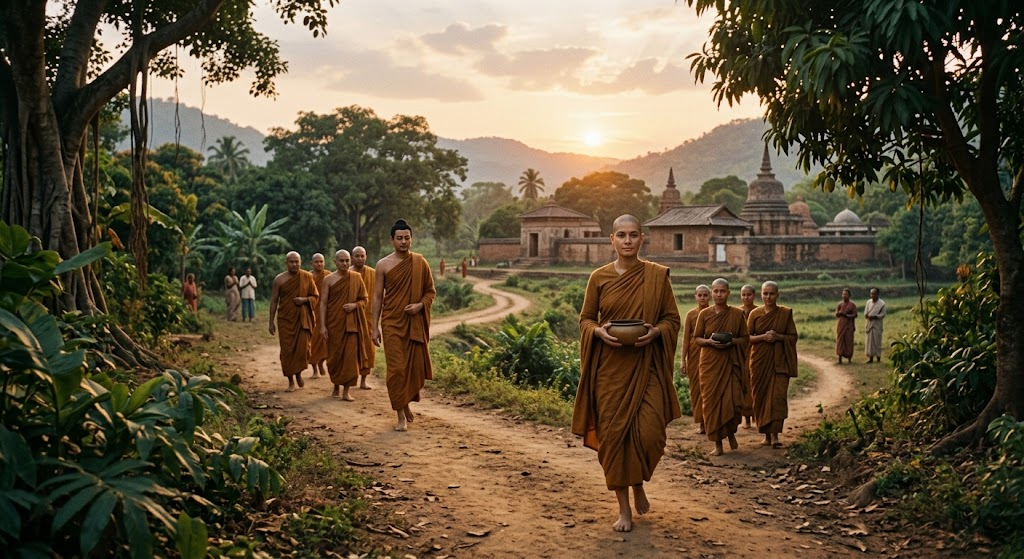
The forgotten story of the Buddha’s wife, whose devotion transformed heartbreak into a journey toward spiritual liberation.
Introduction: The Woman Behind the Enlightened One
When people think of Siddhartha Gautama, the Buddha, they remember the prince who abandoned his luxurious life, meditated beneath the Bodhi tree, and discovered a path beyond suffering. His journey has inspired millions of people across the world to seek wisdom, compassion, and liberation from the endless cycle of desire.
Yet behind this extraordinary story stands a woman whose own spiritual journey is less widely known.
Her name was Yasodharā, also spelled Yashodhara. In Buddhist traditions, she is remembered as Siddhartha’s wife and the mother of their son, Rāhula. Later traditions describe her becoming a Buddhist nun and attaining enlightenment herself. <Cite refs={[“turn616380search0″,”turn616380search6”]}/>
Her story is one of love, loss, loyalty, sacrifice, and spiritual transformation. It asks a question that remains relevant today: can our devotion to another person become a path toward something greater than the relationship itself?
Yasodharā’s life is especially compelling because she did not begin her spiritual journey by leaving the world behind. She began as someone who was left behind by the man she loved.
And, according to the Buddhist traditions that preserve her story, she eventually discovered a path of her own.
1. A Princess Married to a Future Buddha
According to traditional accounts, Yasodharā married Siddhartha Gautama while he was still a prince, living within the protected world of royal privilege.
Siddhartha’s life appeared enviable. He possessed wealth, status, comfort, and a family. Yet the traditional story tells us that he became increasingly troubled by the realities of human existence.
Old age, sickness, and death revealed the impermanence hidden beneath the pleasures of palace life. Siddhartha began to ask whether there was a way to overcome the suffering that accompanies ordinary existence.
His search eventually led him to renounce his royal position and become a wandering ascetic.
Yasodharā was part of the life he left behind.
The historical details of their relationship are difficult to reconstruct with certainty. Early Buddhist texts say relatively little about her, and much of the fuller account comes from later biographies, commentaries, and regional literary traditions. <Cite refs={[“turn616380search1″,”turn616380search6”]}/>
Nevertheless, her place in the traditional narrative is significant. She represents the human relationships that exist on the other side of a spiritual awakening.
For Siddhartha, leaving the palace meant pursuing an answer to the problem of suffering. For Yasodharā, his departure meant facing the consequences of that decision without having chosen it herself.
The same event could therefore be understood in two very different ways: as the beginning of a great spiritual quest and as a profound personal loss.
Both perspectives deserve to be taken seriously.
2. The Pain of Being Left Behind
One of the most moving aspects of Yasodharā’s story is the grief associated with Siddhartha’s departure.
In many traditional accounts, the prince leaves while his wife and young son remain behind. The dramatic image of a man leaving his family in the middle of the night has become one of the defining scenes in Buddhist storytelling.
From Siddhartha’s perspective, the departure was a renunciation of worldly attachments. From Yasodharā’s perspective, it could mean abandonment, uncertainty, and the sudden loss of the future she might have expected.
This tension makes her story more than a simple tale of a devoted wife.
It forces us to consider the human cost of spiritual ambition.
Can a person pursue a noble goal while causing pain to those closest to them? Does the greatness of a spiritual achievement automatically justify the sacrifices others are required to make?
These questions cannot be answered merely by praising Siddhartha’s eventual enlightenment.
His spiritual quest became one of the most influential journeys in religious history, but that does not mean Yasodharā’s feelings were unimportant. Nor does devotion require us to pretend that suffering was not involved.
Indeed, the emotional depth of her story comes partly from this contradiction. A person may love someone deeply and still experience that person’s choices as painful.
Spiritual growth does not make human relationships irrelevant. It confronts us with the difficult task of understanding them more honestly.
3. Her Devotion: Following the Path From Afar
Some Buddhist biographies describe Yasodharā responding to Siddhartha’s renunciation by adopting aspects of the ascetic life herself.
According to these accounts, she gave up certain royal luxuries, wore simpler clothing, and restricted her comforts. When she heard that Siddhartha had abandoned the privileges of royalty, she sought to live in a manner that reflected his discipline. <Cite refs={[“turn616380search9″,”turn616380search23”]}/>
These details belong to the traditional religious narrative rather than a fully verifiable modern biography. Yet their symbolic meaning is powerful.
Yasodharā was not depicted merely as someone waiting for her husband to return. She was portrayed as someone whose own life was being reshaped by the spiritual path he had chosen.
Her devotion involved more than remembering him affectionately. It involved changing how she lived.
In this sense, her story resembles the lives of people who encounter a spiritual teacher and begin transforming themselves through the teacher’s example.
But there is an important distinction between following a person and following the truth that person seeks.
If Yasodharā had simply spent her life longing for Siddhartha’s attention, her story would have remained a tale of romantic attachment. The deeper significance of her traditional story is that devotion eventually becomes a route toward her own spiritual development.
She does not remain merely an extension of his life.
She becomes a seeker in her own right.
4. When the Buddha Returned
Traditional Buddhist accounts describe Siddhartha returning to his former home after attaining enlightenment. By then, he was no longer simply the prince Yasodharā had known. He was the Buddha, a teacher who had discovered what he understood as the way beyond suffering.
One account preserved by BuddhaNet describes Yasodharā initially remaining in her room rather than immediately approaching him. When the Buddha came to see her, she reportedly expressed her grief and reverence by falling at his feet and weeping. <Cite refs={[“turn616380search9″,”turn616380search23”]}/>
The scene is deeply human.
Imagine encountering someone you once loved, knowing that his life has changed beyond recognition. The person has returned, yet the relationship cannot simply return to what it was.
Siddhartha was now a spiritual teacher whose path required a different understanding of attachment, identity, and desire.
Yasodharā’s response, as portrayed in the traditional account, was neither a simple reunion nor an ordinary romantic reconciliation. It was an encounter between two people whose lives had been transformed by separation.
The Buddha’s father, King Śuddhodana, is also described in the tradition as praising Yasodharā’s loyalty and the austerities she had undertaken. The story emphasizes that her devotion was recognized rather than forgotten.
This recognition matters because Yasodharā’s experience could easily have disappeared from the narrative. The great teacher had become famous, while the person who had lived through his departure remained largely outside the spotlight.
Her appearance in these accounts restores a measure of dignity to the person left behind.
It reminds us that a spiritual journey may be undertaken by one individual, but its effects are often experienced by many.
5. Was Yasodharā’s Love a Form of Spiritual Devotion?
The story raises a fascinating question about the relationship between romantic love and spiritual awakening.
In many religious traditions, worldly attachment is regarded as something that must be understood, disciplined, or eventually transcended. Buddhism, in particular, distinguishes between compassionate love and craving that depends on possession, permanence, or the expectation that another person must satisfy our desires.
But does that mean love itself is an obstacle to enlightenment?
Not necessarily.
Love can become possessive when we believe another person belongs to us. It can become a source of suffering when we demand that life remain exactly as we wish it to be. It can also motivate patience, generosity, compassion, and a willingness to recognize another person’s humanity.
Yasodharā’s traditional story allows us to explore this distinction.
Her devotion began within a marriage. Yet its eventual significance, in Buddhist accounts, lies in her movement toward spiritual liberation.
The deeper question is whether love can change form.
At first, love may mean wanting to be with someone. Later, it may mean respecting the significance of their journey, even when that journey changes the relationship. Finally, it may become a motivation to understand the suffering that affects all people, not only those we personally love.
This should not be interpreted as a command to accept neglect or harmful treatment. Nor should the story be used to suggest that someone must sacrifice their needs to prove spiritual purity.
Rather, it invites reflection on whether love can expand beyond possession without requiring us to deny the pain that accompanies loss.
Yasodharā’s story is compelling precisely because it places these questions within a deeply personal relationship.
6. The Mother of Rāhula
Yasodharā was also the mother of Rāhula, the son she had with Siddhartha.
His presence makes the story more complicated. Siddhartha’s departure did not affect only his wife; it also changed the life of their child.
In Buddhist tradition, Rāhula eventually became a disciple of his father. Some accounts describe the Buddha accepting him into the monastic community, where he became known for his discipline and willingness to learn. <Cite refs={[“turn616380search22″,”turn616380search26”]}/>
This part of the narrative introduces another dimension of Yasodharā’s life: motherhood.
A person’s spiritual choices do not take place in isolation from their responsibilities. Parents, partners, and children may all experience the consequences of a decision that one individual considers essential to their own development.
The traditional story does not erase this complexity. Instead, it places Yasodharā at the center of a family whose members eventually become connected to the Buddhist path in different ways.
Her contribution was not limited to being the Buddha’s former wife. She was also a mother whose life intersected with the formation of the early Buddhist community.
This is one reason her story deserves more attention. Spiritual history often celebrates the person who leaves home to seek enlightenment, while overlooking the people who remain to carry the ordinary responsibilities of life.
Yet caregiving, raising a child, enduring uncertainty, and making difficult decisions can also require extraordinary patience and strength.
A spiritual tradition that speaks about compassion should have room to recognize those forms of labor.
7. From Wife to Nun: Yasodharā’s Own Enlightenment
Perhaps the most important part of Yasodharā’s traditional story is its conclusion.
In later Buddhist traditions, Yasodharā enters the monastic order and becomes a Buddhist nun, or bhikkhunī. She is remembered as attaining arahantship—the state of liberation from the defilements and bondage of the cycle of rebirth as understood in early Buddhist teachings. <Cite refs={[“turn616380search0″,”turn616380search8”]}/>
This is a profound transformation.
Yasodharā begins her story through her relationship with Siddhartha. She is identified as his wife, the mother of his child, and the woman affected by his departure.
But she does not remain confined to those identities.
Her spiritual achievement is ultimately her own.
She is not remembered only because she was close to the Buddha. In the traditions that describe her attainment, she is a practitioner who follows the path and realizes its goal.
This distinction is essential.
If the story ended with Yasodharā being reunited with Siddhartha, her significance would depend largely on the restoration of their relationship. If it ended with her receiving recognition from him, her importance might still depend on his approval.
Instead, the tradition gives her a destination beyond either possibility.
She becomes a spiritual figure in her own right.
Her story therefore offers a powerful perspective on women’s place in religious history. A woman who initially appears at the margins of a famous man’s biography becomes a person whose own liberation is worthy of remembrance.
The historical record of her life remains incomplete, and the fuller account developed over time through Buddhist literary traditions. Nevertheless, the image of Yasodharā as a nun and liberated practitioner became an enduring part of the religious imagination. <Cite refs={[“turn616380search1″,”turn616380search6”]}/>
8. Why Was Her Story Less Widely Known?
The Buddha’s renunciation is one of the central events in Buddhist biography. Yasodharā’s experience of that renunciation has generally received less attention in widely circulated versions of his life.
Part of the explanation lies in the way religious biographies are constructed. Stories about a founder’s awakening and teachings naturally become central, while the experiences of family members can become secondary.
Scholars have also noted that Yasodharā appears only briefly, or not at all, in some early textual sources, while fuller accounts emerge in later traditions and regional literature. Sri Lankan works such as the Yasodharāvata and Yasodharapadānaya preserve more developed narratives about her grief, devotion, spiritual history, and eventual religious attainment. <Cite refs={[“turn616380search1″,”turn616380search7”]}/>
This development is important because it shows how religious communities revisit the stories they inherit.
As generations reflect on a famous spiritual figure, they may begin asking questions that earlier accounts left unanswered. Who was the spouse? What happened to the child? What did the people left behind experience? Could they also possess spiritual wisdom?
Yasodharā’s story provides an answer to at least one of those questions: in the Buddhist traditions that celebrate her, she was not merely a supporting character in the Buddha’s life. She was a person capable of profound spiritual attainment.
Her story reminds us that historical visibility and spiritual significance are not the same thing.
A person can occupy little space in the most familiar version of a narrative and still embody important dimensions of its teachings.
9. The Difference Between Devotion and Attachment
One of the most useful lessons to draw from Yasodharā’s story concerns the difference between devotion and attachment.
Attachment, in the Buddhist sense relevant here, does not simply mean caring about someone. It refers to forms of craving and clinging that make our happiness dependent on possessing what we desire or preventing what we fear.
Devotion can also become unhealthy if it requires us to abandon our judgment, tolerate mistreatment, or define our entire worth through another person.
But devotion can take a different form: a commitment to values that a person or teacher has helped us discover.
We might admire someone’s compassion and begin practicing compassion ourselves. We might encounter a teacher whose discipline inspires us to become more mindful. We might love someone and discover, through that relationship, how much we need to grow in patience, honesty, or understanding.
In these cases, the relationship becomes a starting point rather than a prison.
Yasodharā’s traditional journey can be interpreted in this light. Her life does not end when her relationship with Siddhartha changes. Instead, the experience becomes part of a larger movement toward spiritual practice.
The lesson is not that everyone should imitate her response to abandonment. People facing loss must make choices appropriate to their own circumstances, and there is no spiritual obligation to remain loyal to someone who harms them.
The lesson is that a painful experience need not determine the rest of our lives.
We can acknowledge grief without allowing it to become our only identity. We can cherish what someone taught us without needing to possess them. We can allow love to deepen our understanding of life rather than making our existence dependent on a particular outcome.
10. What Yasodharā Can Teach Us Today
Yasodharā’s story speaks to a world in which people frequently define themselves through relationships, recognition, and the desire to be chosen.
When someone leaves, rejects us, or pursues a different path, it can feel as though our own story has been interrupted. We may wonder whether the relationship meant less to the other person, whether our sacrifices were worthwhile, or whether we have lost the future we imagined.
Yasodharā’s story does not offer a simple solution to such pain. Instead, it presents the possibility that a person’s life can develop in ways that were not originally anticipated.
Several lessons emerge from her traditional biography:
Your identity can extend beyond your relationship. Being someone’s partner, spouse, or former love is only one dimension of who you are. Your own values, abilities, and spiritual development remain important.
Pain can become a reason to seek understanding. Suffering does not automatically make us wiser, but it can prompt questions about impermanence, desire, and the nature of happiness.
Devotion is strongest when it produces growth. Admiring another person’s virtues means little if that admiration never changes how we live. Inspiration becomes meaningful when it is embodied in our own conduct.
Recognition is not the same as attainment. Yasodharā’s eventual spiritual status in Buddhist tradition matters because her achievement is not merely the result of being acknowledged by a famous teacher.
A quiet life can contain a profound spiritual journey. The people who remain outside the spotlight may still be doing difficult and meaningful work that deserves respect.
Above all, her story encourages us to ask whether our relationships help us become more conscious, compassionate, and free—or whether they keep us trapped in fear, possession, and dependence.
Conclusion: The Woman Who Found Her Own Path
Yasodharā’s story begins with a prince who leaves his palace to seek liberation from suffering.
But it does not end there.
In the Buddhist traditions that preserve her fuller biography, the woman he leaves behind also becomes a seeker. She experiences grief, raises their son, adopts a life of spiritual discipline, and eventually enters the monastic order. She is remembered not simply as the Buddha’s wife but as a woman who attained liberation herself.
Her story complicates the familiar image of enlightenment as a solitary journey.
One person may leave home in pursuit of truth, but the people connected to that person continue to live, struggle, learn, and change. Their experiences are not erased by the greatness of the journey that inspired them.
Nor must devotion mean remaining forever in the shadow of another person’s achievement.
The deepest significance of Yasodharā’s story is that she ultimately becomes more than the woman who waited for the Buddha. She becomes a spiritual figure in her own right, whose life invites reflection on love, suffering, discipline, and freedom.
Perhaps this is the most beautiful lesson her story offers: we may encounter the path to wisdom through another person, but we must eventually walk that path ourselves.
Love can open the door. Loss can force us to look more deeply. Devotion can inspire us to change.
But spiritual liberation cannot simply be borrowed from someone we admire. It must be realized through our own understanding and practice.
Yasodharā’s legacy, as remembered in Buddhist tradition, is therefore not merely a story about loyalty to a great man.
It is a story about a woman who discovered that her own spiritual destiny was greater than the role history first assigned to her.