
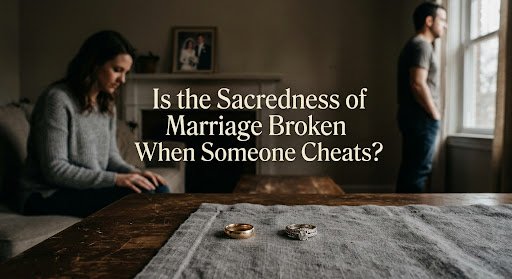
Marriage has traditionally been treated as more than a legal contract. Across many cultures and spiritual traditions, it is a covenant: two people deliberately joining their lives and promising loyalty, intimacy, protection, and trust.
That raises a difficult question. If one partner cheats, has the sacredness of the marriage itself been destroyed?
The answer may be more complicated than simply yes or no.
What Makes Marriage Sacred?
The sacredness of marriage does not necessarily come from the wedding ceremony, rings, paperwork, or even religious ritual.
Its deeper sacred quality comes from the commitment behind those things.
Two people essentially say:
I choose you. I will protect the trust between us. Certain forms of intimacy will belong uniquely to this relationship.
That creates a boundary around the marriage.
In spiritual language, we might think of marriage as a protected space shared by two people. Emotional vulnerability, sexuality, family, finances, dreams, and personal struggles are placed within that space.
Faithfulness helps preserve it.
Why Infidelity Feels Like More Than a Mistake
Cheating is therefore different from many ordinary marital problems.
Forgetting an anniversary, arguing over money, or saying something insensitive can hurt a marriage, but infidelity directly violates one of the boundaries that often defines marriage in the first place.
Sexual or romantic intimacy that was understood to be exclusive is given to someone outside the relationship.
For the betrayed partner, the pain often goes beyond jealousy. Their understanding of the relationship itself may suddenly become uncertain.
They may wonder:
Was our intimacy really unique?
Were the promises genuine?
How long was I being deceived?
Can I trust what I remember about our marriage?
This is why adultery has traditionally been treated so seriously by religions and cultures around the world.
Has the Sacred Bond Been Broken?
In one sense, yes.
If two people explicitly promised sexual or romantic faithfulness and one secretly violates that promise, the covenant has been breached.
Something sacred has been damaged.
But damaged does not necessarily mean permanently destroyed.
There is an important distinction between breaking a covenant and making restoration impossible.
Human beings violate promises constantly. What happens afterward becomes another part of the moral story.
A person might conceal the affair, continue lying, blame their spouse, or repeatedly cheat.
In that situation, the violation becomes ongoing.
But another person might confess, end the affair completely, accept responsibility, understand the damage they caused, and spend years rebuilding trust.
Those are very different situations.
Repentance Matters More Than Saying Sorry
From a spiritual perspective, genuine repentance usually involves more than regret.
Someone can regret cheating because they were caught.
True repentance means recognizing why the action was wrong and changing one’s behavior accordingly.
That may involve complete honesty, ending contact with the affair partner, accepting uncomfortable questions, tolerating the betrayed spouse’s anger or sadness, changing situations that enabled the affair, and demonstrating reliability over a long period.
Words may begin reconciliation.
Behavior proves it.
Forgiveness Does Not Erase Consequences
Spiritual traditions frequently praise forgiveness, but forgiveness is sometimes misunderstood.
Forgiving someone does not necessarily mean pretending nothing happened.
It does not automatically restore trust.
And it does not necessarily require remaining married.
A betrayed spouse might forgive someone spiritually while still deciding that the marriage cannot continue.
Another couple may choose reconciliation.
Neither path changes the fact that a violation occurred.
Forgiveness primarily concerns what happens to resentment and hatred within the person who was harmed. Reconciliation requires participation from both people.
Can a Marriage Become Sacred Again?
Possibly.
In fact, some marriages that survive infidelity eventually become unusually honest because both people are forced to confront things that previously remained hidden.
That does not make the cheating beneficial or necessary.
Rather, human beings sometimes create something meaningful after something destructive.
Think of a temple that has been damaged.
Repairing it does not mean the damage never happened.
The cracks may remain visible.
But the building can still become sacred again.
A marriage can work similarly.
Its innocence may never return, but its depth sometimes can.
Repeated Cheating Is Different
There is also an important difference between a single serious failure followed by genuine transformation and a continuing pattern of betrayal.
Repeated affairs accompanied by deception suggest that the person is repeatedly rejecting the covenant itself.
At some point, the marriage may remain intact legally while its underlying promises have effectively stopped functioning.
Sacredness cannot survive through ceremony alone.
A marriage certificate cannot create fidelity.
The people inside the marriage must continually choose it.
The Spiritual Meaning of Fidelity
Fidelity is ultimately an act of restraint.
Throughout life, married people may still encounter attractive people. Marriage does not magically eliminate desire.
The promise is not:
“I will never find anyone else attractive.”
The promise is closer to:
“Even when other possibilities appear, I will protect what we created together.”
That voluntary restraint is part of what makes commitment meaningful.
If there were no temptation, faithfulness would require very little character.
Marriage as a Living Covenant
Perhaps the best way to understand marital sacredness is not as something permanently granted during a wedding ceremony.
It is something continually maintained.
Every act of honesty strengthens it.
Every sacrifice strengthens it.
Every protected confidence strengthens it.
Every temptation resisted strengthens it.
And every serious betrayal weakens it.
The wedding begins the covenant.
The marriage itself keeps creating it.
So Does Cheating Destroy the Sacredness of Marriage?
Cheating breaches something sacred because it violates trust and exclusivity that often lie at the heart of marriage.
But whether the marriage’s sacred character is permanently destroyed depends partly on what follows.
Some betrayals become the beginning of the end.
Others become the beginning of a long process of confession, accountability, forgiveness, and reconstruction.
A sacred bond is not necessarily one that has never been wounded.
Sometimes it is one whose participants recognize the seriousness of the wound and deliberately choose to rebuild what was broken.
But rebuilding cannot be demanded from the betrayed person.
Sacredness requires freedom.
And ultimately, the sacredness of marriage does not reside merely in two people being called husband and wife.
It resides in whether they continue treating their bond as something worthy of honesty, protection, loyalty, and care.
WordPress Tags: marriage, infidelity, cheating, adultery, sacred marriage, spirituality, relationships, fidelity, trust, forgiveness, repentance, marriage vows, betrayal, reconciliation, spiritual relationships