
Astrology has existed for thousands of years as a symbolic and interpretive system. But in the modern world—dominated by science and data—a critical question arises:
Can astrology be validated using statistics?
This question sits at the intersection of:
- Ancient tradition
- Modern scientific methodology
- Human pattern recognition
The answer is not simple. Some attempts have been made, some have shown intriguing results, and many have failed to produce consistent proof.
Understanding why requires looking at both how astrology works and how statistics works.
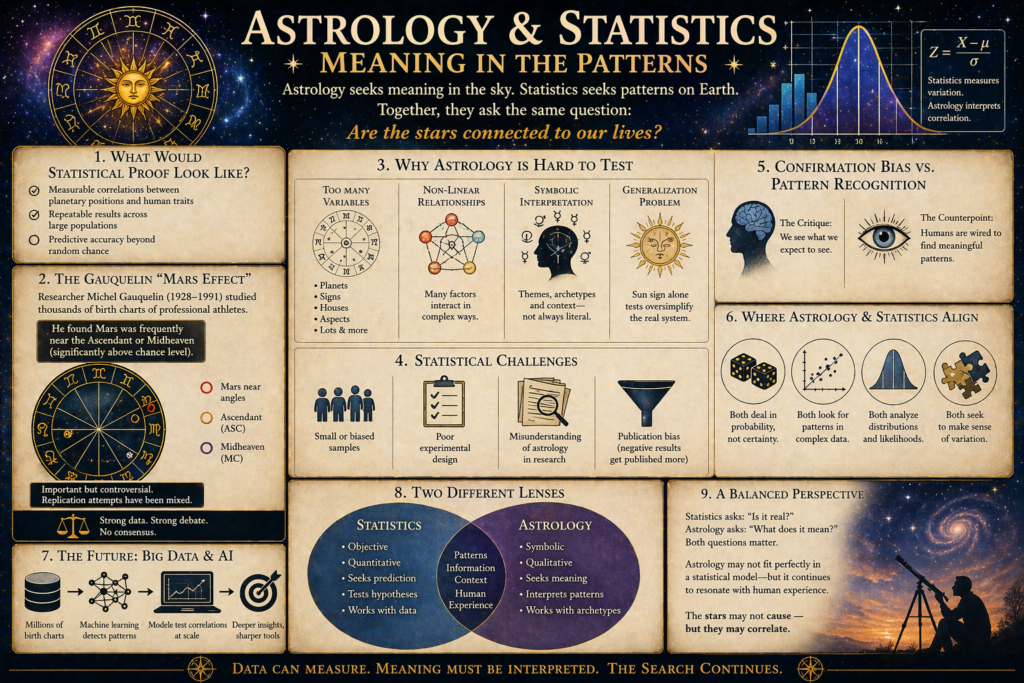
1. What Would Statistical Proof of Astrology Look Like?
For astrology to be statistically validated, we would expect:
- Measurable correlations between planetary positions and human traits
- Repeatable results across large populations
- Predictive accuracy beyond random chance
For example:
- People with Mars in certain positions showing consistent behavioral traits
- Birth charts correlating with career paths or life outcomes
2. Early Statistical Studies
One of the most famous attempts was by Michel Gauquelin.
The Gauquelin “Mars Effect”
Gauquelin studied thousands of birth charts and found:
- A statistically significant correlation between Mars placement and professional athletes
- Mars often appeared near angles (Ascendant or Midheaven) in their charts
Why It Was Important
- Used large sample sizes
- Applied statistical rigor
- Produced results above chance
The Controversy
- Some replication attempts failed
- Critics questioned methodology
- Supporters argued bias in data selection
Key Insight
Even one of the strongest statistical cases for astrology remains debated.
3. Why Astrology Is Difficult to Test Statistically
1. Too Many Variables
A birth chart includes:
- 10+ planets
- 12 signs
- 12 houses
- Dozens of aspects
This creates:
An extremely high-dimensional system
Statistically, isolating one variable becomes difficult.
2. Non-Linear Relationships
Astrology does not operate in simple “if-then” rules.
Example:
- Mars in Aries could mean:
- Athletic drive
- Aggression
- Leadership
- Conflict
The outcome depends on:
- Other planets
- Aspects
- Environment
3. Symbolic Interpretation
Astrology is not purely literal.
It describes:
- Archetypes
- Tendencies
- Themes
Statistics prefers:
- Clear categories
- Binary outcomes
4. The Problem of Generalization
Sun sign astrology is often tested statistically—but:
- It ignores most of the chart
- It oversimplifies the system
This leads to:
Testing a simplified version, not astrology itself
4. Confirmation Bias vs Pattern Recognition
Critics argue that astrology works because of:
- Confirmation bias
- Selective memory
- Generalized statements
The Counterpoint
Humans are naturally good at:
- Detecting patterns
- Recognizing meaningful correlations
The question becomes:
Are we seeing real patterns—or projecting them?
5. Statistical Weaknesses in Astrology Research
Many studies fail because:
1. Poor Experimental Design
- Small sample sizes
- Lack of controls
- Simplified variables
2. Misunderstanding Astrology
Researchers often:
- Test Sun signs only
- Ignore chart complexity
3. Publication Bias
- Positive results are rare
- Negative results dominate academic publishing
6. Where Astrology Aligns with Statistics
Interestingly, astrology shares some ideas with statistical thinking:
1. Probability, Not Certainty
Astrology does not claim:
- Absolute outcomes
It suggests:
- Increased likelihood of certain patterns
2. Pattern-Based Systems
Both astrology and statistics:
- Look for recurring patterns
- Try to model complex systems
3. Large Data Potential
With modern tools:
- Millions of charts could be analyzed
- Machine learning could detect correlations
This is an emerging frontier.
7. The Role of AI and Big Data
Modern technology may change the conversation.
With AI:
- Large datasets can be analyzed
- Subtle correlations can be detected
- Complex interactions can be modeled
Potential Future
- Astrology tested at scale
- Pattern validation across populations
- Hybrid symbolic + statistical models
8. A Philosophical Question
At its core, the debate is not just scientific—it is philosophical.
Is Astrology Meant to Be Statistical?
Or is it:
- A symbolic language
- A psychological tool
- A framework for interpretation
9. A Balanced Perspective
What Statistics Suggests
- No universally accepted proof
- Some intriguing correlations
- Many inconclusive results
What Astrology Offers
- Structured symbolic system
- Personal insight
- Pattern-based interpretation
Final Thoughts
Astrology and statistics approach reality from different angles:
- Statistics seeks objective measurement
- Astrology offers symbolic meaning
They overlap—but do not fully align.
The challenge is not just proving astrology—it’s determining:
What kind of system astrology actually is
Until then, astrology remains:
- Difficult to measure
- Difficult to dismiss entirely
And perhaps best understood as something in between:
A pattern language that may not fit perfectly into statistical models—but continues to resonate with human experience.