
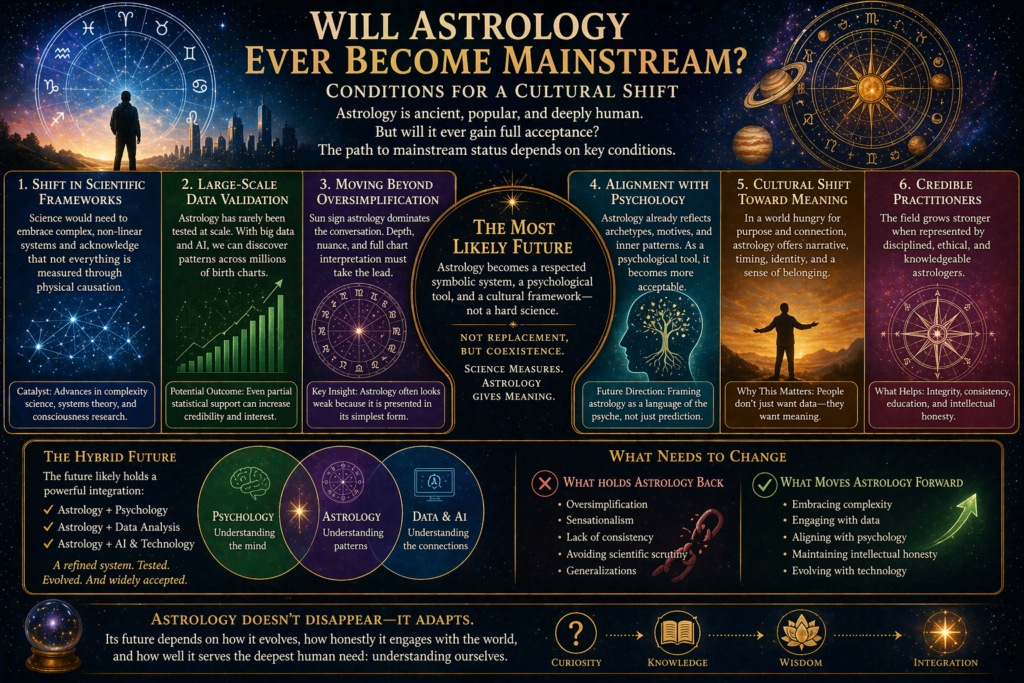
Astrology today exists in a strange position.
It is:
- Widely known
- Frequently used
- Deeply embedded in pop culture
Yet at the same time:
- Not considered a science
- Often dismissed by academia
- Treated as entertainment in many circles
So the question becomes:
Will astrology ever become truly mainstream—or even fully accepted?
The answer is not a simple yes or no. Astrology has already achieved a form of mainstream visibility—but not mainstream legitimacy.
Whether it reaches that next level depends on several key conditions.
1. What Does “Mainstream” Actually Mean?
Before answering the question, we need to define it.
Astrology is already mainstream in terms of:
- Social media presence
- Dating culture
- Personal identity (“What’s your sign?”)
But it is not mainstream in terms of:
- Scientific acceptance
- Institutional credibility
- Academic integration
Two Different Outcomes
| Type | Description |
|---|---|
| Cultural mainstream | Widely used, casually accepted |
| Institutional mainstream | Recognized as valid knowledge system |
Astrology has achieved the first—but not the second.
2. Astrology Has Already Gone Mainstream—Once Before
Historically, astrology was not fringe.
In ancient and medieval times, it was:
- Taught in universities
- Used in medicine
- Consulted by rulers
Figures like Claudius Ptolemy treated astrology as part of natural philosophy.
What Changed?
The Scientific Revolution shifted the dominant worldview:
- From symbolic → empirical
- From meaning → measurement
Astrology didn’t disappear—it just lost institutional authority.
3. Condition #1: A Shift in Scientific Frameworks
For astrology to become fully mainstream again, science itself would need to evolve.
Current Limitation
Modern science prioritizes:
- Measurable data
- Repeatability
- Physical causation
Astrology operates on:
- Symbolism
- Correlation
- Pattern recognition
What Would Need to Change
- Acceptance of complex, non-linear systems
- Recognition of pattern-based (not strictly causal) models
- Integration of qualitative data with quantitative analysis
Possible Catalyst
Advances in:
- Complexity science
- Systems theory
- Consciousness research
4. Condition #2: Large-Scale Data Validation
Astrology has rarely been tested at scale.
But with modern technology, that may change.
What Would Help
- Millions of birth charts analyzed
- Correlations identified across populations
- AI detecting patterns humans cannot see
Potential Outcome
Even partial statistical support could:
- Increase credibility
- Shift public perception
- Encourage academic interest
5. Condition #3: Moving Beyond Oversimplification
One of astrology’s biggest obstacles is how it is presented.
Current Problem
- Sun sign astrology dominates
- Oversimplified content spreads fastest
- Depth is often lost
What Needs to Happen
- More emphasis on full chart analysis
- Education on complexity
- Reduction of stereotypes
Key Insight
Astrology often looks weak because it is presented in its simplest form.
6. Condition #4: Alignment with Psychology
One of the strongest pathways for astrology is through psychology.
Why This Works
Astrology already overlaps with:
- Personality analysis
- Archetypes
- Behavioral patterns
Thinkers like Carl Jung explored this connection.
Future Direction
If astrology is framed as:
- A psychological tool
- A symbolic framework
It becomes:
- More acceptable
- Less controversial
- Easier to integrate
7. Condition #5: Cultural Shifts Toward Meaning
Modern society is highly data-driven—but often lacks meaning.
Astrology provides:
- Narrative
- Identity
- Pattern recognition
- A sense of timing and purpose
Why This Matters
As people search for:
- Identity
- Direction
- Understanding
Astrology becomes more attractive.
8. Condition #6: Credible Practitioners
Mainstream acceptance depends heavily on:
- Who represents the field
What Would Help
- More disciplined, serious astrologers
- Less sensationalism
- More structured methodology
What Hurts Astrology
- Absolute predictions
- Vague generalizations
- Lack of consistency
9. The Most Likely Outcome
Astrology is unlikely to become mainstream in the same way as:
- Physics
- Biology
- Chemistry
More Realistic Scenario
Astrology becomes:
- A respected symbolic system
- A psychological tool
- A cultural framework
Rather than:
- A hard science
10. A Hybrid Future
The most likely future is not one where astrology replaces science—but one where it coexists with it.
Possible Integration
- Astrology + psychology
- Astrology + data analysis
- Astrology + AI
Result
A system that is:
- More refined
- More tested
- More widely accepted
Final Thoughts
Astrology’s future depends on how it evolves.
It will not become mainstream by:
- Staying simplistic
- Avoiding scrutiny
- Relying on belief alone
It will move closer to mainstream if it:
- Embraces complexity
- Engages with data
- Aligns with psychology
- Maintains intellectual honesty
The Real Question Isn’t Just:
Will astrology become mainstream?
It’s:
What will astrology need to become in order to get there?
Because astrology has already proven one thing over thousands of years:
It doesn’t disappear—it adapts.