
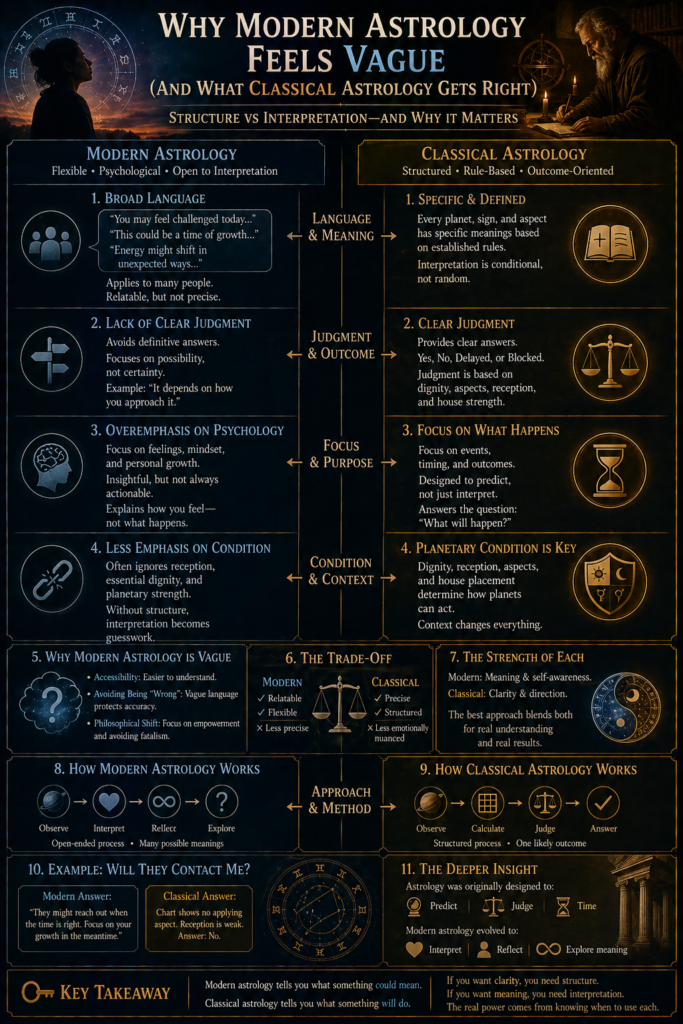
Structure vs Interpretation—and Why It Matters
If you’ve spent time reading astrology online, you’ve probably noticed something:
A lot of modern astrology feels… vague
- “You may feel challenged today…”
- “This could be a time of growth…”
- “Energy might shift in unexpected ways…”
These statements are rarely wrong—but they’re also rarely specific.
This leads to a deeper question:
Is astrology supposed to be this open-ended?
To answer that, we need to compare two fundamentally different approaches:
- Modern astrology
- Classical astrology
1. The Core Difference: Structure vs Interpretation
Modern Astrology
- Flexible
- Psychological
- Open to interpretation
Classical Astrology
- Structured
- Rule-based
- Outcome-oriented
Key Insight
Modern astrology describes possibilities
Classical astrology evaluates outcomes
2. Why Modern Astrology Feels Vague
1. Broad Language
Modern astrology often uses:
- General emotional descriptions
- Open-ended phrasing
Result
- Applies to many people
- Feels relatable—but not precise
2. Lack of Clear Judgment
Modern astrology avoids:
- Definitive answers
- Binary outcomes
Example
Instead of:
- “Yes or no”
You get:
“It depends on how you approach it”
3. Overemphasis on Psychology
Modern astrology focuses on:
- Feelings
- Internal states
- Personal growth
Effect
- Insightful—but not actionable
Insight
It explains how you feel—but not what happens
3. What Classical Astrology Does Differently
Classical astrology operates more like:
A structured system of logic
Key Features
- Clear rules
- Defined meanings
- Outcome-based interpretation
4. The Role of Planetary Condition
In classical astrology, everything depends on condition.
Example
Mars can mean:
- Conflict
- Action
- Force
But Its Expression Depends On
- Sign (dignity)
- Aspects
- Reception
Insight
Meaning is not vague—it is conditional
5. Yes/No Astrology (Horary Thinking)
One of the biggest strengths of classical astrology:
It gives answers
In Horary
Questions like:
- “Will this happen?”
- “Will they respond?”
Are Answered With
- Yes
- No
- Delayed
- Blocked
Insight
Astrology becomes decisive—not interpretive
6. The Importance of Reception and Dignity
Modern astrology often ignores:
- Reception
- Essential dignity
But These Are Critical
They determine:
- Whether planets cooperate
- Whether outcomes develop
Insight
Without structure, interpretation becomes guesswork
7. Why Modern Astrology Avoids Precision
Reason 1: Accessibility
- Easier to understand
- Appeals to wider audience
Reason 2: Avoiding Being “Wrong”
- Vague language protects accuracy
Reason 3: Philosophical Shift
- Focus on empowerment
- Avoiding fatalism
Insight
Vagueness is often intentional
8. The Trade-Off
Modern Astrology
✔ Relatable
✔ Flexible
✖ Less precise
Classical Astrology
✔ Precise
✔ Structured
✖ Less emotionally nuanced
Key Insight
You gain clarity—but lose flexibility (and vice versa)
9. The Best Approach (Your Style)
The strongest approach blends both.
Use Classical For
- Structure
- Timing
- Decision-making
Use Modern For
- Psychology
- Self-awareness
- Meaning
Result
Precision + understanding
10. Why This Matters Practically
If you rely only on modern astrology:
- You gain insight—but lack direction
If you rely only on classical:
- You gain answers—but may lack context
Balanced Approach
Understand the situation—and act on it
11. The Deeper Insight
Astrology was originally designed to:
- Predict
- Judge
- Time events
Modern astrology evolved to:
- Interpret
- Reflect
- Explore meaning
Insight
Both are valid—but serve different purposes
Final Thoughts
Modern astrology feels vague because:
- It prioritizes openness over precision
Classical astrology feels sharp because:
- It prioritizes structure over flexibility
Core Idea
Modern astrology tells you what something could mean.
Classical astrology tells you what something will do.
Final Insight
If you want clarity, you need structure.
If you want meaning, you need interpretation.
The real power comes from knowing when to use each.