
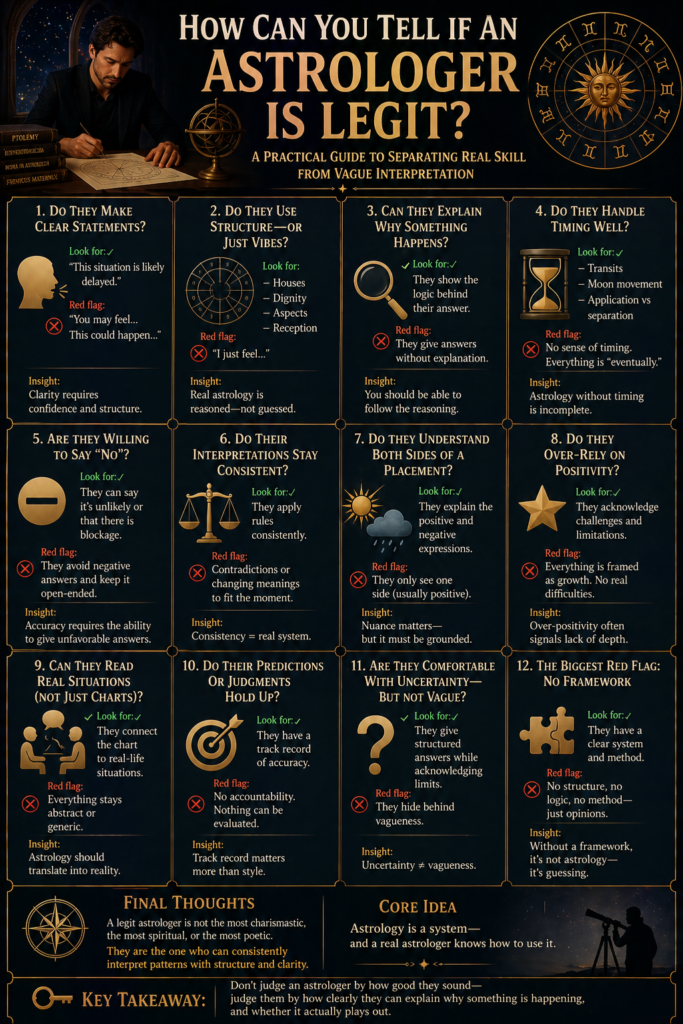
A Practical Guide to Separating Real Skill from Vague Interpretation
Astrology has exploded in popularity.
But with that comes a problem:
Not all astrologers are equally skilled—or even credible
Some:
- Speak in vague generalities
- Avoid clear answers
- Rely on aesthetics over substance
Others:
- Demonstrate precision
- Show consistent reasoning
- Can actually predict or judge outcomes
So how do you tell the difference?
1. Do They Make Clear Statements?
A legit astrologer can:
Take a position
Weak Style
- “You may feel…”
- “This could happen…”
- “Energy might shift…”
Strong Style
- “This situation is likely delayed”
- “There is strong attraction here, but instability”
- “This will require effort and time”
Insight
Clarity requires confidence and structure
2. Do They Use Structure—or Just Vibes?
Astrology is a system—not just intuition.
Look For
- References to houses
- Planetary condition (dignity)
- Aspects
- Reception
Red Flag
If everything sounds like:
“I just feel…”
Insight
Real astrology is reasoned—not guessed
3. Can They Explain Why Something Happens?
A legit astrologer doesn’t just give answers—they show logic.
Example
Instead of:
- “This relationship is strong”
They say:
- “Because Venus receives Mars, and the Moon applies, there is cooperation and development”
Insight
You should be able to follow the reasoning
4. Do They Handle Timing Well?
Timing is one of the hardest—and most important—skills.
Look For
- Use of transits
- Moon movement
- Application vs separation
Red Flag
- No sense of timing
- Everything is “eventually”
Insight
Astrology without timing is incomplete
5. Are They Willing to Say “No”?
This is one of the biggest signals.
Weak Astrologer
- Avoids negative answers
- Keeps everything open-ended
Strong Astrologer
- Says:
- “This is unlikely”
- “There is blockage here”
Insight
Accuracy requires the ability to give unfavorable answers
6. Do Their Interpretations Stay Consistent?
A legit astrologer:
- Applies rules consistently
- Doesn’t change meaning based on preference
Red Flag
- Contradictions
- Reframing everything to fit a narrative
Insight
Consistency = real system
7. Do They Understand Both Sides of a Placement?
Every placement has:
- Positive expression
- Negative expression
Example
Saturn can mean:
- Discipline
- Or restriction
Legit Astrologer
Explains:
Which side is active—and why
Insight
Nuance matters—but it must be grounded
8. Do They Over-Rely on Positivity?
Red Flag
- Everything is framed as growth
- No real challenges acknowledged
Reality
Astrology includes:
- Difficulty
- Friction
- Limits
Insight
Over-positivity often signals lack of depth
9. Can They Read Real Situations (Not Just Charts)?
A strong astrologer connects:
- Chart → real life
Example
Instead of abstract ideas, they explain:
- How this shows up in relationships
- How it affects decisions
Insight
Astrology should translate into reality
10. Do Their Predictions or Judgments Hold Up?
This is the ultimate test.
Ask
- Were they right before?
- Do outcomes match their interpretations?
Insight
Track record matters more than style
11. Are They Comfortable With Uncertainty—But Not Vague?
A legit astrologer knows:
- Astrology isn’t perfect
But they still:
- Give structured answers
- Define likely outcomes
Insight
Uncertainty ≠ vagueness
12. The Biggest Red Flag: No Framework
If someone:
- Doesn’t reference structure
- Doesn’t explain reasoning
- Speaks only in generalities
Then
They are likely not practicing real astrology
Final Thoughts
A legit astrologer is not:
- The most charismatic
- The most spiritual
- The most poetic
They are the one who:
Can consistently interpret patterns with structure and clarity
Core Idea
Astrology is a system—
and a real astrologer knows how to use it.
Final Insight
Don’t judge an astrologer by how good they sound—
judge them by how clearly they can explain why something is happening, and whether it actually plays out.