
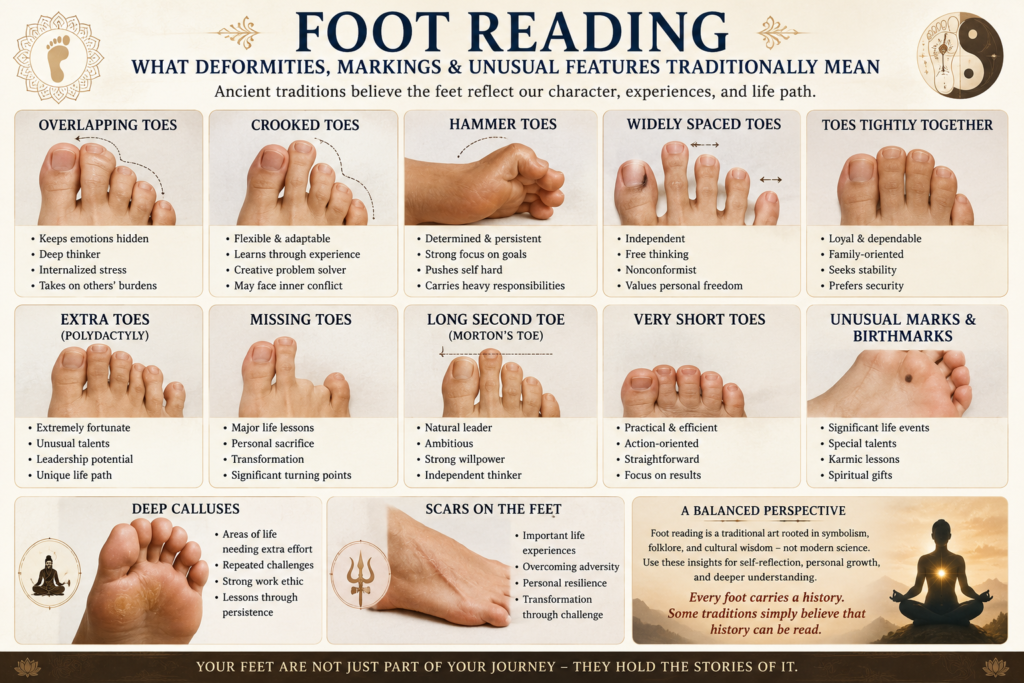
For thousands of years, practitioners of foot reading have believed that the feet reveal aspects of a person’s personality, life experiences, health tendencies, and even destiny.
Foot reading appears in various forms throughout Chinese face and body reading, Indian Samudrika Shastra, reflexology traditions, and folk fortune-telling systems around the world.
While modern science does not support the predictive claims of foot reading, many practitioners continue to view the feet as a symbolic map of a person’s character and life path.
One of the most interesting aspects of foot reading involves unusual markings, deformities, and structural differences that make an individual’s feet unique.
Overlapping Toes
One of the most commonly discussed abnormalities is an overlapping toe, where one toe partially covers another.
Traditional interpretations suggest:
- A tendency to keep emotions hidden
- Complexity of thought
- Internalized stress or worry
- Difficulty expressing personal needs
- Carrying responsibilities for others
Some foot readers believe overlapping toes indicate a person who thinks deeply before acting and often keeps private matters hidden from the outside world.
The specific meaning may vary depending on which toe overlaps.
Crooked Toes
Crooked or twisted toes are often associated with flexibility and adaptability.
Traditional readers sometimes interpret them as signs that the individual:
- Learns through experience
- Adjusts easily to changing circumstances
- Rarely follows a straight path in life
- Possesses creative problem-solving abilities
In some traditions, severely twisted toes can symbolize inner conflict or competing desires.
Hammer Toes
Hammer toes curve downward at the middle joint.
Traditional symbolism associates them with:
- Determination
- Persistence
- Strong focus on goals
- A tendency to push oneself too hard
Some readers believe hammer toes appear more frequently among individuals who carry significant responsibilities throughout life.
Widely Spaced Toes
Large gaps between toes are often viewed positively in traditional foot reading.
They may symbolize:
- Independence
- Free thinking
- Nonconformity
- Desire for personal freedom
People with widely spaced toes are sometimes said to dislike excessive rules or restrictions.
Toes That Press Tightly Together
Toes that naturally rest close together are traditionally associated with:
- Loyalty
- Family orientation
- Stability
- Preference for security
These individuals may prefer predictability over risk.
Extra Toes (Polydactyly)
In some ancient cultures, an extra toe was considered extremely fortunate.
Traditional interpretations include:
- Unusual talents
- Strong destiny
- Leadership potential
- Unique life experiences
Many historical rulers and legendary figures were sometimes rumored to possess extra digits, increasing the mystical associations surrounding the condition.
Missing Toes
Historically, missing toes were often interpreted through the circumstances that caused them.
Some traditions viewed them as symbols of:
- Major life lessons
- Personal sacrifice
- Transformation
- A life marked by significant turning points
The symbolism generally focused less on the physical absence and more on the story behind it.
Long Second Toe (Morton’s Toe)
One of the most famous foot-reading features is the second toe being longer than the big toe.
Traditionally this indicates:
- Leadership
- Ambition
- Strong will
- Independent thinking
Ancient Greek statues frequently depicted this feature, leading some traditions to call it the “Greek Foot.”
Very Short Toes
Short toes are often associated with:
- Practical thinking
- Efficiency
- Preference for action over theory
- Straightforward communication
These individuals are traditionally viewed as people who focus on results rather than endless planning.
Unusual Marks and Birthmarks
Moles, birthmarks, and unusual markings have been interpreted differently across cultures.
Common symbolic meanings include:
- Significant life events
- Special talents
- Karmic lessons
- Spiritual gifts
The location of the marking often determines the interpretation.
Deep Calluses
Foot readers sometimes view calluses symbolically rather than medically.
Traditional interpretations include:
- Areas of life requiring extra effort
- Repeated challenges
- Strong work ethic
- Lessons learned through persistence
Many readers consider calluses evidence of life’s journey physically recorded on the body.
Scars on the Feet
Scars are frequently associated with:
- Important life experiences
- Overcoming adversity
- Personal resilience
- Transformation through challenge
The larger the scar, the more significant the symbolic life lesson is often believed to be.
A Balanced Perspective
It is important to remember that foot reading belongs to the realm of symbolism, folklore, and traditional metaphysical systems rather than modern science.
Many of these interpretations developed over centuries through observation, mythology, and cultural beliefs.
Whether viewed as a spiritual art, a psychological tool for self-reflection, or simply an interesting cultural tradition, foot reading offers a unique way of exploring the stories people have long believed the body can tell.
After all, every foot carries a history.
Some traditions simply believe that history can be read.