
When people think of astrology, they often picture zodiac signs and planetary charts. But in ancient Mesoamerican cultures—such as the Aztecs and Maya—astrology took a very different form.
Instead of focusing on planets moving through signs, these systems were built around interlocking calendars, sacred numbers, and repeating cycles of time.
To understand Aztec and Mayan astrology, you have to shift perspective:
This is not astrology based on space—it is astrology based on time.
1. The Foundation: Time as a Living Force
In Mesoamerican belief systems:
- Time was not linear
- Time was cyclical and sacred
- Each day carried a unique energy or identity
Rather than asking:
- “What sign are you?”
The system asks:
- “What day were you born on—and what energy does that day carry?”
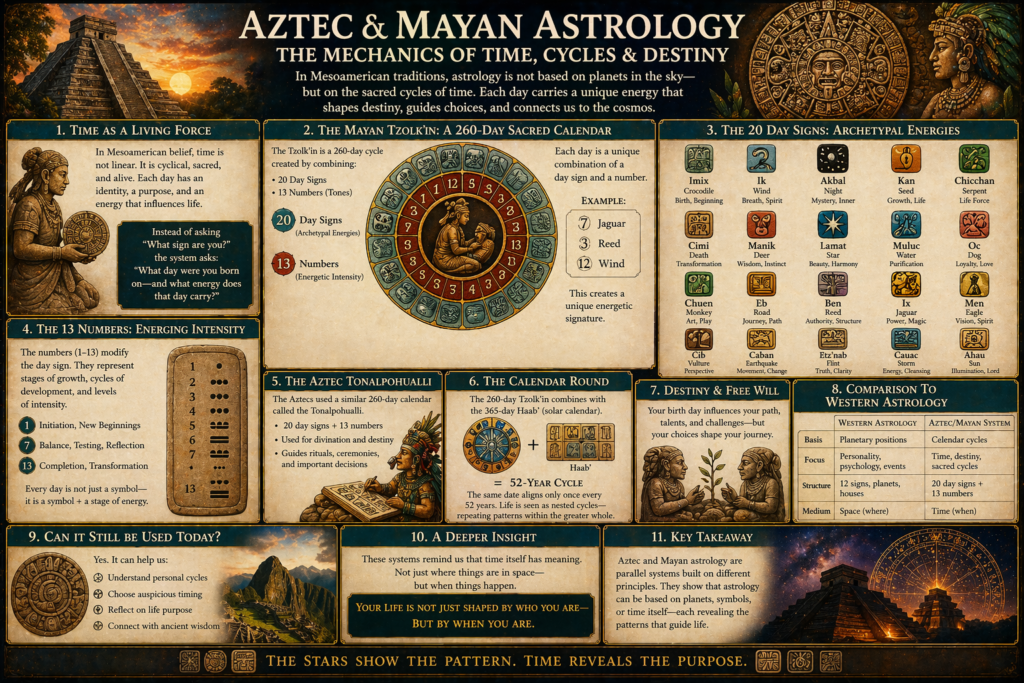
2. The Mayan Tzolk’in: A 260-Day Sacred Calendar
The core of Mayan astrology is the Tzolk’in, a 260-day cycle.
It is created by combining:
- 20 day signs
- 13 numbers (tones)
How It Works
Each day is assigned:
- A number (1–13)
- A symbol (one of 20 day signs)
Diagram: Tzolk’in Cycle


Example
A person might be born on:
- 7 Jaguar
- 3 Reed
- 12 Wind
Each combination creates a unique energetic signature.
3. The 20 Day Signs: Archetypal Energies
Each day sign represents a type of force or archetype.
Examples
- Jaguar → power, mystery, the underworld
- Eagle → vision, higher perspective
- Wind → communication, breath, spirit
- Reed → authority, structure
Key Insight
These are not “personality traits” in the modern sense—they are:
Forces that shape behavior, destiny, and life direction
4. The 13 Numbers: Energetic Intensity
The numbers (1–13) modify the day sign.
They represent:
- Cycles of growth
- Phases of development
- Levels of intensity
Example
- 1 → initiation
- 7 → balance or testing
- 13 → completion or transformation
Combined Meaning
A day is not just a symbol—it is:
A symbol + a stage of energy
5. The Aztec Tonalpohualli
The Aztecs used a similar system called the Tonalpohualli, also a 260-day calendar.
It functions almost identically:
- 20 day signs
- 13 numbers
- Combined into unique daily energies
Aztec Focus
- Divination
- Destiny interpretation
- Ritual timing
Priests used this system to:
- Interpret birth days
- Choose auspicious dates
- Guide decisions
6. No Planets—So Is It Astrology?
Unlike Western astrology:
- There is little emphasis on planetary movement
So What Defines It as Astrology?
It still:
- Links cosmic cycles to human life
- Assigns meaning to time
- Uses structured symbolic systems
Key Difference
- Western astrology → spatial (planets in signs)
- Mesoamerican systems → temporal (cycles of days)
7. The Calendar Round: A Larger Cycle
The Tzolk’in (260 days) combines with the Haab’ (365-day solar calendar).
Result
A larger cycle of 52 years before a date repeats exactly.
Meaning
Life is seen as:
- Nested cycles
- Repeating patterns
- Interconnected time systems
8. Destiny and Free Will
In these systems:
- Your birth day influences your life path
- But it does not completely fix it
Similar to Other Astrologies
- Patterns are indicated
- Outcomes are shaped through action
9. Comparison to Western Astrology
| Feature | Western Astrology | Aztec/Mayan System |
|---|---|---|
| Basis | Planetary positions | Calendar cycles |
| Focus | Personality + events | Time + destiny |
| Structure | 12 signs | 20 day signs + 13 numbers |
| Medium | Space | Time |
10. Why These Systems Feel Different
Modern astrology focuses on:
- Identity
- Psychology
Mesoamerican systems focus on:
- Timing
- Sacred cycles
- Alignment with cosmic rhythm
11. Can It Still Be Used Today?
Yes—but differently.
Modern Use
- Personal reflection
- Understanding cycles
- Ritual timing
- Cultural study
Limitations
- Requires deep understanding of symbols
- Less accessible than Western astrology
- Often simplified in modern interpretations
12. A Deeper Insight
These systems remind us of something often lost in modern astrology:
Time itself has meaning
Not just:
- Where things are in space
But:
- When things happen
Final Thoughts
Aztec and Mayan astrology are not primitive versions of Western astrology—they are parallel systems built on different principles.
They show that astrology can be based on:
- Planets
- Symbols
- Or time itself
And perhaps most importantly, they reveal a profound idea:
Your life is not just shaped by who you are—but by when you are.