
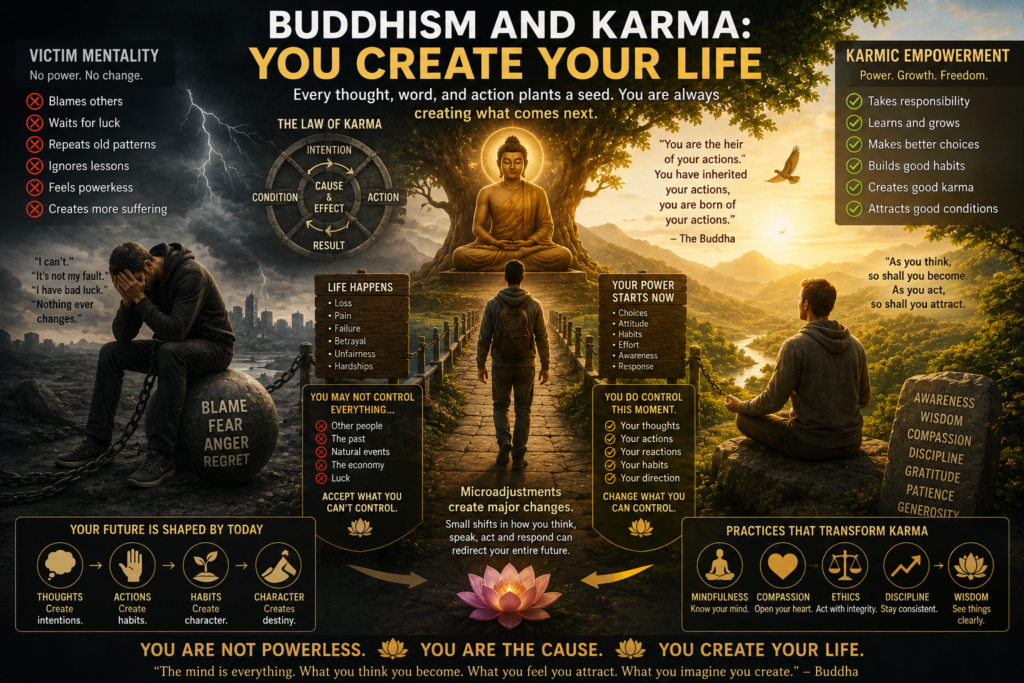
One of the most challenging ideas in Buddhism is karma.
Karma is often misunderstood as a cosmic punishment system: do something bad, and eventually something bad happens to you. Do something good, and the universe rewards you.
Traditional Buddhist thought is more subtle.
Karma literally concerns intentional action and the consequences that flow from it. Every decision, habit, reaction, word, and mental tendency creates conditions that make certain future outcomes more or less likely.
This produces a powerful psychological consequence.
If actions have consequences, then even when life places us in difficult circumstances, we can still ask:
What part of this situation is within my influence?
What choice brought me closer to this outcome?
What warning did I ignore?
What habit made me vulnerable?
What could I do differently next time?
What tiny adjustment today could change the direction of tomorrow?
This way of thinking can dramatically reduce victim mentality.
Not because Buddhism teaches that every tragedy is literally your fault—it does not—but because Buddhism continually redirects attention toward agency.
You may not control everything that happens to you.
But you are constantly helping create what happens next.
Karma Does Not Mean Everything Is Your Fault
This distinction is essential.
Buddhism does not require us to believe that someone who is assaulted, becomes seriously ill, experiences a natural disaster, loses a family member, or is born into poverty consciously caused that event.
The Buddha explicitly rejected overly simplistic views in which every experience is explained only by past karma.
Life arises from many interacting causes:
- Other people’s decisions
- Biology
- Physical environment
- Social conditions
- Economic structures
- Accidents
- Natural forces
- Collective behaviour
- Your own previous decisions
- Your present response
Karma is one part of a much larger causal web.
Therefore, Buddhist accountability should never become victim blaming.
If someone harms you, the fact that you can learn from the situation does not erase the responsibility of the person who harmed you.
The useful question is not:
“How is everything that happened to me my fault?”
It is:
“Given that this happened, where is my power now?”
That difference changes everything.
Karma Makes Passive Victimhood Difficult
A victim mentality places almost all causal power outside the self.
My boss ruined my career.
My ex ruined relationships for me.
My parents made me this way.
Society prevented me from succeeding.
Bad luck follows me.
People never treat me fairly.
Sometimes these statements contain genuine truth.
Other people can hurt us. Institutions can be unfair. Families can cause profound damage. Circumstances are not distributed equally.
But Buddhism asks another question immediately afterward:
And now what are you doing?
That is where radical accountability begins.
Perhaps you did not create the original wound.
But if you repeat the same reaction for twenty years, your present behaviour begins creating new suffering around the original injury.
Someone betrayed you.
That was their action.
You then become permanently suspicious of everyone.
That becomes yours.
Someone humiliated you.
That was their karma.
You spend the next decade trying to dominate people so nobody can humiliate you again.
That becomes yours.
Life gave you the first arrow.
Buddhism asks whether you are repeatedly firing the second one into yourself.
Karma Is More Like Momentum Than Punishment
Imagine pushing a shopping cart.
One small push barely changes its movement.
Push it repeatedly in the same direction and eventually the cart develops considerable momentum.
Human life works similarly.
One angry thought probably does not transform your personality.
But repeating anger every day creates an angry mind.
One missed workout changes little.
A year of inactivity changes the body.
One impulsive purchase may not matter.
Hundreds of impulsive purchases can create debt.
One awkward social interaction does not determine your relationships.
Years of avoiding difficult conversations may create isolation.
This is karma operating at an ordinary level.
Your repeated intentional actions become tendencies.
Tendencies become habits.
Habits influence decisions.
Decisions create environments.
Environments shape future choices.
Eventually, what began as a tiny action can appear to be “fate.”
Microadjustments Can Produce Completely Different Futures
One of the most useful ways to understand karma is through tiny corrections.
People often imagine that transforming life requires one enormous decision.
In reality, small behavioural adjustments can redirect an entire trajectory.
Suppose someone repeatedly enters unhealthy relationships.
They might conclude:
“I just have terrible luck with people.”
A karmic approach asks for closer examination.
Perhaps they:
Ignore early dishonesty because they feel attraction.
Move too quickly.
Avoid asking uncomfortable questions.
Confuse emotional intensity with compatibility.
Stay after boundaries are repeatedly violated.
Choose similar personalities without realizing it.
None of these observations mean they deserve mistreatment.
But changing even one of them could produce a different outcome.
The microadjustment might simply be:
When I see the first serious inconsistency, I slow down instead of explaining it away.
That tiny change can alter who remains in the person’s life six months later.
A small karmic correction creates a new branch of possibility.
The Buddhist Universe Is Extremely Sensitive to Causes
Buddhist philosophy is deeply causal.
Everything arises because conditions are present.
This is expressed through the principle of dependent origination: things do not appear independently. They emerge from networks of causes and conditions.
A tree requires a seed.
But the seed also requires soil, moisture, temperature, sunlight, and time.
Remove one crucial condition and the result changes.
Human events are similar.
Consider missing a flight.
You might say:
“I had terrible luck.”
But perhaps the causal chain included:
You went to bed thirty minutes later.
You snoozed the alarm twice.
You packed that morning rather than the previous evening.
You chose a slightly slower transportation route.
You stopped for coffee.
Traffic was unusually heavy.
The traffic was outside your control.
But perhaps several earlier causes were not.
This is where Buddhist accountability becomes extraordinarily practical.
You do not need control over the entire causal chain.
Sometimes you only need influence over one link.
Creating Your Own Luck
People often speak about lucky people as though luck simply follows them.
But much of what appears to be luck can be cultivated.
A person who regularly meets new people has more opportunities for fortunate introductions.
A person who saves money has more ability to exploit an unexpected opportunity.
A person who continually develops skills is more likely to appear “lucky” when an unusual job opening appears.
A person who treats people well develops relationships that may unexpectedly help them years later.
A person who takes care of their health improves the probability of remaining capable when opportunity arrives.
None of these guarantees success.
But they increase the number of favourable conditions surrounding the individual.
From a karmic perspective, this is extremely close to creating luck.
You plant many seeds.
You cannot command which one will grow.
But someone who plants one hundred healthy seeds has very different probabilities from someone who plants none and waits for fortune to appear.
Good Karma Is Often Practical Before It Is Mystical
You do not need to believe in supernatural karma to observe many of its effects.
Consider generosity.
A generous person often develops stronger social relationships.
People trust them.
They remember them positively.
They are more likely to help them later.
What appears years later as unexpected good fortune may have roots in small acts of kindness that seemed insignificant at the time.
Or consider honesty.
An honest person develops a reputation for reliability.
That reputation produces opportunities.
Those opportunities produce new relationships and resources.
Again, what appears to be luck can have a long causal history.
Traditional Buddhism extends karma beyond one lifetime, but even within a single lifetime the principle is visible everywhere.
Mental Karma Comes Before External Karma
Buddhism places enormous emphasis on intention because actions begin in the mind.
Before anger becomes an insult, there is irritation.
Before betrayal becomes an action, there is desire.
Before procrastination becomes failure, there is avoidance.
Before generosity becomes behaviour, there is compassion.
The mind repeatedly creates the conditions from which behaviour emerges.
That means karma begins earlier than most people realize.
If you want to change the external pattern, sometimes you must intervene at the mental stage.
Notice resentment before speaking.
Notice greed before buying.
Notice insecurity before seeking approval.
Notice attraction before idealizing someone.
Notice fear before avoiding an opportunity.
The earlier you interrupt a karmic chain, the easier it is to redirect.
Meditation Makes Karma Visible
This is one reason meditation is so central to Buddhism.
Meditation trains you to observe the moment between stimulus and response.
Something happens.
Ordinarily, you react immediately.
Someone insults you.
Anger.
Someone attractive appears.
Desire.
Someone disagrees with you.
Defensiveness.
Someone succeeds.
Jealousy.
The reaction feels automatic.
But through mindfulness, you begin noticing:
There is actually a small gap here.
Within that gap, another response becomes possible.
That gap may last only a second.
But spiritually, it is enormous.
Because that second is where karma changes.
Instead of reacting automatically, you choose.
And every conscious choice weakens one habit while strengthening another.
Your Personality Is Partly Accumulated Karma
People often speak about personality as though it were completely fixed.
“I am just an angry person.”
“I am naturally jealous.”
“I am bad with money.”
“I always choose the wrong people.”
“I have terrible discipline.”
Buddhism treats these patterns more dynamically.
Many aspects of personality can be understood as accumulated conditioning.
You have repeatedly thought, felt, and behaved in certain ways until those ways became easier.
The neural pathway, psychological habit, and karmic tendency all begin reinforcing one another.
This is actually hopeful.
If habits were created through repetition, they can also be weakened through repetition.
Every time you act differently, you cast a small vote for a different future self.
Radical Accountability Gives You Power
There is a strange comfort in blaming everything outside ourselves.
If nothing is our responsibility, nothing needs to change within us.
But that comfort comes at a price.
It removes power.
Suppose you believe every failed relationship happened solely because everyone you met was terrible.
Then your future depends entirely upon accidentally meeting a perfect person.
You have little agency.
But suppose you believe:
Some people genuinely treated me badly, and there are patterns in whom I choose, what I tolerate, how quickly I attach, or how I communicate that I can improve.
Now you have options.
You can change selection.
Boundaries.
Communication.
Pacing.
Expectations.
Environment.
Suddenly the future becomes more controllable.
Accountability is uncomfortable because it implies responsibility.
But responsibility and power are closely related.
The Goal Is Not Self-Blame
There is a dangerous counterfeit version of accountability.
Something bad happens and the person immediately thinks:
“I caused this.”
“I deserved this.”
“This is punishment.”
“I must have terrible karma.”
That is not necessarily wisdom.
It may simply be shame wearing spiritual clothing.
Healthy karmic reflection sounds different.
It asks:
What causes were involved?
Which were mine?
Which were outside my control?
What can I learn?
What should I change?
What should I accept?
What should I prevent?
What must I forgive?
What should I never tolerate again?
This is investigation rather than condemnation.
Buddhism encourages awareness.
Not self-hatred.
Karma Also Means Other People Are Responsible
Radical accountability applies to everyone.
If someone mistreats you, Buddhism does not require pretending their behaviour was acceptable because of your karma.
Their intentional action creates consequences for them.
Your responsibility concerns your side of the causal chain.
Perhaps your karma is to recognize the behaviour and walk away.
Their karma is what they chose to do.
Forgiveness does not erase accountability.
Compassion does not require passivity.
Karma can actually strengthen boundaries because it teaches that actions should have consequences.
Some Circumstances Really Are Outside Your Control
Suppose you are walking safely on the sidewalk and a reckless driver loses control of a vehicle.
There may have been essentially nothing practical you could have done.
Buddhist accountability does not require inventing imaginary responsibility.
Radical accountability should never become magical thinking.
Sometimes the correct conclusion is:
I could not reasonably have prevented this.
But even then, the karmic question reappears afterward:
How will I respond?
Will pain become bitterness?
Will trauma become cruelty?
Will grief deepen compassion?
Will I seek treatment?
Will I isolate permanently?
Will I rebuild?
You may have had no meaningful control over the event.
You still have some influence over the next chapter.
Karma Turns Regret Into Information
Regret becomes useful when converted into learning.
Instead of:
“I can’t believe I was so stupid.”
Ask:
“What signal did I miss?”
Instead of:
“I wasted five years.”
Ask:
“What did those five years teach me that prevents me wasting another five?”
Instead of:
“I made a terrible financial decision.”
Ask:
“What rule should exist now so this cannot happen again?”
This is karmic intelligence.
Every painful outcome becomes data.
The suffering has already occurred.
The question is whether you will extract wisdom from it.
If you do, the bad karma itself becomes a condition for future good karma.
You Are Constantly Voting for Your Future
Every day contains hundreds of small karmic votes.
Get up or stay in bed.
Speak kindly or aggressively.
Save or spend.
Exercise or avoid.
Tell the truth or distort.
Call someone or isolate.
Study or procrastinate.
Forgive or rehearse resentment.
Take responsibility or find someone to blame.
One decision rarely determines your life.
But thousands of decisions create tendencies.
Tendencies create direction.
Direction becomes destiny.
This is why Buddhist discipline can appear almost obsessive about small actions.
Small actions are not small when repeated.
Your Environment Is Also Karma
Sometimes the best behavioural adjustment is not willpower.
It is changing conditions.
If certain friends constantly encourage reckless behaviour, spend less time around them.
If an app makes you angry every morning, remove it.
If keeping junk food visible leads to overeating, change the environment.
If you constantly overspend when browsing online stores, block the sites.
If being around certain people repeatedly produces humiliation or manipulation, stop repeatedly entering the situation.
Buddhism teaches dependent origination.
Change the conditions and different experiences arise.
You do not always need to become infinitely stronger.
Sometimes you simply stop planting yourself in bad soil.
Karma and the Victim Identity
A person can experience genuine victimization without making victimhood their permanent identity.
This distinction is important.
“I was victimized” describes an event.
“I am a victim” can become an identity.
Once victimhood becomes central to identity, every new experience may be interpreted through helplessness.
Buddhist practice attempts to loosen all rigid identities.
You are not permanently defined by what someone did to you.
Nor are you permanently defined by what you once did.
Karma changes because actions change.
That means your story remains open.
Forgiveness Can Be Karmic Self-Protection
Holding resentment can feel like keeping someone accountable.
But often the person being punished most consistently is you.
You replay the event.
Your body generates anger.
Your attention remains attached.
The other person may not even be present.
Forgiveness does not mean restoring trust or allowing someone back into your life.
It means refusing to continue producing suffering inside yourself because of something another person did.
In karmic terms, you stop allowing their old action to generate new negative mental states through you.
The chain ends here.
Karma Makes Success Less Mysterious
Successful lives often look mysterious from outside.
Someone appears lucky.
But behind the visible result may be years of invisible causes.
Skills developed.
People contacted.
Money saved.
Habits maintained.
Mistakes corrected.
Reputations built.
Risks taken.
Emotions regulated.
Opportunities noticed.
Thousands of causes converged at the moment others called “luck.”
Buddhist thinking encourages us to look backward through the causal chain.
Success has causes.
Failure has causes.
Peace has causes.
Conflict has causes.
Strong relationships have causes.
Loneliness has causes.
Not every cause belongs to you.
But enough usually do that changing them matters.
The Most Liberating Buddhist Question
When something goes wrong, ask:
“What is the smallest thing I could have done differently?”
Not because you must blame yourself.
Because small causes often produce disproportionately large consequences.
Maybe you needed to leave ten minutes earlier.
Ask one more question.
Read the contract.
Save another five percent.
Wait one week before committing.
Say no once.
Speak up sooner.
Sleep before making the decision.
Listen to the uncomfortable intuition.
Apologize immediately.
Walk away when the first serious boundary is crossed.
One microadjustment can redirect years of consequences.
That is karma in action.
You Cannot Control Karma Completely
Buddhist practice does not promise complete control over life.
You can exercise, eat well, and still become ill.
You can treat someone beautifully and still be betrayed.
You can make an excellent investment and encounter an unforeseen crisis.
You can prepare thoroughly and still fail.
Karma is not a vending machine.
Good action does not purchase guaranteed outcomes.
What it does is change conditions and probabilities.
You cannot control the weather.
But you can carry an umbrella.
You cannot guarantee success.
But you can become the kind of person who repeatedly creates favourable conditions for success.
That may be the closest thing human beings have to manufacturing luck.
Conclusion: You Are Always Creating What Comes Next
The Buddhist law of karma can initially sound severe because it places enormous emphasis on personal responsibility.
But understood correctly, it is profoundly empowering.
It does not say:
Everything bad that happens to you is your fault.
It says:
Your intentional actions matter.
They matter even when circumstances are unfair.
They matter after someone hurts you.
They matter after failure.
They matter when life seems random.
They matter because each action becomes another condition shaping what can happen next.
You inherit circumstances from the past.
Some were produced by you.
Many were not.
But the present moment is where new karma is created.
And that means every moment contains a degree of freedom.
You may not choose the cards you receive.
But you repeatedly choose how to play them.
Over enough time, better choices create better conditions.
Better conditions create more opportunities.
More opportunities begin looking like luck.
In that sense, Buddhism asks us to stop waiting passively for good fortune and begin constructing the causes from which good fortune is more likely to emerge.
The deepest form of karmic accountability is therefore not guilt.
It is authorship.
You are not the author of everything that happens to you.
But you are always helping write what happens next.