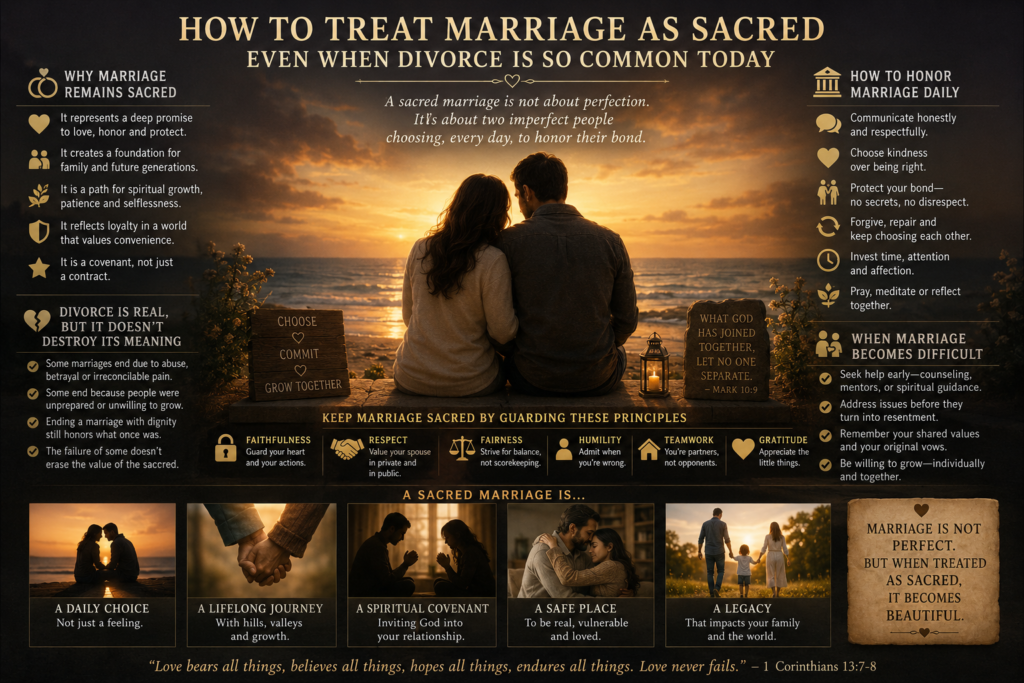
Marriage is still described as sacred in many religious, spiritual, and cultural traditions. It is supposed to represent commitment, loyalty, responsibility, family, sacrifice, and the joining of two lives.
Yet modern society also treats divorce as normal.
People marry, separate, remarry, co-parent, create blended families, and sometimes leave relationships only a few years—or even months—after promising to remain together for life.
This creates an understandable question:
How can marriage still be considered sacred when so many marriages end?
The answer depends on what we believe makes something sacred.
If sacredness means that something must never fail, then modern divorce appears to destroy the idea of sacred marriage.
But if sacredness means that something carries deep moral, emotional, and spiritual significance, then marriage can remain sacred even in a world where not every marriage survives.
The failure of some marriages does not necessarily prove that marriage itself has lost its meaning.
It may instead reveal how difficult sacred commitments are to uphold.
Sacred Does Not Mean Easy
People sometimes confuse sacredness with permanence.
They assume that if a marriage ends, it was never sacred. But sacred commitments can be broken, neglected, misunderstood, or entered without sufficient preparation.
A temple can be abandoned without ceasing to have once been sacred.
A religious vow can be violated without proving that the vow had no meaning.
A friendship can be betrayed without proving that friendship itself is meaningless.
Likewise, a marriage can fail without proving that marriage has no spiritual value.
Sacredness does not guarantee success.
It creates responsibility.
Marriage is sacred partly because it asks people to do something difficult: to continue choosing another person after novelty fades, conflict appears, attraction changes, and life becomes less romantic.
The difficulty is not evidence against its value.
The difficulty is part of its value.
Divorce Reveals That Marriage Is Not Automatic
Modern society often celebrates weddings more than marriages.
A wedding is visible, exciting, romantic, and easy to photograph. Marriage is slower. It includes patience, repetition, compromise, financial decisions, illness, changing bodies, family responsibilities, emotional repair, and long periods when life feels ordinary.
Many people are prepared for the ceremony but not the covenant.
They are prepared to feel love but not always to practise it.
They are prepared to receive affection but not necessarily to maintain connection through disappointment.
Marriage cannot survive on emotion alone.
Feelings change. Attraction rises and falls. Stress affects behaviour. Careers shift. Children reshape priorities. Families interfere. Health problems appear. Resentment accumulates.
A sacred marriage requires structure, discipline, and repeated effort.
Divorce is common partly because marriage is not self-sustaining.
It must be continually rebuilt.
Marriage Can Be Sacred Without Becoming a Prison
Treating marriage as sacred does not mean that every marriage must continue under every circumstance.
Some marriages involve abuse, coercion, humiliation, addiction, violence, chronic betrayal, severe manipulation, or the complete refusal of one partner to participate in repair.
A sacred view of marriage should not be used to trap people in danger.
If marriage protects dignity, love, responsibility, and mutual care, then a relationship that systematically destroys those things may already have violated the spirit of marriage, even if the legal contract remains intact.
Remaining married at any cost is not always the same as honouring marriage.
In some situations, separation may be the only way to preserve life, sanity, safety, or basic human dignity.
The challenge is to distinguish between leaving because the marriage is genuinely destructive and leaving because the relationship has become inconvenient, imperfect, or emotionally demanding.
Sacredness requires both commitment and discernment.
Divorce Does Not Always Mean the Marriage Was Worthless
Some people interpret divorce as proof that the entire relationship was a mistake.
But marriages can have meaning even if they do not last forever.
Two people may have loved one another sincerely, raised children, supported each other through difficult periods, learned important lessons, and shared years of genuine companionship.
The ending does not erase everything that came before it.
A relationship can be real without being permanent.
At the same time, this should not be used to make divorce casual. The fact that a marriage contained value does not mean its ending causes no harm.
Divorce can bring grief, financial strain, divided families, loneliness, disrupted children, social fragmentation, and long-lasting emotional consequences.
A mature society should be able to acknowledge both truths:
- Some divorces are necessary.
- Divorce is rarely spiritually or emotionally insignificant.
Sacredness Comes From Intention
Marriage becomes sacred through the intentions carried into it.
A couple may ask:
Are we joining our lives only because we are attracted to each other?
Are we marrying because we fear loneliness?
Are we following social expectations?
Are we seeking financial security, social status, immigration benefits, family approval, or a beautiful wedding?
Or are we consciously creating a shared life based on loyalty, honesty, responsibility, growth, and mutual service?
The legal contract alone does not make a marriage sacred.
The intention behind the contract matters.
Two people can be legally married while emotionally treating each other as disposable.
Another couple may deeply honour their bond through devotion, care, and sacrifice even if they do not constantly speak in religious language.
Sacredness is created through how the relationship is lived.
Marriage Is a Daily Practice
People often imagine that commitment is established once, during the wedding vows.
In reality, commitment must be renewed repeatedly.
Marriage is built through small daily actions:
Listening when tired.
Speaking respectfully during disagreement.
Protecting private information.
Keeping promises.
Remaining emotionally available.
Helping without keeping score.
Being honest before problems become crises.
Maintaining affection.
Apologizing without turning the apology into another argument.
Making decisions as a team.
Creating time for the relationship.
Defending the marriage from unnecessary interference.
A sacred marriage is not sustained by one dramatic promise.
It is sustained by thousands of ordinary choices.
Modern Culture Encourages Replacement
One reason marriage feels less sacred today is that modern culture trains people to replace rather than repair.
Phones are replaced.
Cars are replaced.
Jobs are changed.
Cities are left.
Profiles are deleted.
People swipe through romantic options.
Social media constantly displays other relationships, bodies, lifestyles, and possibilities.
This can create the feeling that there is always someone better available.
When conflict appears, a person may begin comparing a real spouse with an imagined alternative.
The spouse has flaws, bad moods, habits, responsibilities, and history.
The imagined alternative has none of these because the imagined relationship has not yet been tested.
This makes commitment harder.
Marriage requires choosing one real person over countless theoretical possibilities.
That is partly why it remains sacred.
Sacredness means refusing to treat a human being like a product that should be discarded whenever dissatisfaction appears.
Compatibility Matters, but Character Matters More
Modern relationship advice often focuses on compatibility.
Do the partners share interests?
Do they have similar lifestyles?
Are they sexually compatible?
Do they enjoy the same social activities?
These questions matter.
But compatibility alone does not sustain a marriage.
Two people can enjoy the same music, food, travel, politics, and hobbies while lacking loyalty, discipline, humility, or emotional maturity.
Character determines what happens when compatibility is not enough.
A sacred marriage requires qualities such as:
- Honesty
- Patience
- Self-restraint
- Courage
- Forgiveness
- Responsibility
- Emotional regulation
- Loyalty
- Humility
- The willingness to repair
These qualities are less exciting than attraction, but more important to longevity.
Marriage Exposes the Ego
Marriage can be spiritually powerful because it exposes the ego.
Living closely with another person reveals selfishness, insecurity, control, jealousy, avoidance, pride, defensiveness, and hidden expectations.
A spouse often sees the parts of us that strangers do not.
This can create conflict, but it can also create growth.
Marriage asks a person to confront questions such as:
Can I love someone without controlling them?
Can I listen without preparing a defence?
Can I admit when I am wrong?
Can I care for another person when I am not receiving immediate reward?
Can I remain faithful when temptation appears?
Can I communicate rather than withdraw?
Can I forgive without becoming passive?
Can I preserve my individuality while building a shared life?
From this perspective, marriage is not only companionship.
It is a spiritual discipline.
Divorce Can Become Too Easy—and Too Shameful
Society often swings between two unhealthy extremes.
One extreme treats divorce as a minor lifestyle adjustment. If a marriage becomes boring, difficult, sexually unsatisfying, or inconvenient, leaving is presented as automatic self-empowerment.
The other extreme treats every divorced person as a failure and pressures people to remain in destructive marriages.
Neither approach respects the complexity of marriage.
Divorce should not be the first response to ordinary difficulty.
But it should not be made impossible when a relationship becomes abusive, chronically unsafe, or completely unrecoverable.
A sacred view does not trivialize marriage.
It also does not worship the institution more than the human beings inside it.
Commitment Requires Realistic Expectations
Many marriages suffer because people expect one spouse to satisfy every human need.
The spouse is expected to be:
A lover.
Best friend.
Therapist.
Financial partner.
Adventure companion.
Co-parent.
Spiritual partner.
Primary source of entertainment.
Emotional regulator.
Constant admirer.
No single person can perfectly fulfil every role.
Marriage becomes more stable when both partners have realistic expectations and healthy connections outside the relationship.
Friends, family, community, spiritual practice, meaningful work, and personal interests can support the marriage rather than compete with it.
Sacred commitment does not require emotional isolation.
It requires that the marriage hold a uniquely protected place.
Love Must Mature Beyond Emotion
Early romantic love often feels effortless.
There is excitement, curiosity, physical attraction, fantasy, and emotional intensity.
But long-term love eventually changes form.
It becomes less about constant excitement and more about trust.
Less about idealization and more about acceptance.
Less about being impressed and more about being known.
Less about receiving and more about mutual responsibility.
Some people interpret this transition as falling out of love.
In reality, it may be the point at which love becomes more serious.
Infatuation asks, “How do you make me feel?”
Mature love asks, “How can we care for what we have built?”
This does not mean passion must disappear. It means passion cannot carry the entire weight of the marriage.
Sacred Marriage Needs Boundaries
Commitment requires protection.
A marriage can be weakened when outside people, digital spaces, family members, former partners, work relationships, or private fantasies are allowed to occupy too much emotional space.
Boundaries do not mean controlling a spouse.
They mean recognizing that intimacy needs protection.
Examples include:
Not humiliating a spouse publicly.
Not sharing every private conflict with outsiders.
Not maintaining flirtatious relationships that undermine trust.
Not allowing relatives to control marital decisions.
Not comparing a spouse constantly with people online.
Not using separation threats as a weapon.
Not turning every disagreement into a public campaign.
A sacred space remains sacred partly because access to it is limited.
Marriage should contain an inner world that belongs primarily to the couple.
Couples Need to Learn Repair
Conflict does not destroy marriage as quickly as failed repair.
Every couple will misunderstand each other.
Both people will occasionally speak badly, act selfishly, forget something important, become defensive, or fail to meet expectations.
The important question is what happens next.
Healthy repair may include:
Acknowledging what happened.
Listening to the other person’s experience.
Taking responsibility without excessive justification.
Offering a sincere apology.
Making a practical change.
Allowing time for trust to return.
Avoiding the use of old wounds as permanent weapons.
Marriage becomes more secure when both people know conflict does not automatically mean abandonment.
A relationship can survive imperfection when repair is reliable.
Do Not Wait Until Resentment Becomes Contempt
Many couples seek help only when the marriage is already collapsing.
By that point, irritation may have hardened into contempt.
Partners stop assuming goodwill. Every action is interpreted negatively. Affection disappears. Communication becomes defensive or hostile.
Treating marriage as sacred means addressing problems while they are still manageable.
Couples should not be ashamed to use counselling, religious guidance, relationship education, or structured conversations.
Asking for help does not mean the marriage has failed.
It may mean the couple respects the marriage enough to protect it.
Sacredness Is Preserved by Preparation
Many people spend more time planning the wedding than preparing for marriage.
Preparation should include honest conversations about:
Money.
Debt.
Children.
Religion.
Sex.
Careers.
Household responsibilities.
Family boundaries.
Where to live.
Health.
Addiction.
Conflict styles.
Expectations of fidelity.
Friendships with former partners.
Cultural differences.
Long-term goals.
A sacred promise should be made with awareness.
Love does not eliminate practical incompatibilities.
Marriage preparation is not unromantic. It is an expression of respect for the seriousness of the vow.
Children Should Not Be the Only Reason to Stay
Children are deeply affected by divorce, but they are also affected by chronic hostility, fear, humiliation, and emotional neglect within the home.
Remaining married solely “for the children” is not always protective if the household is filled with tension or abuse.
However, children can be a meaningful reason to attempt repair before leaving.
Parents should consider not only their immediate emotional relief but also the long-term stability of the family.
This does not mean sacrificing safety.
It means recognizing that marriage decisions affect more than the two adults involved.
Sacredness includes responsibility toward those who depend upon the union.
A Marriage Can End With Dignity
When divorce becomes unavoidable, the way it is handled still matters.
A couple can end a marriage with cruelty, revenge, humiliation, manipulation, and the destruction of each other’s reputation.
Or they can attempt to separate with honesty, restraint, fairness, and respect for what once existed.
Ending with dignity does not mean pretending there was no betrayal or pain.
It means refusing to turn the other person into a permanent enemy unless protection genuinely requires distance.
Where children are involved, dignified separation becomes even more important.
A marriage may end legally, but the moral responsibilities created by shared parenthood continue.
Even divorce can be approached with a degree of sacred seriousness.
What Sacred Marriage Looks Like Today
Treating marriage as sacred in the modern world does not require denying that divorce exists.
It means approaching marriage differently from casual dating.
A sacred marriage involves:
Choosing carefully.
Preparing honestly.
Making promises consciously.
Protecting the relationship.
Remaining faithful in behaviour and attention.
Learning how to repair.
Seeking help early.
Accepting that love changes form.
Refusing to leave over every discomfort.
Refusing to remain in serious abuse.
Honouring shared responsibilities.
Ending with dignity if the marriage genuinely cannot continue.
Sacredness is not proven by pretending every marriage will last.
It is proven by refusing to treat marriage carelessly.
Conclusion
Marriage can remain sacred even when divorce is common because its sacredness does not come from statistics.
It comes from what the commitment represents.
Marriage asks two people to move beyond temporary emotion and create a shared life. It asks them to protect trust, practise loyalty, confront the ego, tolerate imperfection, repair damage, and take responsibility for the effect they have on one another.
Some marriages will still end.
Some should end.
Others may end because the people involved were unprepared, impulsive, incompatible, or unwilling to grow.
None of this eliminates the spiritual meaning of the institution.
In fact, the frequency of divorce may make sacred marriage even more distinctive.
In a culture that encourages endless options, sacred marriage says: I will not treat you as disposable.
In a culture of instant gratification, it says: We will work through what can be repaired.
In a culture of performance, it says: Our private bond matters more than how we appear.
In a culture that fears difficulty, it says: Love is not only something we feel. It is something we practise.
Marriage remains sacred not because every marriage survives, but because two people can still choose to treat their union as something worthy of truth, protection, sacrifice, growth, and reverence.