
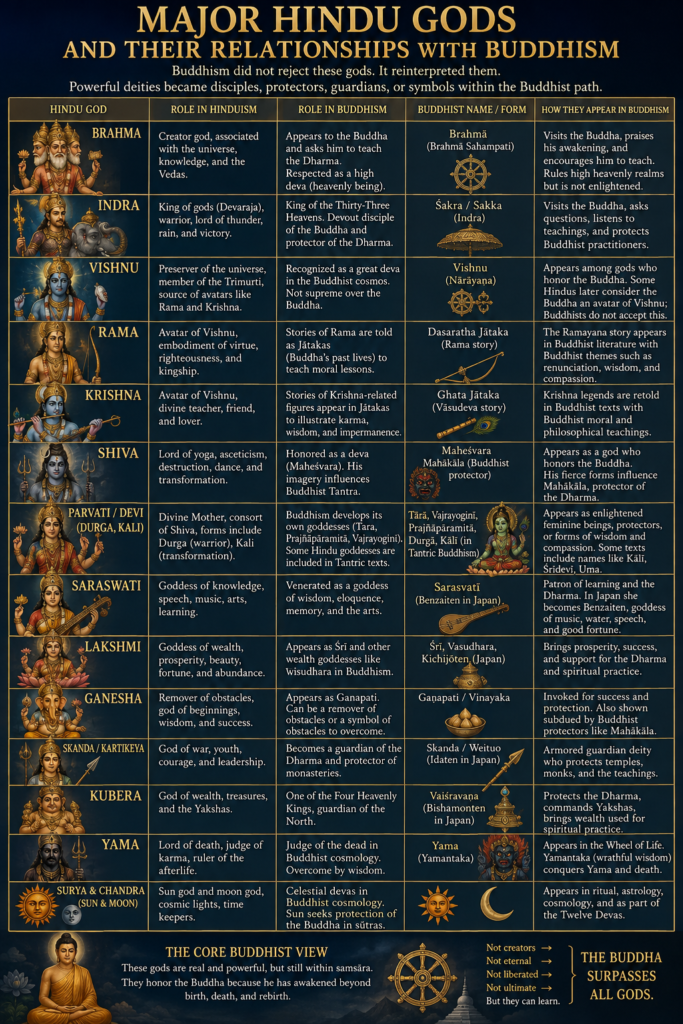
Hinduism and Buddhism are often presented as completely separate religions, but historically they developed within the same Indian spiritual environment.
The Buddha taught in a culture already populated by devas, nature spirits, celestial kings, Brahmins, yogis, sacrificial traditions, ideas about karma, rebirth, meditation, and liberation. Buddhism rejected some Brahmanical teachings, reinterpreted others, and preserved many Indian gods within a new spiritual hierarchy.
Buddhism therefore did not simply declare that every older Indian god was imaginary.
Instead, it usually changed the gods’ status.
A Hindu tradition might worship a particular deity as the supreme reality, creator of the universe, or source of liberation. Buddhism could recognize the same deity as a powerful celestial being while maintaining that the deity was still living within samsara—the cycle of birth, death, karma, and rebirth.
Even gods could possess great power without possessing complete enlightenment.
This is the central principle needed to understand the Hindu–Buddhist relationship:
Buddhism often accepted the gods but denied that they were ultimate.
There Is No Single Hindu–Buddhist Pantheon
There is no perfect chart in which every Hindu god corresponds to one Buddhist figure.
The relationship developed differently in early Indian Buddhism, Theravāda countries, Mahāyāna Buddhism, Tibetan Vajrayāna, Nepalese Buddhism, Chinese Buddhism, and Japanese Esoteric Buddhism.
A Hindu deity might appear in Buddhism in several different ways:
- As the same recognizable god, now listening to or protecting the Buddha.
- As a deva living within Buddhist cosmology, powerful but unenlightened.
- As a protector of the Dharma, Buddhist teachings, monasteries, or practitioners.
- As a regional guardian deity, particularly in Nepal, Sri Lanka, Tibet, China, or Japan.
- As the inspiration for a new Buddhist deity, with related imagery but a different identity and philosophy.
- As a symbolic figure who is subdued by a Buddha or bodhisattva, representing Buddhism’s mastery over pride, death, obstacles, or worldly power.
Hindu and Buddhist traditions existed side by side for centuries, especially in India and Nepal. Their artists, ritual specialists, symbols, myths, and deities continually influenced one another.
Brahma: The Creator Who Asked the Buddha to Teach
In many Hindu traditions, Brahma is the creator god and a member of the Trimurti alongside Vishnu and Shiva.
Brahma’s Buddhist relationship is especially important because he appears near the beginning of the Buddha’s teaching career.
After his awakening, the Buddha reportedly wondered whether the Dharma was too subtle for ordinary people to understand. Brahmā Sahampati appeared before him and asked him to teach, arguing that there were beings with sufficiently little “dust” in their eyes to understand the path.
The Buddha then agreed to begin teaching.
This gives Brahma an honoured position in Buddhism. He recognizes the Buddha’s awakening and helps initiate the spread of the Dharma.
However, Buddhist Brahma is not the eternal creator of everything.
Brahmas are extremely elevated devas associated with refined heavenly realms, meditation, radiance, and long life. They may be spiritually advanced compared with ordinary beings, but they are not necessarily enlightened. They remain subject to impermanence and rebirth.
Buddhist traditions may therefore respect Brahma as:
- A heavenly protector
- A supporter of the Buddha
- A ruler of elevated celestial realms
- A symbol of refined concentration and virtue
But Brahma is not regarded as the source of nirvana. A Buddha has surpassed even the heavenly states over which Brahma presides.
Indra: From Vedic Warrior God to Buddhist Disciple
Indra was one of the greatest gods of the Vedic world. He was associated with thunder, rain, victory, kingship, and warfare.
In Buddhism, Indra generally appears under the names Śakra in Sanskrit and Sakka in Pali. He is the king of the gods of the Heaven of the Thirty-Three.
Sakka is not presented as omnipotent. He is powerful, long-lived, and virtuous, but still imperfect.
He visits the Buddha, asks questions, listens to the Dharma, honours enlightened beings, and sometimes protects Buddhist practitioners. The Sakkapañha Sutta presents him approaching the Buddha and questioning him about conflict, desire, and the causes of suffering.
Indra’s transformation demonstrates a common Buddhist pattern.
A god who once stood near the top of the religious universe becomes a respectful student of the Buddha.
His thunderbolt also influenced the Buddhist vajra, one of the most important symbols in Vajrayāna Buddhism. The vajra came to represent indestructible wisdom, spiritual power, and the unbreakable nature of awakened reality.
Indra was not erased. His authority was redirected toward the protection of the Dharma.
Vishnu: Protector, Regional Guardian, and Source of a Major Disagreement
Vishnu is one of Hinduism’s principal deities. In Vaishnavism, he may be worshipped as the supreme being who preserves cosmic order and descends into the world through avatars such as Rama and Krishna.
Vishnu does not possess the same central role in most Buddhist scriptures that Brahma and Indra do.
He or related forms such as Nārāyaṇa can appear among the great gods attending the Buddha, hearing teachings, witnessing sacred events, or existing within the Buddhist cosmos. Yet Buddhism does not generally place Vishnu above the Buddha.
In Hindu traditions, the historical Buddha was eventually included in several lists of Vishnu’s avatars. From that perspective, the Buddha can be understood as a manifestation of Vishnu who descended into the world for a cosmic purpose.
Buddhists do not normally accept this interpretation.
From the Buddhist perspective, Siddhartha Gautama became a Buddha through the perfection of wisdom, compassion, ethical conduct, meditation, and countless previous lives. He is not usually considered a temporary incarnation of a creator or preserver god.
This produces an important difference:
- Some Hindus incorporate the Buddha into the story of Vishnu.
- Buddhists generally regard the Buddha as an independently awakened teacher who surpassed the gods.
Vishnu nevertheless remained culturally important in regions where Hinduism and Buddhism coexisted. Nepalese art, for example, contains major images of Vishnu alongside Buddhas, bodhisattvas, Tara, Ganesha, Shiva, and other deities.
Rama and Krishna: Hindu Avatars Within Buddhist Storytelling
Rama and Krishna are usually approached through their relationship with Vishnu, but both became major devotional figures in their own right.
Buddhism did not generally adopt Rama or Krishna as universal Buddhist saviours. However, stories resembling their Hindu narratives entered Buddhist literature.
The Dasaratha Jātaka contains a Buddhist version of the Rama story. The plot differs from the classical Ramayana, but figures associated with King Dasaratha and Rama are placed within a Buddhist account of the Buddha’s previous lives.
Similarly, the Ghata Jātaka contains characters and narrative material related to Vāsudeva and Krishna traditions. The story is redirected toward Buddhist lessons about grief, attachment, wisdom, and impermanence.
This does not mean that Buddhism simply accepted Hindu theology.
Buddhist storytellers often took well-known cultural characters and used them to communicate Buddhist teachings.
Rama could become an example of virtue, patience, kingship, or renunciation. Krishna-related characters could appear within stories illustrating the danger of attachment and the need for wisdom.
Hanuman: A Cultural Bridge More Than a Buddhist God
Hanuman is one of Hinduism’s most beloved figures, representing courage, loyalty, devotion, strength, service, and disciplined spiritual power.
He does not have one universally recognized Buddhist equivalent.
His Buddhist relationship is primarily cultural rather than doctrinal.
The Ramayana spread throughout South and Southeast Asia, including societies where Buddhism became the dominant religion. Buddhist communities in Thailand, Cambodia, Laos, Myanmar, and other regions continued to perform and reinterpret Rama and Hanuman stories.
These societies could honour Buddhist teachings while also treating Hanuman as a heroic, magical, protective, and morally significant cultural figure.
The Ramayana remained an important source of art and performance across Southeast Asia, including Buddhist kingdoms.
Hanuman therefore occupies an unusual position. He is not usually a central Buddhist deity, but he can exist comfortably inside the religious imagination of Buddhist cultures.
Shiva: Asceticism, Destruction, Maheshvara, and Mahakala
Shiva is one of the most complex Hindu gods.
He is the supreme deity of Shaivism, the lord of yoga, the great ascetic, the cosmic dancer, the destroyer of illusion, the master of transformation, and the god through whom destruction becomes the beginning of renewal.
In Buddhist texts, Shiva can appear as Īśvara, Maheśvara, or Mahādeva.
He may attend the Buddha, hear the Dharma, offer praise, or be presented as a powerful god within a Buddhist universe. In these accounts, Shiva is honoured, but he is not placed above Buddhahood.
The strongest Hindu–Buddhist relationship involving Shiva appears in Tantra.
Medieval Hindu and Buddhist tantric traditions developed in close proximity. They shared cremation-ground imagery, skull ornaments, multiple arms, fierce expressions, mantras, yogic symbolism, tridents, flames, dancing postures, and wrathful forms.
The Buddhist deity Chakrasamvara, for example, possesses iconographic features resembling Shiva, including three eyes, a skull cup, a trident, and an elephant skin. Yet Chakrasamvara is a distinct Buddhist meditational deity, not merely Shiva under another name.
Is Buddhist Mahakala the Same as Shiva?
The name Mahākāla, meaning “Great Black One” or “Great Time,” is connected with fierce forms of Shiva in Hinduism.
Buddhism adopted Mahakala as one of its most important wrathful protectors. In Buddhist interpretation, Mahakala protects the Dharma, monasteries, teachers, lineages, and practitioners.
Some Buddhist forms of Mahakala are understood as manifestations of Avalokiteshvara, the bodhisattva of compassion. This may appear contradictory: how can a terrifying black deity represent compassion?
Vajrayāna answers that compassion does not always appear gentle. Fierce compassion destroys obstacles, ignorance, spiritual corruption, and forces that prevent liberation.
A Metropolitan Museum description directly identifies Buddhist Mahakala as a form rooted in Shiva Bhairava imagery but adopted into Esoteric Buddhism as a fierce manifestation of Avalokiteshvara and guardian of the Dharma.
Mahakala therefore demonstrates transformation rather than simple equivalence.
The Hindu and Buddhist figures are historically related, but they function inside different theological systems.
Parvati, Devi, Durga, and the Great Goddess
Hindu goddess traditions are enormously diverse.
Parvati may appear as Shiva’s peaceful consort, loving mother, mountain goddess, and embodiment of spiritual power. Durga is the warrior goddess who destroys demonic forces. Kali represents time, death, fierce transformation, liberation from ego, and the terrifying power of the divine feminine.
In Shaktism, all goddesses may be understood as manifestations of one supreme Mahadevi or Shakti.
Buddhism does not have one goddess who corresponds exactly to every form of Devi.
Instead, Buddhist goddess traditions developed their own figures, including:
- Tara
- Prajnaparamita
- Vajrayogini
- Kurukulla
- Marichi
- Vasudhara
- Ushnishavijaya
- Palden Lhamo
- Numerous dakinis and female protectors
Some Buddhist goddesses were shaped by the same Indian tantric environment that produced Hindu forms of Durga, Kali, Bhairavi, and other powerful goddesses.
Buddhist texts can directly include names such as Kali, Śrīdevī, Uma, Bhairavi, and Mahashri. A Buddhist tantra devoted to praises of Śrīdevī Kali survives in the Tibetan Buddhist canon.
However, resemblance does not always mean identity.
Is Tara the Buddhist Version of Parvati or Durga?
Tara is sometimes compared with Hindu goddesses because she is a powerful divine mother, saviour, protector, and embodiment of compassion.
But Tara is not simply Parvati, Durga, or Kali with a Buddhist name.
Buddhist traditions understand Tara as an enlightened figure, frequently connected with Avalokiteshvara and the compassionate activity of the Buddhas. Her identity and purpose are specifically Buddhist.
The better interpretation is that Hindu and Buddhist goddess traditions grew within a shared Indian understanding of feminine spiritual power while developing different theologies.
Saraswati: From Hindu Goddess of Learning to Buddhist Protector of Wisdom
Saraswati is the Hindu goddess of knowledge, speech, music, poetry, education, memory, and refined culture.
Her entry into Buddhism was remarkably successful.
In the Buddhist Sūtra of Golden Light, Saraswati promises to help those who preserve and recite the sutra. She offers wisdom, eloquence, memory, skills, protection, and the ability to communicate the Dharma effectively.
This role closely resembles her Hindu function.
Buddhists could appeal to Saraswati for:
- Intelligence
- Learning
- Musical skill
- Eloquence
- Memory
- Understanding of scripture
- Effective teaching
As Buddhism travelled into East Asia, Saraswati entered China and Japan.
In Japan she became Benzaiten, associated with music, water, speech, prosperity, protection, beauty, and good fortune. She is commonly shown playing a lute-like instrument. British Museum and Metropolitan Museum collections directly identify Benzaiten with the Indian goddess Saraswati.
Saraswati is one of the clearest examples of a Hindu deity who entered Buddhism while retaining much of her original personality.
Lakshmi: Prosperity, Good Fortune, and Buddhist Śrī
Lakshmi is the Hindu goddess of wealth, beauty, fertility, abundance, good fortune, royal authority, and auspiciousness.
She also appears in Buddhist traditions under names such as Śrī, Mahāśrī, and regional East Asian forms.
A Buddhist text called The Twelve Names of the Goddess Śrī survives in the Tibetan Buddhist canon, demonstrating that the goddess of fortune was directly incorporated into Buddhist ritual literature.
In Buddhist contexts, Lakshmi or Śrī may become a minor goddess of prosperity, auspiciousness, protection, and success.
However, Buddhism also developed its own major wealth goddesses.
The best-known is Vasudhara, especially important in Nepalese Buddhism. Vasudhara grants agricultural fertility, prosperity, generosity, spiritual abundance, and material support for Dharma practice. She shares clear parallels with Lakshmi but remains a distinct Buddhist deity.
In Japan, Lakshmi became associated with Kichijōten or Kisshōten, a Buddhist goddess of beauty, prosperity, fertility, and good fortune.
As with Saraswati, Lakshmi’s basic association with abundance was preserved even as she entered a Buddhist religious universe.
Ganesha: Remover of Obstacles and Obstacle to Be Overcome
Ganesha is the elephant-headed Hindu god of wisdom, beginnings, learning, success, protection, and the removal of obstacles.
His Buddhist identity is usually called Ganapati or Vinayaka.
Ganesha has one of the most complicated relationships with Buddhism because he can appear in both positive and negative roles.
In some Buddhist practices, Ganapati is:
- A giver of success
- A bringer of wealth
- A remover of obstacles
- A protector
- A deity invoked before important undertakings
Buddhist scriptures and tantric texts devoted specifically to Ganapati survive in the Tibetan canon, including The Tantra of Great Ganapati and The Noble Heart Mantra of Ganapati.
In other Buddhist imagery, Ganapati represents worldly obstacles, pride, attachment, or obstructive forces that must be subdued. He may be shown beneath the feet of a wrathful Buddhist protector such as Mahakala.
The Rubin Museum explains that Ganapati can be worshipped as a deity of luck and success, appear as a wrathful Buddhist figure, or symbolize obstacles being overcome.
In Nepal, Ganesha has long been revered by both Hindu and Buddhist communities. His image may stand near Buddhist temple entrances beside Mahakala.
This double role makes spiritual sense.
The same force that places obstacles in our path may also teach us how to overcome them.
Skanda or Kartikeya: Hindu War God Turned Buddhist Guardian
Skanda, also known as Kartikeya, Kumara, or Murugan, is the Hindu god of war, youth, courage, discipline, leadership, and divine military power.
He is traditionally the son of Shiva and Parvati and the brother of Ganesha.
Buddhism transformed Skanda into a guardian of temples, monasteries, monks, and the Dharma.
In China he became Weituo, usually portrayed as an armoured general holding a weapon or vajra staff. In Japan he became Idaten.
The Metropolitan Museum describes Skanda or Weituo as a bodhisattva and guardian devoted to protecting Buddhist teachings and monasteries.
Another Japanese image shows Idaten protecting Buddhist communities from Mara, the force of temptation and spiritual obstruction.
Skanda’s military nature was therefore retained, but the object of his warfare changed.
Instead of fighting primarily for the Hindu gods, he became a general protecting the Buddhist path.
Kubera: Hindu God of Wealth Becomes Vaishravana
Kubera is the Hindu god of wealth, hidden treasure, yakshas, worldly abundance, and the riches of the earth.
Buddhism adopted him as Vaiśravaṇa.
Vaiśravaṇa became one of the Four Great Heavenly Kings, specifically the guardian of the north. He commands yakshas and protects the Buddhist world.
Buddhist texts frequently identify Vaiśravaṇa with Kubera and describe him as a ruler of yaksha kingdoms and a god of wealth.
In China he became Duōwén Tiānwáng. In Japan he became Bishamonten.
Bishamonten is depicted as an armoured warrior carrying a spear and a miniature stupa representing the Buddhist teachings. The Metropolitan Museum explains that the Hindu directional guardians were adopted into Buddhism and that Bishamonten became the northern protector.
Kubera’s Buddhist transformation combines prosperity with responsibility.
Wealth is not merely for personal enjoyment. It can protect temples, maintain communities, support teachers, and preserve the Dharma.
Yama: Lord of Death and Judge of Karma
Yama is the ancient Indian lord of death.
In both Hindu and Buddhist traditions, he is connected with judgment, morality, the dead, the underworld, and the consequences of human action.
Buddhism preserved Yama as the lord or judge of the hell realms. He reviews the karma of beings and symbolizes the unavoidable consequences of actions.
Yama appears prominently in Buddhist images of the Wheel of Life. He holds the entire wheel in his claws, demonstrating that every realm within samsara remains under the power of impermanence and death.
Even gods cannot remain in heavenly realms forever.
Yet Buddhist Tantra goes one step further.
The wrathful figure Yamantaka, also called Vajrabhairava, conquers Yama. Yamantaka is understood as a fierce manifestation of Manjushri, the bodhisattva of wisdom.
Wisdom defeats death—not necessarily by preventing the physical body from dying, but by overcoming ignorance and escaping compulsory rebirth.
Yamantaka’s victory over Yama symbolizes enlightenment transcending the fear and power of death.
Surya and Chandra: The Sun and Moon Gods
Surya, the sun god, and Chandra, the moon god, entered Buddhist cosmology as celestial devas.
They were not generally treated as supreme beings, but they retained their cosmic and astrological significance.
In The Sūtra of the Sun, Surya is threatened by the asura Rahu. The sun god remembers the Buddha and seeks protection, demonstrating again that a powerful Hindu deity can become a beneficiary of Buddhist refuge.
Sun and moon imagery also became important within Buddhist Tantra, astrology, medicine, mandalas, subtle-body symbolism, and ritual calendars.
The sun may represent wisdom, clarity, activity, heat, or method.
The moon may represent compassion, coolness, receptivity, calmness, nectar, or contemplative awareness.
Their Hindu identities were preserved while their symbolism was expanded within Buddhist practice.
Agni, Varuna, Vayu, and the Vedic Nature Gods
Many older Vedic gods also entered Buddhist ritual systems.
These include:
- Agni, god of fire
- Varuna, associated with waters, cosmic order, and the western direction
- Vayu, god of wind
- Prithvi, goddess of the earth
- Ishana, guardian of the northeast
- Other planetary and directional devas
In Esoteric Buddhism, some were organized into groups such as the Twelve Devas, guardians of directions, elements, heavens, earth, sun, and moon.
Their role was usually protective and cosmological rather than supreme.
The British Museum identifies several ancient Hindu or Vedic gods as Buddhist members of the Twelve Devas and protectors of the faith.
This shows how Buddhism could absorb an entire sacred geography.
The gods of fire, wind, water, sky, and direction continued to exist, but their powers were placed within a Buddhist mandala governed by awakened wisdom.
Why Are Hindu Gods Sometimes Shown Beneath Buddhist Deities?
Some Vajrayāna images show Hindu gods being trampled, subdued, converted, or placed beneath Buddhist figures.
This can look like a declaration that Buddhism hates Hinduism.
Historically, the meaning is more complicated.
Tantric images frequently use conquest to represent the overcoming of:
- Ego
- Pride
- Attachment
- Death
- Desire
- Obstructive forces
- Limited forms of worldly spirituality
- The belief that divine power alone equals enlightenment
A Hindu god beneath a Buddhist deity may symbolize the Buddhist claim that awakened wisdom transcends even the highest worldly gods.
But the conquered deity is often not destroyed.
The deity may be converted, bound by oath, and appointed as a protector of the Dharma. The Rubin Museum distinguishes enlightened wrathful beings from indigenous or non-Buddhist gods who were incorporated into Buddhism and required to protect its teachings.
Subjugation can therefore mean transformation.
Worldly power is not eliminated. It is placed in the service of awakening.
Are Hindu Gods Buddhas or Bodhisattvas?
The answer depends upon the deity, text, region, and Buddhist tradition.
Some Hindu gods remain ordinary devas.
Some become Dharma protectors.
Some are treated as emanations of bodhisattvas.
Some are given distinct Buddhist forms.
Some continue to be worshipped by communities practising both Hinduism and Buddhism.
A Buddhist may honour Saraswati for learning, Ganesha for removing obstacles, Vaishravana for protection, Brahma for virtue, or Skanda for defence of the Dharma without considering any of them equal to a Buddha.
In Buddhist philosophy, a Buddha possesses complete awakening.
A deva may possess extraordinary power, beauty, longevity, intelligence, or pleasure while still lacking liberation.
This distinction is crucial.
Spiritual power is not the same as enlightenment.
The Deepest Difference Between Hindu and Buddhist Views of the Gods
Many Hindu traditions understand a chosen god as the supreme being, ultimate reality, personal form of Brahman, or divine source through whom liberation becomes possible.
Buddhism generally places liberation in awakening to the nature of reality through ethical conduct, meditation, compassion, and wisdom.
Gods may help.
Gods may protect.
Gods may teach lesser truths.
Gods may inspire devotion.
Gods may inhabit magnificent heavens.
But gods cannot permanently free another being from ignorance without that being’s own transformation.
The Buddha’s achievement is not that he became the most powerful god.
It is that he awakened beyond the entire cycle in which humans and gods are repeatedly born.
Hinduism’s Relationship With the Buddha
The exchange also moved in the opposite direction.
Just as Buddhism incorporated Hindu gods, Hindu traditions incorporated the Buddha.
By identifying the Buddha as an avatar of Vishnu, Hinduism placed Buddhism inside a larger Hindu cosmic history.
Buddhists generally rejected that interpretation because it subordinated the Buddha to Vishnu. Nevertheless, it demonstrates how Indian religions often responded to one another through inclusion rather than absolute exclusion.
A competing religion’s sacred figure could be accepted—but assigned a new meaning.
Conclusion
The relationship between Hindu gods and Buddhism is not simply one of acceptance or rejection.
It is a history of reinterpretation.
Brahma became the god who encouraged the Buddha to teach.
Indra became a disciple and protector.
Shiva appeared as Maheshvara, influenced Buddhist Tantra, and contributed to the development of Mahakala imagery.
Saraswati became a protector of Buddhist learning and Japan’s Benzaiten.
Lakshmi entered Buddhism as Śrī while inspiring comparisons with Vasudhara.
Ganesha became both a remover of obstacles and a symbol of obstacles being conquered.
Skanda became Weituo, the armoured guardian of Buddhist monasteries.
Kubera became Vaishravana, king of the north and protector of the Dharma.
Yama became the judge of karma, while Buddhist wisdom appeared as Yamantaka to overcome death itself.
Surya, Chandra, Agni, Varuna, Vayu, and other Vedic gods became celestial and directional guardians.
Rama, Krishna, and Hanuman entered Buddhist cultures primarily through shared stories, ethics, art, and regional traditions.
Buddhism did not have to deny that the gods possessed power.
Its more radical statement was that power, immortality, beauty, heavenly pleasure, and cosmic authority are still not enlightenment.
The gods themselves could hear the Dharma.
The gods themselves could seek protection.
The gods themselves could bow before an awakened mind.
That is the deepest Buddhist reinterpretation of the Hindu pantheon: even the greatest deity may still have something to learn from the Buddha.