Sometimes the most effective yoga discoveries do not come from memorizing a long list of Sanskrit names.
They come from direct experience.
You try a movement.
The body responds.
A tight or blocked area finally opens.
Breathing changes.
Stress drops.
And you immediately know:
“This is doing something the other stretches were not doing.”
That is exactly how many meaningful yoga variations are born.
A practitioner explores a movement pattern, finds a position that produces a uniquely deep and intelligent stretch, and then begins using it repeatedly because the effect is obvious.
One such variation is a standing twisting backbend, done with the help of a wall or other support for balance.
It appears to draw from the family of standing backbends, especially Anuvittasana or Ardha Chakrasana-type movements, but adds a twist-like entry and a supported setup that helps the practitioner sink more deeply into the front-body opening.
For some people, this kind of pose may create exactly the stretch that more conventional movements fail to reach:
The abdominals lengthen.
The hip flexors release.
The front of the pelvis opens.
The chest expands.
Breathing becomes bigger.
And on an energetic level, the pose can feel like it opens the sacral chakra, while also influencing the solar plexus and heart.
This article explores what this pose is, how it works, what it may be related to in yoga tradition, how to practise it carefully, and why a modern practitioner living in an apartment or city environment may find it especially useful.
A Personal Discovery That Still Fits Into Yoga Tradition
Not every valuable posture has one clean official label.
In modern yoga, there are many named poses, many lineages, and many variations within those lineages.
Sometimes a pose is clearly standardized.
Other times, what someone is doing is better understood as a variation of an existing pose family.
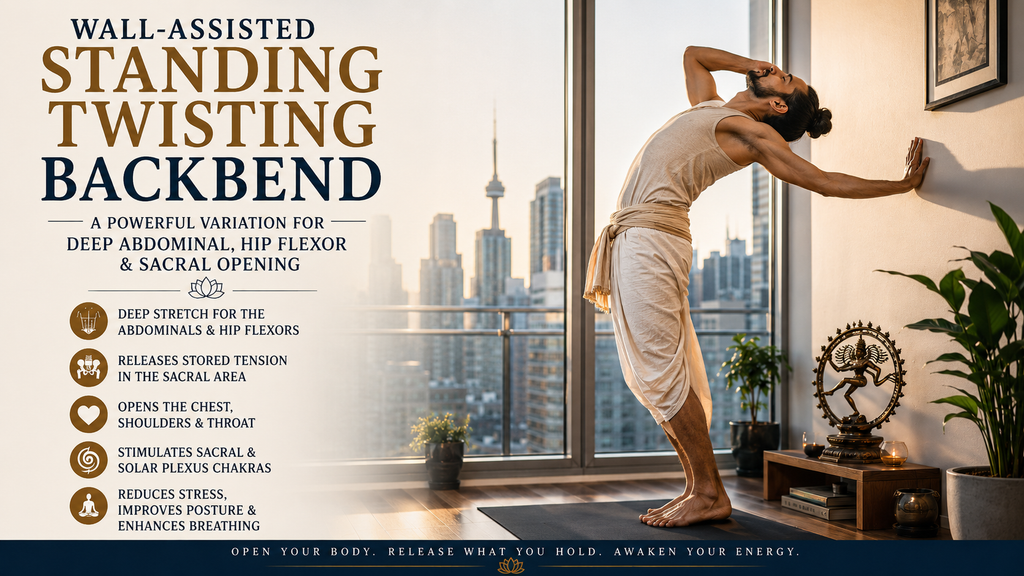
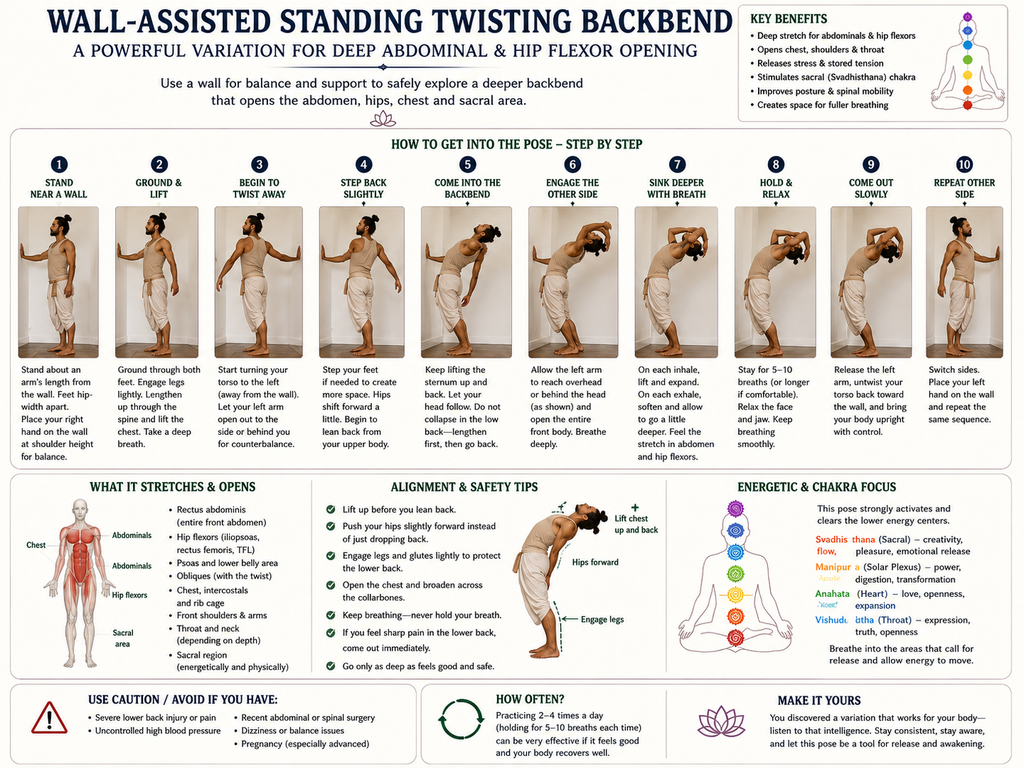
This particular movement is best described as a wall-assisted standing twisting backbend.
It resembles:
- Standing Backbend / Anuvittasana
- Ardha Chakrasana (Half Wheel Pose) in some schools
- a mild-to-deeper side-opening or twisting backbend variation
- a supported front-body-opening posture with a rotational entry
So while this may not be a universally catalogued “official” pose with one perfectly fixed name, it clearly belongs to an established yogic vocabulary.
That matters because it shows something important:
You may not have invented the entire movement category, but you may have found a variation that is uniquely effective for your own body.
And that is often how real practice matures.
Why This Variation Feels Different
A lot of people try to stretch their hip flexors or lower abdomen through:
Lunges.
Cobra.
Upward-facing dog.
Camel pose.
Bridge.
Standing backbends.
All of these can help.
But sometimes they still do not quite reach the specific tightness a person is carrying through the front of the hips, lower abdomen, psoas region, and deep fascial line running up the front of the body.
What makes this variation feel different is that it combines several things at once:
- standing balance
- backward extension
- rotational entry
- support from a wall
- a feeling of “opening and hanging” into the front body
- active breathing while the chest and abdomen are exposed
The support makes a big difference.
Many people cannot go deep into a standing backbend because balance gets in the way first.
The wall removes part of that problem.
Instead of the nervous system saying:
“Don’t go farther or you’ll fall,”
the body gets permission to soften more deeply.
That is often when the real stretch begins.
How the Pose Is Entered
Based on your description, the movement works something like this:
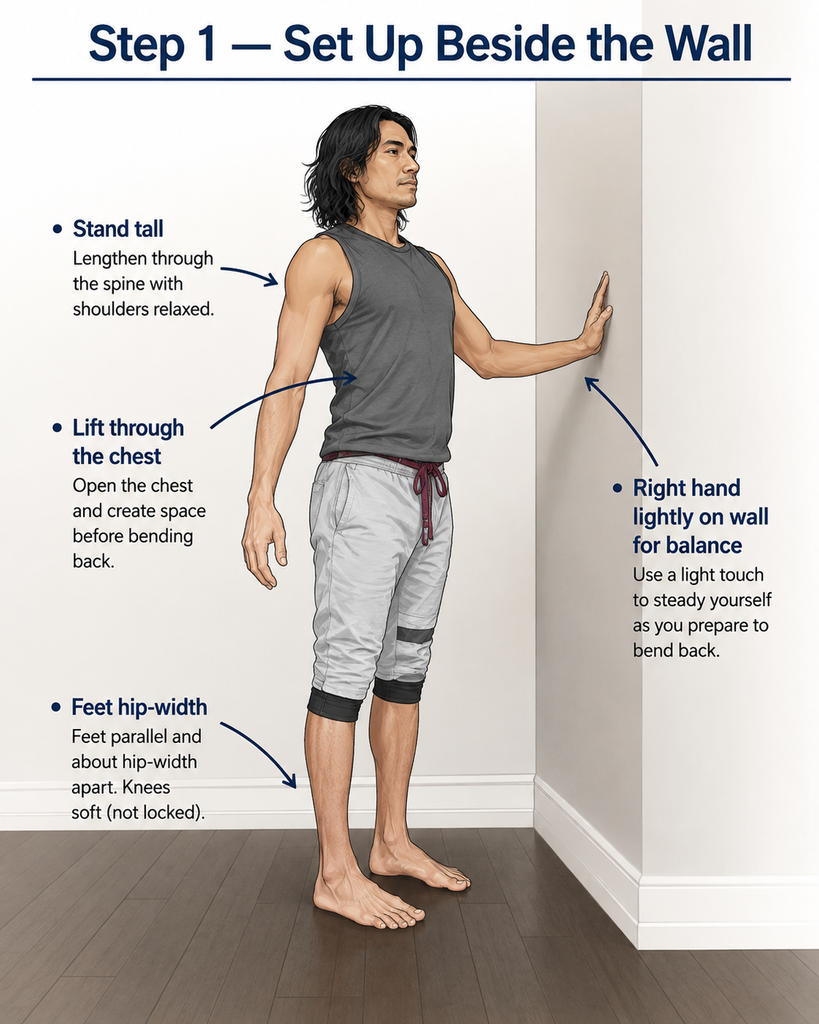
You begin standing near a wall.
At first, you use one hand—say the right hand—touching the wall in front of you for balance.
That gives the body a stable orientation.
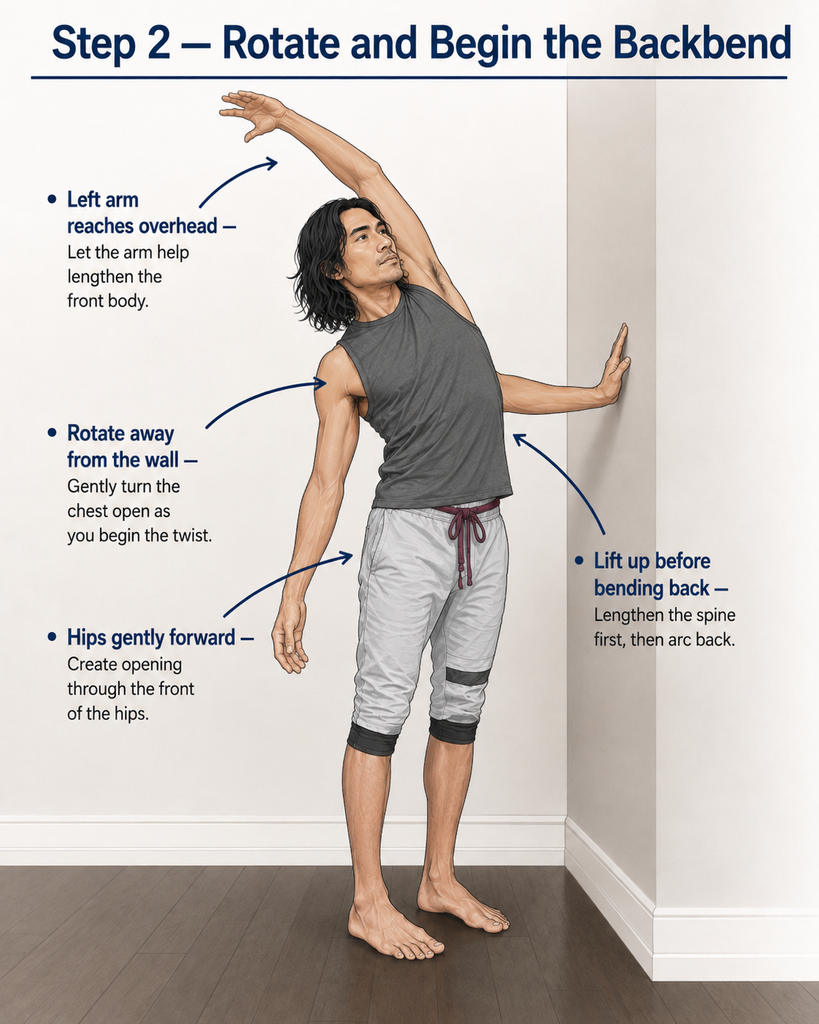
Then you begin rotating and leaning backward so that you are no longer facing the wall in the same way.
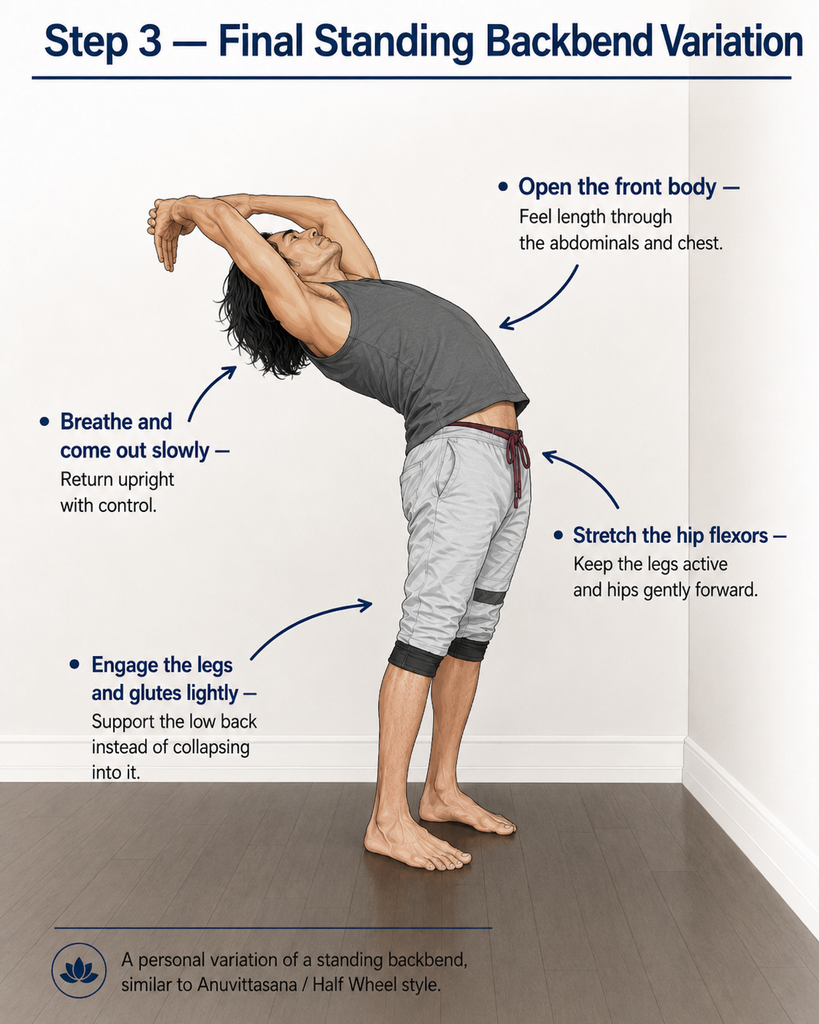
As you enter the backbend more fully, the body opens through the front line and the support shifts so you can engage the other side—such as the left arm or left-side opening—while deepening into the posture.
In effect, this creates a supported, twisting, chest-opening standing backbend.
This type of entry can be very useful because it does not throw you abruptly into the final shape.
Instead, you move through stages:
- Establish stability
- Introduce rotation
- Lean into extension
- Let the front body open
- Use support so the stretch goes deeper without forcing
That gradual progression may be part of why the posture works so well.
The Anatomy of the Stretch
When a pose “feels right,” there is usually a good anatomical reason for it.
This variation can plausibly affect several areas at once.
1. Rectus Abdominis and Front Abdominal Line
When you backbend deeply, the abdominal wall lengthens.
That includes the rectus abdominis—the “six-pack” muscle—as well as fascial tissues running through the front of the trunk.
For someone holding tension through the belly or solar-plexus area, this can feel like a major release.
2. Hip Flexors
If the pelvis is allowed to extend and the legs remain grounded, the pose may also lengthen the front of the hips.
This includes muscles such as the hip-flexor complex, especially if the body is not merely collapsing backward from the waist, but actually extending through the hips.
3. Psoas Region
The psoas is not a simple “stretch this one spot” structure, but many people subjectively experience deep front-body backbending as affecting the psoas area strongly.
Because the psoas is so connected with posture, stress response, and the sense of bracing through the core, a release here can feel emotionally significant.
4. Chest and Rib Cage
The chest opens.
The sternum lifts.
The rib cage expands.
This can change the quality of breathing, which often immediately affects stress levels.
5. Shoulders and Upper Front Body
If the arms go overhead or behind the head, the shoulders, upper chest, and arm lines may also be involved.
This increases the feeling that the whole front body is opening rather than just the low back bending.
Why the Wall Helps So Much
The wall may be the secret ingredient.
Without support, many standing backbends stop early because of one of three problems:
- fear of falling
- lack of balance
- too much low-back compression before other areas open
Support can help solve all three.
Balance
The hand on the wall gives the nervous system a point of reference.
This decreases anxiety and can allow greater depth.
Gradual Entry
The wall lets you organize the movement in stages rather than collapsing into it.
Confidence
A person is often able to breathe more fully when they feel safe.
Better Distribution
When the pose is entered carefully, the stretch can distribute more through the hips, abdomen, chest, and upper spine rather than jamming everything into one place.
In that sense, the wall is not “cheating.”
It is a tool for creating a more intelligent stretch.
Is It a Sacral Chakra Pose?
From an energetic perspective, it makes complete sense that you experience this as opening the sacral chakra.
The sacral chakra, or Svadhisthana, is generally associated with:
- the pelvic region
- sensuality
- emotional flow
- creativity
- pleasure
- release
- openness in the lower abdomen and hips
If a pose creates a deep sensation across the front of the pelvis, lower belly, and hip-flexor zone, many practitioners will naturally interpret it as sacral work.
At the same time, the pose likely affects multiple energetic centres.
Sacral Chakra
Because the lower abdomen and pelvis are strongly involved.
Solar Plexus Chakra
Because the abdominal centre is deeply exposed and lengthened.
Heart Chakra
Because the chest opens and the front body expands upward.
Throat Chakra
Potentially, if the neck and front throat are opened as part of the backbend.
So while the pose may be experienced as especially sacral, it is probably better described as a front-body-opening pose with a sacral–solar-plexus emphasis.
Why It May Help Release Stress and Tension
Many people store stress not only in the neck and shoulders, but in the front of the body:
The belly tightens.
The hips grip.
The chest closes.
Breathing becomes shallow.
The whole front line subtly contracts.
This can happen from:
sitting too much,
screen time,
stress,
defensive posture,
emotional holding,
lack of movement,
and general modern tension patterns.
A deep supported backbend does the opposite.
It says to the body:
Open the front.
Lengthen the belly.
Lift the chest.
Breathe.
Stop bracing.
That can be subjectively powerful.
Sometimes what feels like a “chakra opening” is also the nervous system finally being given permission to stop guarding a region.
The spiritual and physical interpretations do not have to conflict.
They may be describing different aspects of the same experience.
Why Repeating It Multiple Times a Day Can Feel So Good
When a posture reaches an area that has been chronically under-mobilized, the relief can be striking.
That is why you may feel drawn to repeat it multiple times a day.
The body starts learning:
This position gives me access to a release I was missing.
There is nothing inherently wrong with returning to a pose often if it is helping and being done safely.
But frequency should be guided by awareness.
If the pose keeps feeling:
- expansive
- relieving
- breath-opening
- stable
- energizing
that is different from a pose that starts creating:
- pinching in the low back
- dizziness
- neck strain
- joint irritation
- overstretching
- instability
Good repetition deepens intelligence.
Bad repetition deepens compensation.
So the key is not merely doing it often.
The key is doing it well.
The Biggest Caution: Avoid Dumping Into the Low Back
Whenever someone finds a deep backbend they love, one major caution immediately appears:
Do not let the entire bend collapse into the lumbar spine.
That is the most common issue.
A backbend feels dramatic, but a lot of the motion may be coming from low-back compression rather than true front-body opening.
A healthier approach is to think:
- lengthen upward first
- root through the feet
- gently engage the legs
- let the hips participate
- lift the sternum
- broaden the chest
- create space before depth
- breathe into the opening
The feeling should be more like elongated extension than hinging and crunching.
If the low back feels sharp, jammed, or pinched, back off.
If the stretch feels broad through the front body, that is generally a better sign.
The Pose May Be Especially Valuable for Urban Life
Modern life closes the front body constantly.
We sit.
We work at computers.
We look down at phones.
We drive.
We slump.
Even when we stand, many of us stand in subtly collapsed patterns.
An urban apartment lifestyle, especially one with long hours indoors, can create a body that is physically safe but emotionally and structurally contracted.
That is one reason this posture may feel so important.
It is almost like a counter-pose to city life.
Instead of folding inward, you do the opposite.
You stand.
Open.
Lean back.
Breathe.
Expand.
The apartment wall becomes a yoga prop.
The hallway becomes a practice zone.
A simple home environment becomes a place where the body reclaims space.
Why This Can Feel Spiritually Significant
Sometimes people dismiss pose discoveries as “just stretching.”
But yoga has always involved more than range of motion.
A meaningful pose can shift:
- breathing
- emotional state
- energy flow
- posture
- attention
- nervous-system tone
- body awareness
- self-trust
If a particular variation repeatedly helps someone release held tension and feel more open, energized, and emotionally balanced, then it makes sense that the person experiences it as spiritually meaningful.
Especially if it seems to affect the lower abdomen and pelvis, the pose may feel connected with:
creativity,
sexual energy,
emotional flow,
confidence,
and energetic clearing.
A pose does not need to be ancient in exactly your version to be spiritually real in your practice.
A Good Working Name for the Pose
If you want to discuss or teach the variation informally, it may help to use a practical descriptive name.
Possible names include:
- Wall-Assisted Standing Twisting Backbend
- Supported Standing Twisting Backbend
- Wall-Supported Front-Body Opener
- Twisting Standing Backbend Variation
- Supported Sacral Opening Backbend
If you want something simple and clear, Wall-Assisted Standing Twisting Backbend is probably the most accurate.
It tells the reader:
- it is standing
- it is supported
- it includes a backbend
- there is a rotational or twisting component
Suggested Step-by-Step Method
A safe basic method might look like this:
Step 1: Stand Near a Wall
Position yourself so one hand can comfortably touch the wall for support.
Step 2: Ground the Feet
Keep the feet stable and the legs awake rather than floppy.
Step 3: Use the First Hand for Balance
For example, place the right hand forward on the wall.
Step 4: Lift Before You Lean
Lengthen upward through the spine and chest before beginning the backbend.
Step 5: Begin the Rotation
Allow the torso to turn as you start moving into the backward-opening pathway you described.
Step 6: Open the Front Body
Let the abdomen, chest, and front hips begin to lengthen.
Step 7: Breathe
Do not hold the breath. Let the breath help the front body open.
Step 8: Use the Opposite Side
As the posture deepens, engage the other arm/side as appropriate for your variation.
Step 9: Come Out Slowly
Return carefully rather than snapping upright.
Step 10: Pause
Notice the after-effect before repeating.
This slower, staged approach respects the depth of the movement.
Who Might Benefit From It
This variation may be helpful for people who:
- feel chronically tight in the front hips
- hold stress in the lower abdomen
- want a deeper standing front-body opener
- enjoy backbends but need balance support
- resonate with sacral- or solar-plexus-based yoga work
- live in small spaces and want an effective home stretch
- find that ordinary hip-flexor stretches are not quite enough
Who Should Be More Careful
Anyone with the following should be more cautious and ideally get qualified input if needed:
- significant low-back pain
- spinal injuries
- severe dizziness or balance issues
- uncontrolled blood pressure issues
- major shoulder limitations
- neck problems aggravated by extension
- recent abdominal surgery
- any condition where deep backbending is not appropriate
Also, even without injury, a person should be careful not to confuse intensity with quality.
A pose can feel intense and still be structurally poor.
The best version is not the deepest-looking version.
It is the one that gives the clearest, broadest, healthiest opening.
Other Poses Related to This One
If you enjoy this variation, related postures worth exploring include:
- Anuvittasana (Standing Backbend)
- Ardha Chakrasana
- Anjaneyasana (Low Lunge), especially with a backbend
- Ustrasana (Camel Pose)
- Bhujangasana (Cobra Pose)
- Urdhva Mukha Svanasana (Upward-Facing Dog)
- supported chest openers using a wall or bolster
But it is also worth recognizing that none of these may feel exactly the same.
Sometimes a specific variation works because it combines the right direction, the right support, and the right depth for your body.
A Pose Can Become a Daily Ritual
One of the most powerful aspects of finding a pose like this is that it can become more than an exercise.
It becomes a ritual.
You return to it in the morning.
Again later in the day.
Perhaps again in the evening.
Each time, it reminds the body:
Open.
Release.
Breathe.
Reset.
In a small apartment or city environment, that kind of repeatable private ritual can become a major part of self-regulation.
You do not need an entire studio.
You need awareness, consistency, and one movement that genuinely works.
Conclusion: A Valuable Variation Hidden in Plain Sight
The standing twisting backbend you discovered appears to belong to the traditional family of standing backbends, especially Anuvittasana/Ardha Chakrasana-type movements, but with a supported wall-assisted entry and a rotational dimension that may make it uniquely effective.
What makes it important is not whether every detail already existed somewhere in a yoga manual.
What makes it important is that it seems to create a deep, intelligent, repeatably effective opening in the exact area where you needed it most.
That includes the:
abdominals,
front hips,
hip flexors,
chest,
and lower energetic centres.
For a modern practitioner, especially someone living in an apartment and using home practice as a real spiritual tool, this kind of discovery can be extremely significant.
It demonstrates something yoga has always quietly taught:
The body itself can become a teacher.
A posture does not have to be trendy or perfectly standardized to matter.
If it helps you breathe more deeply, release more completely, and feel more open physically and energetically, then it may have become an important part of your path.
In that sense, this variation deserves attention.
Not as a claim that a brand-new ancient pose has been uncovered.
But as something more practical:
a powerful modern home-practice backbend variation that may help release front-body tension, open the sacral area, and restore aliveness in a body shaped by stress, sitting, and urban life.
And sometimes that is exactly what a yogi needs.