Anyone who has lived with a cat has probably experienced the moment.
The room appears completely empty.
Your cat suddenly freezes.
Its ears point forward.
Its eyes become enormous.
It stares intensely at a corner of the ceiling.
Perhaps its head slowly follows something across the room.
Then it runs after something you cannot see—or simply sits there watching.
And inevitably you wonder:
What exactly is the cat looking at?
For thousands of years, cats have existed on the boundary between the ordinary and the mysterious. They are creatures of darkness and twilight, moving almost silently through places where humans struggle to see. Their eyes glow at night. Their hearing extends far beyond ours. They can detect tiny movements and vibrations completely invisible to us.
That naturally produced one of humanity’s oldest suspicions:
Perhaps cats can perceive more than we can.
Modern science gives us excellent reasons why cats sometimes appear to stare at invisible things. But spiritual traditions offer another possibility:
What if cats really can perceive aspects of the environment—or perhaps even spirits—that human senses normally filter out?
We cannot scientifically prove that cats see ghosts.
But the idea becomes considerably more interesting when we examine feline biology, ancient Egyptian spirituality and the cat’s unusual position between the visible and invisible worlds.
Cats Literally Perceive a Different World Than We Do
Before considering anything supernatural, we should recognize something extraordinary:
Your cat already experiences a different sensory reality from yours.
Cats see approximately six times better than humans in dim light because of adaptations including numerous light-sensitive rod cells and the reflective tapetum lucidum behind the retina.
Their hearing is even more remarkable.
Human hearing generally tops out around 20,000 hertz when young, while cats can detect frequencies around 60,000 hertz or higher.
So when a cat suddenly turns toward an apparently empty wall, it may actually be hearing:
a mouse inside the wall,
water moving through plumbing,
an insect,
another animal outside,
electrical or mechanical sounds,
or something occurring at a frequency completely beyond human perception.
What appears to us as:
“The cat is reacting to nothing.”
may actually mean:
“The human cannot detect what the cat is detecting.”
That distinction becomes very important spiritually.
Because we already know that the cat’s perceptual world contains things ours does not.
The Famous Cat Staring at an Empty Corner
Veterinary sources specifically address this strange behaviour.
When cats appear to stare at nothing, they may be responding to minute visual movement or sounds that humans simply cannot perceive. Their exceptional low-light vision and hearing can make tiny insects, movements or noises obvious to them while remaining completely unnoticed by us.
This provides a strong natural explanation.
But it also created the perfect animal for spiritual folklore.
Imagine living thousands of years ago.
It is nighttime.
The house is quiet.
You cannot see much beyond the candlelight.
Suddenly your cat looks toward a dark doorway.
Its ears rotate.
Its pupils expand.
It watches something for thirty seconds.
Then its head follows an invisible movement across the room.
You see nothing.
The cat clearly sees—or senses—something.
It is easy to understand why humans began associating cats with invisible worlds.
Ancient Egypt: Where Cats Became Sacred Protectors
No civilization is more closely associated with the spiritual significance of cats than ancient Egypt.
Cats were practical companions first.
They protected households and food stores from mice, rats and snakes. The British Museum notes that cats were highly valued both as pets and for controlling pests around homes and granaries.
But over time their religious significance became extraordinary.
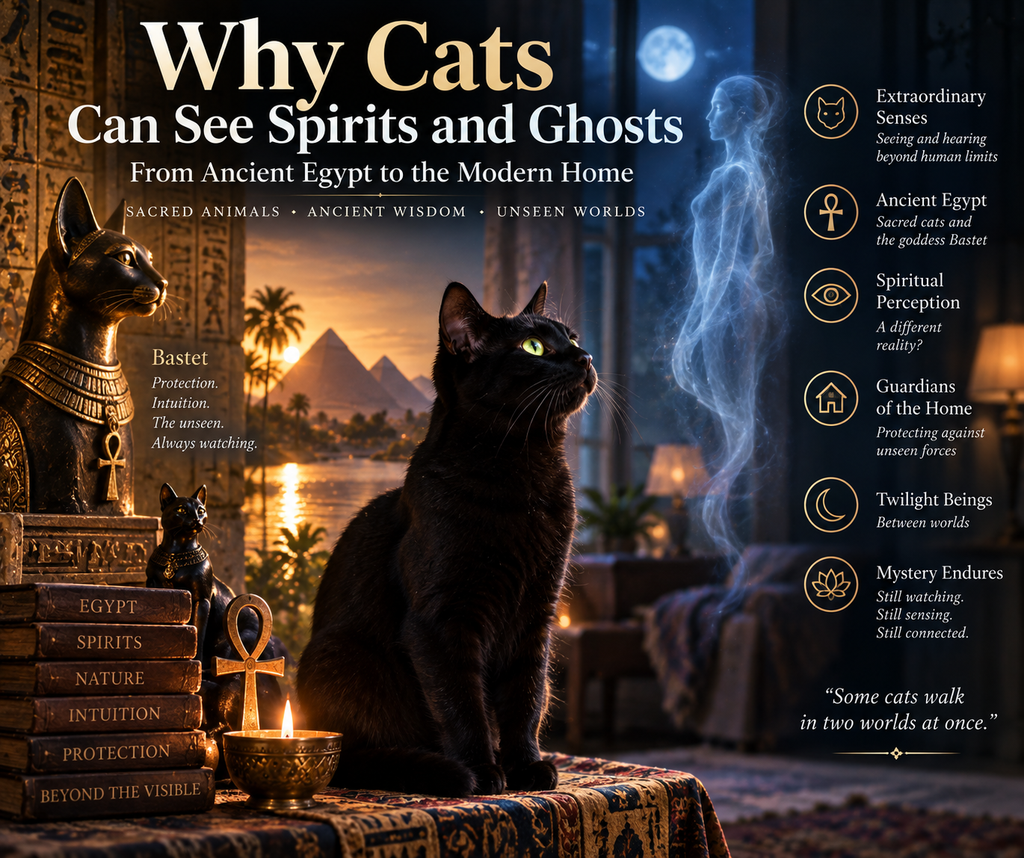
Cats became closely connected with the goddess Bastet.
Bastet could be represented as either a cat or a woman with a cat’s head. She was associated with fertility, motherhood, protection, joy and the household. The British Museum specifically notes that Bastet was believed to offer protection against evil spirits and disease.
That creates an intriguing historical connection.
Ancient Egyptians did not simply look at cats as cute household animals.
The feline form itself became associated with a protective divine presence.
Bastet: The Cat Who Guards Against Invisible Threats
The Metropolitan Museum of Art describes Bastet as a powerful protective goddess whose feline form appears poised and alert, guarding against external forces. Cats were considered sacred to her, and enormous numbers of cat statuettes were eventually dedicated at temples.
Think about the symbolism.
A cat sits quietly.
It appears relaxed.
Yet its ears are listening.
Its eyes are watching.
Its entire body can transform from stillness into action instantly.
This makes the cat a perfect guardian archetype.
It watches even while everyone else sleeps.
It notices what humans overlook.
It catches animals hidden inside walls.
It kills snakes that can threaten the household.
To an ancient Egyptian observer, perhaps the conclusion felt natural:
If the cat protects us from physical dangers we cannot detect, perhaps it also protects us from invisible ones.
That last step is spiritual interpretation rather than established Egyptian historical fact—but it fits beautifully with Bastet’s documented protective role.
Did Ancient Egyptians Actually Believe Cats Could See Ghosts?
Here we need to be precise.
There is excellent evidence that cats:
were connected with Bastet,
possessed religious importance,
were used in temple offerings,
were mummified,
and were associated with protection.
There is not equally strong evidence for the specific modern claim that ancient Egyptians believed ordinary household cats literally watched ghosts walking around rooms.
That idea is largely a later spiritual interpretation.
But Egyptian religion certainly placed cats very close to the boundary between everyday animal and sacred protector.
Cat statuettes were deposited in temples and catacombs, and cats were mummified in large numbers as offerings associated with Bastet.
So while we should not put modern ghost beliefs directly into the mouths of ancient Egyptians, their culture provides fertile ground for the later idea that cats possess unusual spiritual perception.
Cats Were Connected With the World of the Dead
There is an even more fascinating Egyptian connection.
The Metropolitan Museum’s discussion of Egyptian feline imagery notes an ancient text in which a divine cat is asked to grant passage toward the “Land of the Dead” in peace. Egyptian mythology also depicted a great cat fighting the serpent Apophis, an embodiment of destructive cosmic forces.
The symbolism again puts cats in an interesting position.
Protection.
Night.
Death.
The afterlife.
Combat against destructive forces.
Divine guardianship.
These themes surround feline imagery in ancient Egyptian religion.
No wonder the cat eventually became one of the world’s quintessential occult animals.
The Cat as a Liminal Creature
Anthropologists sometimes describe certain things as liminal—existing on a boundary.
Cats fit that symbolism almost perfectly.
They are domesticated, but never feel completely domesticated.
They live inside our homes but remain natural hunters.
They can be affectionate and then disappear silently into darkness.
They are awake when humans sleep.
They can move through the night almost invisibly.
They seem simultaneously:
wild and domestic,
loving and independent,
visible and hidden,
sleeping and alert.
Spiritually, creatures associated with boundaries often become connected with other boundaries:
life and death,
day and night,
physical and spiritual,
known and unknown.
The cat naturally became an animal of thresholds.
Cats Are Creatures of Twilight
Cats are naturally crepuscular, meaning much of their activity is concentrated around dawn and dusk.
Spiritually, twilight has always carried unusual symbolism.
It is neither fully day nor fully night.
Shapes become less certain.
Ordinary boundaries soften.
Many cultures consequently associate dawn, dusk and midnight with spiritual activity.
Cats thrive exactly where human perception becomes weaker.
Our world becomes less visible.
Theirs remains accessible.
This naturally gives the impression that cats belong partly to another realm.
Their Eyes Strengthened the Myth
Then there are the eyes.
A cat’s eyes can appear to glow dramatically at night because of the tapetum lucidum, a reflective layer behind the retina that sends incoming light through the retina again and improves low-light vision.
We understand the biology today.
But imagine encountering this before modern anatomy.
Two luminous eyes appear inside a completely dark room.
The animal sees you.
You can barely see the animal.
That alone would seem supernatural.
The cat became a creature that could apparently see through darkness.
Spiritually, darkness represents the unknown.
So the symbolic leap becomes:
If cats can see through physical darkness, perhaps they can see through spiritual darkness too.
What Would It Mean for a Cat to “See” a Spirit?
If spirits existed, there is no reason to assume they would necessarily be seen through ordinary visible light.
Perhaps “seeing” would be the wrong word.
A cat might theoretically react to:
sound,
vibration,
movement,
electromagnetic changes,
smell,
temperature,
or some unknown sensory phenomenon.
Animals routinely perceive information that humans cannot.
Dogs smell chemicals we cannot detect.
Birds navigate using sensory mechanisms that humans lack.
Cats hear ultrasonic frequencies and perceive minute movements in darkness.
So the broader philosophical idea that another species may detect information unavailable to humans is already true.
The leap occurs when we say the information is a ghost.
That part remains unproven.
Perhaps Animals Have Fewer Mental Filters
There is also an interesting spiritual theory.
Human beings constantly filter perception through thought.
We categorize everything.
Door.
Wall.
Chair.
Person.
Nothing unusual.
An animal may engage the environment much more immediately.
A cat is not thinking:
“Ghosts aren’t scientifically established, therefore I should ignore this sensation.”
It simply reacts.
Sound.
Movement.
Presence.
Something changed.
From a spiritual viewpoint, perhaps animals are less intellectually filtered and therefore more receptive to subtle phenomena.
That would not necessarily mean their senses are magically supernatural.
It might mean they attend to sensory information that humans habitually dismiss.
Why Cats Sometimes Avoid Certain Rooms
Many cat owners report curious behaviour:
the cat refuses to enter one room,
stares repeatedly at one location,
suddenly arches its back,
runs from an apparently empty area,
or sits watching a doorway.
Again, there are many mundane explanations.
Smells.
Rodents.
Air currents.
Neighbouring animals.
Electrical noises.
Past experiences.
Even something positioned strangely in the room.
But paranormal traditions interpret repeated location-specific behaviour differently.
Perhaps, they suggest, the cat perceives the energy of the place.
If spirits or residual emotional energy exist, the cat might be reacting to something human perception cannot easily register.
There is no scientific evidence establishing this.
But it remains one of the reasons cats feature so heavily in modern ghost lore.
Cats as Household Spiritual Guardians
This brings us back to Bastet.
From a spiritual perspective, perhaps the cat’s traditional role goes beyond detecting spirits.
It might act as a guardian of the household.
That idea makes remarkable symbolic sense.
A house cat constantly patrols its territory.
It checks:
doors,
windows,
corners,
closets,
hallways,
basements.
It marks the home with its scent.
It sleeps in strategic locations.
It notices unfamiliar sounds immediately.
In physical terms, this is territorial behaviour.
Spiritually, one can interpret the same behaviour as maintaining the energetic boundary of the home.
That resembles Bastet remarkably well:
the feline protector watching over domestic space.
Why Cats Sit Near Sick or Dying People
Another feature contributing to cats’ spiritual reputation is their tendency sometimes to stay near people who are ill.
Cats can react to:
changes in movement,
body temperature,
routine,
smell,
and behaviour.
So there are perfectly plausible natural explanations.
Yet families sometimes experience the cat’s presence as meaningful.
The animal seems to know that something has changed before the humans fully acknowledge it.
That contributes to the ancient impression that cats can sense transitions involving illness or death.
Some people subsequently interpret their companionship as almost psychopomp-like:
the cat sits at the boundary while someone prepares to leave this world.
Again, this is spiritual symbolism rather than established feline biology.
But it is powerful symbolism.
Cats May Notice Something—Without Us Knowing What It Is
Perhaps this is the fairest conclusion.
If your cat suddenly stares into an empty hallway, you should not immediately conclude:
“There is a dead person standing there.”
The cat may simply hear a mouse.
Or plumbing.
Or an insect.
Or movement outside.
Cats demonstrably possess sensory capabilities that humans lack.
But equally, we should remember the philosophical implication of that fact.
Human perception is not the boundary of reality.
There are sounds around you that exist even though you cannot hear them.
There are wavelengths of electromagnetic radiation around you that exist even though you cannot see them.
There are smells your brain cannot detect.
Reality does not stop where human senses stop.
That is scientifically certain.
The spiritual question is whether consciousness or spirits could occupy another part of that unseen reality.
Science currently cannot confirm that cats detect them.
But the question is not completely absurd merely because humans cannot perceive whatever the cat is reacting to.
Perhaps This Is Why Cats Feel Magical
Dogs usually make their intentions relatively obvious.
Cats often seem to live partially in a private world.
They disappear.
Observe.
Wait.
Stare.
Return.
They spend enormous amounts of time silently watching environments that humans barely notice.
Their mystery is partly biology.
But perhaps mystery itself is what makes them spiritually powerful symbols.
Ancient Egyptians saw enough in the feline form to connect it with divine protection.
Bastet became a guardian of home, family and protection against dangerous forces.
Thousands of years later, a modern cat still sits in a dark hallway at 3 a.m., staring intently at something its owner cannot see.
And the owner still asks essentially the same question:
“What do you know that I don’t?”
So Can Cats Really See Ghosts?
Scientifically:
There is no evidence proving that cats can see ghosts or spirits.
But several things are true.
Cats perceive sounds humans cannot hear.
They see enormously better than humans in dim light.
They detect minute movement and environmental changes.
They evolved as highly alert hunters.
Ancient Egyptian culture associated feline imagery with divine protection and Bastet, including protection from evil forces.
And throughout history, humans have repeatedly interpreted cats as animals capable of perceiving things beyond ordinary human awareness.
The spiritual interpretation is therefore possible to entertain without presenting it as established fact.
Perhaps the cat staring into the darkness is watching a tiny insect.
Perhaps it heard something inside the wall.
Perhaps its senses detected some environmental change invisible to you.
Or, if the spiritual worldview is correct, perhaps the ancient Egyptians were onto something when they associated the feline form with guardianship against unseen forces.
We cannot presently know.
But perhaps that uncertainty is part of the cat’s enduring magic.
Human beings domesticated cats thousands of years ago.
Yet somehow, after all that time, the cat has never entirely entered our world.
It still seems to keep one paw somewhere else.