
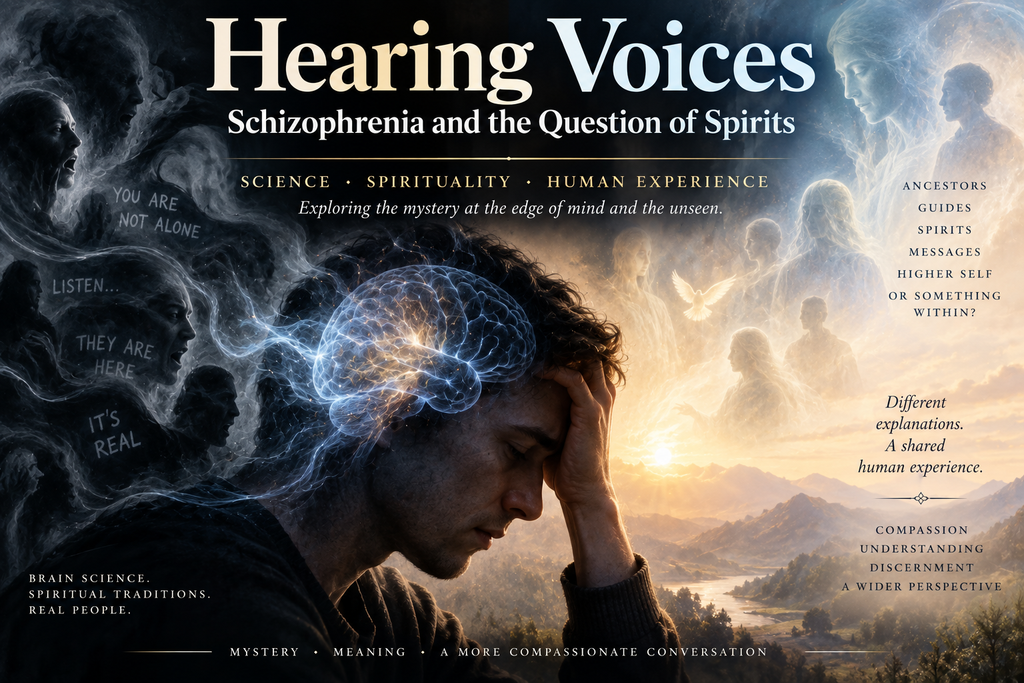
Throughout human history, people have reported hearing voices that nobody else around them could hear.
Sometimes the voice was interpreted as God.
Sometimes an ancestor.
Sometimes a guardian spirit.
Sometimes a demon.
Sometimes the dead.
And in modern psychiatry, persistent voice-hearing can also appear as an auditory hallucination, particularly in conditions such as schizophrenia and other forms of psychosis.
This creates one of the most difficult questions at the boundary between spirituality and mental health:
If someone hears a voice, how do we know whether it comes from the brain or from a spirit?
The most scientifically responsible answer is:
At present, we do not have a reliable test that can demonstrate that an apparently disembodied voice comes from a spirit.
Modern medicine has strong evidence that brains can generate convincing voice-hearing experiences without an external speaker. Hearing voices is one of the common psychotic symptoms experienced by people with schizophrenia, although not everyone with schizophrenia hears voices and hearing voices does not automatically mean someone has schizophrenia.
But the story becomes more interesting when we discover that voice-hearing also occurs outside schizophrenia, including among people without a psychiatric disorder.
And across cultures, people interpret those experiences in remarkably different ways.
Perhaps the real question is therefore not simply:
“Are voices hallucinations or spirits?”
It may be:
“What is the experience of hearing a voice, what can science tell us about it, and where does spiritual interpretation begin?”
First: Hearing Voices Is Not the Same Thing as Having Schizophrenia
This distinction is essential.
Schizophrenia is a complex disorder involving much more than auditory hallucinations. It can involve delusions, disorganized thinking, cognitive difficulties, changes in behaviour and disruptions in social or occupational functioning.
Voice-hearing can also occur in association with:
other psychiatric conditions,
severe stress,
sleep disruption,
trauma,
substance use,
neurological conditions,
and sometimes in people who otherwise function normally.
Reviews of auditory verbal hallucinations have found voice-hearing experiences in both clinical and nonclinical populations. Some people hear voices without requiring psychiatric treatment at all.
That alone complicates the idea that:
“Hearing a voice means schizophrenia.”
It doesn’t.
The experience exists on a much broader human spectrum.
What Does a Voice Actually Feel Like?
For someone who has never experienced it, the phrase “hearing voices” can sound almost metaphorical.
But for many voice-hearers, it can feel extremely real.
A voice may seem:
inside the head,
outside the head,
behind the person,
next to the person,
male,
female,
familiar,
unfamiliar,
whispering,
shouting,
supportive,
critical,
or conversational.
Some voices communicate entire sentences.
Others consist of words or fragments.
Some seem like recognizable personalities.
Research on auditory verbal hallucinations shows enormous variation in loudness, location, linguistic complexity, identity and emotional content.
The person is therefore not necessarily “pretending” to hear something.
The experience itself can be very real.
The uncertainty concerns its source.
The Psychiatric Explanation
From a psychiatric perspective, an auditory hallucination is a perceptual experience occurring without the corresponding external sound source.
The voice feels heard even though another person standing nearby would not hear an external speaker.
Researchers have proposed many mechanisms that may contribute to this experience.
One influential family of theories concerns source monitoring.
Normally, the brain distinguishes between:
something you thought,
something you imagined,
something you remembered,
and something someone actually said.
If the mechanisms that identify the source of inner speech become disrupted, internally generated language may sometimes be experienced as though it came from somewhere else.
The result can be astonishing:
a person’s own brain generates language, but consciousness experiences the language as another speaker.
That is one possible neurological and cognitive explanation.
Research continues because the mechanisms behind voice-hearing are complex and are not yet completely understood.
But Why Does the Voice Seem Like Another Personality?
This is where the phenomenon becomes particularly fascinating.
Voices often do not feel random.
They may seem to possess:
personality,
intentions,
opinions,
memory,
emotional attitudes,
and relationships with the hearer.
Some voice-hearers even assign names or identities to them.
Research has shown that perceptions of a voice’s identity and intentions strongly affect how distressing the experience becomes.
The psychiatric interpretation is that the human brain is exceptionally good at generating models of other minds.
We do this constantly.
You can imagine:
what your mother would say,
how your boss would respond,
what your friend would think.
The brain contains extraordinarily sophisticated representations of other people.
Under unusual circumstances, those internally generated representations may become experienced with a surprising degree of autonomy.
But the spiritual interpretation asks a different question:
What if at least some apparently autonomous voices really do represent another consciousness?
Science has not established that possibility.
Yet human spiritual traditions have considered it for thousands of years.
Before Psychiatry, Voices Were Often Spiritual
For most of history, hearing an unseen voice did not immediately mean:
mental disorder.
The interpretation depended on the culture.
Voices might be understood as:
ancestors,
gods,
angels,
spirits,
demons,
or divine revelation.
Religious history contains countless stories involving people receiving communication from invisible beings.
Importantly, we should not retrospectively diagnose every prophet, mystic or visionary with schizophrenia.
We usually do not possess enough information to make such diagnoses, and unusual spiritual experiences by themselves are not equivalent to psychiatric illness.
The historical record instead tells us something more basic:
human beings have always had experiences that they interpret as communications from beyond ordinary consciousness.
Culture Changes What Voices Seem to Be
Perhaps the most fascinating research in this field concerns culture.
Anthropologist Tanya Luhrmann and colleagues interviewed people diagnosed with schizophrenia who heard voices in:
the United States,
India,
and Ghana.
The basic phenomenon of voice-hearing appeared in all three locations.
But the relationship with the voices was strikingly different.
American participants were more likely to describe harsh or violent voices.
Participants in India were more likely to identify voices with relatives or family members.
Participants in Ghana, where spiritual explanations were culturally more accepted, often described voices in religious terms and sometimes reported more positive relationships with them.
That finding is extraordinary.
The underlying ability to hear voices may be human.
But culture helps determine:
what the voice becomes.
The Mind Gives the Voice a Language
Imagine two people having roughly similar anomalous auditory experiences.
One grows up in a highly secular Western environment.
They may think:
“Something is wrong with my brain.”
Another grows up in a culture where ancestors regularly communicate with descendants.
They may think:
“My grandmother is speaking to me.”
Another grows up in a charismatic religious community.
They may think:
“God is guiding me.”
Another grows up terrified of demons.
They may think:
“An evil spirit has entered my mind.”
Culture does not necessarily create the entire experience.
But research strongly suggests that culture influences the content, meaning and emotional tone of hallucinations.
This is where psychiatry and spirituality become intertwined.
Could Some Voice-Hearers Interpret Hallucinations as Spirits?
Certainly.
Someone experiencing a psychiatric hallucination can interpret that voice through whatever spiritual worldview they already possess.
A Christian may hear Satan.
A spiritualist may hear a ghost.
Someone interested in aliens may hear extraterrestrials.
Someone focused on government surveillance may hear agents.
A person’s existing beliefs can provide the narrative through which an unusual experience is understood.
Research on psychotic voice-hearing has documented spiritual explanations including ghosts, spirits, demons and supernatural forces.
Therefore:
“The voice told me it is a spirit”
cannot by itself establish that the voice actually is a spirit.
A hallucinated voice can identify itself as anything.
But Spiritual People Without Psychosis Also Report Voices
Here is the important counterpoint.
Researchers have also studied people who report voice-like experiences while remaining otherwise psychologically and socially functional.
These can include:
religious practitioners,
people identifying as psychic mediums,
and other nonclinical voice-hearers.
A systematic review found meaningful differences between clinical and nonclinical voice-hearing populations. Nonclinical hearers often reported more control, less distress and more positive interpretations of their experiences. Spiritual frameworks were especially common among some healthy voice-hearing groups.
Another study specifically examined people reporting spiritually significant voices and found that such experiences often occurred infrequently, sometimes during prayer, and differed phenomenologically from many voices reported in psychosis.
Again, this does not prove spirits are communicating.
But it does demonstrate something important:
voice-hearing is broader than schizophrenia.
The Mediumship Question
Mediumship presents perhaps the most obvious challenge.
People identifying as mediums sometimes claim that they intentionally receive:
names,
images,
voices,
thoughts,
or impressions
from deceased people.
A psychiatrist might describe some voice-like experiences in terms of unusual perception, absorption or internally generated cognition.
The medium interprets them as communication from spirits.
Research examining spiritual voice-hearers suggests that expectation, cultural training and attentional practices can influence how people learn to identify and interpret inner experiences as communications from gods, spirits or the dead.
That gives us an interesting possibility without requiring a supernatural conclusion:
human attention can be trained to make subtle internal experiences more vivid.
Meditation does something similar.
Visualization does something similar.
Dream practice does something similar.
Whether anything external ever participates remains another question.
Spirituality Can Help—or Make Things Worse
Spiritual interpretations of voices are not automatically harmful.
Research examining spirituality and voice-hearing has found that spiritual frameworks can sometimes provide:
meaning,
comfort,
community,
coping strategies,
and reduced fear.
But the same research warns that spiritual interpretations can become harmful if they intensify fear, encourage isolation or delay useful psychiatric treatment.
This distinction is incredibly important.
Compare:
“I occasionally experience a comforting voice during prayer. I don’t know exactly what it is, but it helps me feel compassionate.”
with:
“Demons control my thoughts, everyone around me is possessed, and I must obey the voices.”
Both involve spiritual interpretation.
They are not psychologically equivalent.
Perhaps the Most Important Question Is Not “Spirit or Hallucination?”
Clinically, another question may sometimes be more useful:
What effect does the voice have on the person’s life?
Does it create:
terror,
paranoia,
confusion,
sleep deprivation,
social withdrawal,
dangerous behaviour,
or inability to function?
Or is it:
rare,
non-commanding,
comforting,
controllable,
and compatible with normal functioning?
Research comparing clinical and nonclinical voice-hearers finds that distress, negative content, frequency and loss of control help distinguish experiences associated with greater need for care.
This doesn’t determine whether a voice is spiritually meaningful.
But it helps determine whether the person needs help.
The Spiritual Discernment Problem
Spiritual traditions themselves have historically understood that not every inner voice should automatically be trusted.
This is an important point.
Christian mystics developed ideas about discernment of spirits.
Buddhist traditions warn that unusual visions or perceptions during meditation should not automatically be treated as enlightenment.
Sufi traditions emphasize spiritual discipline and guidance rather than blindly following every internal experience.
Why?
Because even within a spiritual worldview:
the mind can deceive itself.
Therefore someone can remain spiritually open while also remaining skeptical.
A genuinely mature spiritual approach might say:
“I experienced a voice. I do not yet know what produced it.”
That position leaves room for mystery without abandoning discernment.
The Brain and Spirit Do Not Have to Be Competing Explanations
There is another philosophical possibility.
Suppose someone believes consciousness includes a spiritual dimension.
That does not require rejecting neuroscience.
The brain clearly participates in perception.
Even ordinary conversation reaches consciousness through:
ears,
auditory nerves,
brain processing,
memory,
language,
and attention.
So discovering a brain mechanism associated with voice-hearing would not automatically answer every metaphysical question about consciousness.
A spiritual person could theoretically argue:
The brain mediates spiritual experience just as it mediates ordinary experience.
That hypothesis is philosophically possible.
But it is important to recognize what it is:
a spiritual hypothesis.
Neuroscience can study brain activity.
It cannot currently demonstrate that a particular voice originates from a deceased person or independent spirit.
A Radio Analogy—and Its Limitation
Spiritual thinkers sometimes compare the brain to a radio.
A damaged radio can distort a broadcast.
That does not mean the radio created the radio station.
Perhaps, they argue, consciousness similarly receives information.
It is an interesting metaphor.
But we should not confuse metaphor with evidence.
We know external radio transmitters exist because we can independently detect them.
We currently cannot independently identify a “spirit transmitter” responsible for auditory hallucinations.
So the radio analogy may help articulate a spiritual possibility.
It does not prove it.
Could Schizophrenia Represent Excessive Spiritual Sensitivity?
This idea appears frequently in spiritual communities.
Some people suggest that individuals diagnosed with schizophrenia are:
psychically open,
mediumistic,
sensitive to another dimension,
or unable to control spiritual perception.
There is currently no scientific evidence establishing schizophrenia as psychic sensitivity or spirit communication.
And presenting schizophrenia that way can become dangerous if it convinces someone to stop treatment while severely unwell.
Schizophrenia is associated with genuine impairment and increased health risks, and effective treatments—including medication and psychosocial support—exist.
However, there is a more nuanced version of the idea worth considering:
Perhaps certain individuals possess unusually high levels of:
absorption,
imagination,
sensitivity,
pattern recognition,
or permeability between inner imagery and external perception.
Those traits might contribute to spiritual experiences in one environment and distressing voices in another.
Research into spiritually significant voices and cross-cultural experiences suggests that expectation, absorption, culture and learned attention can indeed influence sensory-like spiritual experience.
That is intriguing without requiring us to conclude that schizophrenia equals mediumship.
The Shamanic Comparison
Another popular idea is that someone diagnosed with psychosis in Western society might have become a shaman in another culture.
There is a grain of truth and a large danger of oversimplification here.
Some traditional cultures contain socially recognized roles for people reporting visions, dreams, trance or spirit communication.
Those cultures may provide:
teachers,
ritual structures,
community interpretation,
and rules governing unusual experiences.
That can profoundly change how an experience is understood.
But traditional shamans are not simply “untreated people with schizophrenia.”
They frequently undergo training and retain substantial functioning within their communities.
The comparison becomes useful only if made carefully.
Culture may determine whether unusual experiences become:
integrated,
feared,
celebrated,
or stigmatized.
It does not mean every psychotic episode represents a spiritual initiation.
Why Demonic Interpretations Require Particular Caution
Among the most dangerous interpretations is immediately deciding:
“The voices are demons.”
Why?
Because frightening interpretations can make already distressing experiences much worse.
If someone hears:
“You are worthless,”
that is distressing.
If they additionally become convinced:
“A supernatural demon has permanently entered my mind,”
the fear may multiply enormously.
Research on spirituality and voice-hearing specifically warns that frightening spiritual explanations can increase distress and reduce perceived control.
A safer spiritual approach is:
Do not assume hostility equals supernatural origin.
Brains can generate hostile voices.
Trauma can influence voices.
Stress can influence voices.
Psychosis can produce religious content.
Rule those possibilities in rather than automatically jumping to demons.
What About Voices That Reveal Unknown Information?
This would theoretically be much more interesting evidence for a spirit hypothesis.
Suppose a voice repeatedly supplied:
specific information,
unknown to the hearer,
later independently verified,
under controlled conditions.
That would be scientifically interesting.
The stronger the information and the tighter the controls, the more difficult ordinary explanations would become.
But anecdotes are not enough.
Humans remember hits and forget misses.
We unconsciously absorb information.
Coincidences happen.
Memories change.
Therefore demonstrating genuine external intelligence requires rigorous testing.
Until such evidence exists, the content of a voice alone cannot establish its supernatural source.
Don’t Argue With the Experience
There is also a compassionate lesson here.
If someone says:
“I hear a voice,”
responding:
“That’s ridiculous; you’re imagining everything”
may not help.
The experience may feel completely real.
A better response is:
“I believe that you’re experiencing a voice. I’m not sure what is causing it.”
That distinction is powerful.
You validate the person’s experience without automatically validating their explanation.
Psychiatry increasingly recognizes the importance of understanding the cultural and spiritual framework through which people interpret mental-health experiences rather than simply dismissing those beliefs.
Spirituality and Treatment Can Coexist
A person does not necessarily have to choose between:
psychiatrist
and
spiritual practice.
Someone might take prescribed medication and meditate.
Attend therapy and pray.
Discuss voices with a doctor and speak with a trusted religious teacher.
Use grounding techniques and maintain spiritual beliefs.
The safest approach is one where spirituality adds support without replacing necessary care.
If treatment reduces frightening voices, that does not prove the voices were meaningless.
It simply means the treatment helped.
When Hearing Voices Needs Immediate Attention
Certain situations should be treated seriously regardless of someone’s spiritual interpretation.
Especially concerning are voices that:
command someone to harm themselves,
command someone to harm others,
create overwhelming fear,
prevent sleep for long periods,
produce severe paranoia,
make ordinary functioning impossible,
or appear alongside major confusion or loss of contact with reality.
Psychosis can make it difficult for a person to distinguish internal experience from external events, and early treatment can matter.
In those situations, the safest response is professional medical or mental-health support.
You can investigate spiritual meaning later.
Safety comes first.
Perhaps Psychiatry and Spirituality Ask Different Questions
Psychiatry asks:
What mechanisms produce this experience?
Does the person need treatment?
Is the experience causing impairment?
Can distress be reduced?
Spirituality asks:
Does this experience have meaning?
What does consciousness consist of?
Could reality contain forms of intelligence we do not understand?
How should we respond to mystery?
These questions overlap.
But they are not identical.
A psychiatrist may successfully reduce someone’s voices without answering whether spirits exist.
A spiritual tradition may provide meaning without explaining the neural mechanisms producing perception.
Perhaps both perspectives become weaker when they pretend to answer questions outside their domain.
The Most Balanced Position
We can therefore construct a middle position.
1. Hearing voices is a genuine human phenomenon.
People are not necessarily pretending.
2. Hearing voices can occur in schizophrenia and other psychiatric or neurological conditions.
This is well established.
3. Some people without serious mental illness also report voice-hearing.
This is also supported by research.
4. Culture strongly influences what voices seem to represent and how people respond to them.
God, ancestors, spirits, relatives and threatening strangers can all appear within different cultural frameworks.
5. Spiritual interpretations can sometimes provide meaning and comfort.
But they can also intensify fear.
6. Science currently cannot establish that an individual voice comes from a spirit.
There is no validated clinical test distinguishing “spirit communication” from an internally generated voice.
7. Therefore the wisest approach is discernment rather than automatic belief or automatic dismissal.
Perhaps the Mystery Is Consciousness Itself
Ultimately, this subject brings us back to one of humanity’s greatest unresolved questions:
What exactly is consciousness?
We know brains profoundly affect consciousness.
Alter the brain through:
sleep,
injury,
drugs,
disease,
meditation,
or medication,
and subjective experience can change dramatically.
But philosophers and scientists still debate why physical brain activity produces subjective experience at all.
That unresolved problem leaves room for profound philosophical questions.
Could consciousness exist independently of the brain?
Could consciousness interact with something beyond ordinary perception?
Could some mystical experiences involve realities science has not yet characterized?
Possibly.
But possibility should not be confused with proof.
Hearing a Voice Does Not Tell Us Where It Came From
This may be the central lesson.
A voice is an experience.
“Spirit” is an interpretation of the source.
“Hallucination” is a clinical description of perception occurring without an identifiable external stimulus.
Those are different levels of explanation.
Someone may genuinely hear a voice.
The experience can be powerful.
It can be meaningful.
It can even change their life.
But the experience alone does not tell us with certainty whether its source was:
brain activity,
memory,
trauma,
psychosis,
subconscious processing,
spiritual practice,
or something beyond current scientific understanding.
And perhaps the most spiritually mature response is not:
“Every voice is just a broken brain.”
Nor is it:
“Every voice is a spirit.”
It is:
“Something has been experienced. Let us understand it carefully.”
Respect the person.
Protect their health.
Remain curious.
Test what can be tested.
Do not feed unnecessary fear.
And leave some space for the possibility that consciousness may still contain mysteries neither psychiatry nor spirituality has fully solved.