
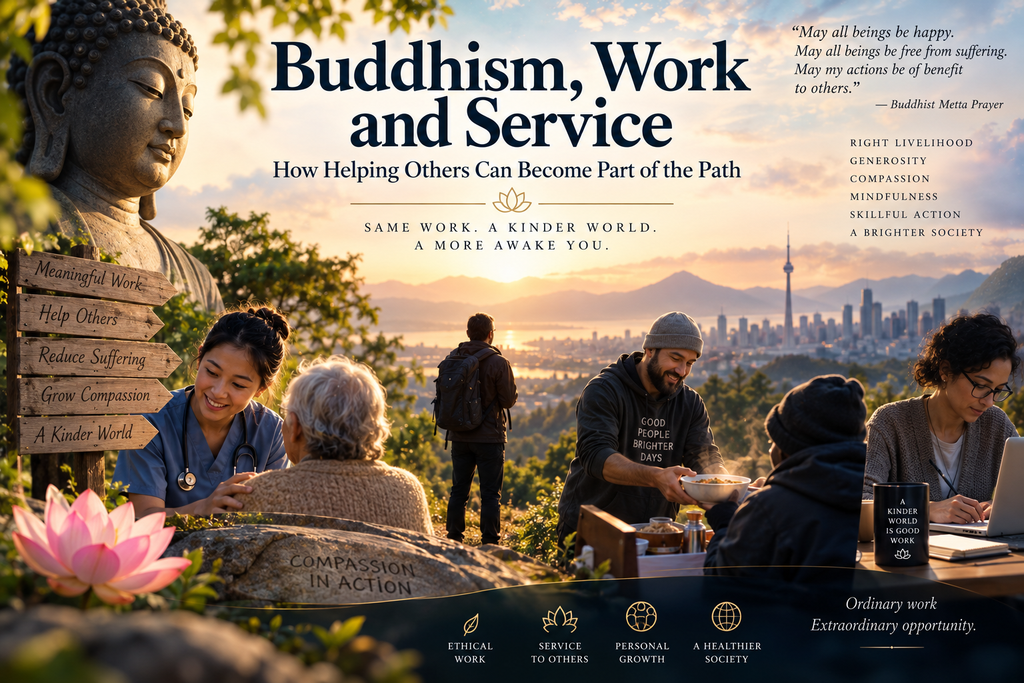
Buddhism is often imagined as a path of meditation, monasteries, silence and withdrawal from ordinary life.
That is certainly one side of the tradition.
But Buddhism also has a deeply practical question at its core:
How should we live in a way that reduces suffering?
That question applies not only to meditation.
It applies to:
work,
money,
career,
volunteering,
charity,
family responsibility,
and the way we use our abilities in the world.
For a monk, spiritual practice may happen primarily through meditation, study and community discipline.
For a layperson, however, much of life happens through work.
We spend enormous amounts of time earning money, solving problems, dealing with people and contributing something to society.
So from a Buddhist perspective, work does not have to be spiritually separate from practice.
It can become part of practice.
The important question becomes:
Does what I do increase suffering, reduce suffering, or simply keep the machinery of life moving without much awareness?
Right Livelihood
The clearest Buddhist connection to work appears in the Noble Eightfold Path through Right Livelihood.
Right Livelihood is traditionally understood as earning a living in a way that does not cause unnecessary harm.
That means work is not morally neutral.
How we earn money matters.
Traditionally, Buddhist teachings discourage livelihoods connected with things such as:
weapons,
human trafficking or exploitation,
slaughter,
intoxicants,
and poisons.
The basic principle is easy to understand even in modern life:
Do not make your living by creating suffering for other beings.
But Right Livelihood can go further than simply avoiding obviously harmful professions.
It can also ask:
Does my work exploit people?
Does it encourage addiction?
Does it manipulate people?
Does it destroy the environment unnecessarily?
Does it make society more confused, fearful or aggressive?
Or does it:
help,
build,
repair,
teach,
heal,
organize,
create,
or support?
This makes career itself a Buddhist ethical practice.
You Do Not Have to Be a Monk to Practice Buddhism
One common mistake is imagining that the most spiritual life is necessarily one far removed from ordinary society.
But the Buddha taught both monastics and laypeople.
Lay Buddhists have always had:
families,
jobs,
businesses,
property,
and social responsibilities.
A carpenter can practice Buddhism.
A software engineer can practice Buddhism.
A nurse can practice Buddhism.
A mechanic can practice Buddhism.
A teacher can practice Buddhism.
A cleaner can practice Buddhism.
The profession does not automatically determine the spiritual value.
Intention, conduct and consequence matter enormously.
A person working an ordinary job with honesty and compassion may be practicing Buddhism more deeply than someone constantly talking about spirituality while treating other people poorly.
Work Can Be a Form of Dana
One of Buddhism’s most important virtues is dāna, or generosity.
We normally think of generosity as giving money.
But generosity can involve much more.
You can give:
time,
skill,
attention,
knowledge,
labour,
encouragement,
food,
transportation,
or protection.
Volunteer work is therefore an obvious Buddhist practice.
Helping at a food bank.
Teaching someone without charging them.
Cleaning up a neighbourhood.
Helping elderly people.
Supporting an animal shelter.
Mentoring younger people.
Using professional skills for a charitable organization.
All of these can become forms of dāna.
And there is something especially powerful about giving your time.
Money can sometimes be replaced.
Time cannot.
When you give someone an hour of your life, you are giving something that can never be recovered.
Charity Is Not Only About the Recipient
Buddhist generosity also transforms the giver.
Why?
Because giving weakens attachment.
The ordinary ego says:
This is mine.
My money.
My time.
My energy.
My possessions.
My knowledge.
Generosity says:
Some of what I have can flow outward.
That changes consciousness.
You begin loosening the constant grip of:
mine,
mine,
mine.
In that sense, charity is not only social service.
It is spiritual training.
The Bodhisattva Ideal
This connection becomes even stronger in Mahayana Buddhism through the bodhisattva ideal.
A bodhisattva seeks awakening not only for themselves but for the benefit of all beings.
The spiritual objective becomes:
May my development eventually help reduce suffering beyond myself.
That does not mean you must save the world.
It means your life does not revolve entirely around private gratification.
You begin asking:
Who benefits from what I do?
Does my knowledge help anyone?
Can my work reduce someone else’s difficulty?
Can I create something useful?
Can I make one person’s day easier?
This is a much more realistic form of compassion than imagining grand heroic acts.
Most service happens quietly.
Service Does Not Need to Look Spiritual
A person repairing someone’s plumbing may be reducing suffering.
A programmer fixing an accessibility bug may be reducing suffering.
A bus driver getting people safely to work may be reducing suffering.
A cook preparing food may be reducing suffering.
A researcher solving a technical problem may eventually reduce suffering.
This is important because Buddhism does not require service to look religious.
You do not need incense.
You do not need robes.
You do not need a temple.
Sometimes compassion looks like competence.
Doing your job properly can itself be a gift.
Competence Can Be Compassion
Imagine two surgeons.
One is warm and spiritual but careless.
The other is quiet, disciplined and extraordinarily precise.
Which one helps more?
Sometimes compassion is not emotional display.
Sometimes compassion means:
showing up on time,
learning your craft,
checking your work,
not making careless mistakes,
and taking responsibility.
This fits Buddhism surprisingly well.
Mindfulness is about attention.
Right Effort is about disciplined cultivation.
Right Livelihood is about ethical work.
Combined together, they suggest that doing useful work carefully can become a form of practice.
Mindfulness at Work
Work also creates endless opportunities for mindfulness.
Notice:
impatience,
ego,
frustration,
competition,
jealousy,
resentment,
boredom,
fear,
and craving
as they appear during the day.
A workplace can expose your mind faster than a quiet meditation hall.
Someone criticizes you.
What arises?
Anger?
Defensiveness?
Embarrassment?
Someone succeeds.
Do you feel happy for them—or threatened?
Someone wastes your time.
Can you remain patient?
Someone makes a mistake.
Do you humiliate them?
Every interaction becomes practice.
Work Reveals Attachment to Status
Career can also reveal how deeply identity depends on status.
People become attached to:
titles,
income,
prestige,
recognition,
authority,
and comparison.
Buddhism would not necessarily say ambition is forbidden.
But it would ask:
What happens if you do not receive the recognition you expected?
Does your self-worth collapse?
Do you envy people above you?
Do you treat people below you differently?
Does money become proof that you matter?
These questions make work a powerful mirror.
Right Livelihood Does Not Mean You Must Love Your Job
Another misconception is that a spiritually appropriate profession must constantly feel meaningful.
Sometimes work is simply work.
You may do something ordinary because:
it pays the bills,
supports your family,
gives you stability,
or allows you to pursue other meaningful activities.
There is nothing inherently unspiritual about this.
If your work is ethical and you perform it honestly, it can still fit within Right Livelihood.
Not every person needs a profession with an inspirational mission statement.
Sometimes providing for yourself responsibly is itself part of the path.
Supporting Family Can Be Service
Buddhism does not require compassion to begin with strangers.
Supporting parents.
Raising children.
Helping siblings.
Caring for someone who is sick.
Paying household expenses.
These can all be forms of service.
Sometimes people become attracted to grand charitable causes while neglecting the people directly around them.
But compassion begins close.
If your work allows another person to:
eat,
live safely,
study,
recover,
or age with dignity,
that work has moral value.
Volunteering and the Ego
Volunteer work can also become ego-driven.
This is worth mentioning.
People can become attached to being seen as:
good,
generous,
spiritual,
or socially conscious.
Then charity becomes identity.
The Buddhist practice is therefore not only:
“Did I help?”
but also:
“Why did I need to be seen helping?”
This does not mean recognition is always wrong.
But it is useful to notice the ego’s ability to turn even compassion into self-promotion.
The deepest service may sometimes happen quietly.
Anonymous Generosity
There is something powerful about helping when nobody can reward you socially.
Donate anonymously.
Help someone without posting it online.
Solve a problem without making sure everyone knows you solved it.
Give without expecting gratitude.
This directly challenges the ego’s hunger for recognition.
The practice becomes:
Can I do something good even if nobody knows it was me?
That is difficult.
And therefore spiritually valuable.
Service Without Attachment to Results
Another deeply Buddhist principle is helping without becoming overly attached to the outcome.
You can assist someone.
But you cannot control everything they do afterward.
You can teach.
They may not listen.
You can donate.
The larger problem may remain.
You can volunteer.
Society will still contain suffering.
If your compassion depends upon immediately fixing everything, burnout is almost guaranteed.
Buddhist service therefore requires some detachment.
Do what you can.
Do it sincerely.
Then release the result.
This is not indifference.
It is sustainable compassion.
Compassion Fatigue and Buddhist Balance
People who work in:
medicine,
social services,
education,
charity,
animal rescue,
or caregiving
can become emotionally exhausted.
A Buddhist approach should not mean endlessly sacrificing yourself.
Compassion needs equanimity.
If you destroy your own health trying to help everyone, eventually you may become unable to help anyone.
Therefore service requires boundaries.
Rest.
Meditation.
Solitude.
Sleep.
Time away.
Compassion is not martyrdom.
Metta Can Extend Into Work
Metta, or loving-kindness, can also become part of professional life.
You do not need to feel emotionally affectionate toward everyone.
Instead, you can hold a simple intention:
May this person suffer less.
The customer.
The patient.
The coworker.
The student.
The stranger.
Even the difficult person.
That intention can subtly change how you speak and act.
The work remains practical.
But the consciousness behind the work becomes different.
A Difficult Coworker Can Become Practice
This may be one of Buddhism’s less glamorous lessons.
It is easy to feel compassionate toward humanity in the abstract.
It is harder to feel compassion toward the person who annoys you every Tuesday morning.
But that is where practice becomes real.
Can you recognize:
this person also wants happiness,
this person also fears rejection,
this person also suffers,
this person is also conditioned by their own history?
That does not mean tolerating abuse.
Boundaries still matter.
But understanding reduces hatred.
Charity and Interdependence
Buddhism teaches interdependence.
Nothing exists entirely by itself.
Your food came from:
farmers,
truck drivers,
warehouse workers,
shop employees,
engineers,
water systems,
electricity grids.
Your phone contains the work of thousands of strangers.
Your education came from generations of people preserving knowledge.
Once you see this clearly, the idea of being completely “self-made” becomes difficult to sustain.
Service and charity become a way of returning something to the network that already supports you.
Work as Karma
In Buddhism, karma fundamentally concerns intentional action.
Work therefore creates karma because work contains:
decisions,
motives,
speech,
actions,
and consequences.
A person might spend forty hours per week at work.
That is a huge portion of life.
It would be strange to think that spiritual practice matters only during thirty minutes of meditation while everything done during those forty hours is spiritually irrelevant.
Your work is part of your karma.
How you treat people there matters.
The Three Questions of Buddhist Work
A simple Buddhist framework for work could be:
Does this work cause unnecessary harm?
Can I perform it with mindfulness and integrity?
Can some part of it benefit other beings?
You do not need a perfect answer to all three.
But asking the questions already changes your relationship with work.
Profit Is Not Automatically Un-Buddhist
Buddhism does not require laypeople to reject money.
Earning money ethically can provide:
security,
independence,
family support,
and the ability to give.
The issue is attachment and harm.
A profitable business that:
solves real problems,
treats people fairly,
and produces something useful
can be far more compatible with Buddhist ethics than a nonprofit organization run through ego, exploitation or incompetence.
The label does not determine the ethics.
Conduct does.
Giving Through Your Profession
One of the most powerful forms of service is using what you already know.
A lawyer may occasionally provide free legal help.
A developer may build software for a nonprofit.
A doctor may volunteer clinical time.
A teacher may tutor someone who cannot afford lessons.
A mechanic may help someone repair a vehicle they depend upon.
A designer may help a charity improve its materials.
This approach is especially efficient because you are giving from skill, not only from money.
Ten minutes of specialized expertise can sometimes help more than ten hours of generic volunteering.
Skillful Means
Mahayana Buddhism uses the idea of upāya, or skillful means.
It refers to using methods appropriate to the needs of different beings and situations.
That concept can apply beautifully to service.
Helping does not mean doing the same thing for everyone.
Sometimes compassion means:
giving money.
Sometimes teaching.
Sometimes listening.
Sometimes saying no.
Sometimes introducing someone to a better resource.
Sometimes not interfering.
True service requires intelligence.
Good intentions alone are not enough.
Do Not Create Dependence in the Name of Compassion
Buddhist compassion should ideally reduce suffering in a sustainable way.
Sometimes constantly rescuing someone can increase dependence.
Helping might instead mean:
teaching a skill,
creating structure,
encouraging responsibility,
or allowing someone to experience consequences.
Compassion does not always look soft.
Wisdom and compassion belong together.
Work as a Practice of Non-Self
There is also a deeper Buddhist connection.
When you become absorbed in useful work, sometimes the sense of “me” becomes quieter.
You are simply:
writing,
repairing,
teaching,
building,
cleaning,
coding,
or helping.
The self temporarily recedes.
This resembles meditation in a small way.
Action happens.
Attention is present.
The ego becomes less central.
That can make work surprisingly contemplative.
The Spiritual Value of Ordinary Service
Not everyone will become a monk.
Not everyone will found a charity.
Not everyone will save thousands of lives.
But almost everyone can reduce a little suffering.
Hold the door.
Give useful advice.
Fix something.
Teach something.
Donate something.
Listen carefully.
Do your work honestly.
Avoid exploiting people.
Support someone who needs help.
These actions may seem small.
Buddhism repeatedly reminds us that small actions matter because the mind is shaped through repetition.
Compassion practiced once is an event.
Compassion practiced repeatedly becomes character.
The Best Buddhist Profession May Be One You Can Practice Well
There may not be one ideal Buddhist career.
The better question might be:
What work can I do competently, ethically and with enough stability that I can remain compassionate?
For one person that may be medicine.
For another, engineering.
For another, farming.
For another, creative work.
For another, running a business.
For another, volunteer service.
The path differs.
What matters is whether your work becomes another vehicle for:
mindfulness,
ethics,
generosity,
responsibility,
and compassion.
Service as a Middle Way
The Buddhist Middle Way offers a useful final principle.
Do not live entirely for yourself.
But do not destroy yourself trying to serve everyone.
Do not worship money.
But do not romanticize poverty.
Do not become obsessed with status.
But do not reject useful ambition.
Do not help merely to feed the ego.
But do not avoid helping because your motives are imperfect.
Act.
Observe.
Adjust.
Keep cultivating.
Perhaps Work Is One of the Greatest Lay Buddhist Practices
Most people will spend tens of thousands of hours working during their lifetime.
That makes work one of the largest spiritual opportunities available.
You can spend those hours generating:
resentment,
greed,
ego,
fear,
and harm.
Or you can gradually transform work into:
discipline,
mindfulness,
competence,
service,
generosity,
and compassion.
The profession itself matters.
But the consciousness you bring to it matters too.
Perhaps Right Livelihood ultimately means more than finding a job that is not harmful.
Perhaps it means asking:
How can the way I earn my living become part of the way I awaken?
You do not have to abandon society to practice Buddhism.
Sometimes the path runs directly through society.
Through the office.
Through the workshop.
Through the classroom.
Through the hospital.
Through the volunteer centre.
Through the business.
Through the ordinary responsibilities of daily life.
And perhaps one of the most Buddhist things a person can do is extremely simple:
Become useful without becoming attached to being praised for it.
Help where you can.
Reduce suffering where you can.
Do your work well.
Take care of yourself.
Give something back.
Then let the result go.
That is service.
And service, done with mindfulness and compassion, can become a spiritual path of its own.