
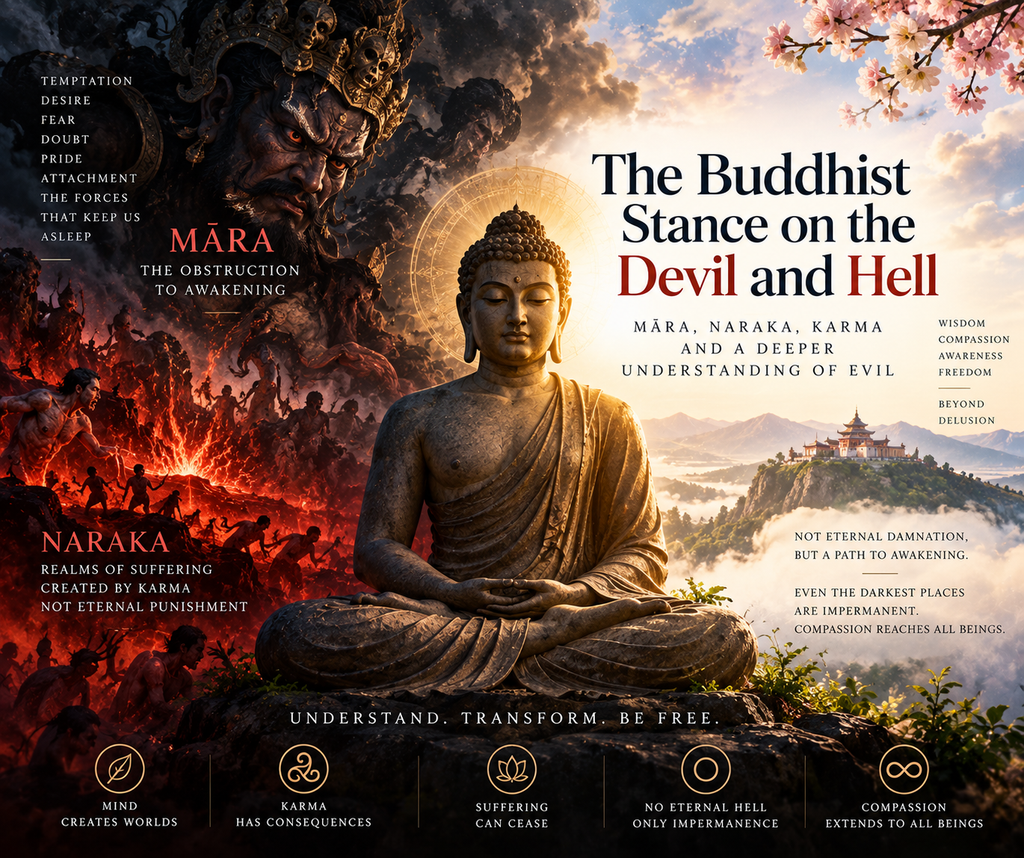
At first glance, Buddhism appears to have something very similar to Christianity’s Devil and Hell.
Buddhist art contains:
demons,
terrifying beings,
judges of the dead,
flaming hell realms,
tempting spirits,
and stories of the Buddha confronting a supernatural adversary named Māra.
Yet once we look more closely, the Buddhist understanding is fundamentally different.
There is no single eternal Devil who stands opposite an all-powerful God.
There is no Hell created by God as everlasting punishment.
And there is no cosmic battle in which evil ultimately exists as an independent force equal to goodness.
Instead, Buddhism places the source of suffering much closer to the human mind.
The Buddhist equivalent of the Devil is best understood through Māra, the force that prevents awakening.
And Buddhist hell—Naraka—is not eternal condemnation but an extremely painful condition of samsaric existence produced through karma and eventually exhausted.
This creates a striking spiritual difference.
Christian imagery often asks:
“Will evil capture your soul?”
Buddhism asks something more like:
“What inside consciousness keeps recreating suffering?”
Buddhism Does Have a Figure Who Looks Like the Devil
The closest Buddhist figure to Satan is Māra.
The name is related to Sanskrit roots associated with death, and traditional Buddhist literature portrays Māra as the great adversary of awakening—the being or force that tries to keep sentient beings trapped within samsara, the cycle of birth, death and rebirth.
The most famous encounter occurs immediately before Siddhartha Gautama becomes the Buddha.
As Siddhartha sits beneath the Bodhi tree preparing for enlightenment, Māra attempts to stop him.
The stories differ across traditions, but Māra uses things such as:
fear,
threats,
desire,
temptation,
doubt,
and challenges to the Buddha’s legitimacy.
The symbolism is obvious.
At the moment consciousness is about to become free, everything that keeps consciousness imprisoned makes one final attempt to regain control.
Māra Is Not Satan
This distinction matters.
Satan in many Christian interpretations is a rebellious spiritual being opposed to God and associated with temptation, evil and damnation.
Māra occupies a very different cosmological position.
He is not:
the creator of evil,
an equal opposite to the Buddha,
the ruler of an eternal Hell,
or the enemy of an omnipotent creator God.
Buddhism generally does not posit such a creator God in the first place.
Māra himself remains part of samsara.
He has not transcended the cycle.
In traditional cosmology, he can be described as a powerful celestial being whose purpose is to prevent liberation, but Buddhist scholastic traditions also interpret Māra more broadly as the forces within existence that obstruct awakening.
So the Buddhist Devil is simultaneously:
a being, an archetype and a psychological principle.
There Are Actually Several Māras
Later Buddhist analysis identifies several forms of Māra.
They include ideas such as:
Kleśa-Māra — the Māra of disturbing emotions such as greed, hatred and delusion.
Skandha-Māra — the Māra connected with attachment to the psycho-physical aggregates that we mistake for a permanent self.
Mṛtyu-Māra — death itself.
Devaputra-Māra — the celestial Māra portrayed in the Buddha’s enlightenment story.
This is very revealing.
Buddhism gradually turns “the Devil” inward.
The enemy is not merely a monster outside you.
Māra is also:
your craving,
your fear,
your pride,
your anger,
your attachment,
your despair,
and the voice that says:
“Do not wake up. Stay exactly as you are.”
Māra’s Greatest Weapon Is Attachment
This is one of the strongest differences between Buddhist and Western demonic imagery.
Māra does not necessarily need to make someone conventionally evil.
He merely needs to keep them attached.
A person can be:
wealthy,
comfortable,
respected,
successful,
and apparently moral
while remaining completely trapped in samsara.
From the Buddhist point of view, Māra wins whenever consciousness keeps clinging to:
pleasure,
identity,
status,
possessions,
beliefs,
or even existence itself.
The trap may therefore look pleasant.
That makes the Buddhist conception of temptation surprisingly subtle.
The Devil Can Offer Pleasure
In Buddhist stories, Māra frequently uses sensual temptation.
This fits Buddhist psychology beautifully.
The problem is not that pleasure itself is intrinsically wicked.
The problem is craving.
Pleasure appears.
The mind says:
“I need more.”
Then:
“I cannot lose this.”
Then:
“I cannot be happy without this.”
The experience has become bondage.
In this sense, the Buddhist Devil may operate just as easily through:
luxury,
romance,
status,
food,
sexual desire,
social approval,
or entertainment
as through obvious cruelty.
Māra wants attachment.
The particular object is secondary.
The Devil Can Also Be Fear
When desire does not work, fear may.
Māra’s armies in Buddhist imagery symbolize:
terror,
aggression,
doubt,
and destabilization.
This creates an interesting spiritual principle.
One side of bondage says:
“Grab this.”
The other says:
“Run away from that.”
Buddhist psychology repeatedly describes suffering through this push-pull dynamic:
craving what we want,
resisting what we dislike.
The awakened mind becomes freer precisely because neither attraction nor aversion completely controls it.
Māra Can Even Appear as Spiritual Pride
This is especially important.
Someone begins meditating.
They experience peace.
Perhaps unusual sensations arise.
Then comes:
“I am spiritually advanced.”
“I understand what other people don’t.”
“I must be enlightened.”
That too can become Māra.
The Buddhist path does not simply replace material ego with spiritual ego.
Attachment to spiritual identity remains attachment.
In some Buddhist traditions, anything that distracts the practitioner from liberation can metaphorically become a “demon.”
The Buddha Does Not Kill Māra
There is something profound about how the enlightenment story resolves.
The Buddha does not defeat Māra by:
destroying him,
torturing him,
or fighting a cosmic war.
He becomes unmoved by him.
Māra’s power depends upon consciousness reacting.
Once the Buddha sees clearly, temptation loses its grip.
That might be one of Buddhism’s deepest teachings about evil.
You do not necessarily defeat the Devil by becoming more violent than the Devil.
You defeat Māra by no longer giving Māra anything to hold onto.
What About Buddhist Hell?
Buddhism absolutely contains hell realms.
The Sanskrit term is Naraka, while Pali texts often use niraya.
Traditional Buddhist cosmology describes Naraka as among the lowest states of rebirth and as a condition of extraordinary suffering. Some systems describe numerous hells, including major hot and cold hells.
The descriptions can be terrifying.
Burning.
Freezing.
Being cut apart.
Crushed.
Pierced.
Attacked by horrifying beings.
Repeated death-like experiences followed by continued suffering.
In visual art, these descriptions can look strikingly similar to medieval Christian Hell.
But the theological mechanism is completely different.
Buddhist Hell Is Not Eternal
Perhaps the most important difference is:
Naraka is temporary.
The stay can be described as unimaginably long, but it does not last forever.
A being remains there while the karma responsible for that rebirth ripens.
When that karmic force is exhausted, another rebirth occurs.
This is crucial because Buddhism generally treats everything conditioned as impermanent.
An eternal Hell would create a philosophical problem.
If something has causes and conditions, eventually those causes and conditions change.
Hell therefore belongs to samsara just as Heaven does.
Both eventually end.
Even Heaven Is Temporary
This is another important contrast.
Buddhist cosmology contains heavenly realms inhabited by devas.
Some are extraordinarily pleasurable and may last for vast spans of time.
But even gods eventually die.
The Stanford Encyclopedia notes that Buddhist cosmology treats heavenly rebirth as highly pleasant but still finite; beings remain within samsara until liberation is attained.
So Buddhism does not divide existence simply into:
eternal Heaven
versus
eternal Hell.
Instead there are many possible states within samsara.
Some wonderful.
Some horrific.
None permanent.
Nirvana is something else entirely.
Nobody Sends You to Hell
Another major distinction:
there is no supreme God sentencing someone to Naraka.
Hell is traditionally understood as a karmic result.
Intentional actions motivated by:
hatred,
cruelty,
greed,
or profound delusion
can generate karmic conditions for painful rebirths.
Classical Buddhist ethics connects harmful action with the possibility of rebirth in lower realms, including the hells.
The model is therefore closer to:
cause and effect
than:
crime and divine sentence.
Karma Is Not Exactly God’s Courtroom
This difference is easy to miss because translations use words such as:
reward,
punishment,
judgment.
But karma is not normally described as a conscious cosmic judge choosing punishments.
It is more like a moral causal structure.
Plant one kind of seed.
A corresponding fruit develops.
Hatred conditions consciousness in one direction.
Compassion conditions it differently.
From within traditional Buddhism, one’s future experience follows from that karmic stream.
No divine being has to become angry first.
Then Who Is Yama?
Buddhist imagery often complicates this because it includes Yama, commonly depicted as the Lord or King of Death.
In East Asian Buddhist art, Yama can appear very much like a judge presiding over the dead.
This can look remarkably similar to a supernatural courtroom.
But Yama is not equivalent to God.
Nor is he the creator of karmic law.
He belongs inside the Buddhist cosmological system rather than standing outside it as ultimate creator and judge.
In some Buddhist narratives he functions almost as a personification of:
death,
judgment,
or karmic reckoning.
So when Buddhist artwork shows Yama judging the dead, the deeper principle remains:
karma determines the condition.
Yama does not invent morality.
Does Buddhism Believe Hell Literally Exists?
Traditionally, yes.
It is important not to modernize Buddhism so aggressively that its historical cosmology disappears.
Early Buddhist teachings already include rebirth into hells, heavens, animal states and other realms, and scholarly treatments generally regard karma and rebirth as genuine parts of the Buddha’s teachings rather than merely metaphors invented later.
Many traditional Buddhists therefore understand Naraka as an actual possible realm of rebirth.
However, modern Buddhists sometimes interpret the realms psychologically as well.
The Stanford Encyclopedia notes that some contemporary teachers understand the six realms as states of mind occurring during this very life.
These interpretations do not necessarily have to exclude one another.
A traditional practitioner might believe:
hell realms exist cosmologically,
and
hell can manifest psychologically now.
Hell as a State of Mind
This psychological reading is extremely powerful.
Consider a person consumed by hatred.
They wake angry.
Think angry thoughts.
Interpret everything as an insult.
Replay old grievances.
Imagine revenge.
Their entire world becomes hostile.
Even while physically sitting in an ordinary apartment, mentally they inhabit something like hell.
The outer world may not be burning.
The inner world is.
That is very compatible with Buddhist thought.
Consciousness participates in creating the world it experiences.
Anger Is Especially Hell-Like
Traditional Buddhist interpretations often connect hellish rebirth with intense hatred and destructive action.
This makes intuitive sense psychologically.
Anger burns.
Language itself reveals the connection.
Burning rage.
Seeing red.
Boiling with anger.
Consumed by hatred.
A person who nourishes rage continually creates an internal climate increasingly similar to the symbolism of the hot hells.
The punishment is not only later.
The hatred already hurts the person carrying it.
Hungry Ghosts Are Another Kind of Hell
Buddhist cosmology also contains the preta, or hungry ghost realm.
Hungry ghosts are traditionally depicted with:
huge bellies,
tiny throats,
and endless hunger they cannot satisfy.
The symbolism is extraordinarily modern.
It resembles addiction.
You want:
another drink,
another purchase,
another sexual experience,
another like,
another promotion,
another video,
another dose.
For a moment:
satisfaction.
Then hunger returns.
The hungry ghost does not lack access to desire.
The hungry ghost is made of desire.
That may be more frightening.
The Devil and Hell Are Therefore Connected Through Mind
This is where Buddhist cosmology becomes psychologically elegant.
Māra represents forces that maintain bondage.
Hell represents one of the most extreme results of karmically conditioned bondage.
The connection is therefore not:
Devil kidnaps soul → throws soul into Hell.
It is closer to:
ignorance → craving/hatred → intentional action → karmic consequence → suffering.
The mechanism is impersonal.
This also means there is no Devil to blame for everything.
Buddhism Gives the Devil Less Power
That may be one of the largest philosophical differences.
If a demon tempts you, your response still matters.
Buddhism generally places enormous emphasis on:
intention,
awareness,
and action.
You cannot ultimately say:
“The Devil made me do it.”
Māra may tempt.
But craving must arise within consciousness.
Hatred must be acted upon.
Delusion must remain unexamined.
This creates tremendous personal responsibility.
The true battleground is not somewhere in the cosmos.
It is consciousness itself.
The Three Poisons Are Almost a Buddhist Satanic Trinity
If Buddhism has a fundamental source of evil, it may be better represented by the Three Poisons:
greed,
hatred,
and
delusion.
These are often portrayed at the center of the Buddhist Wheel of Life as:
a rooster,
a snake,
and a pig.
They keep samsara turning.
That places the real enemy not outside creation but at the center of ordinary psychological activity.
Greed says:
“I need.”
Hatred says:
“I reject.”
Delusion says:
“I do not see clearly.”
Together they generate tremendous suffering.
If one wanted the closest Buddhist equivalent to “satanic influence,” these three forces may actually be more fundamental than Māra himself.
Evil in Buddhism Is Fundamentally Ignorance
This produces another important difference.
Western theology can conceptualize evil as deliberate rebellion against God.
Buddhism often traces harmful behavior deeper—to ignorance.
A being does not understand:
impermanence,
non-self,
karma,
or the nature of suffering.
From that ignorance arise craving and attachment.
Then harmful actions follow.
This does not excuse cruelty.
Buddhism still takes ethical conduct very seriously.
But it changes the ultimate diagnosis.
The murderer is not necessarily metaphysically evil at the core.
The murderer is profoundly deluded.
That leaves open the possibility of transformation.
There Is No Eternally Evil Soul
This follows naturally from anattā, the doctrine of non-self.
If there is no permanent, unchanging soul-identity, it becomes difficult to imagine someone as eternally and essentially evil.
A person’s mental states are conditioned.
Conditions can change.
Karma has consequences.
But awakening remains theoretically possible.
This is why even extremely negative beings are not metaphysically condemned forever.
Buddhism has no need for an eternal class of damned souls.
Even Hell Beings Can Eventually Escape Hell
This may be one of Buddhism’s most compassionate ideas.
A being can suffer for an almost inconceivably long period.
But the hell experience eventually ends.
Karma changes.
Another rebirth becomes possible.
There is no divine declaration:
“You are beyond redemption forever.”
Impermanence becomes a form of hope.
Even the worst condition cannot remain permanently fixed.
Kṣitigarbha: The Bodhisattva Who Enters Hell
Mahayana Buddhism develops this compassion dramatically through the bodhisattva Kṣitigarbha, known in East Asia as:
Dizang in China,
Jizō in Japan,
and Jijang in Korea.
Kṣitigarbha becomes especially associated with beings suffering in the hell realms.
His great vow is traditionally connected with refusing final Buddhahood until beings suffering in those realms are liberated.
This creates almost the opposite image from a deity condemning people to Hell.
The bodhisattva goes into Hell to help beings get out.
That is an extraordinarily Buddhist idea.
Compassion Extends Even to the Damned
The spiritual message is profound.
If someone is in Hell, Buddhism does not necessarily ask:
“Why should we care? They deserve it.”
The bodhisattva response is:
“They are suffering. How can suffering be reduced?”
Karma explains the condition.
Compassion determines the response.
Those two principles coexist.
Someone can be responsible for creating terrible karmic consequences while still deserving compassion.
Tibetan Buddhism Makes the Demonic More Psychological
Tibetan Buddhism contains extraordinarily vivid:
wrathful deities,
demons,
protectors,
death imagery,
and terrifying visionary forms.
To an outsider, some Tibetan Buddhist artwork can look almost demonic.
But appearances are deceptive.
A wrathful figure may represent compassion appearing in fierce form.
The frightening appearance does not necessarily mean evil.
This creates a very different symbolic vocabulary from traditions in which frightening supernatural appearance automatically implies Satanic influence.
Wrathful Does Not Mean Evil
A wrathful deity can symbolize energy powerful enough to destroy:
ignorance,
ego,
attachment,
or spiritual obstacles.
Think of a surgeon.
Cutting the body normally appears violent.
But surgery can save life.
Likewise, Buddhist wrathful imagery often represents fierce transformation rather than malevolence.
This is an important warning against judging spiritual symbolism only by appearance.
Tibetan Buddhism Also Speaks of Demons
But Tibetan traditions absolutely do contain beings and forces translated as demons.
Again, these can be understood on several levels.
External hostile beings may appear in traditional cosmology.
But some teachings also interpret demons as:
fear,
ego,
attachment,
illness,
or psychological obstruction.
The famous Tibetan practitioner Machig Labdrön developed the Chöd tradition around confronting and “feeding” demons rather than simply fighting them.
That is extremely Buddhist.
Instead of saying:
destroy the demon,
the practice asks what attachment or fear gives it power.
Buddhism Often Transforms Rather Than Exterminates Demons
This pattern appears repeatedly.
A hostile spirit may become a Dharma protector.
A dangerous force may be converted.
An enemy may become a guardian.
This reflects the Buddhist belief that mental states and beings are not frozen into eternal moral categories.
The energy can change function.
Anger can become clarity.
Fear can become awareness.
Power can become protection.
The demon can become guardian.
Māra Himself Keeps Appearing After Enlightenment
Interestingly, Buddhist stories do not always portray Māra as permanently annihilated after the Buddha awakens.
Māra may continue appearing and attempting to disturb him.
The difference is that the Buddha recognizes him.
Sometimes the Buddha essentially responds:
“I know you, Māra.”
That phrase contains an entire meditation teaching.
The temptation loses much of its power once consciousness can name it clearly.
Anger arises.
I know you.
Craving arises.
I know you.
Despair arises.
I know you.
Ego arises.
I know you.
Recognition replaces possession.
The Buddhist Exorcism Is Awareness
This does not mean Buddhism lacks rituals addressing spirits or harmful entities; many Buddhist cultures absolutely have such rituals.
But philosophically, the deepest protection is not merely ritual.
It is wisdom.
A mind without attachment gives Māra less to manipulate.
A mind without hatred creates less hell.
A mind seeing impermanence stops clinging so desperately.
A mind seeing non-self becomes less defensive about ego.
In this sense, enlightenment is the ultimate exorcism.
Buddhism’s Devil Is More Intimate
The Christian Devil can sometimes be imagined as an external enemy whispering temptation.
Buddhism makes the problem more uncomfortable.
The whisper is already connected with your own mind.
Māra does not need to create greed.
Greed already arises.
He does not need to invent fear.
Fear already arises.
He simply represents the force through which these tendencies maintain bondage.
The enemy is therefore extremely close.
It may feel like:
you.
Yet Buddhism says it is not your permanent self either.
It is conditioned activity.
Therefore it can change.
Buddhist Hell Is Also More Intimate
Likewise, Hell is not merely somewhere you might travel after death.
Every time hatred dominates consciousness, something hell-like appears.
Every time craving becomes endless, hungry-ghost consciousness appears.
Every time jealousy dominates, asura-like consciousness appears.
Every time pride produces complacency, even the gods’ realm appears psychologically.
The six realms become a map not only of cosmology but of states through which consciousness moves continually.
You Can Visit Several Realms in One Day
Consider an ordinary day.
Someone praises you.
For a moment:
heaven.
Someone receives something you wanted.
Jealousy arises:
asura realm.
You compulsively scroll for stimulation:
hungry ghost.
Someone insults you.
Rage explodes:
hell.
You become mindlessly habitual:
animal realm.
Then you become aware of the entire process:
human realm—the precious position from which practice becomes possible.
Whether or not one accepts literal rebirth realms, the psychological map is remarkably useful.
Why the Human Realm Matters
Traditional Buddhist cosmology often describes human rebirth as particularly valuable.
Hell contains too much suffering for easy practice.
Heaven contains so much pleasure that beings may lack motivation.
The human realm contains enough:
pleasure to function
and
suffering to ask serious questions.
That balance makes awakening possible.
This is a fascinating spiritual idea.
We do not need perfect conditions.
In fact, perfect conditions may make spiritual practice less urgent.
Hell Is Not God’s Revenge
Perhaps this is the single most important thing to understand about Buddhist Hell.
Naraka is not fundamentally:
“God became angry with you.”
It is:
“Causes have consequences.”
Hatred has consequences.
Cruelty has consequences.
Consciousness shapes its future through intentional action.
The law is impersonal.
No supreme being needs to hate you.
And because the causes are finite, the result is finite.
Terrible, perhaps.
But not eternal.
Buddhism Removes the Cosmic Scapegoat
This also changes the problem of evil.
There is no single Satan onto whom all evil can be projected.
Human beings cannot simply say:
“Evil comes from him.”
Buddhism repeatedly returns the question to:
ignorance,
craving,
hatred,
and conditioned consciousness.
The uncomfortable implication is:
the seeds of hell and the seeds of enlightenment are both present much closer than we think.
Not necessarily in some remote supernatural battlefield.
In the mind.
The Devil Is Anything That Keeps You Asleep
Perhaps this is the cleanest modern spiritual interpretation of Māra.
Māra is whatever says:
Do not meditate.
Stay angry.
Keep scrolling.
Take it personally.
Buy another thing.
Keep the resentment.
You need their approval.
You cannot forgive.
You are your status.
You are your body.
You are your thoughts.
You will be happy after the next achievement.
Stay asleep.
From that perspective, Māra remains extraordinarily relevant.
And Hell Is What Happens When the Pattern Completely Takes Over
Hell begins when anger is no longer something you occasionally feel.
It becomes the world.
Craving becomes the world.
Fear becomes the world.
Hatred becomes the world.
Traditional Buddhism extends that principle beyond this lifetime through karma and rebirth.
Modern psychological interpretation observes the same dynamic immediately.
Either way, the lesson is similar:
mental patterns create worlds.
Buddhism’s Final Answer to Both Devil and Hell
The Buddha does not ultimately ask followers to defeat Māra through hatred.
Nor does he ask them merely to avoid Hell because they fear punishment.
The deeper solution is to eliminate the causes that make either possible.
Ignorance.
Craving.
Hatred.
Attachment.
When these disappear, Māra has no foothold.
And when the karmic causes of samsaric rebirth cease, there is no future hell realm—or heavenly realm—to enter.
There is liberation.
Nirvana.
The Buddhist Devil Does Not Need to Be Destroyed
He needs to be understood.
The Buddhist Hell does not need to remain forever.
Its causes need to be exhausted and transformed.
Perhaps this is why Buddhism offers such an unusual philosophy of evil.
It does not deny demons.
It does not deny terrible consequences.
It does not deny hell.
But underneath all of them it sees something more fundamental:
conditions.
Conditions arise.
Conditions change.
Conditions cease.
Even the darkest mental state is impermanent.
Even the longest Hell eventually ends.
Even a demon belongs to samsara.
And even Māra cannot hold a mind that has completely awakened.
That may be Buddhism’s most hopeful teaching about evil:
nothing conditioned—not temptation, not hatred, not Hell itself—is powerful enough to become eternal.