

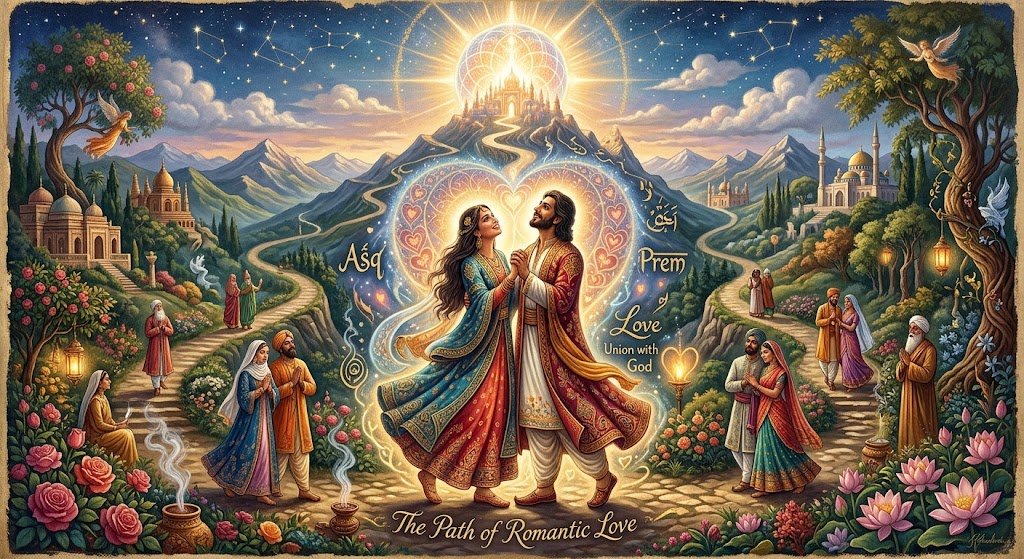
One of the most fascinating discoveries in comparative religion is that Sufism is far from unique in describing the relationship with God as a love affair.
Across Hinduism, Christianity, Judaism, Sikhism and classical Greek philosophy, spiritual thinkers repeatedly arrived at a similar insight:
human romantic love can reveal something about the way consciousness reaches toward the Divine.
Sometimes the comparison remained metaphorical.
God was the bridegroom.
The soul was the bride.
Longing for God resembled longing for an absent lover.
At other times the connection became considerably stronger.
A mystic could fall in love with a particular divine personality such as Krishna.
Physical beauty could become a doorway toward eternal Beauty.
Marriage could symbolize cosmic union.
Even desire itself could become something that, rather than simply being suppressed, was gradually redirected from possession toward transcendence.
This does not mean all these traditions taught the same doctrine.
They did not.
But the recurring pattern is remarkable.
Again and again, mystics discovered that romance naturally produces several psychological states also found in spirituality:
intense attention,
self-forgetfulness,
longing,
devotion,
vulnerability,
surrender,
loss of control,
idealization,
and a desire for union.
The question then became:
Could romantic love teach the soul how to love something greater than itself?
Three Different Ways Religion Uses Romantic Love
Before examining the traditions, it helps to distinguish three approaches.
The first is God as the actual romantic beloved.
The devotee relates to God emotionally almost as one would relate to a lover.
This is especially prominent in certain Hindu bhakti traditions.
The second is romance as metaphor.
The mystical relationship with God is described using:
bride,
bridegroom,
marriage,
kisses,
embraces,
longing,
and union,
even though no ordinary human romance is necessarily involved.
Christian bridal mysticism and Sikh scripture frequently work this way.
The third is human love as a ladder.
The person begins by experiencing attraction toward an actual beautiful human being.
Instead of remaining attached to that one form, the love gradually becomes contemplation of:
beauty itself,
love itself,
or ultimate reality.
Plato provides perhaps the clearest philosophical example.
Sufism sometimes sits intriguingly between all three.
And several other traditions do too.
1. Vaishnava Bhakti: God as the Romantic Beloved
If there is one religious tradition that rivals Sufism in its use of romantic love, it may be Krishna bhakti.
Within Hindu devotional traditions, God can be approached through different emotional relationships.
One may relate to God as:
master,
friend,
child,
or beloved.
Later Vaishnava thinkers developed sophisticated classifications of these devotional moods, including madhura or shringara bhava—the attitude of romantic or erotic love toward God.
This is extraordinary.
Romantic love is not merely tolerated.
It becomes one of the possible spiritual relationships with God.
Krishna as the Divine Lover
Krishna mythology provides the perfect setting.
Krishna is not portrayed only as:
creator,
king,
warrior,
or teacher.
He is also:
beautiful,
playful,
musical,
seductive,
and beloved.
He plays the flute.
The gopis—the cowherd women of Vrindavan—are drawn toward him.
Among them, Radha becomes the supreme symbol of passionate devotion.
Her longing for Krishna becomes the human soul’s longing for God.
Their separation becomes spiritual separation.
Their reunion becomes mystical union.
This is remarkably close to Sufi symbolism.
The language of human romance becomes theological language.
Radha’s Pain Is Spiritually Important
Perhaps the most interesting part is that union is not always the central experience.
Separation becomes spiritually valuable.
Radha longs for Krishna precisely because he is absent.
The pain intensifies remembrance.
Ordinary consciousness says:
If I love someone, I want the pain of separation to end.
Bhakti mysticism discovers another possibility:
longing itself can deepen love.
This resembles Sufi poetry almost perfectly.
The absent beloved becomes more psychologically present than the physically present world.
Romantic Obsession Becomes Devotion
Anyone who has fallen deeply in love understands this state.
Everything reminds you of the person.
A song.
A street.
A season.
A smell.
A place.
Krishna bhakti spiritualizes exactly this mechanism.
If everything begins reminding the devotee of Krishna, then ordinary life becomes continuous remembrance of God.
The romantic mind already knows how to do this.
Bhakti simply redirects the capacity.
Mirabai: Krishna as Her True Husband
One of the greatest examples is Mirabai, the sixteenth-century North Indian mystic poet.
Mirabai became famous for extraordinary devotion to Krishna.
Her poems repeatedly use the language of romantic love, and traditions surrounding her describe Krishna as her true husband or beloved, overriding ordinary social expectations surrounding marriage and status.
Her poetry contains:
longing,
jealousy,
separation,
desire,
devotion,
and surrender.
In other words, the emotional vocabulary of an intense love affair.
But the beloved is Krishna.
Scholar Nancy Martin describes the Mirabai tradition as drawing upon the full emotional spectrum of romance—from agonizing separation to the intoxication of union with the divine Krishna.
Here spirituality does not suppress romantic emotion.
It transfigures it.
The Spiritual Radicalism of Mirabai
There is also a profound ego-dissolving element.
Ordinary identity told Mirabai:
You are a royal woman.
You belong to a particular family.
You have obligations attached to gender and social status.
Her devotion essentially replied:
My deepest identity is lover of Krishna.
Love therefore becomes spiritually revolutionary.
Social identity loses authority.
Status loses authority.
The Divine Beloved becomes more real than the role society assigned her.
This is strikingly similar to the Sufi mystic who appears irrational because divine love has rearranged their priorities.
Andal: Perhaps an Even More Explicit Bridal Mystic
Centuries before Mirabai, the South Indian poet-saint Andal developed an extraordinarily passionate devotional relationship with Vishnu.
Andal is the only woman among the twelve Alvar saints of Tamil Vaishnavism.
Her poetry presents herself as longing to become the bride of the Divine.
Some passages contain unmistakably romantic and erotic imagery.
She dreams about marrying Vishnu.
She suffers from separation.
She addresses birds and clouds as messengers to her beloved.
She longs physically and emotionally for union.
Scholarly work explicitly describes Andal’s spirituality as bridal mysticism, in which romantic and even erotic longing toward Vishnu becomes an expression of bhakti.
This makes Andal one of the closest Hindu parallels to the great Sufi love mystics.
The Human Lover Pattern Is Transferred to God
The psychology is straightforward.
A young woman longs for her beloved.
She cannot sleep.
Her body responds.
She waits for messages.
She imagines union.
She dreams of marriage.
Ordinary literature interprets this as romance.
Andal interprets it as devotion to God.
The emotional machinery is similar.
The spiritual destination is different.
Bhakti’s Great Insight
The underlying discovery is profound:
If the human mind can love another human being with overwhelming intensity, then that capacity can potentially be directed toward God.
Religion no longer needs to rely only upon:
fear,
obedience,
or intellectual doctrine.
God can become attractive.
The Divine can become beautiful.
Spirituality can become longing.
That is perhaps why Krishna bhakti and Sufism often feel emotionally related despite their very different theological foundations.
2. Christian Bridal Mysticism: The Soul Marries Christ
Christianity may initially seem less romantic.
It developed strong traditions of:
celibacy,
monasticism,
and regulation of sexuality.
Yet Christianity produced some of history’s most extraordinary romantic mystical language.
The key idea became:
Christ is the Bridegroom.
The soul is the bride.
The mystical life becomes a marriage.
The Song of Songs Changed Christian Mysticism
The biblical Song of Songs is openly romantic poetry.
Two lovers desire each other.
Bodies are praised.
They search for each other.
There is sensuality, longing and beauty.
Jewish and Christian interpreters increasingly read the poem allegorically.
The lovers became:
God and Israel,
Christ and the Church,
or
Christ and the individual soul.
The erotic poem became mystical scripture.
Bernard of Clairvaux: God and the Soul Desire Each Other
The twelfth-century monk Bernard of Clairvaux became one of the great architects of Christian bridal mysticism.
He delivered an enormous series of sermons interpreting the Song of Songs spiritually.
For Bernard, the contemplative soul becomes the loving bride of Christ.
Scholars describe his mystical theology as involving a mutuality of love, in which God and the human person become objects of desire for one another.
That is an astonishing theological idea.
God does not merely tolerate the soul.
God desires relationship with it.
The soul does not merely obey Christ.
It loves the Bridegroom.
The Kiss Becomes Mystical
Song of Songs begins with longing for a kiss.
Christian mystics could interpret this not as physical sexuality but as direct intimacy with God.
The kiss becomes:
grace,
revelation,
union,
or contemplative experience.
Physical romantic language gives the mystic something theological vocabulary often cannot provide:
a language of intimacy rather than authority.
God is no longer only King.
God becomes Beloved.
Hadewijch: Christian Mysticism Becomes Almost Courtly Romance
The thirteenth-century Flemish mystic Hadewijch of Antwerp pushed this much further.
She developed what scholars call Minnemystik—a mysticism centered around Minne, Love.
Her vocabulary drew partly from the medieval tradition of courtly romantic love.
God and the mystic relate through longing, absence, desire and ecstatic union.
Scholars note that Hadewijch’s mystical relationship with God could take an explicitly erotic emotional character and that her conception of Minne drew significantly upon secular courtly-love traditions.
This makes Hadewijch almost a Christian equivalent of the Sufi love poet.
God Becomes the Courtly Beloved
Imagine the medieval love poet.
The beloved is distant.
The lover suffers.
Service proves devotion.
Separation intensifies longing.
Possession is uncertain.
Hadewijch spiritualizes that structure.
The divine Beloved may feel:
near,
then distant.
Sweet,
then painful.
Love itself becomes a demanding spiritual force.
The relationship with God begins to resemble the psychological drama of romance.
Mechthild of Magdeburg
Another medieval mystic, Mechthild of Magdeburg, developed similarly intense bridal imagery.
Her Flowing Light of the Godhead portrays mystical relationship through language of:
bride,
Bridegroom,
love,
flowing,
intimacy,
and union.
Modern scholarship notes that she explicitly combines the flowing of divine grace with the bridal imagery inherited from the Song of Songs.
Again, Christian spirituality becomes something emotionally closer to falling in love.
Teresa of Avila: Mystical Ecstasy Becomes Almost Erotic
The sixteenth-century Spanish mystic Teresa of Avila famously described a vision in which an angel pierced her heart with a fiery spear.
She described the experience as both extraordinarily painful and intensely sweet.
Modern scholars frequently notice how physically and even erotically charged Teresa’s language can sound, although Teresa herself understood the experience as divine love rather than sexual encounter.
Bernini later immortalized this experience in his sculpture The Ecstasy of Saint Teresa.
Her body appears overwhelmed.
Head tilted.
Eyes partially closed.
Body surrendered.
The sculpture is religious.
Yet the visual language resembles erotic ecstasy.
That overlap is precisely what makes the work so powerful.
Why Would Mysticism Feel Erotic?
Because sexuality and mystical experience can share psychological features.
Both can involve:
loss of ordinary self-awareness,
intense bodily sensation,
surrender,
absorption,
union,
and temporary weakening of normal boundaries.
This does not mean mystical ecstasy is secretly sex.
It means human beings possess a limited emotional vocabulary for experiences of overwhelming union.
Romance and sexuality provide powerful metaphors.
Spiritual Marriage
Christian mysticism eventually developed the concept of spiritual marriage.
The soul becomes so aligned with Christ that its will increasingly becomes united with God’s will.
The Stanford Encyclopedia of Philosophy notes that the spiritual marriage of soul and Christ became a common Christian mystical image.
Again, the language is relational rather than merely philosophical.
Mysticism becomes marriage.
3. The Beguines: Perhaps Christianity’s Closest Equivalent to Sufi Love Mysticism
The medieval Beguines deserve special attention because several of them wrote with an emotional intensity surprisingly reminiscent of Sufi poets.
These were religious women who often lived devotional lives without belonging entirely to conventional monastic institutions.
Their mystical writing frequently emphasized love as lived experience.
Hadewijch is the clearest example.
Researchers describe her theology as a form of Minnemystik in which the relationship between the human being and God takes on the dynamics of a love relationship, including intense bodily and psychological experiences.
This is remarkably close to the Sufi concept of ishq.
Different theology.
Different religion.
Similar psychological discovery:
love can destroy the boundaries of the ordinary self.
Love Is Not Merely an Emotion
For these mystics, Love almost becomes an independent spiritual reality.
The mystic does not merely possess love.
Love possesses the mystic.
This is also found in Rumi.
You think:
I am the one doing the loving.
Eventually love becomes so overwhelming that the identity of the lover becomes unstable.
Who is loving whom?
Is God drawing the human?
Is the human seeking God?
Is Love itself the force moving both?
That is mystical territory.
4. Jewish Mysticism: Song of Songs, Kabbalah and Cosmic Marriage
Judaism contains another extraordinarily rich tradition of romantic spiritual symbolism.
The starting point again is the Song of Songs.
On its literal level, the text is unmistakably erotic love poetry.
Yet rabbinic Judaism came to interpret the lovers as representing God and Israel.
Rabbi Akiva famously regarded the Song of Songs with extraordinary sacredness.
Later Jewish mystical traditions pushed its romantic imagery even further.
Israel as God’s Beloved
The biblical relationship between God and Israel was already sometimes described as a marriage.
Faithfulness becomes marital fidelity.
Idolatry can therefore be described as adultery.
The covenant becomes something like a marriage bond.
This transforms religion from:
lawgiver and subject
into:
beloved and beloved.
Kabbalah Makes the Divine World Erotic
Medieval Kabbalah becomes even more interesting.
Kabbalists describe divine reality through the sefirot, different dimensions or manifestations of divine activity.
Within the Zoharic imagination, masculine and feminine dimensions of the Divine can become separated and reunited.
The Shekhinah, the feminine divine Presence, becomes especially significant.
Scholars studying the Zohar note that erotic union between Shekhinah and masculine divine aspects becomes central symbolism in some Kabbalistic texts.
Now romance has become cosmic.
Human Love Can Affect the Divine World
Some Kabbalistic traditions go even further.
Proper marital sexuality can be understood as reflecting or assisting harmony within the divine realm.
Human union below corresponds symbolically to divine union above.
Historical scholarship notes that Kabbalistic thought could attribute cosmic significance to human sexual relations, particularly when undertaken within the proper sacred framework.
This is different from Sufism.
Yet the underlying intuition is related:
human intimacy can reflect something larger than itself.
Two Lovers Become a Cosmic Symbol
A man and woman joining in love are no longer only two individuals.
Their union can become symbolic of:
masculine and feminine,
heaven and Earth,
transcendence and immanence,
giving and receiving.
Marriage becomes a microcosm.
This resembles Hindu symbolic unions such as Shiva and Shakti, although the theological systems are quite different.
Jewish Mysticism Is Generally More Cautious About “Merging With God”
This distinction matters.
Christian and Sufi mystics sometimes use language sounding like complete union or annihilation in God.
Kabbalistic traditions are often more cautious about claiming literal dissolution of the individual into the divine essence.
Jewish mystical sources commonly emphasize devekut—cleaving or intimate attachment to God—rather than complete ontological absorption.
So the romantic metaphor tends toward:
intimacy,
closeness,
union,
but not necessarily loss of individual existence.
5. Sikh Spirituality: The Soul as Bride and God as Husband
Sikh scripture contains one of the most beautiful uses of bridal mysticism.
Again and again in Gurbani, the human seeker speaks as a bride longing for the Divine Husband.
This metaphor applies regardless of the practitioner’s biological sex.
The soul becomes feminine before the Divine.
God becomes the Beloved Spouse.
Modern Sikh scholarship and teaching explicitly describe Gurbani as using the voice of the human-bride longing for union with IkOankar, the Divine Husband.
Longing Becomes Spiritual Practice
The emotional structure is familiar:
the bride waits.
The Beloved seems distant.
The heart longs.
Ego prevents union.
Grace brings the two together.
This could almost be read as Sufi poetry.
But it develops within Sikh theology.
The purpose is not romantic fantasy.
The metaphor expresses the soul’s yearning to overcome ego and realize intimacy with the One.
Ego Is the Separation
This is particularly interesting in relation to the previous discussion about falling in love and ego dissolution.
Sikh texts repeatedly connect union with the Divine to the weakening of haumai—ego-centeredness.
One contemporary Sikh explanation of the bride imagery describes the seeker’s love culminating in the loss of egoism and the realization of the Divine-Spouse within the heart.
That fits the psychology almost perfectly.
The bride cannot achieve union while obsessed with herself.
Love moves consciousness away from:
I
toward:
Beloved.
The Sikh Wedding Ceremony Itself Contains the Symbol
The Lavan, the four hymns sung during the Sikh marriage ceremony, are simultaneously about human marriage and the soul’s journey toward union with the Divine.
Sikh Research Institute describes the four stanzas as stages in the seeker’s relationship with IkOankar while also being the hymns around which the bride and groom solemnize their marriage.
This produces an extraordinary symbolism.
The human couple marries while listening to verses describing the deeper marriage between:
soul
and
Divine.
Romance becomes nested inside spirituality.
Human Marriage Becomes a Reminder
The relationship therefore says:
Do not stop at:
I love my spouse.
Let marital love remind both partners of something deeper.
The human relationship becomes spiritually educational.
Two people learn:
commitment,
service,
humility,
and devotion,
while simultaneously being reminded that neither human partner is the ultimate Beloved.
6. Plato: A Human Lover Can Lead You Toward Eternal Beauty
Several centuries before Christianity or Islam, Greek philosophy developed one of the clearest theories of romantic love as spiritual ascent.
In Plato’s Symposium, Socrates recounts teachings attributed to Diotima.
The famous result is sometimes called the Ladder of Love.
This is perhaps the closest ancient philosophical equivalent to the idea:
a beautiful person can open a doorway toward God or ultimate reality.
The Ladder Begins With One Beautiful Person
The seeker begins by being attracted to one beautiful body.
This is ordinary eros.
Someone catches your attention.
You desire them.
You are fascinated.
Plato does not necessarily say:
This attraction is spiritually worthless.
Instead, it can become the first step.
Then the Lover Recognizes Beauty in Other Bodies
Gradually the seeker realizes:
the beauty perceived in one person is not unique to that person.
Others also possess beauty.
This begins weakening possessiveness.
The lover starts distinguishing:
the person
from
Beauty appearing through the person.
That is an enormous shift.
From Bodies to Souls
Then the seeker learns to value beautiful souls more than merely beautiful bodies.
Character.
Virtue.
Wisdom.
Courage.
The object of love becomes subtler.
Then beauty is recognized in:
laws,
institutions,
knowledge,
and intellectual truth.
Finally the seeker reaches contemplation of Beauty itself—not one beautiful object, but eternal Beauty.
Stanford’s overview of Plato describes precisely this progression: from one beautiful body, through all beautiful bodies and souls, onward through knowledge until contemplation reaches Beauty itself.
This Is Almost a Blueprint for Spiritualizing Romance
Imagine falling in love with someone because they are beautiful.
At first:
I want this person.
Then:
What is it that I find beautiful?
Then:
Why does beauty affect consciousness so strongly?
Then:
Is the beauty in this person one manifestation of something larger?
Eventually:
What is Beauty itself?
That is the Platonic movement.
The human beloved does not have to be rejected.
But the beloved becomes the first rung rather than the final destination.
The Beautiful Person Is a Doorway
This is extremely close to the Sufi idea discussed previously.
The human beloved awakens something.
But the awakened capacity is larger than the person.
Plato says:
follow the beauty upward.
The Sufi says:
follow the beloved toward the Divine Beloved.
The bhakti mystic says:
make God the Beloved directly.
Different metaphysics.
Very similar spiritual psychology.
Neoplatonism Develops the Idea Further
Later Platonists such as Plotinus transformed the ascent toward Beauty into an explicitly mystical cosmology.
Visible beauty could awaken remembrance of a higher spiritual reality.
The soul ascends from multiplicity toward unity.
Stanford’s history of beauty notes how the Platonic and Neoplatonic tradition came to connect beauty, love, transcendence and ultimately the Divine.
This influenced:
Christian mysticism,
Islamic philosophy,
Jewish philosophy,
and later Renaissance spirituality.
So the idea that romantic attraction can become a ladder toward transcendence has had a remarkably long life.
7. Christian Courtly-Love Mystics: The Beloved Who Cannot Be Possessed
There is another fascinating bridge between ordinary romance and mysticism.
Medieval European courtly love often revolved around an inaccessible beloved.
The knight serves.
Longs.
Waits.
Suffers.
Writes poetry.
The beloved may remain distant.
That structure was remarkably easy for Christian mystics to spiritualize.
Hadewijch’s Minne language explicitly drew from these secular courtly-love traditions.
The earthly lover’s frustration becomes the mystic’s longing for God.
Why Unavailable Love Is So Spiritually Powerful
When the beloved cannot easily be possessed, desire does not end through ordinary satisfaction.
It grows inward.
The lover thinks.
Imagines.
Writes.
Suffers.
Transforms.
Mysticism often operates similarly.
God cannot be physically possessed.
Therefore longing remains open.
The desire becomes potentially infinite.
That may be why traditions of mystical love so frequently emphasize absence rather than simply successful union.
The Beloved’s Absence Creates Interior Space
This is psychologically important.
When someone we love is physically present, attention can remain attached to their body and behavior.
When absent, the beloved increasingly becomes an inner presence.
Memory carries them.
Imagination carries them.
Longing carries them.
Spiritual traditions discovered that this mechanism could be redirected toward the invisible Divine.
8. Jewish and Christian Use of the Song of Songs: Erotic Poetry Becomes Theology
The Song of Songs deserves its own place because it may be the single most influential romantic text in Western mysticism.
On the surface, the poem contains:
desire,
bodies,
perfume,
touch,
searching,
and mutual attraction.
God is not even explicitly mentioned.
Yet Jewish tradition interpreted the lovers as:
God and Israel.
Christian tradition interpreted them as:
Christ and Church,
or
Christ and soul.
Kabbalah later developed cosmic erotic symbolism from it.
This reveals something profound.
Religious traditions could have dismissed erotic poetry as spiritually irrelevant.
Instead they concluded:
romantic love may contain one of our best analogies for the relationship between humanity and God.
Why Use Romance Instead of Friendship?
Friendship can be deep.
Parental love can be profound.
Yet romantic love contains something distinctive:
desire for union.
The lover does not merely want the beloved to prosper somewhere else.
They want closeness.
Presence.
Intimacy.
That makes romance especially useful for mystical language.
The mystic does not merely want:
information about God.
They want:
God’s presence.
9. The Common Pattern Across These Traditions
Despite enormous theological differences, several themes recur.
First comes beauty.
Something attracts consciousness.
Krishna.
Christ.
A human face.
Divine presence.
Then comes attention.
The mind repeatedly returns to the beloved.
Then longing.
Separation becomes painful.
Then surrender.
The lover discovers that love cannot be fully controlled.
Then ego weakening.
Another reality becomes more important than self-centered desire.
Then comes the possibility of union.
Not always literal merging.
Sometimes:
communion,
devotion,
marriage,
devekut,
bhakti,
or mystical presence.
And finally comes transformation.
The lover should emerge:
less selfish,
less possessive,
more open,
more compassionate.
That is the spiritual test.
Human Romance Can Become a Training Ground
This suggests an intriguing possibility.
Perhaps human romantic love is spiritually important not because every romantic partner is cosmically destined.
But because romance naturally trains certain capacities.
You learn how to:
focus intensely on another being.
Become vulnerable.
Surrender control.
Care about another person’s welfare.
Experience longing.
Accept uncertainty.
Allow another person to transform your identity.
Those are also spiritual skills.
But Every Tradition Warns Against Stopping Too Early
This is where things become interesting.
The mystics generally do not say:
Become obsessed with another human being and you are enlightened.
They say something more subtle.
Human love can reveal a capacity.
Then that capacity must mature.
Plato says:
move from one beautiful body toward Beauty itself.
Sufism says:
move from the human beloved toward the Divine Beloved.
Christian mysticism says:
the soul ultimately longs for Christ.
Bhakti says:
God can become the ultimate lover directly.
Sikh spirituality says:
the human-bride seeks the Divine Husband.
Kabbalah places human intimacy inside a larger cosmic symbolism.
In every case, the human form points beyond itself.
Romance Becomes Dangerous When the Person Is Mistaken for God
This also explains one of the greatest spiritual dangers of romantic love.
The beloved awakens:
wonder,
devotion,
beauty,
meaning,
and ego dissolution.
The lover concludes:
Therefore this person must be the source of everything I am feeling.
That may be the mistake.
Perhaps they are the catalyst.
The doorway.
The mirror.
The initial object.
But no human being can permanently provide:
infinite meaning,
perfect security,
eternal beauty,
and unconditional transcendence.
Expecting them to do so turns love into enormous pressure.
The Mystical Traditions Redirect the Discovery
The deeper spiritual interpretation says:
Pay attention to what the beloved awakened in you.
You discovered that you can adore.
That you can surrender.
That another being can matter more than your ego.
That beauty can overwhelm thought.
That separation can produce longing.
That identity can become permeable.
Those capacities belong to consciousness.
The beloved revealed them.
Now ask:
How far can they expand?
Romantic Love Can Be the First Crack in the Ego
This connects directly with the previous discussion of falling in love.
The ordinary ego says:
I am the center.
Romance says:
Apparently not entirely.
Someone else enters.
The boundary becomes porous.
Mystical traditions take that small opening and expand it.
First:
one beloved.
Then:
God.
Then perhaps:
all beings.
Bhakti and Sufism Are Probably the Closest Parallels
Among the traditions discussed here, Krishna bhakti and Sufi love mysticism may be the closest emotional parallels.
Both frequently involve:
a beautiful Divine Beloved,
intense longing,
poetry,
music,
separation,
ecstasy,
surrender,
and ego-transcendence.
Mirabai sings to Krishna.
Rumi sings toward the Divine Beloved.
Radha longs for Krishna.
The Sufi lover longs for Allah.
The theological systems differ enormously.
But the heart’s psychology looks strangely familiar.
Christian Bridal Mysticism Is Another Close Relative
Hadewijch, Mechthild and Bernard provide a Christian version.
Christ becomes Bridegroom.
The soul becomes bride.
Prayer becomes courtship.
Mystical experience becomes embrace.
Union becomes spiritual marriage.
Hadewijch’s use of courtly-love imagery makes the resemblance particularly striking.
Sikhism Creates a Beautiful Synthesis
Sikh spirituality makes the metaphor exceptionally accessible.
Every seeker can become the bride.
The Divine becomes the Husband.
Ego creates separation.
Love and grace produce union.
And the actual wedding ceremony itself reminds the human couple that their marriage symbolizes a still deeper spiritual journey.
Plato Provides the Philosophical Version
Plato strips away much of the religious personality.
No Krishna.
No Christ.
No Divine Husband.
Instead:
Beauty.
You fall in love with one beautiful form.
If you follow the experience wisely, consciousness ascends toward Beauty itself.
It may be the oldest systematic Western explanation of how erotic attraction can become metaphysical awakening.
Kabbalah Provides the Cosmic Version
Kabbalah takes another route.
The human relationship participates symbolically in the structure of reality.
Masculine and feminine divine dimensions seek harmony.
Marriage and sexuality can echo cosmic union.
The couple becomes a microcosm.
Love is not merely psychological.
It becomes cosmological.
Tantra Is Often Mentioned Here—but It Is Different
One important distinction should be made.
People often immediately think of Tantra when discussing spirituality and romance.
But tantra should not simply be classified as another romantic-love tradition.
Some tantric traditions use:
sexual symbolism,
male-female polarity,
and in certain cases ritual sexual practices.
But sexuality is not the same thing as romance.
Tantra is generally much more concerned with:
energy,
consciousness,
ritual,
transformation,
and the overcoming of duality
than with falling romantically in love.
So while Tantra belongs in a discussion of sexuality and spirituality, it is not necessarily the best parallel to Sufi romantic mysticism.
Bhakti is much closer.
Daoist Sexual Cultivation Is Also Different
The same caution applies to certain Daoist practices involving sexual energy.
They may treat male-female interaction as part of energetic cultivation.
But that does not automatically mean:
romantic love leads to God.
Again, spiritual sexuality and mystical romance are related subjects but not identical.
The traditions discussed earlier are more directly centered upon the emotional structure of:
lover,
beloved,
longing,
and union.
Why Does the Same Symbol Keep Appearing?
This may be the largest question.
Why should:
Hindu poets,
Muslim mystics,
Christian nuns,
Jewish Kabbalists,
Sikh Gurus,
and Greek philosophers
all discover something spiritually useful in romantic love?
Perhaps because romance produces one of the strongest naturally occurring alterations of ordinary human consciousness.
The person becomes:
absorbed,
vulnerable,
devoted,
less self-contained,
and oriented toward union.
Those are precisely qualities mystical traditions attempt to cultivate.
Falling in Love Is Almost a Natural Mystical Experiment
Before love:
the self appears independent.
After love:
another person’s existence enters the self.
Before love:
attention revolves mostly around personal concerns.
After:
attention repeatedly returns toward the beloved.
Before:
control seems possible.
After:
vulnerability becomes unavoidable.
Before:
separation feels normal.
After:
union becomes desirable.
The mystic recognizes the pattern.
Then asks:
What if this process could extend beyond one person?
From One Person to All Existence
This may represent the deepest spiritual progression.
At first:
I love her.
Then:
I have discovered what love can do to consciousness.
Then:
Can I love beyond possession?
Then:
Can this openness extend toward strangers?
Then:
toward animals?
Then:
toward all beings?
Then perhaps:
toward reality itself?
This resembles the expansion found across many contemplative traditions.
One human relationship cracks the shell.
Spiritual practice keeps expanding the opening.
The Beloved Becomes a Teacher
The mystical traditions therefore suggest that someone who awakens profound love in us may possess spiritual significance without needing to be our eternal partner.
They may teach us:
how deeply we can care,
how vulnerable we can become,
how much ego can soften,
and how consciousness changes when something beyond itself becomes precious.
The relationship may last.
Or not.
But the capacity discovered through it can remain.
Love Without Possession
This may be where nearly all mature mystical traditions eventually arrive.
Ordinary desire says:
I love you, therefore I want you.
Deeper love says:
I love you, therefore your existence matters.
Mystical love ultimately approaches:
Love itself matters more than my possession of the beloved.
That is a profound transition.
The ego wants ownership.
Spirit wants relationship.
The Romantic Beloved Becomes a Window
The best image may be a window.
You look at a beautiful person.
At first you see:
the person.
Then:
beauty.
Then:
love.
Then:
the mystery that consciousness is capable of recognizing beauty and experiencing love at all.
The window opens.
The mistake would be grabbing the glass and believing:
This window created the sky.
The mystic looks through it.
Different Traditions Give the Sky Different Names
The Vaishnava says:
Krishna.
The Christian mystic says:
Christ.
The Sufi says:
Allah, the Beloved.
The Sikh says:
IkOankar, the Divine Husband.
The Kabbalist speaks of:
divine union and Shekhinah.
The Platonist says:
Beauty itself.
Different metaphysics.
Different theologies.
But the spiritual movement shares a recognizable shape:
finite beauty awakens infinite longing.
Perhaps Romance Feels Spiritual Because It Is an Experience of Transcendence
Romance begins with another person.
Yet the experience often becomes much larger than the individual.
People say:
the world looks beautiful.
music sounds different.
time feels different.
life suddenly has meaning.
The beloved somehow changes the appearance of everything.
That suggests the experience is not occurring only in the beloved.
Consciousness itself has changed.
That may be precisely what the mystics noticed.
The Beloved Activates a State of Consciousness
The person does not manufacture that state from nothing.
They trigger something already latent within us.
The ability to:
devote,
idealize,
surrender,
care,
and transcend self-centeredness
already existed.
The beloved awakens it.
Mysticism asks whether we can learn to access that state without making one fragile human being responsible for maintaining it forever.
The Final Lesson Across the Traditions
Perhaps the common spiritual lesson is not:
romantic love is God.
Nor:
every soulmate leads to enlightenment.
It is:
romantic love reveals that the boundaries of the self are not as permanent as they appear.
Another being can enter consciousness deeply enough that:
their joy becomes yours,
their suffering affects you,
their presence changes identity,
and their beauty opens dimensions of experience that ordinary ego consciousness could not reach.
Mystics noticed this centuries ago.
So they took the language of romance and turned it toward the ultimate questions.
What if God could be loved rather than merely obeyed?
What if beauty were not only physical but a doorway toward eternal Beauty?
What if longing itself purified consciousness?
What if separation created spiritual movement?
What if union with another person gave us a small analogy for union with the Divine?
And what if the great secret of romantic love is not ultimately that we find the one person who completes us, but that one person’s presence can reveal our previously hidden capacity to move beyond ourselves?
That possibility appears again and again:
in Radha longing for Krishna,
in Mirabai singing to her Divine Lover,
in Andal preparing herself as Vishnu’s bride,
in Hadewijch being consumed by Minne,
in the Christian soul marrying Christ,
in the Sikh bride longing for the Divine Husband,
in the Kabbalistic union of divine masculine and feminine,
in Plato’s lover climbing from one beautiful body toward Beauty itself,
and in the Sufi disappearing into the Beloved.
Different civilizations.
Different gods.
Different languages.
But the same extraordinary human discovery:
sometimes falling deeply in love teaches consciousness that it was never meant to remain entirely enclosed within itself.
And for the mystic, that opening may be only the beginning.