
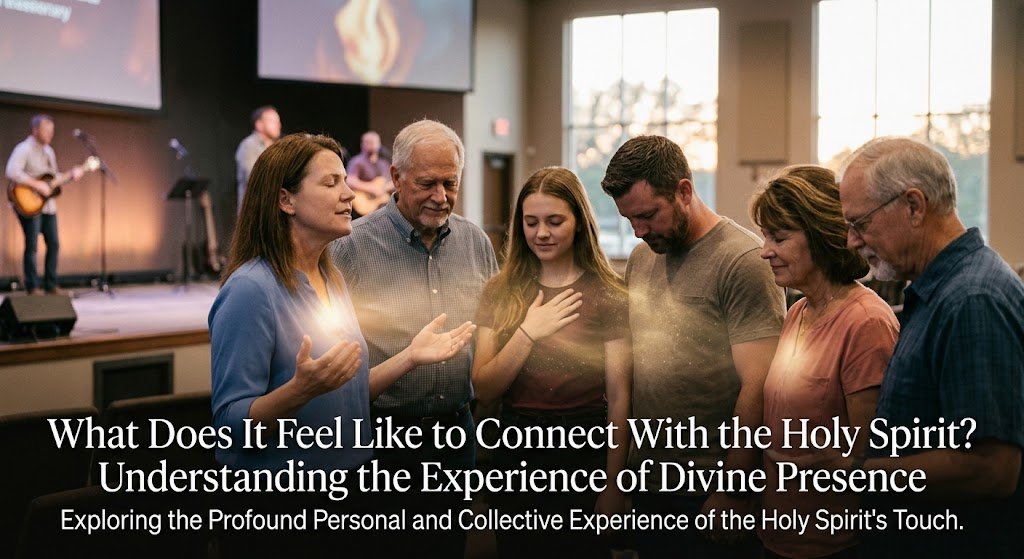
What Does It Feel Like to Connect With the Holy Spirit? Understanding the Experience of Divine Presence
From overwhelming peace and emotional release to inner guidance, warmth, and a renewed sense of love, explore what Christians describe when they experience a connection with the Holy Spirit.
Introduction: When Spirituality Becomes an Experience
For many people, religion begins with belief. They learn about God, read scripture, attend services, and become familiar with the teachings of their faith. But for some Christians, there comes a point when spirituality seems to move beyond intellectual understanding.
Instead of simply believing in God, they feel as though they have experienced God’s presence.
They may describe an extraordinary sense of peace, an overwhelming feeling of love, tears that appear without an obvious reason, or an inner certainty that they are not alone. Some experience warmth, tingling, or a sensation of energy moving through their body. Others describe a quiet voice of conscience, a sudden understanding of something they had been struggling with, or a feeling that their heart has become more compassionate.
Christians often interpret such experiences as connecting with the Holy Spirit.
But what does that actually mean? Is it an emotional experience? A spiritual encounter? A change in consciousness? And how can someone distinguish a genuine experience of divine presence from ordinary feelings of happiness, relief, or excitement?
There is no single answer that applies to everyone. Christian traditions understand the Holy Spirit in theological terms, while individual experiences vary considerably.
Nevertheless, accounts from Christians across different traditions reveal several recurring themes: peace, love, conviction, guidance, spiritual renewal, and a feeling of connection with something greater than oneself.
Understanding these experiences requires looking at both the Christian understanding of the Holy Spirit and the ways people describe encountering that presence in their everyday lives.
- Who Is the Holy Spirit?
In mainstream Christian theology, the Holy Spirit is not simply an invisible energy or an emotional sensation. The Holy Spirit is understood as the third person of the Trinity, alongside God the Father and Jesus Christ.
Christians believe that the Holy Spirit is God’s presence and activity within the world and within the lives of believers.
In the Gospel of John, Jesus describes the Holy Spirit as the Advocate or Helper who will guide his followers and remind them of his teachings.
This is an important distinction.
Connecting with the Holy Spirit is not necessarily understood as generating a particular emotional state. It is understood as entering into a relationship with God’s presence.
For Christians, the Holy Spirit may be experienced through prayer, worship, scripture, acts of compassion, moments of conviction, or seemingly ordinary events that acquire spiritual significance.
Some Christians experience this presence dramatically. Others describe it as a subtle influence that gradually changes their attitudes and behaviour.
The absence of an overwhelming sensation does not mean that someone is spiritually disconnected.
In Christian theology, the Holy Spirit’s work is not limited to extraordinary experiences.
- The First Experience: An Overwhelming Sense of Peace
One of the most frequently reported experiences associated with the Holy Spirit is an unusual sense of peace.
Imagine someone who has been experiencing anxiety, uncertainty, or emotional distress. They begin praying, perhaps asking God for guidance or simply expressing how overwhelmed they feel.
At some point, their emotional state seems to change.
The circumstances have not necessarily improved. Their problems have not disappeared. Yet they experience a sense of calm that feels different from ordinary reassurance.
They may describe it as feeling held, protected, or no longer alone.
The biblical expression the peace of God, which surpasses all understanding, comes from Philippians 4:7. It has become particularly important in Christian descriptions of spiritual peace.
This experience is sometimes described as a quietness that seems to reach deeper than ordinary happiness.
It does not necessarily mean feeling excited or euphoric. In fact, it may feel remarkably gentle.
Someone might sit quietly after prayer and realize that they are no longer struggling against every uncertainty. They can acknowledge their problems without feeling completely overwhelmed by them.
From a Christian perspective, this may be interpreted as the comforting presence of the Holy Spirit.
From a psychological perspective, prayer, focused attention, emotional expression, and a sense of security may also contribute to a person’s experience of calm.
These explanations do not have to be treated as identical. A Christian may understand the psychological processes as part of the way spiritual experience is lived through the human mind and body.
- An Overwhelming Feeling of Love and Compassion
Another experience Christians frequently associate with the Holy Spirit is an unusually powerful feeling of love.
This may be directed toward God, other people, or humanity more generally.
Someone who has been feeling resentment toward another person might suddenly find themselves thinking about that person with greater understanding. They may recognize the other person’s imperfections without feeling the same urge to condemn them.
A person who normally struggles to forgive might become more willing to release bitterness.
Someone who feels disconnected from the world may experience a renewed desire to help others.
Christian theology connects these qualities with the fruits of the Spirit, described in Galatians 5:22–23.
They include:
- Love.
- Joy.
- Peace.
- Patience.
- Kindness.
- Goodness.
- Faithfulness.
- Gentleness.
- Self-control.
The important point is that the Holy Spirit is not understood merely as something that produces unusual sensations. Its influence is also associated with changes in character.
A person may have an emotionally powerful experience during worship, but the deeper question is whether that experience encourages them to become more loving and compassionate afterward.
This is one reason Christian teachers often emphasize spiritual fruits over dramatic displays.
The experience is not only about what you feel during prayer. It is also about how you treat people when you leave the church.
- Tears That Come Without Knowing Why
Some people describe crying when they feel connected with the Holy Spirit.
These tears may occur during worship, prayer, singing, or moments of personal reflection.
Interestingly, they are not always associated with sadness.
A person might begin crying while feeling grateful, relieved, loved, or spiritually overwhelmed. They may struggle to explain why they are emotional.
One interpretation is that the experience allows emotions that have been held back to emerge.
Perhaps someone has been carrying grief for a long time. They have remained busy, distracted, and emotionally guarded. During prayer, they finally allow themselves to acknowledge what they have been feeling.
The tears become a form of release.
Other Christians interpret this experience as being touched by the presence of God.
In charismatic communities, people sometimes describe this as being moved by the Spirit.
It is important, however, not to assume that tears are necessary for a genuine spiritual experience. Some people feel deeply connected with God without crying, while others are naturally more emotionally expressive.
The Holy Spirit is not measured by the quantity of tears someone sheds.
- A Feeling of Warmth, Energy, or Physical Sensation
Some Christians describe physical sensations when praying or worshipping.
These may include:
- Warmth in the chest or hands.
- Tingling sensations.
- A feeling of lightness throughout the body.
- Goosebumps or shivering.
- A sense of emotional energy moving through the body.
- Relaxation or a feeling of physical release.
In Pentecostal and charismatic Christianity, such experiences may be interpreted as manifestations of the Holy Spirit.
For example, someone might describe feeling warmth in their chest while praying for another person. They may interpret this as an expression of divine love or the presence of God.
However, physical sensations are not exclusive to religious experiences.
Emotion, focused attention, breathing patterns, music, expectation, and changes in the body’s stress response can all influence physical sensations.
A person may experience tingling during meditation, prayer, excitement, or deep relaxation.
This does not automatically prove or disprove a spiritual interpretation.
The important distinction is between describing what someone feels and claiming certainty about its supernatural cause.
A person can sincerely interpret an experience as spiritual without needing to claim that every sensation is a direct physical manifestation of God.
- The Feeling That You Are Being Guided
Another common description involves experiencing an inner sense of guidance.
Someone may be facing an important decision and feel uncertain about what to do. They pray for direction, reflect on scripture, and eventually arrive at a sense of clarity.
The decision may not suddenly become obvious, but their priorities become easier to understand.
They may recognize that they have been acting out of fear, jealousy, pride, or insecurity. Alternatively, they may become more aware of a responsibility they had been avoiding.
Christians sometimes describe this as the Holy Spirit guiding their conscience.
The Gospel of John presents the Spirit as one who guides believers into truth. Many Christians therefore understand spiritual guidance as an influence that helps them recognize what is right and move toward a life more consistent with Christ’s teachings.
But there is an important caution.
Not every strong feeling or sudden idea should automatically be attributed to God.
People can mistake their own wishes, fears, or assumptions for divine guidance. A person who desperately wants something may interpret every coincidence as confirmation that God wants them to pursue it.
For this reason, many Christian traditions encourage discernment.
A perceived spiritual message should be considered alongside scripture, ethical principles, wisdom, circumstances, and the advice of trustworthy people.
If an inner impression encourages cruelty, dishonesty, recklessness, or harm, it should not be accepted uncritically simply because it feels powerful.
Spiritual guidance should be approached with humility.
- Speaking in Tongues: When Prayer Goes Beyond Ordinary Language
For some Christians, one of the most distinctive experiences associated with the Holy Spirit is speaking in tongues.
Known as glossolalia, this involves speaking unfamiliar syllables or speech-like sounds during prayer or worship.
The practice is particularly prominent in Pentecostal and charismatic Christianity.
Its biblical foundation is found in Acts 2, where the disciples begin speaking in other languages during Pentecost, and in 1 Corinthians 12–14, where Paul discusses tongues as one of several spiritual gifts.
Some practitioners describe the experience as allowing prayer to emerge without consciously constructing sentences. Others experience it as an expression of devotion, surrender, or spiritual intensity.
There are different Christian interpretations of whether all believers should expect this gift.
Some Pentecostal communities place particular emphasis on tongues, while many other Christian traditions understand the gift differently or do not practise it.
Paul himself emphasizes that spiritual gifts vary among believers and that love is more important than extraordinary displays.
Speaking in tongues can be meaningful to those who experience it, but it is not a universal requirement for connecting with the Holy Spirit.
Someone may experience a deep sense of divine presence through quiet prayer without ever speaking in tongues.
- The Holy Spirit and the Feeling of Being Loved Without Conditions
One of the most emotionally significant descriptions of connecting with the Holy Spirit is the feeling of being loved without needing to earn that love.
Human relationships can be complicated.
We may worry about whether someone likes us, whether we are good enough, whether we have disappointed our family, or whether people will abandon us if we reveal our imperfections.
Even relationships built on genuine affection can involve uncertainty, misunderstanding, and disappointment.
In Christian spirituality, the love of God is often understood as something that does not depend on a person’s social status, achievements, attractiveness, or ability to impress others.
A believer may experience prayer as a moment in which they no longer feel the need to prove their worth.
They can acknowledge their mistakes without believing that they are beyond forgiveness.
They can experience sadness without feeling abandoned.
They can recognize their imperfections while still believing that they are loved.
This is closely connected with the Christian idea of grace.
Grace refers to God’s freely given favour and love, rather than something that must be earned through personal achievement.
For someone who has spent years seeking validation from other people, this can be a profound change in perspective.
Instead of depending entirely on external approval, they begin to develop a sense of spiritual security.
- The Difference Between the Holy Spirit and Emotional Excitement
It is worth considering an important question: how do you know whether an experience is spiritual rather than simply emotional?
Christian worship can be emotionally powerful.
Music, collective singing, prayer, lighting, personal memories, and the presence of a supportive community can all create intense feelings.
A person may become overwhelmed during a worship service and interpret the experience as an encounter with the Holy Spirit.
That interpretation may be deeply meaningful to them.
However, intense emotion alone does not establish the spiritual origin of an experience.
A useful distinction is between the intensity of an experience and the longer-term effects it produces.
Someone may feel euphoric during worship but return to their ordinary habits without any lasting change.
Another person may experience a quiet moment of prayer that gradually encourages greater patience, honesty, forgiveness, and compassion.
Christian theology often places greater importance on the second kind of transformation than on emotional intensity alone.
The question is not simply, “How powerful did I feel?”
It is also, “What kind of person am I becoming?”
- Can You Feel the Holy Spirit Without Going to Church?
Yes, according to many Christian traditions.
Although communal worship is an important part of Christian life, the Holy Spirit is not understood as being confined to church buildings.
People describe spiritual experiences while praying alone, reading scripture, walking in nature, helping someone in need, or sitting quietly in their homes.
A person might experience a sense of gratitude while watching a sunrise. Another might feel spiritually moved while caring for an elderly relative. Someone else may experience a deep sense of connection while asking God for forgiveness.
These moments can become meaningful because they interrupt the usual pattern of everyday consciousness.
You become aware of something that feels more important than your immediate concerns.
For Christians, the Holy Spirit may be understood as present in all these circumstances.
This is one reason private prayer remains important across Christian traditions.
A person does not necessarily need a congregation, a particular ritual, or an emotionally charged environment to seek God’s presence.
- How to Open Yourself to the Holy Spirit
If you want to explore what connecting with the Holy Spirit might mean, Christian traditions offer several practices.
They are not guaranteed techniques for producing a supernatural experience. Rather, they are ways of developing a receptive and reflective spiritual life.
Begin with honest prayer
You do not need elaborate language.
You might simply say:
“God, I want to understand Your presence. Help me become more loving, more truthful, and more aware of Your guidance.”
The important thing is sincerity rather than performance.
Spend time in silence
After praying, allow yourself to sit quietly.
You do not have to fill every moment with words. Notice your thoughts and emotions without immediately reacting to them.
Silence can make it easier to recognize what is happening within you.
Read the teachings of Jesus
The Gospels provide a foundation for understanding the character of the Holy Spirit within Christian faith.
Consider Jesus’ teachings about forgiveness, humility, compassion, generosity, and love for one’s enemies.
These teachings offer a way to evaluate whether an experience is encouraging you toward the values Christianity considers important.
Practise compassion
Look for opportunities to help others without expecting recognition.
Christianity connects the work of the Holy Spirit with changes in character. Acts of kindness and forgiveness can therefore become part of your spiritual practice.
Remain open without demanding a particular sensation
You may feel warmth, peace, or emotional release. You may experience nothing unusual.
Neither outcome needs to become a judgment about your worth or spiritual development.
The purpose is to cultivate a sincere relationship with God, not to chase an extraordinary sensation.
- Is Connecting With the Holy Spirit Similar to Buddhist Meditation?
There are some interesting similarities, even though Christianity and Buddhism understand spiritual reality differently.
In Buddhist meditation, practitioners may cultivate mindfulness, loving-kindness, compassion, and equanimity.
The objective is to understand the nature of suffering, reduce craving and aversion, and develop wisdom.
In Christian prayer, believers may seek closeness with God, openness to the Holy Spirit, forgiveness, and transformation through divine love.
Both traditions can involve silence, contemplation, emotional openness, and a reduction in self-centred thinking.
Consider the experience of releasing resentment.
A Buddhist practitioner might reflect on impermanence, attachment, and the suffering created by hatred. Through this understanding, they cultivate compassion and equanimity.
A Christian might pray for the Holy Spirit to help them forgive someone and become more loving.
The spiritual explanations differ, but the practical transformation may sometimes look remarkably similar.
Both approaches can encourage a person to become less controlled by anger and more capable of responding with compassion.
There is also an important difference.
Buddhist teachings do not generally explain inner transformation through a relationship with a creator God or the Holy Spirit. Christianity, by contrast, understands the Spirit as divine and personal.
Recognizing similarities in practice does not mean the two traditions are teaching precisely the same thing.
- What If You Never Experience Anything Extraordinary?
This is perhaps one of the most important questions.
Someone may pray for years without experiencing the dramatic sensations described by other Christians.
They may never speak in tongues, feel overwhelming warmth, cry during worship, or experience a sudden sense of divine presence.
Does this mean they are disconnected from the Holy Spirit?
Most Christian traditions would say no.
The Christian understanding of spiritual life is broader than emotional experience.
Faith may be expressed through ordinary acts of patience, integrity, generosity, forgiveness, and service. A person may experience spiritual growth gradually, without being able to identify one dramatic moment when everything changed.
There is also a danger in comparing one’s spiritual life with the stories of others.
A person may begin to believe that their experience is inadequate because someone else describes a more dramatic encounter.
But spirituality is not a competition.
The absence of unusual sensations is not proof of spiritual failure, just as the presence of unusual sensations is not automatic proof of spiritual maturity.
A quieter spiritual life can still be deeply meaningful.
- The Deeper Experience: Becoming a More Loving Person
Perhaps the most profound aspect of connecting with the Holy Spirit is not a particular physical sensation or emotional event.
It is the possibility of becoming a different kind of person.
Imagine someone who has spent much of their life feeling defensive. They are easily offended, constantly worried about how others perceive them, and reluctant to forgive people who have hurt them.
Through prayer and spiritual reflection, they gradually become more patient.
They begin to recognize that other people also struggle with insecurity, fear, and suffering. They become less interested in proving themselves right and more interested in understanding others.
They still experience anger and disappointment, but these emotions no longer dictate every decision.
They become more generous without expecting repayment. They learn to apologize. They become more willing to forgive while maintaining appropriate boundaries.
From a Christian perspective, this kind of transformation may be understood as the work of the Holy Spirit.
The experience is no longer confined to the moments when someone is praying.
It becomes visible in everyday life.
The Spirit is understood not merely as a presence that makes someone feel good, but as a divine influence that encourages them to live more closely according to the example and teachings of Christ.
Conclusion: The Holy Spirit as an Experience of Divine Love and Transformation
Connecting with the Holy Spirit can mean different things to different Christians.
For some, it involves an overwhelming experience of peace, warmth, or love. For others, it may involve speaking in tongues, receiving spiritual guidance, or experiencing emotional release during prayer.
And for many, it is something quieter: a gradual change in how they think, feel, and treat other people.
Christian theology understands the Holy Spirit as God’s presence, not simply an emotion or an energy sensation. Individual experiences may be powerful, but they are not all identical, and no single physical or emotional response is required.
Perhaps the most important measure is what the experience produces.
Does it encourage greater love? Does it make forgiveness more possible? Does it inspire honesty, humility, patience, and compassion? Does it help you become less controlled by fear and resentment?
These are qualities Christianity associates with the work of the Spirit.
Ultimately, connecting with the Holy Spirit is not simply about feeling something extraordinary during prayer.
It is about allowing your relationship with God to transform the way you live.
Perhaps the most beautiful experience of the Holy Spirit is not the moment when you feel surrounded by divine love, but the moment when you begin carrying that love into the world and sharing it with others.