
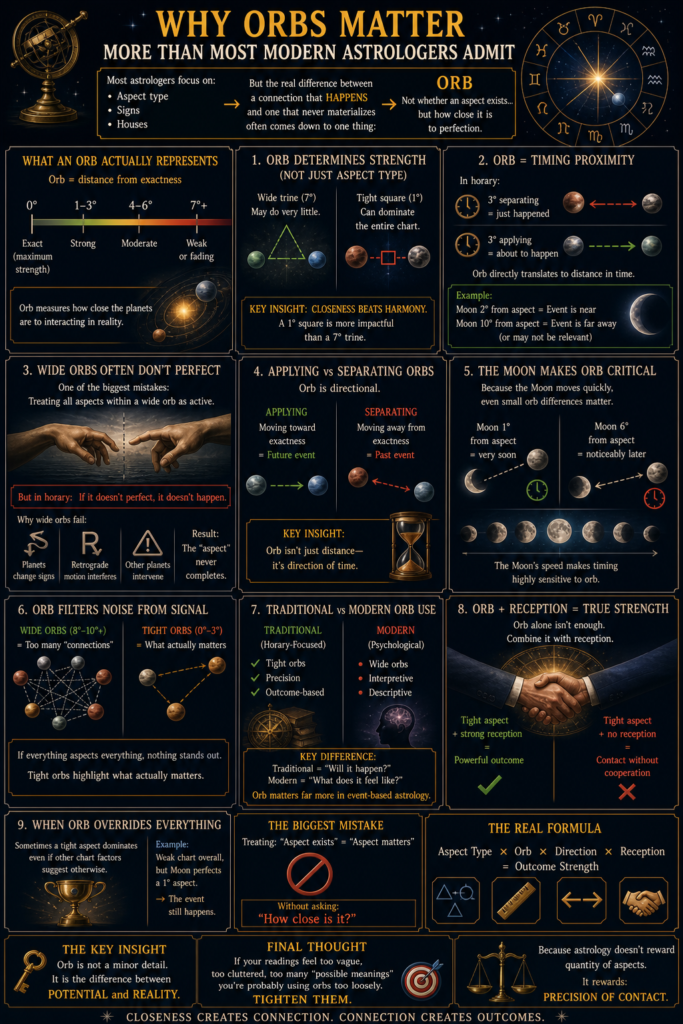
The Quiet Variable That Changes Everything
Most astrologers focus on:
- Aspect type (square, trine, etc.)
- Signs
- Houses
But the real difference between:
- A connection that happens
- And one that never materializes
often comes down to one thing:
Orb
Not whether an aspect exists…
…but how close it is to perfection.
What an Orb Actually Represents
Orb = distance from exactness
- 0° → exact (maximum strength)
- 1–3° → strong
- 4–6° → moderate
- Wide orb → weak or fading
This is not arbitrary.
Orb measures:
→ how close the planets are to interacting in reality
1. Orb Determines Strength (Not Just Aspect Type)


A wide trine:
→ May do very little
A tight square:
→ Can dominate the entire chart
Key Insight
Closeness beats harmony
A 1° square is more impactful than a 7° trine.
2. Orb = Timing Proximity
In horary:
- 3° separating → just happened
- 3° applying → about to happen
Orb directly translates to:
→ distance in time
Example
- Moon 2° from aspect
→ Event is near - Moon 10° from aspect
→ Event is far away (or may not be relevant)
3. Wide Orbs Often Don’t Perfect


One of the biggest mistakes:
→ Treating all aspects within a wide orb as active
But in horary:
If it doesn’t perfect, it doesn’t happen
Why Wide Orbs Fail
- Planets change signs
- Retrograde motion interferes
- Other planets intervene
Result:
→ The “aspect” never completes
4. Applying vs Separating Orbs
This is where orb becomes directional.
Applying Aspect
- Moving toward exactness
→ Future event
Separating Aspect
- Moving away from exactness
→ Past event
Key Insight
Orb isn’t just distance—it’s direction of time
5. The Moon Makes Orb Critical


Because the Moon moves quickly:
- Even small orb differences matter
Example
- Moon 1° from aspect → very soon
- Moon 6° from aspect → noticeably later
6. Orb Filters Noise from Signal
Modern astrology often includes:
- 8°–10° orbs
- Even wider for major aspects
This creates:
→ Too many “connections”
The Problem
If everything aspects everything:
→ Nothing stands out
The Solution
Tight orbs:
→ Highlight what actually matters
7. Traditional vs Modern Orb Use
Traditional (Horary-Focused)
- Tight orbs
- Precision
- Outcome-based
Modern (Psychological)
- Wide orbs
- Interpretive
- Descriptive
Key Difference:
- Traditional → “Will it happen?”
- Modern → “What does it feel like?”
Orb matters far more in:
→ event-based astrology
8. Orb + Reception = True Strength


Orb alone isn’t enough.
Combine it with:
→ Reception
Example
- Tight aspect + strong reception → powerful outcome
- Tight aspect + no reception → contact without cooperation
9. When Orb Overrides Everything
Sometimes:
- A tight aspect dominates
- Even if other chart factors suggest otherwise
Example
- Weak chart overall
- But Moon perfects a 1° aspect
→ The event still happens
The Biggest Mistake
Treating:
→ “Aspect exists” = “Aspect matters”
Without asking:
→ “How close is it?”
The Real Formula
Aspect Type × Orb × Direction × Reception = Outcome Strength
The Key Insight
Orb is not a minor detail.
It is:
→ The difference between potential and reality
Final Thought
If your readings feel:
- Too vague
- Too cluttered
- Too many “possible meanings”
You’re probably using orbs too loosely.
Tighten them.
Because astrology doesn’t reward:
→ Quantity of aspects
It rewards:
→ Precision of contact