
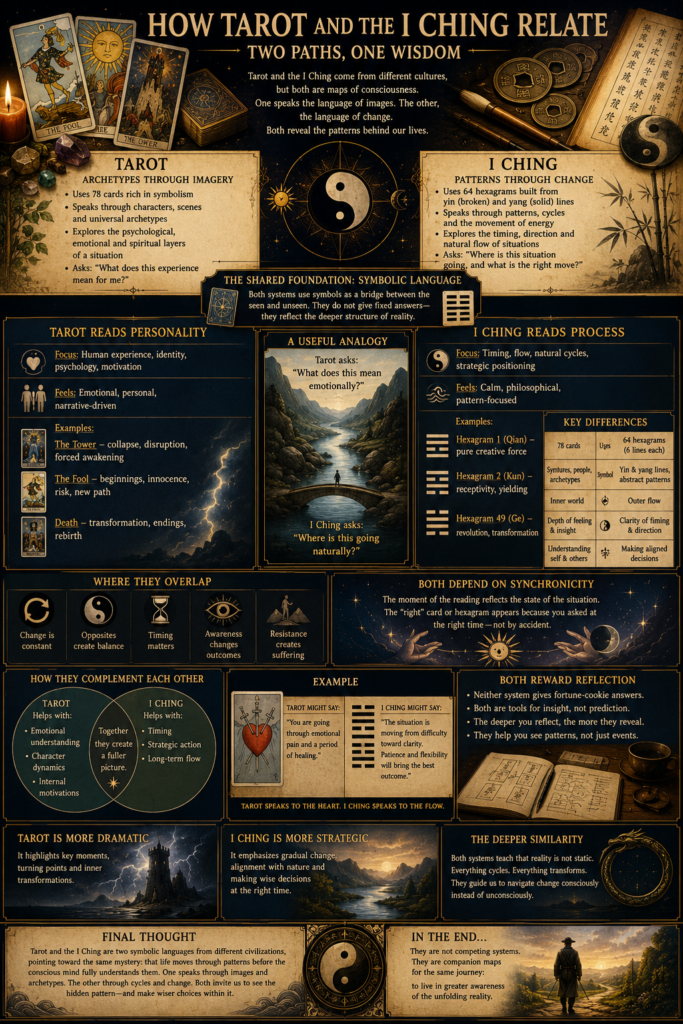
Two Systems From Different Worlds… Solving the Same Problem
At first glance, Tarot and the I Ching seem completely unrelated.
- Tarot emerged through European esoteric traditions
- The I Ching emerged from ancient Chinese philosophy and Taoist cosmology
One uses:
- Cards and archetypal imagery
The other uses:
- Hexagrams built from yin and yang lines
Yet beneath the surface, both systems are trying to answer the same question:
How do hidden patterns shape unfolding reality?
The Shared Foundation: Symbolic Language


Neither Tarot nor the I Ching works through:
- Literal prediction
- Mechanical certainty
Instead, both operate through:
→ symbolic resonance
They present:
- Images
- Patterns
- Archetypes
that reflect:
→ the deeper structure of a situation.
Tarot: Archetypes Through Imagery
Tarot communicates through:
- Visual symbolism
- Human experience
- Psychological archetypes
Examples:
- The Tower → collapse, disruption, forced awakening
- The Fool → beginnings, innocence, risk
- Death → transformation and endings
Tarot tends to feel:
- Emotional
- Personal
- Narrative-driven
It often answers:
“What is this experience psychologically and spiritually?”
The I Ching: Patterns Through Change


The I Ching operates differently.
Instead of archetypal characters, it uses:
- Yin and yang lines
- Hexagrams
- Dynamic states of change
Its focus is:
→ movement between conditions
Example:
- Hexagram 1 → pure creative force
- Hexagram 2 → receptivity and yielding
- Hexagram 49 → revolution and transformation
The I Ching often answers:
“What phase is this situation moving through?”
Tarot Reads Personality. I Ching Reads Process.
This is one of the biggest distinctions.
Tarot
Feels centered on:
- Human emotion
- Identity
- Psychology
- Motivation
I Ching
Feels centered on:
- Timing
- Flow
- Natural cycles
- Strategic positioning
A Useful Analogy


Tarot asks:
“What does this mean emotionally?”
The I Ching asks:
“Where is this going naturally?”
Tarot often interprets:
→ inner experience
The I Ching often interprets:
→ energetic direction
Both Systems Depend on Synchronicity
Neither system assumes:
- Randomness is fully random
Instead, both operate through a principle similar to:
→ synchronicity
Meaning:
- The moment of the reading reflects the state of the situation
This is why:
- The “right” card appears
- The “right” hexagram emerges
Both Systems Reward Reflection, Not Blind Prediction


The best practitioners of either system do not use them as:
- Fortune-cookie prediction devices
Instead, they use them to:
- Clarify patterns
- Understand timing
- See blind spots
- Align with unfolding reality
Where Tarot and I Ching Overlap Strongly
Both systems emphasize:
- Change is constant
- Resistance creates suffering
- Timing matters
- Awareness changes outcomes
- Opposites create balance
This is especially obvious in:
- Taoist concepts in the I Ching
- Duality symbolism in Tarot
Tarot Is More Dramatic. I Ching Is More Strategic.
Tarot often feels:
- Emotional
- Intense
- Archetypal
The I Ching often feels:
- Calm
- Philosophical
- Strategic
Example
Tarot might say:
→ “You are undergoing emotional transformation.”
The I Ching might say:
→ “The situation is shifting from instability into gradual order. Don’t force movement prematurely.”
The I Ching Often Feels Less Ego-Centered


Tarot frequently focuses on:
- Your desires
- Your journey
- Your psychology
The I Ching often reframes the question entirely:
“Are you aligned with the natural movement of events?”
This creates a very different tone.
Why Many People Use Both Together
Tarot and the I Ching complement each other well.
Tarot Helps With:
- Emotional understanding
- Character dynamics
- Internal motivations
I Ching Helps With:
- Timing
- Strategic action
- Long-term flow
Together:
→ They create a fuller picture.
The Deeper Similarity
At the deepest level, both systems teach:
Reality is not static.
Everything:
- Changes
- Cycles
- Evolves
- Transforms
And both systems attempt to help people:
→ navigate that transformation consciously.
Final Thought
Tarot and the I Ching are not really competing systems.
They are:
- Two symbolic languages
- From two different civilizations
- Pointing toward the same mystery:
That life moves through patterns before the conscious mind fully understands them.
One speaks through:
- Images and archetypes
The other through:
- Cycles and energetic change
But both ask the same thing:
“Can you see the deeper pattern unfolding beneath the surface?”