
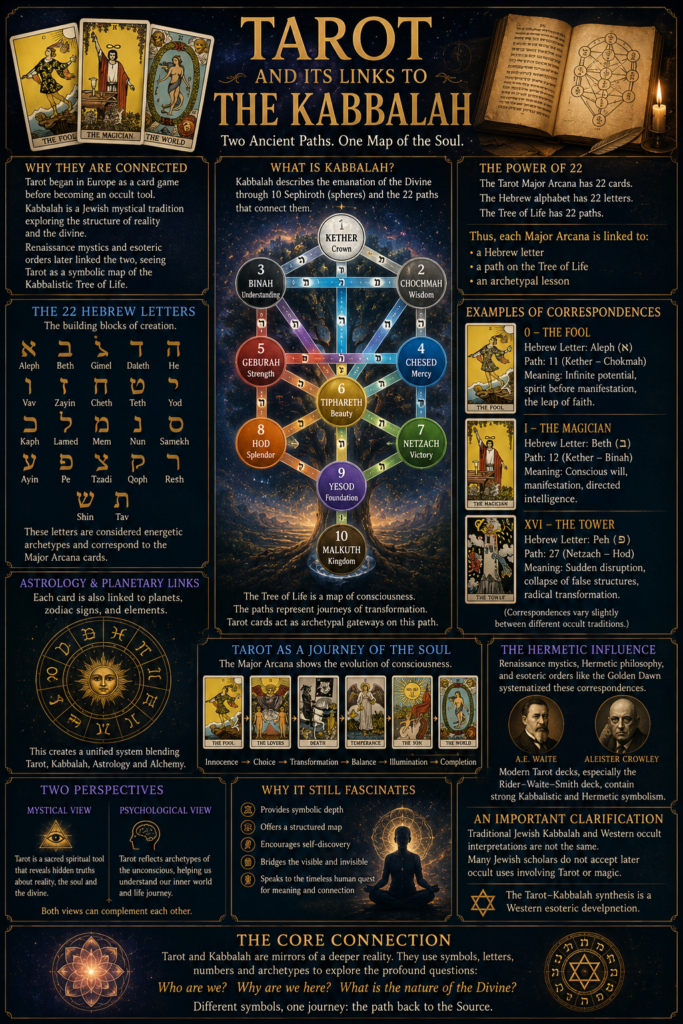
Why Tarot and Kabbalah Became Connected
To many modern occultists, Tarot and the Kabbalah feel almost inseparable.
Books, decks, and esoteric schools frequently connect:
- Tarot cards
- Hebrew letters
- Astrology
- The Tree of Life
But historically, these systems did not originally emerge together.
Tarot developed in Europe primarily as:
- A card game
before later becoming an occult tool.
Kabbalah emerged from:
- Jewish mystical traditions focused on divine structure, consciousness, and creation.
The connection between them was largely developed later by:
- Renaissance occultists
- Hermetic traditions
- Esoteric societies such as the Hermetic Order of the Golden Dawn.
Yet despite their different origins, many practitioners believe the systems fit together remarkably well.
What Is the Kabbalah?


Kabbalah is a mystical framework within Jewish spirituality that attempts to describe:
- The structure of reality
- Consciousness
- Divine emanation
- The relationship between humanity and the infinite
One of its most famous symbols is:
→ the Tree of Life
The Tree consists of:
- 10 Sephiroth (spheres/emanations)
- 22 connecting paths
These represent:
- Stages of creation
- Psychological states
- Spiritual evolution
- Energetic principles
Why the Number 22 Matters
This is where Tarot enters the picture.
The Tarot Major Arcana contains:
→ 22 cards
The Hebrew alphabet also contains:
→ 22 letters
Esoteric traditions eventually linked:
- Each Major Arcana card
to - A Hebrew letter
and - A path on the Tree of Life
This became one of the foundations of Western occult Tarot systems.
The Tree of Life as a Spiritual Map


The Tree of Life is often interpreted as:
→ a map of consciousness
Movement through the Tree symbolizes:
- Spiritual development
- Inner transformation
- The balancing of opposing forces
The Tarot cards were seen as:
→ archetypal gateways between these states.
Examples of Tarot-Kabbalah Correspondences
Different occult schools assign slightly different associations, but common examples include:
The Fool
- Often associated with:
- Aleph (א)
- Represents:
- Infinite potential
- Spirit before manifestation
- Pure openness
The Magician
- Linked with:
- Beth (ב)
- Represents:
- Conscious will
- Manifestation
- Directed intelligence
The Tower
- Associated with:
- Sudden disruption
- Collapse of false structures
- Radical transformation
Astrology Also Became Integrated


Western esoteric systems eventually fused:
- Tarot
- Astrology
- Kabbalah
- Alchemy
into one symbolic framework.
Examples:
- Certain Tarot cards assigned zodiac signs
- Others linked to planets
- Paths on the Tree tied to astrological forces
This created an interconnected symbolic system intended to explain:
→ both the universe and human consciousness.
The Hermetic Influence
The Tarot-Kabbalah relationship was heavily shaped by:
- Hermetic philosophy
- Renaissance mysticism
- Occult revival movements of the 19th century
Groups like the Golden Dawn systematized these correspondences extensively.
Later influential figures included:
- Aleister Crowley
- Arthur Edward Waite
Modern Tarot decks such as the:
- Rider-Waite Tarot
contain many hidden esoteric and Kabbalistic influences.
Tarot as a Journey Through Consciousness


Many occultists interpret the Major Arcana as:
→ stages of spiritual evolution
The journey progresses through:
- Innocence
- Desire
- Conflict
- Sacrifice
- Transformation
- Enlightenment
This aligns strongly with the Kabbalistic idea that:
→ consciousness evolves through structured stages.
Psychological Interpretation vs Mystical Interpretation
Some people view Tarot-Kabbalah systems as:
- Literal spiritual maps
Others interpret them psychologically:
- Archetypes of the unconscious
- Symbolic frameworks for self-understanding
Influence from thinkers like Carl Jung reinforced the psychological interpretation of symbolic systems.
Why These Systems Still Fascinate People


Tarot and Kabbalah continue to fascinate people because they offer:
- Symbolic depth
- Structured meaning
- Psychological reflection
- Spiritual exploration
They create the feeling that:
→ reality may contain deeper hidden patterns.
An Important Clarification
Traditional Jewish Kabbalah and Western occult Kabbalah are not identical.
Many Jewish scholars do not fully accept later occult reinterpretations involving:
- Tarot
- Astrology
- Ceremonial magic
The modern Tarot-Kabbalah synthesis is largely:
→ a Western esoteric development.
The Core Connection
At their deepest level, both Tarot and Kabbalah attempt to answer similar questions:
- How does consciousness evolve?
- How do hidden patterns shape reality?
- How does the human mind relate to the divine?
Both systems use:
→ symbolic language
to explore experiences that are difficult to explain literally.
Final Thought
Tarot and Kabbalah became linked because both systems offer:
- Structured symbolism
- Archetypal transformation
- A map of inner and outer reality
Whether viewed:
- Mystically
- Psychologically
- Philosophically
their fusion created one of the most influential symbolic systems in Western esotericism.
And perhaps that is why people remain fascinated by them:
Because beneath the cards, symbols, and diagrams lies a timeless human question:
“Is there a hidden structure behind consciousness and existence itself?”