
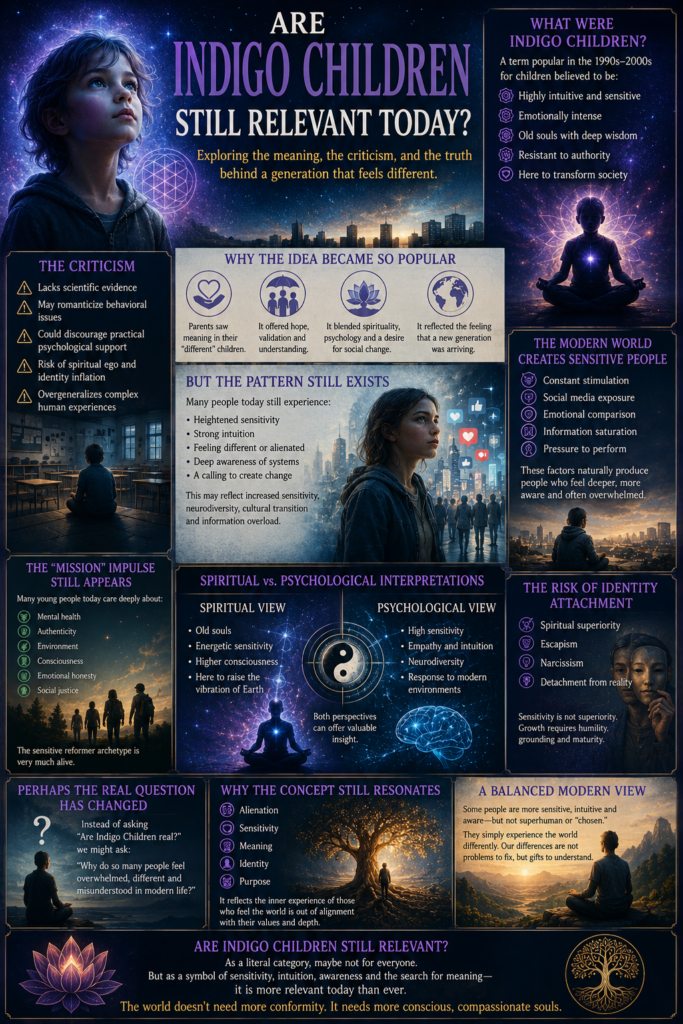
A Concept That Refused to Disappear
The idea of “Indigo Children” became especially popular in the 1990s and early 2000s.
These children were described as:
- Spiritually gifted
- Highly intuitive
- Emotionally intense
- Resistant to authority
- Deeply sensitive
- “Old souls” with a mission to transform society
The concept blended:
- New Age spirituality
- Psychology
- Energy beliefs
- Generational frustration with traditional systems
Today, the phrase is less commonly used.
But the deeper question remains:
Are the traits associated with Indigo Children still appearing in modern society?
In many ways:
→ yes.
Though perhaps interpreted differently now.
What Were Indigo Children Supposed to Be?


The original Indigo Child theory claimed certain children possessed:
- Heightened awareness
- Strong intuition
- Nonconformist tendencies
- Spiritual sensitivity
They were often described as:
- Feeling “different”
- Struggling in rigid school systems
- Rejecting artificial authority
- Being emotionally or psychically perceptive
Many were believed to arrive during periods of:
→ societal transition.
Why the Idea Became So Popular
Part of the appeal was psychological.
Parents saw children who:
- Did not fit conventional systems
- Felt emotionally intense
- Questioned authority
- Struggled with conformity
The Indigo framework gave meaning to behaviors that otherwise seemed:
- Difficult
- Misunderstood
- Alienated
For some families, it offered:
→ hope and validation.
The Criticism of the Concept


The theory also received strong criticism.
Critics argued:
- It lacked scientific evidence
- It romanticized behavioral issues
- It could discourage practical psychological support
Some psychologists worried the label could:
- Inflate ego identity
- Prevent grounded self-understanding
- Oversimplify neurodiversity or emotional sensitivity
These criticisms are important and shouldn’t be ignored.
But the Underlying Pattern Still Exists
Even if one rejects the literal “Indigo” framework…
many modern people still describe:
- Feeling emotionally overwhelmed
- Hyper-aware of social systems
- Sensitive to environments
- Alienated by modern culture
- Intuitively perceptive
This may not require a supernatural explanation.
It may reflect:
- Increased psychological sensitivity
- Neurodiversity
- Cultural transition
- Information overload
- Heightened emotional awareness
The Modern World Creates Sensitive People


Modern society amplifies sensitivity through:
- Constant stimulation
- Social media exposure
- Emotional comparison
- Information saturation
People today are exposed to:
- More perspectives
- More emotional input
- More psychological pressure
than perhaps any generation before.
This naturally produces individuals who feel:
→ deeply sensitive and psychologically different.
The “Mission” Aspect Still Appears
One of the strongest Indigo themes was:
→ feeling called to improve or transform society.
That impulse absolutely still exists today.
Many younger people strongly care about:
- Mental health
- Authenticity
- Environmental concerns
- Consciousness
- Emotional honesty
- Spiritual exploration
Even if they never use the term “Indigo Child,” the archetype persists:
→ the sensitive reformer.
The Spiritual Interpretation vs The Psychological Interpretation


Today, many people interpret Indigo traits through:
- Psychology
- Trauma sensitivity
- Empathy research
- Nervous system awareness
Others still interpret them spiritually:
- Old souls
- Energetic sensitivity
- Higher consciousness
The two views do not always completely contradict each other.
The Risk of Identity Attachment
One danger of the Indigo label is:
→ becoming attached to being “special.”
If interpreted poorly, it can create:
- Spiritual superiority
- Escapism
- Narcissism
- Detachment from reality
Healthy growth requires:
- Humility
- Grounding
- Emotional maturity
Sensitivity alone does not equal wisdom.
Perhaps the Real Question Has Changed


Instead of asking:
“Are Indigo Children real?”
The modern question may be:
“Why do so many people feel psychologically and spiritually overwhelmed by modern life?”
That question is very real.
Why the Concept Still Resonates
The Indigo Child idea continues to resonate because it speaks to:
- Alienation
- Sensitivity
- Meaning
- Identity
- Purpose
It reflects the feeling many people have that:
→ modern society often rewards conformity while neglecting emotional depth.
A More Balanced Modern View
A grounded perspective might be:
Some people genuinely are:
- More sensitive
- More intuitive
- More emotionally perceptive
- More resistant to artificial systems
But this does not necessarily make them:
- Superhuman
- Spiritually superior
- Cosmically chosen
It simply means:
→ different nervous systems and personalities interact with the world differently.
Final Thought
Are Indigo Children still relevant today?
As a literal supernatural category?
→ many people remain skeptical.
But as a symbolic idea representing:
- heightened sensitivity
- alienation
- intuition
- resistance to shallow systems
- the search for meaning
the concept is arguably more relevant than ever.
Because in a world of:
- endless stimulation
- performance culture
- emotional disconnection
many people still quietly feel:
“I experience the world differently from those around me.”
And perhaps that feeling—
whether spiritual, psychological, or cultural—
is what the Indigo idea was trying to describe all along.