
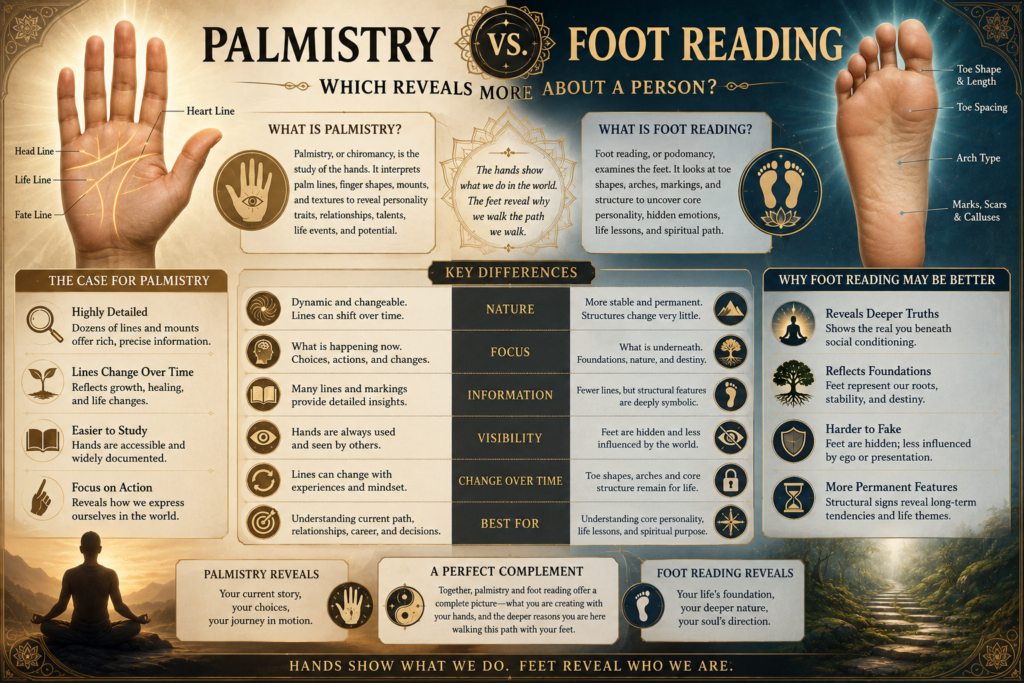
Among the world’s oldest forms of body reading, two systems have fascinated spiritual seekers for centuries: palmistry and foot reading.
Both traditions are based on the idea that the human body reflects aspects of personality, character, life experiences, and destiny. Yet while palmistry has become far more widely known, foot reading remains one of the lesser-known branches of traditional divination.
Many practitioners argue that the feet may actually reveal deeper truths than the hands.
But is that really the case?
Let’s explore the similarities, differences, and reasons some readers consider foot reading the more powerful art.
What Is Palmistry?
Palmistry, also known as chiromancy, is the practice of interpreting:
- Palm lines
- Finger shapes
- Mounts of the hand
- Hand texture
- Finger length and proportions
The tradition appears in India, China, Persia, Greece, and many other ancient cultures.
Palmists believe the hands reveal:
- Personality traits
- Talents
- Relationships
- Career tendencies
- Major life events
- Emotional patterns
Palmistry focuses heavily on movement, action, and conscious choices.
Since we interact with the world through our hands, many traditions see them as symbols of what we actively create in life.
What Is Foot Reading?
Foot reading, sometimes called podomancy, examines:
- Toe shape
- Toe length
- Toe spacing
- Arch structure
- Foot proportions
- Calluses
- Scars
- Birthmarks
- Structural abnormalities
Foot reading traditions appear in Chinese body reading, Indian Samudrika Shastra, reflexology systems, and various folk traditions.
Practitioners believe the feet reveal:
- Core personality
- Hidden emotions
- Deep motivations
- Life lessons
- Unconscious tendencies
- Spiritual path
Where palmistry often examines what a person does, foot reading often attempts to reveal who a person fundamentally is.
The Case for Palmistry
Palmistry has several advantages.
More Detailed Maps
The hands contain dozens of major and minor lines.
This allows for highly detailed interpretations.
A skilled palmist can examine:
- Heart line
- Head line
- Life line
- Fate line
- Sun line
- Marriage lines
- Numerous secondary markings
The amount of information available is enormous.
Lines Change Over Time
One of palmistry’s most fascinating claims is that palm lines evolve.
Many practitioners believe changes in thought patterns, lifestyle, and personal growth can literally alter the hands over time.
This makes palmistry a dynamic system.
Easier to Study
Most people can easily examine their own hands.
As a result, palmistry became far more widespread and developed larger bodies of literature.
Why Some Practitioners Prefer Foot Reading
Despite palmistry’s popularity, many traditional readers argue that feet reveal deeper truths.
Feet Change Less
Hands are constantly used.
Work, hobbies, injuries, and daily activities can alter their appearance.
Feet tend to change more slowly.
Because of this, some practitioners believe feet preserve more information about a person’s underlying nature.
Feet Reflect Foundations
Spiritually speaking, feet represent our foundation.
They literally support our entire body.
Many traditions associate the feet with:
- Stability
- Survival
- Destiny
- Life path
- Root energy
For this reason, foot readers often focus on long-term patterns rather than temporary circumstances.
Harder to Fake
People consciously present their hands to the world.
They gesture, shake hands, and communicate through them.
Feet remain largely hidden.
Many readers believe this makes foot characteristics less influenced by social conditioning and more reflective of the authentic self.
Structural Features May Be More Permanent
An overlapping toe, unusually high arch, Morton’s toe, or unusual toe spacing may remain present for decades.
Palm lines, by contrast, are believed by many practitioners to shift throughout life.
Foot readers often argue that permanent structures reveal deeper life themes.
What Each System May Reveal
Palmistry Focuses On
- Current mindset
- Choices
- Relationships
- Career direction
- Personal development
- Life changes
Foot Reading Focuses On
- Core personality
- Hidden emotional patterns
- Long-term tendencies
- Foundational life lessons
- Spiritual growth
- Subconscious motivations
Many practitioners view palmistry as reading the story currently being written.
They view foot reading as reading the book’s foundation.
Which Is More Accurate?
There is no scientific evidence demonstrating that either palmistry or foot reading can predict personality or future events.
From a metaphysical perspective, however, many readers believe the two systems complement one another.
Palmistry may reveal what is happening now.
Foot reading may reveal why it keeps happening.
Some readers compare the difference to weather and climate.
The hands show today’s weather.
The feet reveal the climate underneath.
A Balanced Perspective
Whether one prefers palmistry or foot reading ultimately depends on what they hope to learn.
Palmistry offers a detailed picture of current circumstances and conscious choices.
Foot reading emphasizes deeper structures, hidden motivations, and long-term patterns.
For those interested in self-discovery, the two systems can be viewed as complementary rather than competing.
Yet if the goal is to uncover the deeper foundations of personality, many traditional practitioners would argue that the feet hold a unique advantage.
After all, before we reach for the world with our hands, we first stand upon it with our feet.