When people think of countries influenced by Taoism, most immediately think of China — the birthplace of Taoist philosophy and home of Lao Tzu, author of the Tao Te Ching.
Yet there is an interesting argument that modern South Korea may quietly be one of the most Taoist societies in the world, even if many Koreans themselves would not consciously describe their culture that way.
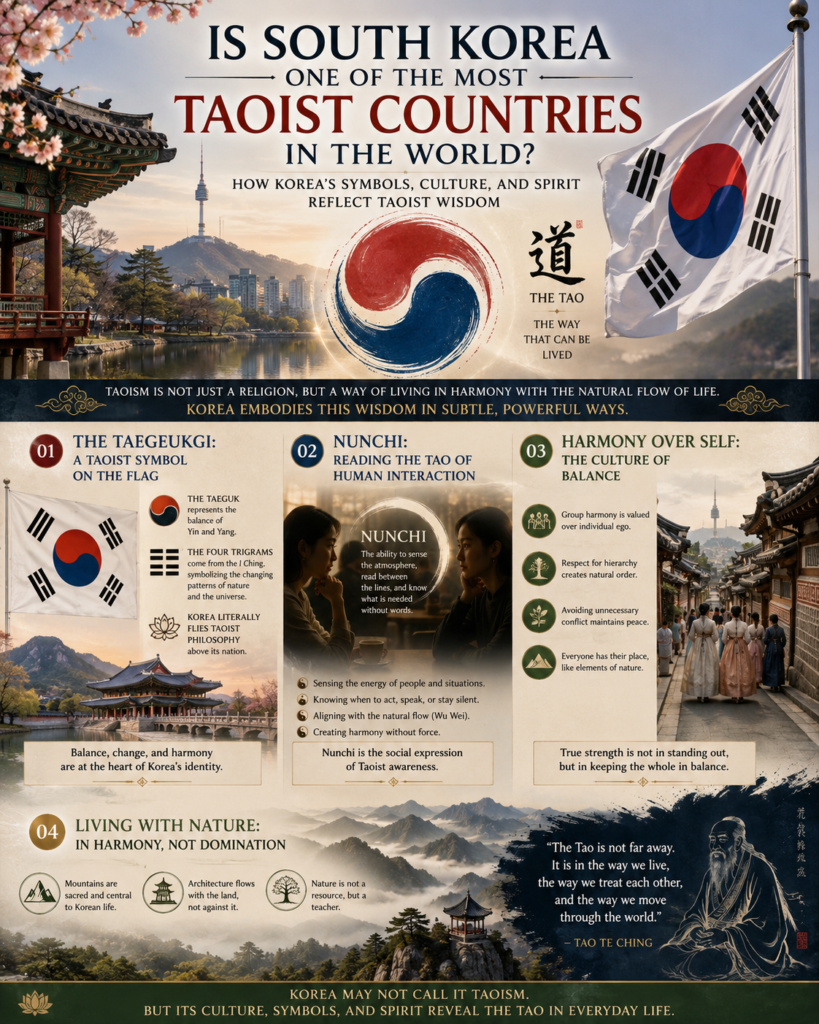
From the symbolism on its national flag, to the subtle art of nunchi, to its deep cultural emphasis on harmony and social balance, Korea seems to embody many of the principles central to Taoist philosophy.
In some ways, Taoism may be more deeply woven into everyday Korean behavior than people realize.
The Korean Flag and the Taoist Universe
One of the strongest pieces of evidence is visible every day on the Korean flag itself.
South Korea’s national flag, known as the Taegeukgi, contains one of the most overt Taoist symbols found on any national flag in the world.
At its center sits the Taeguk, the familiar red and blue symbol representing the balance of opposites.
It is closely related to the Chinese concept of Yin and Yang, a core principle of Taoist philosophy.
The symbol teaches that reality is built upon complementary forces:
- Light and dark
- Masculine and feminine
- Expansion and contraction
- Action and stillness
- Order and chaos
Surrounding the Taeguk are four black trigrams derived directly from the I Ching, or Book of Changes.
I Ching has long been connected to Taoist cosmology and represents the changing patterns of nature and reality itself.
Few countries place such direct metaphysical symbolism at the center of their national identity.
In a sense, Korea literally flies Taoist philosophy above its nation.
Nunchi: Korea’s Unspoken Practice of Reading the Tao
One uniquely Korean concept is Nunchi (눈치).
Difficult to translate perfectly into English, nunchi refers to the ability to read the emotional atmosphere of a room, sense subtle social dynamics, and intuitively understand what is happening without explicit communication.
Someone with strong nunchi can immediately feel:
- When tension exists
- Who holds social authority
- Whether speaking is appropriate
- When someone feels uncomfortable
- How group energy is shifting
At first glance, nunchi may appear to be simple social awareness.
But philosophically, it mirrors a deeply Taoist principle.
Taoism teaches alignment with the natural flow of reality — the Tao itself.
Rather than forcing action, the wise person first observes the movement of circumstances before responding.
This idea appears in the Taoist principle of Wu Wei, often translated as “effortless action” or “action in harmony with the natural flow.”
Tao Te Ching teaches that the strongest person is often not the one forcing change, but the one who understands when movement is already occurring.
In this sense, Koreans practice a social version of Taoism every day.
Nunchi is, in many ways, learning how to sense the Tao of human interaction.
Korean Culture Prioritizes Harmony Over Individual Expression
A third overlooked connection lies in Korean society’s relationship with harmony.
Modern Western societies often emphasize individual expression.
Speak your truth.
Stand out.
Assert yourself.
By contrast, Korean culture traditionally places enormous importance on maintaining social balance.
Consider everyday behaviors:
- Speaking differently to seniors and juniors
- Watching group consensus before acting
- Avoiding unnecessary public confrontation
- Preserving collective harmony over personal opinion
- Understanding one’s position within relationships
This does not simply reflect Confucian hierarchy.
It also mirrors Taoist thinking.
Taoism teaches that disorder often arises when individuals force their will against the natural balance of a system.
Harmony is not weakness.
Harmony is intelligence.
Much of Korean social life revolves around sensing imbalance and restoring equilibrium before conflict escalates.
Even Korean Architecture and Nature Reflect Taoist Thinking
Traditional Korean design often emphasizes coexistence with nature rather than domination over it.
Ancient temples were frequently built directly into mountain landscapes rather than reshaping the environment aggressively.
Many Korean gardens and historical sites embrace asymmetry, natural materials, and peaceful integration with surrounding geography.
This reflects another Taoist ideal:
Human beings should not attempt to conquer nature.
They should live within its rhythms.
Even today, despite rapid modernization, mountains remain deeply integrated into Korean identity.
Weekend hiking culture, reverence for mountain temples, and the importance of natural spaces reveal a continuing relationship with this philosophy.
Why Korea May Be More Taoist Than China in Daily Practice
Ironically, modern China — despite being Taoism’s birthplace — has undergone tremendous political and social transformation over the last century.
Many ancient traditions were disrupted or weakened.
Meanwhile, Korea preserved many subtle cultural behaviors that continue reflecting Taoist principles even without explicitly labeling them as such.
In some ways, Taoism in Korea became cultural instinct rather than formal religion.
People may not study Lao Tzu directly.
Yet many daily behaviors unconsciously mirror his teachings.
A Final Thought
Perhaps Taoism is not simply something people study.
Perhaps it is something cultures naturally embody.
South Korea may never market itself as a Taoist nation.
Yet its national symbolism, social awareness through nunchi, cultural pursuit of harmony, and relationship with nature all suggest something fascinating.
Among modern societies, Korea may quietly be one of the world’s most Taoist countries.
Not because people consciously practice Taoism.
But because the philosophy has become woven into the unconscious fabric of daily life.
Sometimes the deepest philosophy is not spoken.
It is simply lived.