
Symbols have always carried immense psychological and spiritual power. Across human history, civilizations have used geometric signs, sacred shapes, and visual icons to represent ideas far deeper than language itself.
Yet one of the most misunderstood symbols in modern history is the swastika.
For much of the world today, the swastika immediately evokes images of World War II, Nazi Party, and the atrocities committed under Adolf Hitler.
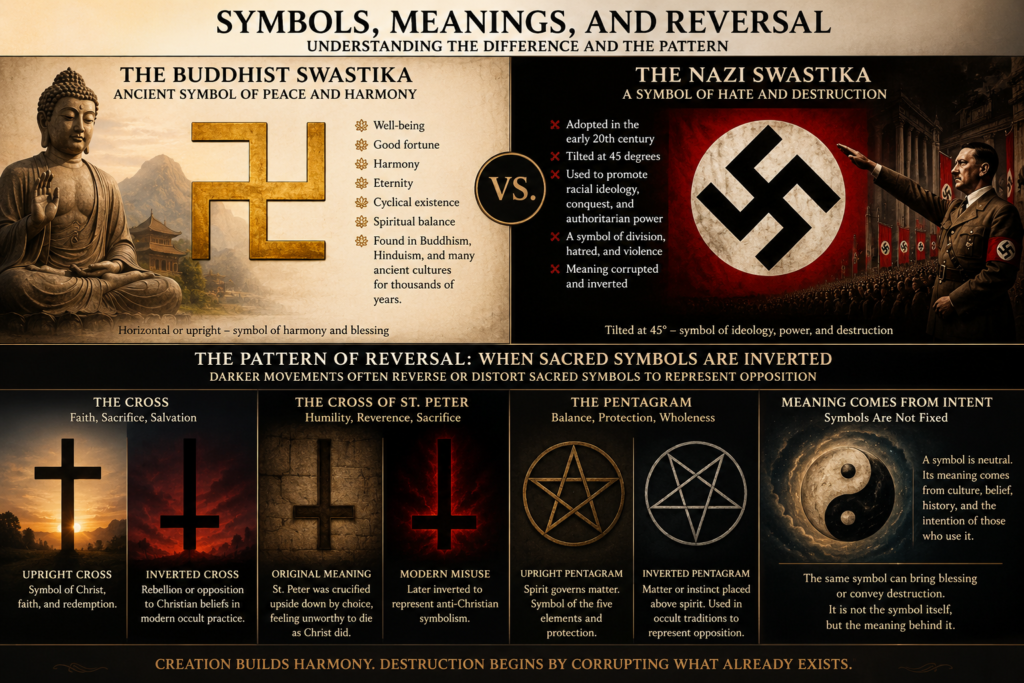
However, long before the Nazis adopted it, the swastika had existed for thousands of years as a sacred symbol in traditions such as Buddhism, Hinduism, and many other cultures around the world.
Its transformation from a sacred symbol into one associated with destruction reveals an interesting pattern found repeatedly throughout history: darker movements often take existing sacred symbols and invert, distort, or repurpose them.
The Ancient Meaning of the Swastika
The word swastika comes from the Sanskrit word svastika, roughly meaning:
“Well-being,” “good fortune,” or “that which brings harmony.”
For over 3,000 years, the swastika appeared throughout Asia, Europe, and indigenous cultures worldwide.
In Buddhist tradition, the swastika represents:
- Harmony of the universe
- Spiritual balance
- Eternity and cyclical existence
- Prosperity and good fortune
- The movement of cosmic energy
It can still commonly be found in temples across countries such as Japan, China, India, and South Korea.
In Japanese maps, Buddhist temples are often marked with the swastika symbol even today.
Originally, it had no association whatsoever with hatred or violence.
How the Nazis Changed the Symbol
In the early 20th century, German nationalist movements began searching for symbols that represented what they believed to be ancient Aryan heritage.
The Nazis adopted a modified version of the swastika.
But several important changes were made.
The original sacred symbol was typically:
- Flat and balanced
- Often oriented horizontally
- Associated with harmony and blessing
The Nazi version became:
- Tilted at a 45-degree angle
- Placed inside a white circle with a red background
- Used to symbolize racial ideology, conquest, and authoritarian power
The meaning completely changed.
A symbol once associated with cosmic harmony became associated with destruction.
In essence, the Nazis did not create the symbol.
They appropriated it and gave it an entirely new psychological meaning.
The Pattern of Symbolic Reversal
Throughout religious and occult history, darker movements have often not created entirely new symbols.
Instead, they frequently reverse, invert, or distort existing sacred imagery.
This is psychologically powerful because the human mind already recognizes the original symbol as meaningful.
By corrupting it, the symbol takes on an oppositional meaning.
We see this pattern repeatedly.
The Upside Down Cross
The traditional Christian cross represents sacrifice, salvation, and the teachings of Jesus Christ.
In modern popular culture, the upside down cross is often associated with anti-Christian rebellion or occult imagery.
Ironically, historically the inverted cross originally had another meaning.
It was known as the Cross of Saint Peter.
According to tradition, Peter requested crucifixion upside down because he felt unworthy to die in the same manner as Christ.
But later subcultures repurposed the inversion to represent opposition to Christianity.
Again, meaning was reversed.
The Pentagram and Inverted Pentagram
The five-pointed star, or pentagram, has ancient sacred origins.
For thousands of years it represented:
- Balance of the five elements
- Protection against harmful forces
- Harmony between spirit and matter
- The human body in perfect proportion
Ancient Greek philosophers such as Pythagoras regarded it as a symbol of mathematical perfection.
When the single point faces upward, many traditions interpret this as:
Spirit governing the physical world.
Later occult traditions sometimes used the inverted pentagram — with two points upward.
This reversal was often interpreted as:
Material or instinctive forces placed above spiritual order.
Again, the symbolism changes through inversion.
Why Reversal Carries Psychological Power
There is an interesting pattern here.
When movements wish to challenge an established belief system, they often do not invent completely new imagery.
Instead they reverse familiar sacred symbols.
Why?
Because the human mind instinctively reacts to inversion.
A reversed symbol communicates:
- Opposition
- Rebellion
- Distortion of previous meaning
- Rejection of established order
It creates immediate psychological tension.
The original symbol represents structure.
The inversion represents challenge to that structure.
Symbols Are Not Fixed — Meaning Comes From Intent
One of the most important lessons in studying symbols is understanding that symbols themselves are neutral.
Meaning emerges from:
- Cultural context
- Collective belief
- Historical use
- The intention of those using them
A Buddhist swastika and the Nazi swastika may visually resemble one another.
Yet they represent radically different ideas.
One symbolizes harmony.
The other became associated with destruction.
The same pattern appears in many spiritual traditions.
A sacred image can be used for blessing.
Or it can be deliberately distorted to signal opposition.
Final Thoughts
Human beings understand reality through symbols.
This is why symbols hold such extraordinary power over culture.
The story of the swastika reminds us that appearances alone can be misleading.
A symbol that represented peace for thousands of years was temporarily transformed into something terrifying by political ideology.
Likewise, throughout history, many darker traditions have not invented new symbols — they have simply taken existing sacred imagery and reversed it.
Perhaps this reveals something deeper about human psychology.
Creation often builds harmony.
Destruction often begins by corrupting what already exists.
Sometimes the most powerful way to challenge a civilization is not to invent a new symbol.
It is to take its sacred symbols and turn them upside down.
Get a Buddha Statue