
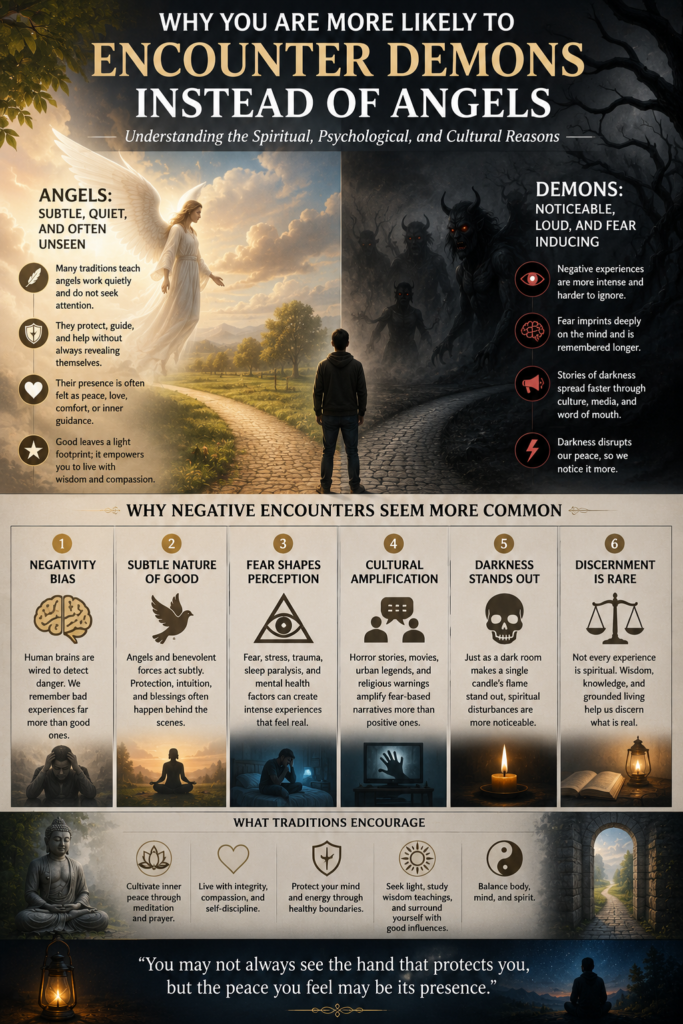
Across many cultures and religions, people frequently tell stories about frightening supernatural encounters. Reports of shadow figures, oppressive presences, nightmares, or seemingly malevolent entities appear far more common than stories of direct encounters with angels.
Does this mean negative spiritual beings are more common than positive ones?
Not necessarily.
Different spiritual traditions offer several explanations, while psychology provides its own perspective. Whether one interprets these experiences spiritually or psychologically, there are interesting reasons why frightening encounters tend to receive far more attention.
Negative Experiences Capture Our Attention
Human beings are naturally wired to notice danger.
From an evolutionary perspective, paying attention to potential threats increased the chances of survival.
This phenomenon, often called the “negativity bias,” means frightening experiences are generally remembered more vividly than peaceful ones.
If someone has a terrifying nightmare, sleep paralysis episode, or unexplained experience, it is often far more memorable than years of calm, uneventful nights.
Many Religious Traditions Describe Angels as Subtle
In religions such as Christianity, Judaism, and Islam, angels are typically portrayed as messengers or protectors rather than beings who constantly reveal themselves.
For example, in the Bible, angelic appearances are relatively rare and usually occur for a specific purpose.
Many theologians suggest that, if angels exist, they often work quietly rather than dramatically.
Protection may occur without people ever realizing it.
Fear Can Shape How We Interpret Experiences
Psychologists note that intense emotions—especially fear—can influence how unusual experiences are interpreted.
Sleep paralysis, vivid dreams, anxiety, grief, and periods of high stress have all been associated with reports of sensing an unseen presence.
For someone with a spiritual worldview, such experiences may be interpreted as encounters with harmful spiritual beings.
Someone with a different worldview may interpret the same experience differently.
Many Traditions Teach That Good Does Not Seek Attention
Some spiritual traditions suggest that benevolent forces do not constantly announce themselves.
Instead, they may work quietly through:
- Moments of unexpected peace
- Acts of compassion
- Inner guidance
- Protection from unseen dangers
- Helpful people appearing at the right time
From this perspective, dramatic manifestations are not necessarily signs of greater spiritual power.
Stories of Demons Spread More Easily
Throughout history, frightening stories have been shared more widely than comforting ones.
Ghost stories, horror films, urban legends, and tales of possession naturally attract attention.
This creates the impression that negative encounters are far more common than positive ones.
In reality, many people also report profound experiences involving love, peace, forgiveness, or what they interpret as divine presence, although these stories often receive less public attention.
Some Spiritual Traditions Teach That Darkness Is More Noticeable
Various religious traditions describe darkness as the absence or corruption of good rather than an equal opposing force.
Just as a single loud noise immediately captures attention in a quiet room, experiences perceived as frightening may stand out precisely because they disrupt an otherwise peaceful life.
This does not necessarily imply they are more numerous.
They may simply be more noticeable.
The Importance of Discernment
Regardless of one’s beliefs, many spiritual traditions encourage discernment rather than assuming every unusual experience has a supernatural cause.
Strong emotions, medical conditions, sleep disorders, environmental factors, and psychological stress can all produce experiences that feel deeply real.
Likewise, many faiths advise humility when interpreting extraordinary events and caution against becoming overly preoccupied with frightening spiritual narratives.
Final Thoughts
The perception that people encounter demons more often than angels may arise from several factors:
- Humans naturally remember frightening experiences more vividly.
- Many religious traditions describe angels as acting quietly rather than dramatically.
- Psychological and medical factors can contribute to unusual experiences.
- Fearful stories tend to spread more widely through culture and media.
Whether one views these reports through a spiritual, psychological, or religious lens, the evidence does not establish that negative spiritual beings are more active or more numerous than positive ones.
Perhaps the more enduring lesson found across many traditions is that cultivating compassion, wisdom, integrity, and inner peace is considered a more reliable spiritual path than seeking extraordinary encounters—whether frightening or comforting.