
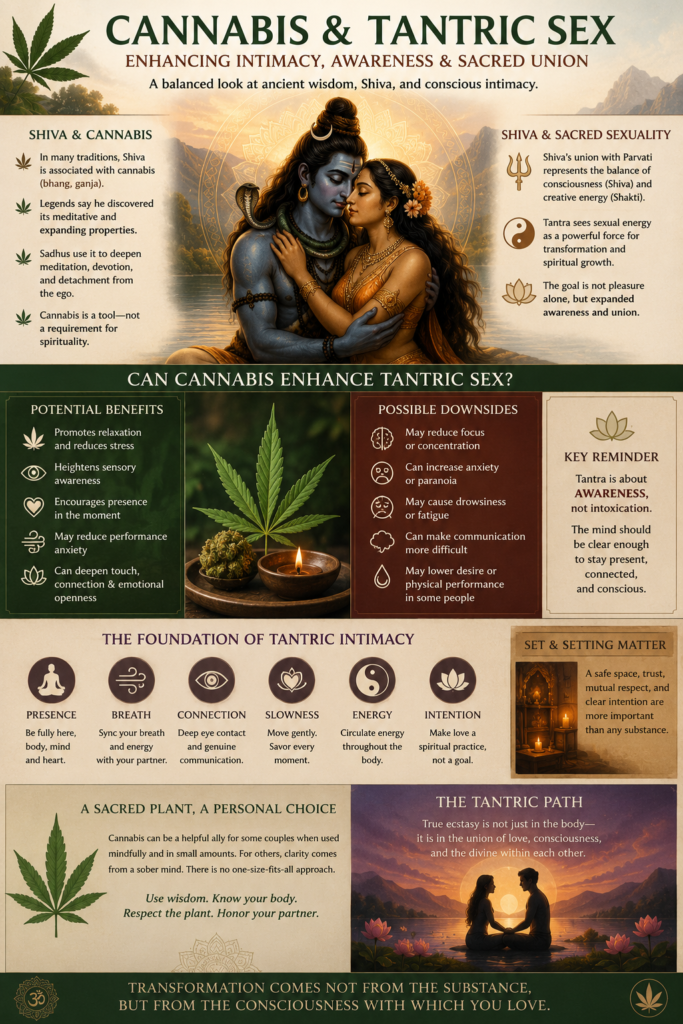
For thousands of years, cannabis has been used in spiritual ceremonies, meditation, and healing traditions across parts of Asia. At the same time, Tantra developed as a path that viewed the body, consciousness, and even sexuality as potential means of spiritual realization.
Because both cannabis and Tantra have roots in India, many people wonder whether the two naturally belong together. Some also point to the association between Shiva and cannabis as evidence that the plant has a sacred role in sexuality.
The relationship, however, is more nuanced than many assume.
Shiva and Cannabis
In Hindu tradition, Shiva has long been associated with cannabis, particularly in certain ascetic and devotional traditions.
According to various legends, Shiva discovered the cannabis plant after resting beneath it during meditation. In another story, the plant is said to have emerged from divine origins and became one of Shiva’s favored herbs.
Today, some devotees, especially certain sadhus, consume cannabis in the form of bhang during festivals such as Maha Shivaratri.
For these practitioners, cannabis is not viewed as a recreational drug but as an aid to:
- Deep meditation
- Withdrawal from worldly distractions
- Extended contemplation
- Devotion to Shiva
It is important to note that not all Hindu traditions approve of cannabis use, and many followers of Shiva never use it.
Is There a Link Between Shiva and Sexuality?
Shiva is also closely connected with sacred sexuality through his relationship with Parvati.
Their union symbolizes the balance of masculine and feminine energies, often described as consciousness and creative energy working together.
In Tantric philosophy, this union is symbolic as well as spiritual. Sexual energy is not viewed merely as physical pleasure but as a powerful force that, when approached with awareness and discipline, can become a path toward spiritual growth.
However, traditional Tantra emphasizes meditation, breath control, mindfulness, and presence far more than physical techniques or intoxicants.
Can Cannabis Enhance Tantric Sex?
Some couples report that small amounts of cannabis can enhance aspects of intimate connection by:
- Increasing relaxation
- Reducing performance anxiety
- Heightening sensory awareness
- Encouraging slower, more mindful touch
- Helping partners remain present in the moment
These qualities may complement some principles associated with modern interpretations of Tantric intimacy, which emphasize slowing down, breathing together, and deep emotional connection rather than focusing solely on orgasm.
However, people’s responses to cannabis vary widely.
For others, cannabis may:
- Reduce concentration
- Increase anxiety or paranoia
- Make communication more difficult
- Cause drowsiness
- Reduce sexual desire or physical performance
The experience depends on factors such as the individual, the dose, the setting, and the specific cannabis product used.
Tantra Is About Awareness, Not Intoxication
One common misconception is that Tantra requires altered states of consciousness.
Historically, this is not the case.
Traditional Tantric practices usually emphasize cultivating awareness through:
- Meditation
- Breathwork
- Yoga
- Mantra
- Eye contact
- Presence
- Mutual respect
The goal is to experience greater consciousness—not simply greater stimulation.
While some esoteric traditions experimented with ritual substances, these practices were generally limited to specific lineages and were never universal.
Setting and Intention Matter
Whether cannabis enhances intimacy often depends less on the substance itself and more on the environment.
Many couples who report positive experiences also describe:
- Feeling emotionally safe
- Having mutual trust
- Communicating openly
- Moving slowly without pressure
- Treating intimacy as a shared experience rather than a goal
These are also qualities emphasized in many Tantric teachings.
A Sacred Plant or Simply a Tool?
Across many spiritual traditions, cannabis is viewed neither as inherently sacred nor inherently harmful.
Like many tools, its value depends on how—and why—it is used.
For some practitioners devoted to Shiva, cannabis represents a way to quiet the mind before meditation.
For others, spiritual clarity is best achieved without any intoxicants.
Similarly, some couples may find that cannabis encourages relaxation and mindful intimacy, while others may feel more connected through meditation, breathwork, or simple presence alone.
Final Thoughts
The connection between Shiva, cannabis, and Tantra is rooted in history, but it is often simplified in modern culture.
Shiva’s association with cannabis primarily relates to meditation, ascetic practice, and devotion—not to sexuality itself.
Tantra, meanwhile, teaches that intimacy can become a spiritual practice when approached with awareness, respect, presence, and conscious intention.
For some adults, cannabis may enhance relaxation and sensory awareness in ways that complement mindful intimacy. For others, it may distract from the very awareness that Tantra seeks to cultivate.
Perhaps the deeper lesson from both Shiva and Tantra is that transformation comes less from the substance itself and more from the consciousness with which life—and love—is experienced.